


JINYUAN
JINYUAN
JINYUAN
JINYUAN
JINYUAN
JINYUAN
JINYUAN
JINYUAN
JINYUAN
JINYUAN
JINYUAN
JINYUAN
JINYUAN
JINYUAN
JINYUAN
JINYUAN
Content
- 1 1. The Role of Integrated Traffic Signal Infrastructure
- 2 2. Product Overview and Design Philosophy
- 3 3. Advanced LED Signal Performance
- 4 4. Structural Strength and Wind Resistance
- 5 5. Corrosion Protection and Outdoor Durability
- 6 6. Manufacturing Capabilities Behind the Product
- 7 7. Quality Management and International Project Support
- 8 8. Intelligent Control and Traffic Efficiency
- 9 9. Environmental Operating Range
- 10 10. Comparison with Conventional Traffic Signal Arrangements
- 11 11. Customization for Different Projects
- 12 12. Application Areas
- 13 13. Installation and Maintenance Recommendations
- 14 14. Project Workflow from Consultation to Completion
- 15 15. Main Technical Specifications
- 16 16. Why Manufacturing Integration Matters
- 17 17. Questions and Answers
- 17.1 Q1: What is an integrated framework traffic signal light?
- 17.2 Q2: Where can this product be installed?
- 17.3 Q3: What are the available arm lengths?
- 17.4 Q4: What signal face sizes are available?
- 17.5 Q5: How much power does each lamp consume?
- 17.6 Q6: How long can the LED light source operate?
- 17.7 Q7: Is the structure suitable for windy areas?
- 17.8 Q8: What corrosion protection is used?
- 17.9 Q9: Can the product operate in very hot or cold conditions?
- 17.10 Q10: What does IP54 protection mean?
- 17.11 Q11: Can the signal timing respond to traffic flow?
- 17.12 Q12: Can the structure be customized?
- 17.13 Q13: Does the manufacturer provide design support?
- 17.14 Q14: What manufacturing equipment supports production?
- 17.15 Q15: How should customers begin a project inquiry?
- 18 18. Conclusion
- 19 References
- 20 Product: Integrated Framework Traffic Signal Light
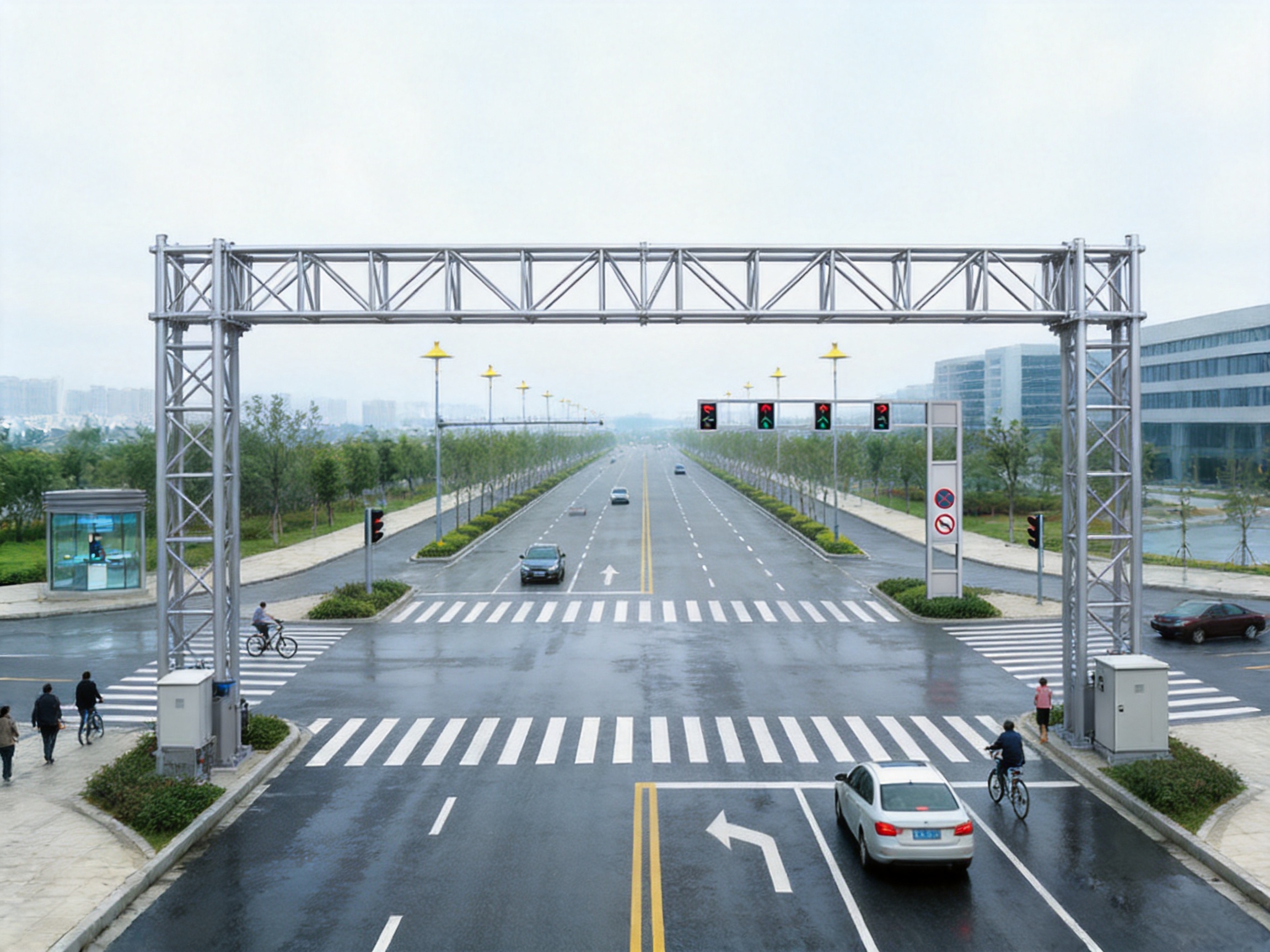
Reliable traffic signal equipment is essential to safe transportation, efficient intersection management, and the orderly movement of vehicles and pedestrians. As cities expand and traffic volumes increase, road authorities require signal systems that combine high visibility, structural strength, stable electrical performance, intelligent control, and long-term resistance to demanding outdoor conditions. The integrated framework traffic signal light is designed to meet these requirements through a unified structural concept, efficient LED technology, durable materials, and adaptable engineering services.
Unlike conventional traffic signal arrangements that depend on multiple separate structural elements, the integrated framework design consolidates the primary signal-supporting functions into a coordinated framework. This creates a cleaner visual appearance, improves structural continuity, simplifies installation planning, and supports reliable operation at urban intersections, highways, arterial roads, and other major transportation facilities. The product is suitable for projects that require large-span signal support, strong wind resistance, accurate signal visibility, and a professional appearance.
Manufactured by Yangzhou Jinyuan Lamps Co., Ltd., a professional road illumination and engineering company established in 2002, this traffic signal solution benefits from extensive experience in lighting structures, steel fabrication, electrical equipment, and project services. The company operates a production site of more than 70,000 square meters, employs more than 300 professional technicians, and exports products to customers in more than 200 countries. Its manufacturing capabilities, engineering resources, and quality management systems support customized traffic infrastructure projects of different sizes and technical requirements.
1. The Role of Integrated Traffic Signal Infrastructure
Traffic signals are more than illuminated indicators. They are safety-critical communication devices that must deliver clear instructions under changing weather, lighting, traffic, and environmental conditions. A signal installation must remain visible during bright daylight, function reliably at night, resist vibration and wind, maintain accurate color output, and continue operating despite dust, moisture, temperature changes, and electrical interference.
The support structure is equally important. Signal heads may span wide lanes and intersections, requiring poles and cross arms with sufficient strength and dimensional accuracy. If a support structure moves excessively in strong wind, signal visibility can be affected. If the structure corrodes, its service life and safety performance may decline. If separate components are poorly aligned, installation and maintenance can become more complicated.
The integrated framework traffic signal light addresses these challenges by combining a structural framework with advanced LED signal modules and a reliable control arrangement. The result is a coordinated system in which the pole, cross arm, signal heads, electrical supply, and control functions are considered together rather than as isolated parts.
This integrated approach is especially useful for intersections with broad road widths, multiple traffic lanes, complex turning movements, and high traffic density. It can also be adapted to highways, municipal corridors, industrial parks, logistics zones, airport access roads, and large-scale residential or commercial developments.
2. Product Overview and Design Philosophy
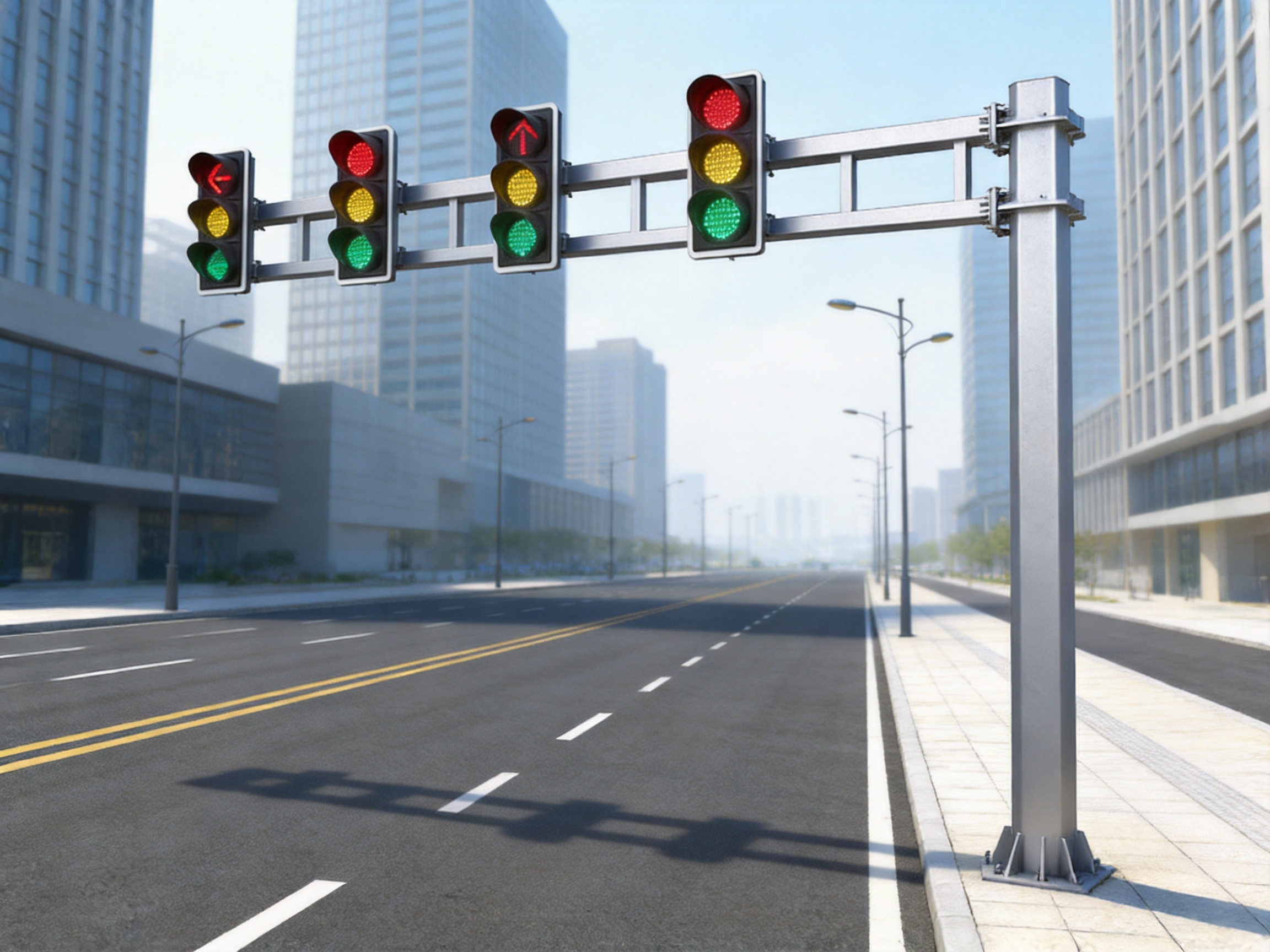
The product uses a rectangular structural framework with an elegant and modern appearance. Its principal pole and cross arm are manufactured from square steel tubes, creating a visually consistent design and a strong load-bearing arrangement. The rectangular geometry supports accurate fabrication, stable connection points, and a clean appearance that fits contemporary urban streetscape requirements.
The main pole height is typically between 7,000 and 7,500 millimeters. Depending on the intersection layout and required signal span, the arm length can range from approximately 6,000 to 14,000 millimeters. This broad range allows the system to serve both medium-sized urban intersections and wider roadways requiring extended overhead coverage.
The main pole tube is specified as a 150 by 250 millimeter square tube with a wall thickness of approximately 5 to 10 millimeters. The cross arm tube is specified as a 100 by 200 millimeter square tube with a wall thickness of approximately 4 to 8 millimeters. These dimensions may be evaluated and adjusted according to wind load, foundation conditions, signal configuration, span length, and local engineering requirements.
The integrated framework is intended to achieve a balance between visual simplicity and structural performance. Its design reduces the need for visually disconnected support components and provides a more organized installation. For municipal projects, this can help create a consistent appearance across multiple intersections while also simplifying project planning and equipment procurement.
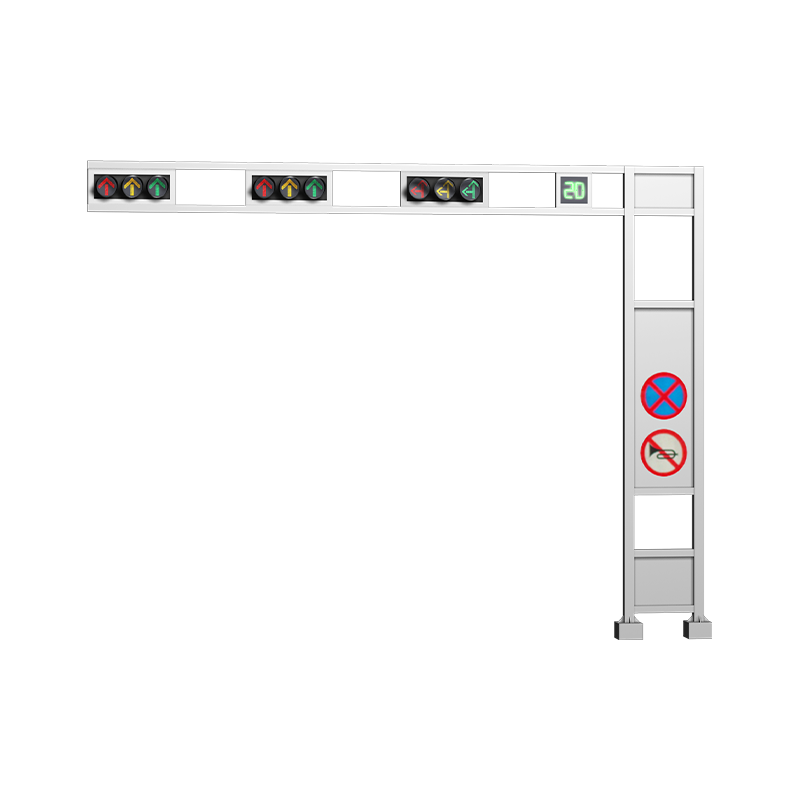
Integrated Framework Traffic Signal Light
3. Advanced LED Signal Performance
The signal light uses LED light sources that provide high brightness with comparatively low power consumption. LEDs are well suited to traffic applications because they offer rapid illumination, long operating life, stable color performance, and efficient energy use. The rated power of each individual lamp is less than 20 watts, helping reduce operating costs compared with many older signal technologies.
High brightness is essential because traffic signals must remain clearly visible in direct sunlight, haze, rain, and other challenging conditions. The signal modules are designed to provide a clear and uniform display, helping drivers and pedestrians distinguish the active instruction quickly and accurately. Uniform light distribution also reduces confusing bright spots and dark areas within the signal face.
The available signal face diameters include 400 millimeters and 500 millimeters. The correct size can be selected according to road classification, viewing distance, lane arrangement, local standards, and project specifications. Larger signal faces may be beneficial on wide roads or high-speed approaches where signal recognition distance is particularly important.
The specified chromaticity ranges are red at 620–625 nanometers, green at 504–508 nanometers, and yellow at 590–595 nanometers. These controlled color ranges support accurate recognition of the three primary traffic signal indications. Consistent color is important for road safety because drivers must interpret the signal immediately, even in changing ambient light.
With a stated light-source service life of more than 50,000 hours, the LED system is designed to reduce replacement frequency and maintenance interruptions. Longer service life can be especially valuable at busy intersections where lane closures, elevated work platforms, and nighttime maintenance operations create additional costs and safety risks.
3.1 Energy Efficiency
LED technology reduces the energy required to produce visible signal output. Although the total energy saving depends on the number of signal heads, operating schedule, control configuration, and local electricity rates, the low individual lamp rating provides a practical foundation for efficient intersection operation.
Lower power consumption also reduces the thermal load within the signal housing and electrical system. This can support component stability and reduce the burden on power supplies, wiring, and control cabinets. For municipalities managing many intersections, even modest savings per signal can become significant across an entire transportation network.
3.2 Long-Term Reliability
Traffic signals often operate continuously, including during weekends, holidays, and severe weather. The LED light source is designed for this demanding duty cycle. Its solid-state construction has no filament to burn out and can provide stable illumination over a long operating period when properly installed and maintained.
Long-term reliability is further supported by the product’s resistance to electrical interference, environmental exposure, dust, and water. The specified protection class is IP54, offering protection against limited dust ingress and water splashes from various directions. The actual installation should still follow appropriate sealing, cable routing, grounding, and maintenance practices.
4. Structural Strength and Wind Resistance
One of the key advantages of the integrated framework is its structural continuity. The framework structure is engineered to withstand outdoor exposure and resist wind-related movement. This is particularly important for overhead signal systems with long cross arms, because extended spans can be exposed to considerable wind pressure.
The use of rectangular steel tubing provides a practical combination of strength, fabrication efficiency, and visual consistency. The wall thickness can be selected within the stated range according to project calculations. For large-span installations, structural engineers can evaluate the pole, cross arm, connection details, foundation, anchor bolts, and local wind conditions as one coordinated system.
Mechanical calculation services for wind and foundation conditions are available as part of the project support process. This allows the proposed structure to be reviewed against local environmental requirements rather than selected solely from a standard catalog dimension. Such engineering coordination is valuable for coastal areas, open highways, typhoon-prone regions, elevated roads, and locations exposed to strong seasonal winds.
A stable support structure helps keep signal heads correctly positioned over the intended lanes. It can also reduce excessive oscillation and improve the visual confidence of the installation. While no outdoor structure is entirely unaffected by severe weather, an appropriately calculated and manufactured framework can improve performance and reduce the risk associated with inadequate sizing or inconsistent fabrication.
4.1 Foundation Coordination
The performance of a traffic signal pole depends not only on the steel structure but also on the foundation and anchoring system. Soil conditions, foundation depth, concrete strength, anchor-bolt arrangement, drainage, and local loading requirements all influence the final design.
For this reason, the product support process includes mechanical calculation for wind and foundation conditions. Project teams can provide road drawings, pole locations, arm lengths, signal quantities, local wind speeds, soil information, and applicable standards so that the structural proposal can be developed more accurately.
5. Corrosion Protection and Outdoor Durability
Outdoor traffic equipment is exposed to rain, humidity, road spray, dust, pollution, ultraviolet radiation, and temperature variation. In coastal or industrial regions, salt and chemical contaminants can accelerate corrosion. A suitable surface treatment is therefore essential to preserve both structural integrity and appearance.
The pole body is hot-dip galvanized to provide long-term corrosion resistance. The supplied specification states that the galvanized structure can remain rust-free for 20 years under appropriate conditions. Actual service life depends on the environment, coating quality, mechanical damage, installation practices, and maintenance, but hot-dip galvanizing is widely recognized as an effective method for protecting steel in outdoor infrastructure.
Optional plastic spraying is available for projects requiring a specific color or additional aesthetic customization. This allows traffic signal structures to coordinate with municipal streetscape guidelines, architectural surroundings, or a broader public lighting design. Custom colors can help distinguish transportation zones, improve visual integration, or meet a city’s standardized infrastructure palette.
The manufacturing process is supported by rapid production cycles and strict quality control. Automated lines, surface treatment equipment, and organized inspection procedures help ensure a more consistent finish. Proper surface preparation, coating coverage, and handling are important because even a durable coating system can be compromised by scratches, impact, or poor storage.
6. Manufacturing Capabilities Behind the Product
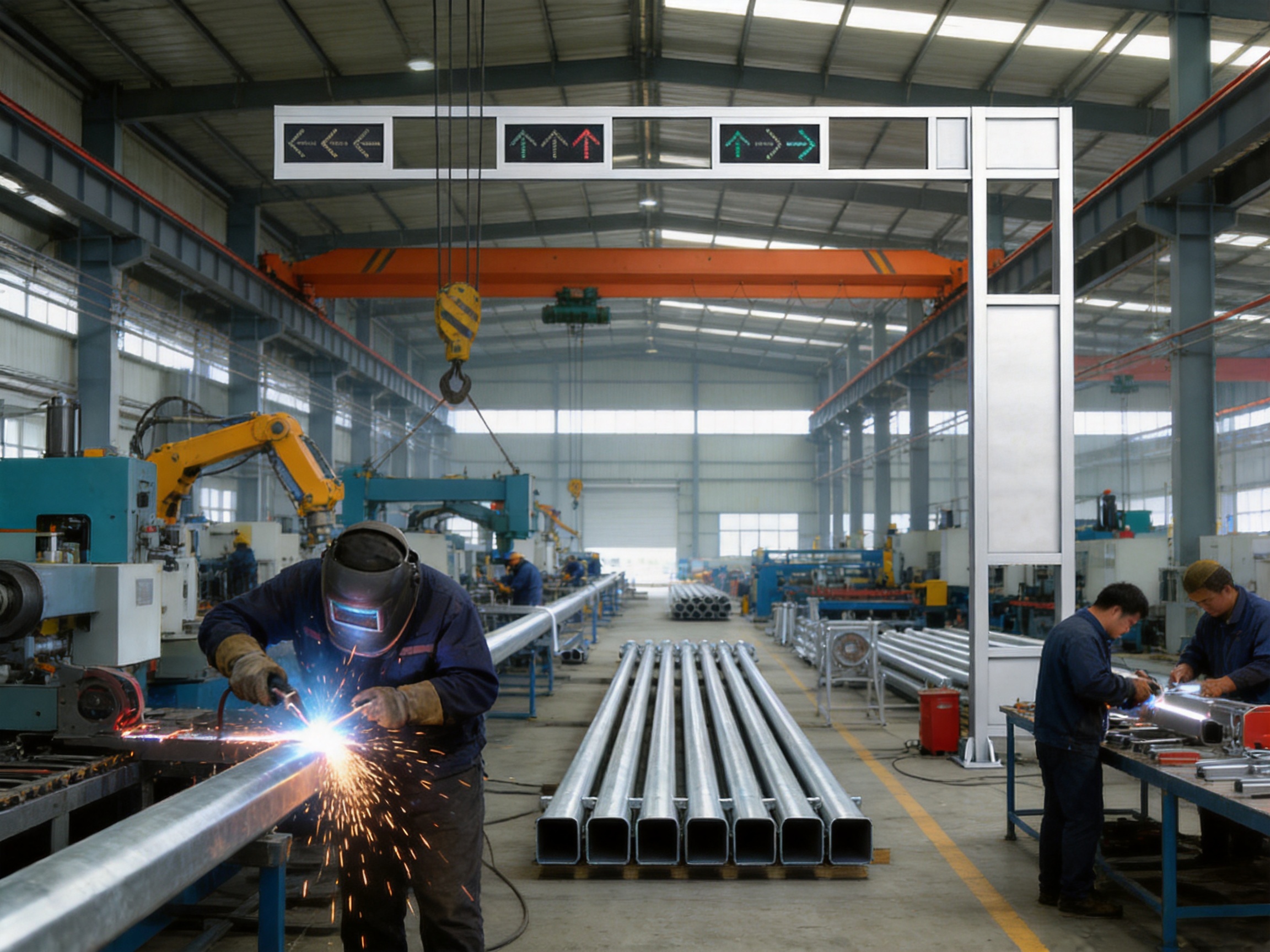
The performance of a traffic signal framework begins with material selection and continues through cutting, forming, welding, surface treatment, assembly, inspection, packaging, and installation support. A manufacturer with integrated production capabilities can coordinate these stages more effectively and reduce the risks associated with fragmented outsourcing.
The company maintains extensive stocks of structural materials, including Q235B, Q345B, S275JR, S355JR, Q460, A36, A572, GR56, and GR50, subject to project requirements and availability. Maintaining a broad material inventory can help reduce procurement delays and support faster production scheduling. Material selection can be matched to design loads, regional standards, customer specifications, and required mechanical performance.
6.1 CNC Bending
Precise CNC bending equipment is used to produce consistent structural shapes and accurate component geometry. Controlled bending improves repeatability between batches and helps reduce dimensional variation. This is important when long cross arms, connection plates, signal mounting brackets, and related components must be assembled accurately on site.
Consistent bending also supports structural integrity by reducing unnecessary deformation and minimizing the need for post-production corrections. Better dimensional control can shorten assembly time, improve alignment, and reduce the possibility of installation difficulties caused by mismatched parts.
6.2 High-Accuracy Cutting
The manufacturing process offers cutting accuracy of up to 0.01 millimeters for applicable operations. Highly accurate cutting supports exact dimensions, clean edges, and reliable fit-up during fabrication. Clean, consistent edges also make welding and finishing more predictable.
Accurate cutting is particularly useful for large structural components because small dimensional differences can become more noticeable as parts are assembled over long spans. By controlling the cutting stage, the manufacturer can improve the overall consistency of the completed framework.
6.3 Professional Welding
The company employs certified welders with many years of experience. Skilled welding is essential for traffic signal structures because weld quality affects strength, alignment, fatigue resistance, and long-term durability.
Experienced welding teams can manage material thicknesses, joint configurations, reinforcement requirements, and production schedules more effectively. Welding inspection and process control help ensure that the finished framework meets the project’s required standards. The combination of experienced personnel and organized production supports both quality and timely delivery, which is important for large infrastructure projects with fixed construction schedules.
6.4 Automated Production Lines
Automated production lines improve consistency and help increase manufacturing efficiency. Automation can reduce repetitive manual variation, improve process repeatability, and support a more predictable production cycle. It can also help reduce material waste and operating costs when combined with appropriate process planning.
Automation does not replace engineering judgment or skilled inspection. Instead, it provides a controlled production foundation that allows technicians and quality personnel to focus on design verification, welding quality, surface treatment, assembly accuracy, and final product compliance.
6.5 Surface Treatment Equipment
Powder electrostatic painting equipment and other surface treatment capabilities support consistent finishing for components requiring painted or sprayed surfaces. A controlled coating process can improve appearance and help create a more uniform protective layer.
Surface treatment is performed after appropriate fabrication and preparation stages. Quality checks may include visual inspection, coating coverage evaluation, dimensional review, and confirmation that mounting and grounding areas remain suitable for installation.
6.6 Die-Casting Capability
The manufacturing facilities include a 1,250-ton die-casting machine. This capability supports the production of relevant aluminum or metal components used across the company’s lighting and electrical product range. In an integrated manufacturing environment, die-casting capacity can contribute to better component coordination, tooling control, and supply stability.
7. Quality Management and International Project Support
Road infrastructure projects often involve strict documentation, technical approval, inspection, delivery, and installation requirements. The company’s quality management systems include ISO9001, ISO14001, and OHSAS18001-related standards and practices. These certifications and management systems reflect a structured approach to quality, environmental responsibility, and occupational health and safety.
Quality control should be applied throughout the production process rather than only at final inspection. Material identification, cutting accuracy, bending geometry, welding quality, galvanizing or coating condition, electrical performance, packaging, and shipping protection all influence the final result.
For international customers, manufacturing experience across more than 200 export markets provides familiarity with different project environments, communication requirements, packaging expectations, and documentation procedures. The company can coordinate with contractors, consultants, distributors, municipal departments, and engineering teams during product selection and project execution.
International delivery also requires careful attention to dimensions, transport limitations, lifting points, component protection, container loading, and assembly instructions. Large traffic signal structures may require sectional packaging or carefully planned logistics. A manufacturer involved in both engineering and production can help customers evaluate these considerations before fabrication begins.
8. Intelligent Control and Traffic Efficiency
The integrated framework traffic signal light is designed to work with an intelligent control system capable of adjusting signal duration according to real-time traffic flow. The exact control strategy depends on the customer’s traffic management system, sensors, controllers, communication network, and local regulations. However, the product concept supports a more responsive approach than fixed-time operation alone.
Adaptive signal timing can help allocate green time more effectively when traffic demand changes during peak hours, off-peak periods, weekends, public events, or emergencies. If one approach experiences greater traffic volume while another remains lightly used, an intelligent controller may adjust phase duration within approved safety limits.
Improved timing can reduce unnecessary waiting, lower queue lengths, support smoother traffic flow, and improve intersection efficiency. It may also reduce vehicle idling and help road authorities respond more effectively to fluctuating demand.
It is important to distinguish the physical signal product from the broader traffic control network. The signal light provides the visible indication, while the controller, detector, communication system, software, and traffic management center determine the timing logic. The integrated product can therefore serve as a reliable field device within a larger intelligent transportation system.
8.1 Interference Resistance
Traffic signal equipment may be installed near power lines, communication systems, vehicle detection equipment, and other electronic devices. High interference resistance helps support stable operation in environments with electrical noise or electromagnetic activity.
Correct grounding, cable separation, surge protection, controller design, and installation procedures remain important. Product reliability is best achieved when the signal heads, control cabinet, power supply, wiring, and communication equipment are designed as a coordinated system.
9. Environmental Operating Range
The specified ambient operating temperature range is from -40°C to +80°C. This broad range supports deployment in cold northern climates, hot regions, and locations with significant seasonal temperature variation. Traffic signals installed outdoors must continue to operate despite freezing conditions, intense summer heat, rapid temperature changes, and solar exposure.
Temperature resistance is especially important for the LED modules, driver components, seals, cables, and structural coatings. Product selection should consider the actual climate, enclosure ventilation, condensation risk, installation orientation, and maintenance schedule.
The IP54 protection class provides a defined level of protection against dust and water exposure. To preserve this protection in the field, installers should ensure that covers, gaskets, cable glands, connectors, and fasteners are properly fitted. Damaged seals or open cable entries should be corrected promptly during maintenance.
10. Comparison with Conventional Traffic Signal Arrangements
Traditional traffic signal installations may use separate poles, independent mast arms, multiple brackets, and individually coordinated signal housings. These arrangements can be effective, but they may create a more complicated appearance and require additional coordination between structural and electrical components.
The integrated framework approach offers several potential advantages:
Coordinated structural design: The main pole, cross arm, signal mounting points, and foundation considerations can be evaluated together.
Cleaner appearance: The rectangular framework provides a visually organized structure that can be more suitable for modern urban projects.
Large-span flexibility: Arm lengths from approximately 6,000 to 14,000 millimeters support different road widths and intersection layouts.
Reduced installation complexity: A coordinated framework can simplify positioning and alignment when compared with multiple unrelated support elements.
Improved wind-resistance planning: Structural calculations can address the complete framework rather than only individual components.
Efficient LED operation: Low-power LED modules provide high brightness and long service life.
Customization: Signal face sizes, colors, materials, pole dimensions, surface finishes, and structural details can be adapted to project requirements.
Manufacturing integration: CNC bending, precision cutting, welding, galvanizing, painting, automation, and engineering support are available within a professional production environment.
These advantages do not mean that every intersection requires the same structure. Local standards, traffic engineering, road geometry, budget, foundation conditions, and maintenance practices must always be considered. The value of the integrated framework is that it offers a coordinated platform that can be adapted to many project environments.
11. Customization for Different Projects
Traffic infrastructure is rarely identical from one location to another. Intersection widths, lane counts, signal quantities, road elevations, overhead clearance, wind conditions, soil properties, and architectural expectations vary widely. A flexible manufacturer must therefore be able to support customized engineering rather than offer only fixed dimensions.
Available customization may include pole height, arm length, tube dimensions, wall thickness, signal face diameter, surface color, mounting arrangement, electrical configuration, and packaging method. Customers can also request technical drawings, material specifications, performance information, and project-specific engineering review.
Color customization through plastic spraying can support local design standards. Structural material options can be considered according to strength requirements and regional codes. The signal face diameter can be selected based on traffic speed and viewing distance. Arm length can be coordinated with lane alignment and overhead clearance.
Customization should be completed before production begins. Accurate project information helps avoid later changes and ensures that the manufactured components match the foundation, signal arrangement, and installation sequence.
11.1 CAD Design
CAD design services help convert project requirements into accurate two-dimensional drawings. These drawings can show pole dimensions, arm lengths, signal positions, base plates, anchor bolts, cable routes, and connection details.
CAD documentation is useful for design approval, foundation preparation, construction coordination, quantity confirmation, and installation planning. It also provides a reference for future maintenance or replacement.
11.2 Three-Dimensional Product Simulation
Three-dimensional product simulation allows customers to review the proposed framework before fabrication. This can help identify clearance issues, visual conflicts, signal orientation problems, and access requirements.
For complex intersections, a three-dimensional model can improve communication between the manufacturer, contractor, consultant, and owner. It can also reduce misunderstandings that might occur when relying solely on two-dimensional drawings.
11.3 Three-Dimensional Scene Simulation
Scene simulation places the proposed traffic signal structure within a representative road environment. This helps project teams assess how the structure will look in relation to buildings, medians, sidewalks, street lights, landscaping, and other transportation equipment.
Visual simulation can be particularly valuable for urban redevelopment projects, major commercial districts, tourism zones, and streets with strict appearance guidelines. It supports more informed approval before manufacturing begins.
11.4 Specification and Color Customization
Specification and color customization allow the product to fit a project’s technical and aesthetic requirements. Customers may define signal diameters, pole dimensions, coating colors, component arrangements, and other details within feasible production limits.
11.5 Overseas Installation Guidance
For international projects, overseas onsite installation guidance can support local construction teams during assembly and commissioning. Guidance may address component identification, lifting, connection sequence, signal orientation, cable routing, grounding, bolt tightening, and final inspection.
Onsite guidance does not replace local licensed engineering or electrical supervision. Instead, it helps ensure that the supplied equipment is assembled according to the intended design and that communication between the manufacturer and project team remains clear.
12. Application Areas
12.1 Urban Intersections
Urban intersections often have complex lane arrangements, pedestrian crossings, turning lanes, bus routes, and high traffic volumes. The integrated framework provides a clear overhead support arrangement and can accommodate signal heads positioned for different approaches.
12.2 Highways and Arterial Roads
Highways and arterial roads require signal equipment that remains visible from a greater distance and performs reliably under higher vehicle speeds and strong wind exposure. The available 400-millimeter and 500-millimeter signal faces, along with long arm options, can support these requirements when properly designed.
12.3 Industrial and Logistics Parks
Industrial parks and logistics centers often experience heavy truck traffic, wide entrances, large turning radii, and continuous operations. A durable framework with a professional appearance can help manage vehicle movement at major entrances and internal intersections.
12.4 Commercial and Residential Developments
Large residential and commercial developments may require coordinated traffic infrastructure that matches the surrounding architectural environment. Custom colors, clean rectangular geometry, and scene simulation can help integrate the traffic signal structure into the overall development plan.
12.5 Airport and Transportation Access Roads
Airport access roads, terminals, ports, and transportation hubs require clear and dependable traffic instructions. Signal visibility, structural stability, low maintenance requirements, and organized appearance are important in these high-use environments.
13. Installation and Maintenance Recommendations
Correct installation is essential for achieving the intended service life of the traffic signal system. Before construction, the project team should verify foundation dimensions, anchor-bolt positions, underground utilities, drainage, lifting access, road closure requirements, and local safety procedures.
The foundation should be constructed according to approved structural calculations and local building requirements. Anchor bolts must be positioned accurately, protected from damage, and checked before the pole is erected. The base plate should be properly aligned and supported, and all structural fasteners should be tightened according to the approved installation method.
Signal heads should be oriented toward approaching traffic and aligned with the intended lane geometry. Cable routing should avoid sharp bends, standing water, excessive tension, and contact with unprotected edges. Grounding and surge protection should be completed according to electrical regulations.
Routine maintenance may include visual inspection of signal lenses, LED operation, pole alignment, fasteners, coating condition, cable entries, grounding connections, and foundation areas. Salt, dust, mud, and road contaminants should be removed when necessary. Damaged coatings should be repaired according to the recommended surface treatment system.
Maintenance teams should inspect the framework after unusually strong winds, vehicle impact, construction activity, or other events that could affect alignment or structural integrity. Early detection of loose hardware, corrosion damage, cracked welds, water ingress, or cable deterioration can help prevent more serious failures.
14. Project Workflow from Consultation to Completion
A successful traffic signal project begins with a clear understanding of the site and operating requirements. The customer can provide intersection drawings, road widths, lane numbers, signal quantities, required clearance, local wind data, foundation information, power supply conditions, and applicable standards.
The engineering team can then review the information and recommend a framework configuration. CAD drawings and three-dimensional simulations can be prepared for approval. Structural calculations can evaluate wind loading and foundation conditions. Signal specifications, surface treatment, color, and electrical details can be confirmed before production.
Once the design is approved, material preparation and fabrication can begin. Production may include cutting, CNC bending, welding, inspection, galvanizing, optional plastic spraying, component assembly, electrical testing, and packaging. Quality documentation can be prepared according to the project’s requirements.
After delivery, the installation team can use the approved drawings and guidance materials to assemble and erect the framework. Final commissioning should verify signal sequence, color output, brightness, orientation, controller communication, grounding, and safe operation.
15. Main Technical Specifications
| Item | Specification |
|---|---|
| Product type | Integrated framework traffic signal light |
| Main pole structure | Rectangular material structure with an elegant appearance |
| Pole height | Approximately 7,000–7,500 millimeters |
| Arm length | Approximately 6,000–14,000 millimeters |
| Main pole tube | 150 × 250 millimeter square tube |
| Main pole wall thickness | Approximately 5–10 millimeters |
| Cross arm tube | 100 × 200 millimeter square tube |
| Cross arm wall thickness | Approximately 4–8 millimeters |
| Surface treatment | Hot-dip galvanizing; optional plastic spraying |
| Corrosion protection statement | Rust-free performance stated for up to 20 years under suitable conditions |
| Signal face diameter | 400 millimeters or 500 millimeters |
| Red chromaticity | 620–625 nanometers |
| Green chromaticity | 504–508 nanometers |
| Yellow chromaticity | 590–595 nanometers |
| Operating power supply | 187–253 volts, 50 hertz |
| Rated power | Less than 20 watts per lamp |
| Light-source service life | More than 50,000 hours |
| Ambient temperature | -40°C to +80°C |
| Protection class | IP54 |
| Control capability | Compatible with intelligent traffic signal control arrangements, subject to system design |
16. Why Manufacturing Integration Matters
Customers purchasing traffic signal infrastructure are not only buying a light source. They are investing in a structural system that must be engineered, manufactured, transported, erected, powered, controlled, and maintained. Manufacturing integration helps connect these stages and reduces the risk of incompatible components.
When material procurement, fabrication, welding, surface treatment, assembly, and engineering support are managed through one experienced organization, communication can be more direct. Technical changes can be reviewed more quickly, production scheduling can be coordinated more effectively, and quality responsibility can be more clearly defined.
The company’s experience in street light poles, LED street lighting, solar street lights, lighting fixtures, and related road illumination products provides a broader understanding of outdoor infrastructure. This background is valuable because traffic signal structures often share requirements with other road lighting products, including steel fabrication, galvanizing, electrical safety, wind loading, foundation coordination, and international logistics.
The combination of a large production site, professional technicians, advanced equipment, international export experience, and quality management systems gives project customers a strong basis for long-term cooperation. The objective is not merely to supply a standard signal light but to support a complete and dependable road traffic solution.
17. Questions and Answers
Q1: What is an integrated framework traffic signal light?
An integrated framework traffic signal light combines the traffic signal support structure and signal equipment into a coordinated design. It typically includes a main pole, cross arm, signal heads, mounting components, electrical connections, and control compatibility. The integrated arrangement provides a clean appearance and supports coordinated structural engineering.
Q2: Where can this product be installed?
It can be used at urban intersections, highways, arterial roads, industrial parks, logistics centers, commercial developments, residential communities, airport access roads, ports, and other transportation facilities. The final design should be selected according to local traffic engineering and structural requirements.
Q3: What are the available arm lengths?
The standard project range is approximately 6,000 to 14,000 millimeters. The appropriate length depends on road width, lane arrangement, clearance requirements, signal positioning, wind loading, and foundation conditions.
Q4: What signal face sizes are available?
The available signal face diameters are 400 millimeters and 500 millimeters. The correct size can be selected according to viewing distance, road classification, vehicle speed, local regulations, and customer requirements.
Q5: How much power does each lamp consume?
The rated power is less than 20 watts for a single lamp. Actual system consumption depends on the number of signal heads, operating mode, controller, auxiliary equipment, and installation configuration.
Q6: How long can the LED light source operate?
The stated service life of the LED light source is more than 50,000 hours. Actual life depends on temperature, voltage stability, installation quality, operating conditions, maintenance, and the performance of associated electrical components.
Q7: Is the structure suitable for windy areas?
The framework is designed with wind resistance in mind, and mechanical calculation services for wind and foundation conditions are available. For each project, the pole, arm, foundation, anchor bolts, signal configuration, and local wind data should be evaluated together.
Q8: What corrosion protection is used?
The pole body uses hot-dip galvanizing for outdoor corrosion protection. Optional plastic spraying and customized colors are also available. Coating selection should consider the local climate, salt exposure, industrial pollution, appearance requirements, and maintenance plan.
Q9: Can the product operate in very hot or cold conditions?
The specified ambient operating temperature is from -40°C to +80°C. The installation should still follow appropriate electrical, sealing, ventilation, and maintenance procedures for the actual site environment.
Q10: What does IP54 protection mean?
IP54 indicates protection against limited dust ingress and water splashes from various directions. It is important to preserve the enclosure’s protection by correctly installing covers, seals, cable glands, and connectors and by repairing damaged components promptly.
Q11: Can the signal timing respond to traffic flow?
The product is designed to work with an intelligent traffic control system that can adjust signal duration according to real-time traffic flow. The exact function depends on the controller, sensors, communications network, software, and local traffic management design.
Q12: Can the structure be customized?
Yes. Possible customization includes material selection, pole height, arm length, tube dimensions, wall thickness, signal face size, surface finish, color, mounting arrangement, and packaging. Engineering information should be confirmed before production.
Q13: Does the manufacturer provide design support?
Design support includes CAD design, three-dimensional product simulation, three-dimensional scene simulation, specification and color customization, and mechanical calculations for wind and foundation conditions. Overseas onsite installation guidance is also available for suitable projects.
Q14: What manufacturing equipment supports production?
Production is supported by material inventory, CNC bending machines, high-accuracy cutting equipment, welding facilities, automated lines, powder electrostatic painting equipment, automatic welding and cutting machines, and a 1,250-ton die-casting machine.
Q15: How should customers begin a project inquiry?
Customers should provide intersection drawings, required arm length, pole height, signal quantities, signal face diameter, local wind conditions, foundation information, power supply requirements, surface color, applicable standards, delivery location, and installation schedule. These details help the engineering team prepare a more accurate proposal.
18. Conclusion
The integrated framework traffic signal light provides a coordinated solution for modern road intersections that require visibility, strength, efficiency, durability, and intelligent control compatibility. Its rectangular framework design offers a clean appearance and supports large-span applications. Its LED light source provides high brightness, low power consumption, controlled color output, and a service life of more than 50,000 hours.
The product is further supported by hot-dip galvanized steel construction, optional plastic spraying, a broad operating temperature range, IP54 protection, interference resistance, and structural engineering services. The available pole heights, arm lengths, tube sizes, and signal face diameters allow the system to be adapted to different intersection layouts and local requirements.
Its competitive value is strengthened by the manufacturer’s integrated production capabilities. Extensive material options, CNC bending, high-accuracy cutting, experienced certified welders, automated manufacturing lines, surface treatment equipment, quality management systems, and international project experience contribute to dependable delivery and consistent product quality.
For road authorities, contractors, consultants, and infrastructure developers, the product offers more than a visible traffic indication. It provides a coordinated field installation that can support safer traffic management, improved intersection efficiency, reduced maintenance demands, and a more organized urban appearance. With suitable engineering, installation, and maintenance, the integrated framework traffic signal light can serve as a reliable part of modern intelligent transportation infrastructure.
References
1. Product Technical Specification: Integrated Framework Traffic Signal Light, including structural dimensions, LED performance, electrical requirements, operating temperature, and protection class.
2. ISO 9001, Quality Management Systems: Requirements.
3. ISO 14001, Environmental Management Systems: Requirements with Guidance for Use.
4. OHSAS 18001, Occupational Health and Safety Management Systems: Requirements.
5. General Engineering Principles for Hot-Dip Galvanizing of Steel Structures.
6. General Road Traffic Signal Design and Intersection Control Practices.
7. LED Lighting Reliability, Energy Efficiency, and Solid-State Light Source Engineering Principles.
8. Structural Design Considerations for Steel Poles, Mast Arms, Wind Loads, and Foundation Systems.