


JINYUAN
JINYUAN
JINYUAN
JINYUAN
JINYUAN
JINYUAN
JINYUAN
JINYUAN
JINYUAN
JINYUAN
JINYUAN
JINYUAN
JINYUAN
JINYUAN
JINYUAN
JINYUAN
Content
- 1 Introduction
- 2 Product Concept and Application Value
- 3 Split-Level Dual-Arm Configuration
- 4 Independent Dual-Channel LED Control
- 5 Panoramic Illumination for Mixed-Use Roads
- 6 Solar Power and Integrated Energy Operation
- 7 Smart Lighting Control
- 8 Structural Engineering and Wind Resistance
- 9 Manufacturing Strength and Quality Assurance
- 10 Waterproofing, Weather Resistance, and Outdoor Reliability
- 11 Installation and Project Deployment
- 12 Comparison with Conventional Lighting Solutions
- 13 Benefits for Municipal and Commercial Projects
- 14 Maintenance and Lifecycle Considerations
- 15 Customization and Engineering Services
- 16 Technical Specifications
- 17 Recommended Project Evaluation Process
- 18 Questions and Answers
- 18.1 What makes this solar street light different from a conventional single-head model?
- 18.2 Can the two lamp heads operate at different brightness levels?
- 18.3 Is the system suitable for wide intersections?
- 18.4 Does the product require underground electrical wiring?
- 18.5 How long can the light operate continuously at night?
- 18.6 How does the automatic lighting function work?
- 18.7 What happens if one lamp channel has a problem?
- 18.8 What pole heights are available?
- 18.9 Can the pole material be customized?
- 18.10 What testing is performed before delivery?
- 18.11 Can the appearance be customized for an urban development?
- 18.12 Is the product appropriate for cold or hot regions?
- 18.13 What is the warranty period?
- 19 Conclusion
- 20 References
- 21 Product: Bi-Directional Split-Level Panoramic Solar Street Light
Introduction
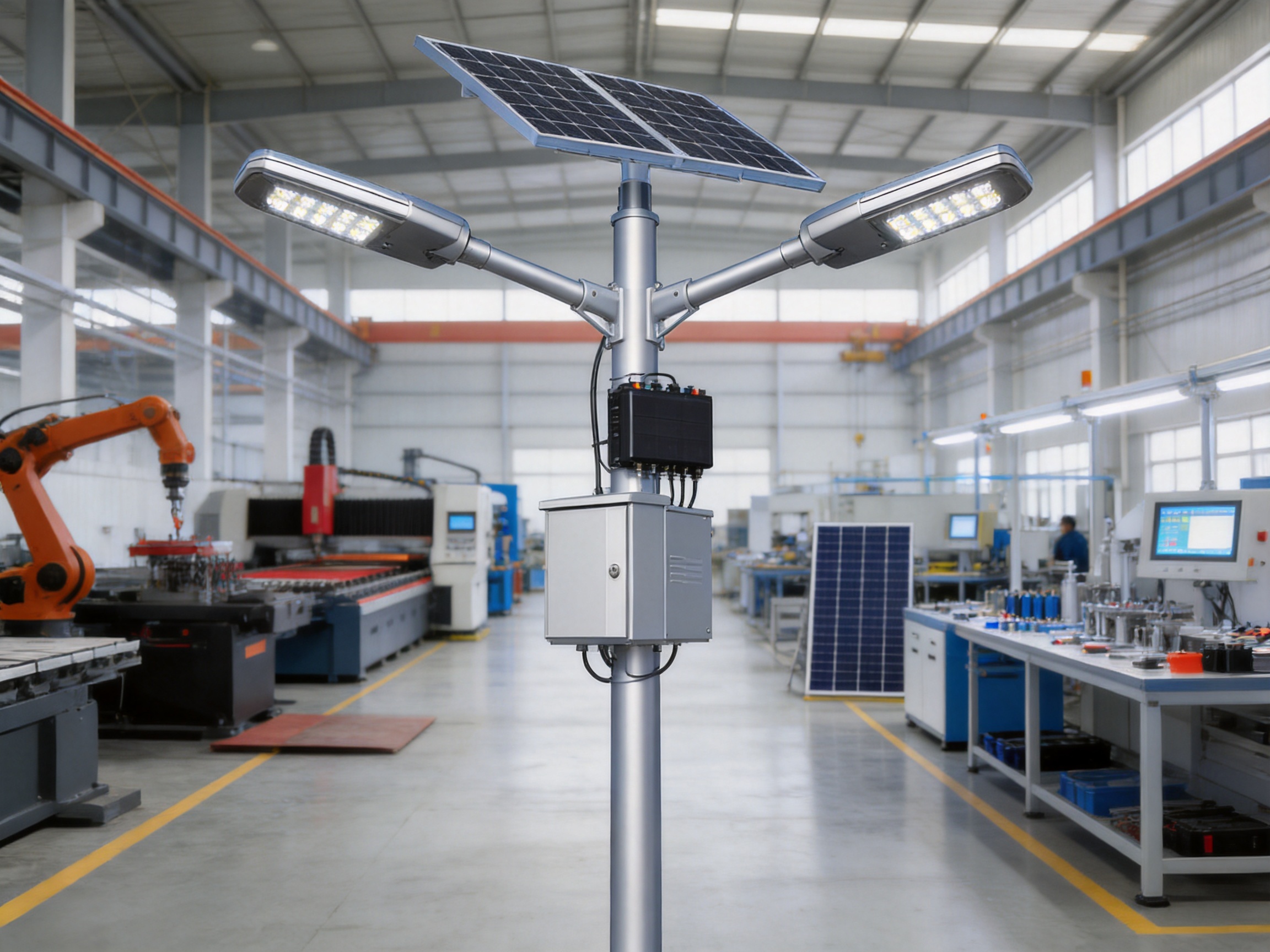
Urban road networks are becoming more complex as cities expand, traffic volumes increase, and public spaces require safer, more efficient, and more environmentally responsible lighting solutions. Conventional single-arm street lights can provide satisfactory illumination along ordinary roads, but they may not fully address the requirements of wide-span intersections, arterial roads, bicycle lanes, pedestrian routes, and multi-level traffic environments. In these applications, lighting must do more than simply produce brightness. It must distribute light intelligently, reduce dark zones, support traffic safety, withstand harsh weather, and operate reliably with minimal infrastructure and maintenance.
The Bi-Directional Split-Level Panoramic Solar Street Light is designed to address these challenges through a coordinated combination of dual-arm illumination, independent LED control, integrated solar energy technology, reinforced structural engineering, and intelligent operating functions. Its split-level arrangement places primary and secondary lamp heads at different heights on the same pole. This allows the lighting system to serve different road users and lighting zones simultaneously, including motor vehicle lanes, bicycle paths, sidewalks, and intersection approaches.
Unlike a traditional single-lamp solar street light, this configuration creates a more comprehensive lighting pattern. The upper lamp head can be directed toward the main carriageway, while the lower or secondary lamp head can illuminate an adjacent bicycle lane, sidewalk, service road, or connecting approach. The result is a three-dimensional illumination network that makes better use of one pole position and one solar power system.
The product is suitable for municipal roads, urban arterial routes, large intersections, industrial parks, residential developments, transportation hubs, public facilities, campuses, and other outdoor environments where independent electrical wiring may be difficult or expensive. It combines the installation advantages of solar lighting with the coverage benefits of a dual-head structure, providing a practical solution for modern roadway projects.

Bi-Directional Split-Level Panoramic Solar Street Light
Product Concept and Application Value
The central design philosophy of this lighting system is to achieve broader and more refined illumination without unnecessarily increasing the number of poles. A road environment rarely consists of a single uniform surface. A typical urban corridor may include a central traffic lane, a non-motorized lane, a sidewalk, a landscaped area, a bus stop, or a side access road. Each area has different lighting needs, mounting heights, viewing angles, and brightness requirements.
A single lamp head mounted at one height often creates compromises. If it is aimed toward the roadway, nearby pedestrian or bicycle areas may receive insufficient light. If it is aimed broadly to cover all areas, the illumination may become less concentrated and less efficient. The split-level design addresses this problem by giving each lamp head a more specific lighting role.
The primary head can be positioned to deliver effective illumination over the main motor vehicle lanes. The secondary head can be aimed toward the bicycle path or sidewalk, where a lower mounting position and different beam direction may be more appropriate. Because the two light sources work independently, the lighting output can be adjusted according to the actual requirements of each zone.
This approach offers several advantages over many conventional competitors. First, it improves the utilization of every installed pole. Second, it reduces the likelihood of dark areas between the main roadway and adjacent paths. Third, it provides more flexibility for projects with different road widths or mixed transportation modes. Fourth, it allows lighting engineers to balance visibility, energy consumption, and visual comfort more precisely.
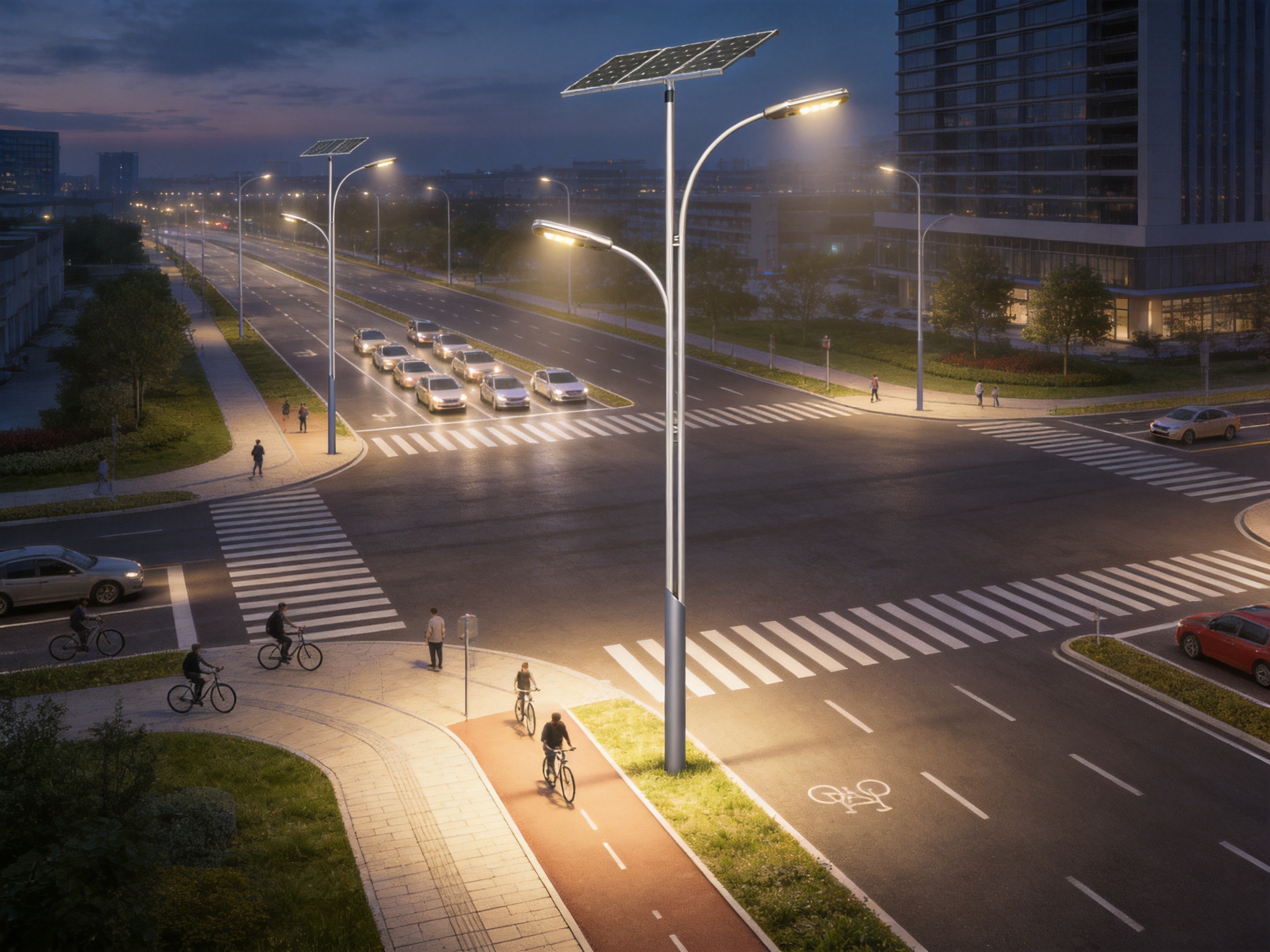
The system is especially valuable at wide-span intersections. Intersections often contain turning lanes, crossing areas, bicycle movements, pedestrian waiting zones, and irregular road geometries. A single forward-facing lamp may leave parts of the intersection poorly illuminated. Dual lamp heads mounted at staggered heights can be oriented in different directions to provide more effective coverage and improve the visual continuity of the entire junction.
Split-Level Dual-Arm Configuration
The split-level dual-arm layout is the defining structural feature of the product. Instead of placing two lamp heads at the same elevation, the design uses different mounting heights to create vertically differentiated illumination. This helps separate the lighting tasks performed by each lamp and reduces the need to force a single beam pattern to cover every area.
The upper lamp head generally serves the primary roadway. Its elevated position allows light to travel across a larger horizontal area and supports more uniform illumination over motor vehicle lanes. The lower or secondary lamp head can be oriented toward a bicycle path, pedestrian walkway, frontage lane, or other nearby area that benefits from more focused and appropriately scaled lighting.
Staggered mounting also helps create a more visually transparent road environment. When the light sources are carefully positioned, the system can illuminate multiple levels of the roadway without producing excessive visual obstruction. The arrangement is suitable for modern urban landscapes where the lighting structure must provide strong performance while maintaining a clean and coordinated appearance.
Another benefit is project adaptability. Although the standard pole height range is approximately 6 to 10 meters, the configuration can be adapted to different roadway conditions through engineering calculations, arm dimensions, lamp power selection, mounting angles, and light distribution requirements. This makes the product applicable to both medium-width urban roads and larger roadway environments.
Compared with installing separate poles for every lighting zone, a dual-arm system may simplify the overall site arrangement. Fewer foundations can reduce civil construction requirements, and fewer individual solar systems can reduce visual clutter. The final configuration should always be confirmed through a professional lighting layout and structural calculation, but the basic concept offers a strong foundation for efficient project planning.
Independent Dual-Channel LED Control
The system uses high-performance dual-channel independent constant-current driving technology. This means that the two LED lamp heads are not required to operate as one undifferentiated lighting source. Each channel can provide a controlled output for its corresponding light head, allowing the lighting design to reflect the different requirements of the main road and adjacent areas.
Constant-current driving is important for LED lighting because it helps maintain stable operating conditions for the LED chips. A controlled current supply supports consistent brightness, reduces the risk of excessive current fluctuations, and contributes to reliable long-term operation. It also supports more predictable energy management in a solar-powered system, where available power can vary according to weather, battery condition, season, and nighttime duration.
Independent channels create additional flexibility during system commissioning. For example, the roadway lamp may be configured for a higher output during periods of heavy traffic, while the bicycle-path lamp may use a lower output that is still sufficient for safety and orientation. Alternatively, both heads can operate at full output in high-risk locations such as large intersections or transport hubs.
This differentiated control can reduce unnecessary energy consumption. Instead of illuminating every area at the same intensity throughout the night, the system can be configured according to traffic patterns and project requirements. The result is a better balance between illumination quality and solar energy availability.
The rated lamp luminous efficacy is listed at approximately 140 lumens per watt. High luminous efficacy means that more visible light can be produced from each unit of electrical energy. In a solar street light, this is particularly valuable because higher optical efficiency can help reduce the required solar panel and battery capacity for a given lighting target, or alternatively provide more lighting output from a similar energy package.
The LED light source can be configured within a color temperature range of approximately 3000K to 6000K. Warmer color temperatures may be suitable for residential areas, pedestrian environments, and locations where a softer visual atmosphere is preferred. Neutral or cooler color temperatures may be selected for arterial roads, industrial zones, and applications where strong visual contrast is required. The color rendering index is specified at Ra 70, supporting practical recognition of road surfaces, vehicles, signs, and surrounding objects.
Panoramic Illumination for Mixed-Use Roads
Modern roads serve multiple forms of transportation. Cars, buses, motorcycles, bicycles, pedestrians, and maintenance vehicles may all use the same general corridor. Lighting systems must therefore support more than vehicle visibility. They must also help users recognize boundaries, obstacles, signs, intersections, crossings, and changes in direction.
The Bi-Directional Split-Level Panoramic Solar Street Light is particularly suitable for mixed-use roads because its two lamp heads can serve separate but connected visual environments. The primary lamp provides roadway illumination, while the secondary lamp supports lower-speed users and adjacent circulation areas. This reduces the possibility that one lighting zone will be sacrificed to improve another.
On a bicycle path, excessive glare can be uncomfortable and may reduce a rider’s ability to identify surface conditions. On a vehicle road, insufficient illumination can affect reaction time and hazard recognition. Separate lamp-head positioning and independent output control help lighting engineers select a more appropriate solution for each space.
The system can also contribute to a stronger sense of continuity along long road sections. Traditional single-lamp arrangements may create alternating bright and dark areas, particularly where poles are spaced widely or where the road width changes. The coordinated dual-head layout can help fill the transitional spaces between the roadway and adjacent routes, reducing the visual impression of isolated pools of light.
For intersections, the panoramic concept is useful because each lamp head can be aimed toward a different approach or traffic zone. This is not a replacement for a professional photometric design, but it provides a versatile hardware platform for addressing irregular road geometries.
Solar Power and Integrated Energy Operation
The product uses solar energy as its primary power source, eliminating the need for underground electrical wiring between the pole and a conventional grid connection. This is one of the most important advantages of solar street lighting in new developments, remote roads, industrial parks, rural-urban connections, and sites where trenching would be disruptive or expensive.
The integrated system combines the solar panel, lighting unit, control equipment, and built-in energy storage into a coordinated outdoor lighting assembly. Because the main energy components are designed as one system, installation can be faster and less complicated than a traditional grid-powered lighting project that requires cable routing, distribution cabinets, trench excavation, and connection testing.
During daylight hours, the photovoltaic module converts sunlight into electrical energy and charges the storage battery. At night, the stored energy powers the LED lamp heads. The system is designed for approximately 5 to 12 hours of continuous lighting, depending on the selected configuration, local solar conditions, battery capacity, lighting output, control schedule, and project design requirements.
The photovoltaic modules use high-density encapsulation technology intended to improve sealing, durability, and resistance to outdoor exposure. High-quality encapsulation helps protect solar cells from moisture, dust, temperature cycling, and mechanical stress. This is important because photovoltaic performance depends not only on the cell itself but also on the long-term integrity of the complete module.
The product information specifies the use of Grade-A silicon wafers. These materials are selected for stable conversion performance, weather resistance, and resistance to aging and degradation. In outdoor applications, the solar panel must continue operating through repeated exposure to ultraviolet radiation, rain, humidity, wind, dust, and seasonal temperature changes.
The solar module is intended to capture effective sunlight in challenging urban environments, including areas where trees or nearby buildings may create partial shading. Actual solar performance will depend on site conditions and should be verified through a project-specific assessment, but the panel construction and energy management system are designed to support reliable charging under a broad range of outdoor conditions.
Smart Lighting Control
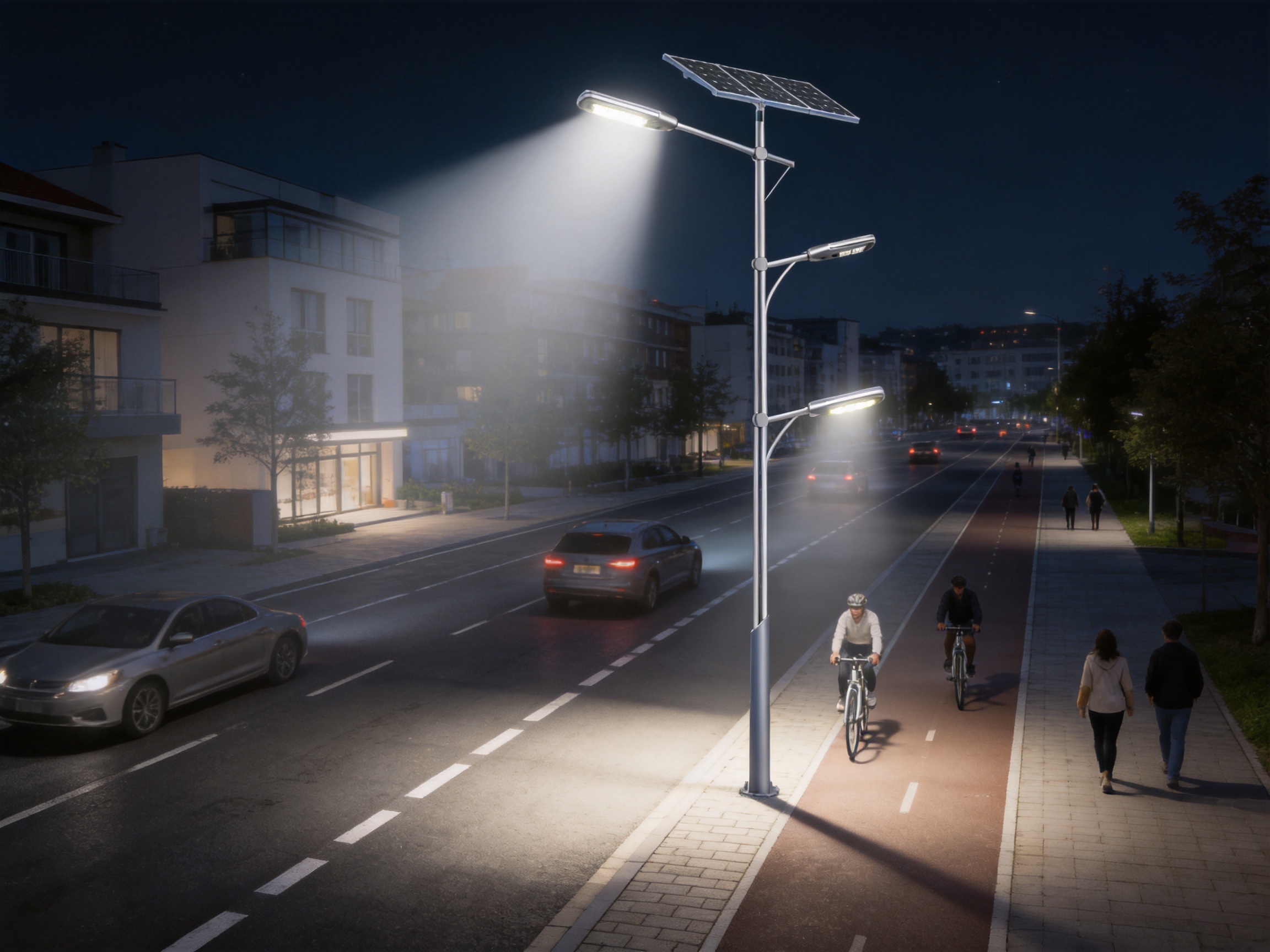
The system combines light control and time control. High-precision ambient light sensors can detect changes in the surrounding environment and initiate operation when natural light falls below the required threshold. This enables the lamps to turn on automatically at dusk and turn off or enter charging mode at dawn.
Light sensing is useful because sunset and sunrise times change throughout the year. A fixed switching schedule may cause the lamp to turn on too early during summer evenings or too late during winter afternoons. Ambient light control responds to actual environmental conditions, supporting a more appropriate operating pattern.
Time control provides an additional layer of management. Lighting output can be arranged according to expected traffic levels, local regulations, or energy-saving targets. For example, the system may operate at a higher level during the first part of the night when traffic and pedestrian activity are greatest, then shift to a reduced output after midnight. The exact operating schedule can be customized according to project requirements.
Dual-channel control makes these strategies more effective. The main roadway lamp and secondary lamp do not have to follow identical brightness profiles. A municipality may choose to maintain stronger roadway lighting throughout the night while reducing the output of a low-use pedestrian route during quiet hours. This type of control can extend battery availability and improve energy efficiency without completely darkening the surrounding environment.
The system also includes a transport mode for safe storage and delivery. After installation, the transport mode can be disabled so that the automatic charging and lighting sequence begins. This feature helps prevent unnecessary battery discharge during transportation, storage, and construction before the lighting system is ready for service.
Structural Engineering and Wind Resistance
Adding a second lamp head creates greater wind load and mechanical demand than a single-head street light. The pole, arms, connection points, foundation, and anchoring system must therefore be designed to carry additional weight and projected surface area. The product addresses this requirement through a reinforced main pole structure and hidden stress-buffer designs at key connection points.
Hidden reinforcement is valuable because it can improve load-bearing performance without compromising the clean appearance of the pole. Modern urban lighting projects often require both structural reliability and visual consistency. Visible reinforcement plates or oversized external braces may provide strength but can create a heavy industrial appearance. Internal or concealed strengthening helps preserve a minimalist form.
The pole can be manufactured from materials such as Q235, Q355, SS400, GR65, and other grades according to project requirements. These steel materials offer different combinations of yield strength, tensile performance, weldability, and cost. Selection should be based on pole height, wind speed, panel area, lamp-head weight, arm geometry, foundation conditions, and applicable local standards.
Structural design should include wind-load calculation, foundation analysis, connection assessment, and, where required, transportation and installation considerations. The manufacturer provides mechanical calculation services covering wind and foundation requirements. These services can help project owners and engineering contractors verify the suitability of the proposed configuration before production.
Precision manufacturing is essential for maintaining structural consistency. CNC bending helps produce repeatable pole shapes and accurate arm geometry. Consistent bending reduces variation between units, improves alignment during installation, and limits the need for post-production correction. Automated welding and cutting equipment further supports uniform fabrication and dimensional control.
The aluminum alloy lamp body provides a balance of low weight, corrosion resistance, and heat dissipation. Effective heat management is important for LED longevity because excessive operating temperature can accelerate component aging. A durable aluminum housing also helps protect internal components from outdoor conditions while keeping the lamp head manageable during installation.
Manufacturing Strength and Quality Assurance
The product is supported by an extensive manufacturing system rather than simple component assembly. The manufacturer operates a large production, design, and engineering organization focused on road illumination products. Its manufacturing capabilities include street light poles, LED fixtures, solar street lights, photovoltaic systems, and related outdoor lighting equipment.
A broad material inventory supports efficient production planning. Available material options include Q235B, Q345B, S275JR, S355JR, Q460, A36, A572, GR56, GR50, and other steel grades. Maintaining material availability can reduce procurement delays and help the factory respond more quickly to project schedules. It also enables the engineering team to select a material that corresponds to the mechanical requirements of a specific order.
Material quality is the foundation of pole reliability. Incoming materials should be checked for dimensions, surface condition, grade identification, and conformity with purchase specifications. Proper material control reduces the risk of inconsistent mechanical performance and supports traceability throughout production.
CNC bending is used to create accurate and repeatable pole and arm forms. Compared with less controlled manual processes, precision bending can improve structural consistency, reduce distortion, and support better alignment between lamp heads and pole bodies. Accurate geometry is also important for maintaining the intended lighting direction after installation.
Automated welding and cutting equipment contributes to stable production quality. Consistent welding parameters help reduce defects and improve the strength of joints. Controlled cutting supports accurate component dimensions and reduces unnecessary rework. These capabilities are especially important for split-level poles, where the position and angle of each arm influence both structural loads and lighting coverage.
Surface treatment is another important factor in outdoor lighting durability. Powder electrostatic painting can provide a uniform protective finish over prepared metal surfaces. The coating helps protect the pole against corrosion, weathering, and environmental contamination. Surface preparation, coating thickness, curing temperature, and adhesion must all be controlled to achieve reliable results.
The manufacturer also operates equipment such as large bending machines, powder coating systems, automatic welding and cutting machines, and a 1250-ton die-casting machine. These facilities support an integrated supply chain and reduce dependence on fragmented external processing. In-house control can make it easier to coordinate component dimensions, production schedules, quality inspections, and engineering changes.
Every completed unit is subjected to critical factory tests. Light source aging and durability testing help identify early LED or driver issues. Structural waterproofing tests assess the ability of the lamp body and related assemblies to resist water intrusion. Comprehensive performance verification checks the operation of the lighting, charging, control, and energy-storage functions.
These tests create a dual-layer quality-control process. Components are inspected during manufacturing, and complete products are tested after assembly. This approach helps reduce the possibility that a defective component will pass unnoticed into the final system. It also supports more reliable field performance and reduces post-sales service requirements.
Waterproofing, Weather Resistance, and Outdoor Reliability
Solar street lights operate continuously in exposed outdoor environments. They must withstand rain, dust, humidity, sunlight, wind, heat, and cold without losing their basic function. The specified operating temperature range of approximately -35°C to 65°C indicates that the system is intended for demanding climatic conditions.
Weather resistance begins with the selection of suitable housing materials and continues through sealing, assembly, coating, and testing. The aluminum alloy lamp body provides a corrosion-resistant enclosure, while properly sealed joints help prevent water and dust from reaching the LED board, driver, sensors, or wiring connections.
Photovoltaic module encapsulation is also essential. A panel that performs well when new may deteriorate prematurely if moisture penetrates the cell assembly or if repeated thermal expansion causes delamination. High-density encapsulation helps preserve the relationship between the solar cells, protective layers, and frame throughout long-term outdoor exposure.
The three primary factory tests—light source aging, structural waterproofing, and complete performance verification—address different reliability risks. Aging tests help evaluate operation over extended periods. Waterproofing tests focus on enclosure protection. Performance verification confirms that the complete integrated system operates as intended after assembly.
Long service life is also influenced by site design. Correct pole orientation, appropriate foundation construction, sufficient drainage, unobstructed solar exposure, and proper tightening of mechanical connections are important for achieving reliable results. The manufacturer’s engineering and installation guidance can support these project-level requirements.
Installation and Project Deployment
One of the principal advantages of an integrated solar street light is simplified installation. Because the system does not require underground power cables, installation can reduce excavation, conduit placement, cable pulling, and grid connection work. This can be especially beneficial where roads are already paved, where underground utilities are congested, or where the project is located far from an electrical distribution network.
The installation process generally includes foundation preparation, pole erection, mechanical fastening, solar panel orientation, lamp-head adjustment, and system activation. Once the pole has been securely installed and the transport mode has been disabled, the system can begin its automatic solar charging and nighttime lighting cycle.
For larger projects, installation should be supported by approved drawings and a coordinated method statement. Pole spacing, mounting height, arm direction, foundation dimensions, wind conditions, road classification, and lighting targets should be reviewed before construction begins. The manufacturer can provide CAD design, 3D product simulation, 3D scene simulation, and specification or color customization services.
Three-dimensional design support allows project stakeholders to examine how the dual-arm structure will appear within the surrounding streetscape. This is useful when the project involves landscaped boulevards, historic districts, modern commercial areas, or architectural developments where visual coordination is important.
Mechanical calculations for wind and foundation requirements can help reduce construction uncertainty. Overseas onsite installation guidance is also available for projects that require additional technical support during assembly and commissioning. These services extend the manufacturer’s role beyond product supply and provide a more complete engineering solution.
Because the lamp heads serve different areas, final aiming is particularly important. The main lamp should be aligned with the roadway’s intended lighting zone, while the secondary lamp should be directed toward the bicycle path, sidewalk, or other target area. Correct adjustment helps limit glare and improves the uniformity of the delivered light.
Comparison with Conventional Lighting Solutions
| Evaluation Factor | Conventional Single-Head Solar Light | Bi-Directional Split-Level Panoramic System |
|---|---|---|
| Lighting coverage | Primarily focused on one roadway zone | Designed to serve roadway and adjacent zones simultaneously |
| Control flexibility | Usually operates as one lighting channel | Independent dual-channel constant-current control |
| Mixed-use road suitability | May require additional poles or fixtures | Supports motor vehicle, bicycle, and pedestrian areas from one pole |
| Intersection adaptability | Limited by one lamp direction | Two lamp heads can be aimed toward different approaches or areas |
| Infrastructure requirement | Solar-powered but may still need separate fixtures for full coverage | Integrated solar, storage, and dual-head lighting arrangement |
| Energy management | Single output profile | Separate output adjustment for primary and secondary lighting zones |
| Structural demand | Lower load from one lamp head | Reinforced structure designed for additional dual-head loading |
| Design appearance | Simple single-arm appearance | Coordinated split-level form for broader three-dimensional illumination |
| Engineering support | May be limited to product supply | CAD, 3D simulation, wind and foundation calculation, and installation guidance |
The comparison shows that the main competitive advantage is not simply the number of LED heads. It is the combination of separate lighting zones, independent control, solar integration, structural reinforcement, and engineering support. A two-head product that lacks adequate control or structural design may not deliver the same practical value. This system is developed as a coordinated platform in which the mechanical, electrical, optical, and energy-storage elements work together.
Benefits for Municipal and Commercial Projects
Municipal projects often need to balance public safety, capital cost, operating cost, visual quality, and environmental objectives. The solar-powered configuration can reduce dependence on grid electricity and avoid extensive cable infrastructure. The dual-head design can improve coverage in areas where one conventional fixture would not be sufficient.
For commercial developments, the clean appearance of the pole and the possibility of color customization can help integrate the lighting into the project’s architectural identity. Business parks, shopping districts, resorts, logistics centers, and residential communities may benefit from a lighting solution that provides both functional illumination and a coordinated streetscape appearance.
Industrial parks and remote facilities often face long distances between electrical connection points. Solar lighting can be installed along internal roads, access routes, perimeter roads, and loading areas without waiting for a complete utility extension. Where roads include both vehicle routes and pedestrian or bicycle circulation, the split-level arrangement provides additional planning flexibility.
Public transportation hubs and large intersections require special attention to visibility. Multiple traffic directions and user groups increase the importance of uniform, well-oriented lighting. The independent dual-head structure can help address these needs while preserving a relatively compact pole arrangement.
Solar lighting can also support sustainability goals. By using renewable energy during daytime charging and efficient LED sources at night, the system can reduce operational energy demand compared with conventional grid-powered fixtures. The environmental benefit depends on local solar conditions, system configuration, battery life, maintenance practices, and the electricity source that would otherwise have been used.
Maintenance and Lifecycle Considerations
A reliable street lighting system should be evaluated over its entire lifecycle rather than only by its initial purchase price. Important factors include installation effort, energy consumption, battery performance, LED durability, coating life, structural stability, inspection requirements, and after-sales support.
The integrated design can simplify maintenance because the key components are organized within a unified product system. Routine inspections may include checking the solar panel surface, confirming that the lamp heads remain correctly aimed, examining pole and arm connections, reviewing battery performance, and cleaning accumulated dust or debris where necessary.
Independent channels can also assist troubleshooting. If one lighting zone experiences a problem, the second channel may remain operational while service is arranged. This can be particularly useful on roads where complete darkness would create safety concerns. Separate control also makes it easier to identify whether an issue is associated with the primary lamp, secondary lamp, driver, sensor, or energy-storage system.
Preventive maintenance should be adapted to the local environment. Dusty areas may require more frequent solar-panel cleaning. Coastal locations may need additional attention to coating condition and fasteners. Regions with heavy snow or prolonged overcast weather may require a design with greater energy-storage capacity or a modified lighting schedule.
The product carries a stated warranty period of three years. Warranty effectiveness depends on correct installation, appropriate use, proper maintenance, and compliance with the agreed technical specification. Project owners should retain installation records, commissioning data, and maintenance documentation to support efficient service management.
Customization and Engineering Services
Road lighting projects rarely have identical requirements. Pole height, solar capacity, battery size, lamp power, color temperature, arm length, coating color, control schedule, and foundation design may all vary. The product platform supports customization so that the final system can be matched to the project environment.
Available pole heights range from approximately 6 to 10 meters. The final selection should consider road width, mounting position, required lighting distribution, wind conditions, and the relationship between the primary and secondary lamp heads. A lower pole may be suitable for a smaller road or pedestrian-oriented area, while a taller pole may be required for a wider arterial route.
Voltage options are listed as 3.2V, 12V, and 24V configurations. The appropriate voltage depends on the battery architecture, LED power, controller design, wiring arrangement, and project specification. Electrical parameters should be confirmed during technical review rather than selected solely from a standard catalog value.
Color temperature can be selected between approximately 3000K and 6000K. The choice should reflect the road function and local visual environment. Warm light may support comfort and reduced visual harshness, while neutral or cool light may assist visual recognition on high-speed roads. The best selection is normally determined through a combination of photometric requirements, local standards, and urban design objectives.
CAD drawings and three-dimensional simulations can help verify pole proportions, arm positions, lamp-head orientation, and overall streetscape compatibility. Specification and color customization services support both functional and aesthetic coordination. These tools are particularly helpful for large developments in which lighting equipment must match other street furniture.
Technical Specifications
| Specification | Available or Rated Information |
|---|---|
| Product type | Bi-directional split-level panoramic solar street light |
| Application | Urban roads, arterial roads, wide intersections, bicycle paths, sidewalks, and public circulation areas |
| Light source | LED |
| Lamp luminous efficacy | Approximately 140 lm/W |
| Color temperature | 3000K–6000K |
| Color rendering index | Ra 70 |
| Operating temperature | Approximately -35°C to 65°C |
| Continuous lighting time | Approximately 5–12 hours, depending on configuration and conditions |
| Control method | Light control and time control |
| Electrical voltage options | 3.2V, 12V, and 24V configurations |
| Lamp body material | Aluminum alloy |
| Pole material options | Q235, Q355, SS400, GR65, and other specified grades |
| Pole height | Approximately 6–10 meters |
| Warranty | Three years |
These values provide a general product reference. Final performance depends on the selected lamp power, photovoltaic module capacity, battery capacity, mounting height, lighting distribution, geographic location, solar radiation, operating schedule, and project-specific engineering requirements. A complete technical proposal should be prepared before production for applications with defined road-classification or illumination targets.
Recommended Project Evaluation Process
The first step in evaluating this system is to define the road environment. Project teams should identify the width of the motor vehicle lanes, the location of bicycle paths and sidewalks, the presence of intersections, the expected traffic levels, and any areas requiring special illumination.
The second step is to review solar conditions. The site should be examined for shading from buildings, trees, signs, bridges, and other structures. The orientation and inclination of the photovoltaic module should be considered, together with seasonal sunlight availability and the required number of autonomous operating hours.
The third step is to establish lighting objectives. These may include roadway visibility, pedestrian safety, bicycle-path illumination, intersection recognition, uniformity, glare control, color temperature, and reduced late-night energy consumption. These objectives will influence the lamp power, mounting height, beam distribution, and control schedule.
The fourth step is to complete mechanical and foundation calculations. The dual-head arrangement, solar-panel area, pole height, wind speed, terrain exposure, and soil condition should all be included. A reinforced pole does not eliminate the need for project-specific structural verification.
The fifth step is to review installation and maintenance access. Although solar lighting reduces underground construction, the pole and panel still require safe access during installation and future service. The location should allow cleaning, inspection, battery service, and replacement work without creating unnecessary traffic disruption.
The final step is to approve drawings, samples, color, control settings, and testing procedures before mass production. This staged approach helps reduce uncertainty and ensures that the delivered product corresponds to the intended roadway application.
Questions and Answers
What makes this solar street light different from a conventional single-head model?
Its main difference is the split-level dual-arm structure. Two lamp heads are installed at different heights and can illuminate different areas, such as the main roadway and an adjacent bicycle path or sidewalk. The arrangement provides broader coverage and more flexible aiming than a single-head model.
Can the two lamp heads operate at different brightness levels?
Yes. The system uses independent dual-channel constant-current driving technology. Each channel can be configured according to the lighting needs of its target area. This allows the primary and secondary lamp heads to use different brightness levels or operating schedules when required.
Is the system suitable for wide intersections?
Yes. The dual-head configuration is designed for urban arterial roads and wide-span intersections. The lamp heads can be aimed toward different approaches, turning areas, bicycle routes, or pedestrian zones. A professional photometric layout should be completed to confirm the exact installation arrangement.
Does the product require underground electrical wiring?
No. It is designed as a solar-powered system with integrated photovoltaic generation and energy storage. This can reduce trenching, cable installation, and grid-connection work. The system still requires a properly designed foundation and mechanical installation.
How long can the light operate continuously at night?
The listed continuous lighting time is approximately 5 to 12 hours. The actual duration depends on solar radiation, panel capacity, battery capacity, LED output, operating schedule, temperature, shading, and the selected system configuration.
How does the automatic lighting function work?
Ambient light sensors detect the surrounding light level. The system can automatically turn on at dusk and enter charging operation at dawn. Time control can be added to establish different output levels or schedules during the night.
What happens if one lamp channel has a problem?
Because the two lamp heads use independent channels, a fault in one channel does not necessarily disable the other. This can help preserve partial illumination while maintenance is arranged. The specific failure behavior depends on the controller and electrical configuration selected for the project.
What pole heights are available?
The stated pole height range is approximately 6 to 10 meters. The correct height should be selected according to roadway width, lighting requirements, wind conditions, solar-panel size, and the desired position of the two lamp heads.
Can the pole material be customized?
Yes. Available material options include Q235, Q355, SS400, GR65, and other grades. The choice should be based on structural calculations, local standards, environmental conditions, and project budget.
What testing is performed before delivery?
The manufacturing process includes light source aging and durability testing, structural waterproofing testing, and comprehensive performance verification. These tests are intended to assess lighting reliability, enclosure protection, and the operation of the complete integrated system.
Can the appearance be customized for an urban development?
Yes. The manufacturer provides specification and color customization services. CAD drawings and three-dimensional simulations can also be used to review the appearance and placement of the product before production.
Is the product appropriate for cold or hot regions?
The listed operating temperature range is approximately -35°C to 65°C. Final suitability should be checked against local climate conditions, battery selection, solar exposure, wind design, and the required operating schedule.
What is the warranty period?
The stated warranty period is three years. Warranty coverage should be reviewed together with the final quotation, technical specification, installation requirements, and maintenance conditions.
Conclusion
The Bi-Directional Split-Level Panoramic Solar Street Light is a specialized solution for roadway environments where ordinary single-head lighting may not provide sufficient coverage or control. Its dual-arm, staggered-height structure enables one pole to serve multiple lighting zones, including vehicle lanes, bicycle paths, sidewalks, and intersection approaches.
Its competitive value comes from the interaction of several features: independent dual-channel LED control, approximately 140 lm/W luminous efficacy, automatic light and time control, integrated photovoltaic generation, built-in energy storage, reinforced structural engineering, aluminum alloy lamp housing, weather-resistant photovoltaic construction, and a manufacturing process supported by precision machinery and factory testing.
The product is also supported by engineering services that include CAD design, three-dimensional simulation, wind and foundation calculations, customization, and overseas installation guidance. These capabilities make it more than a standard lighting fixture. It is a configurable roadway illumination platform intended to support the technical, structural, visual, and operational requirements of modern urban projects.
For municipalities, developers, contractors, and infrastructure planners, the system offers a practical way to improve lighting coverage while reducing underground wiring and supporting renewable-energy objectives. When correctly designed, installed, and maintained, it can provide a durable and efficient lighting solution for complex roads and wide public spaces.
References
1. Product technical information for the Bi-Directional Split-Level Panoramic Solar Street Light, including electrical, structural, optical, and operating specifications.
2. Manufacturer-provided production and quality-control information covering CNC bending, automated welding and cutting, powder electrostatic painting, photovoltaic encapsulation, and factory testing.
3. Manufacturer-provided engineering service information covering CAD design, 3D product simulation, 3D scene simulation, wind and foundation calculations, customization, and onsite installation guidance.
4. General principles of LED roadway lighting, constant-current driver operation, thermal management, and outdoor luminaire reliability.
5. General principles of photovoltaic module encapsulation, silicon-wafer performance, solar charging, battery storage, and autonomous outdoor lighting systems.
6. General structural engineering principles for steel lighting poles, wind-load evaluation, foundation design, mechanical connections, and outdoor corrosion protection.
7. General municipal lighting planning principles for arterial roads, intersections, sidewalks, bicycle paths, pedestrian areas, and mixed-use transportation corridors.