


JINYUAN
JINYUAN
JINYUAN
JINYUAN
JINYUAN
JINYUAN
JINYUAN
JINYUAN
JINYUAN
JINYUAN
JINYUAN
JINYUAN
JINYUAN
JINYUAN
JINYUAN
JINYUAN
Content
- 1 1. Product Concept and Design Identity
- 2 2. Optical Performance and Visual Comfort
- 3 3. Structural Construction and Outdoor Durability
- 4 4. Electrical Flexibility and Lighting Control
- 5 5. Advantages Over Conventional Landscape Lighting
- 6 6. Manufacturing Quality and Production Capability
- 7 7. Engineering and Customization Services
- 8 8. Recommended Applications
- 9 9. Installation and Maintenance Considerations
- 10 10. Sustainability and Lifecycle Value
- 11 11. Supplier Experience and Project Support
- 12 12. How to Specify the C-Shape Ring Light
- 13 13. Frequently Asked Questions
- 13.1 What is the main design feature of the C-Shape ring garden landscape light?
- 13.2 Where can this product be used?
- 13.3 Does the light provide uniform illumination?
- 13.4 What input voltage does the product support?
- 13.5 What color temperatures are available?
- 13.6 Can the light be dimmed?
- 13.7 Is the product suitable for cold and hot climates?
- 13.8 What does the IP65 rating mean?
- 13.9 What material is used for the lamp body?
- 13.10 What is the stated luminous efficacy?
- 13.11 What is the warranty period?
- 13.12 Can the product be customized?
- 13.13 Does the supplier provide engineering assistance?
- 13.14 How does this product compare with a standard garden lamp?
- 14 Conclusion
- 15 References
- 16 Product: C-Shape ring garden landscape light
Outdoor lighting has evolved from a purely functional requirement into an important part of architectural design, landscape planning, public-space management, and nighttime identity. Contemporary projects increasingly require luminaires that provide dependable illumination while also contributing visual character during both the day and the night. The C-Shape ring garden landscape light responds to this demand with a distinctive open-ring form, efficient LED technology, durable aluminum construction, and flexible installation capability.
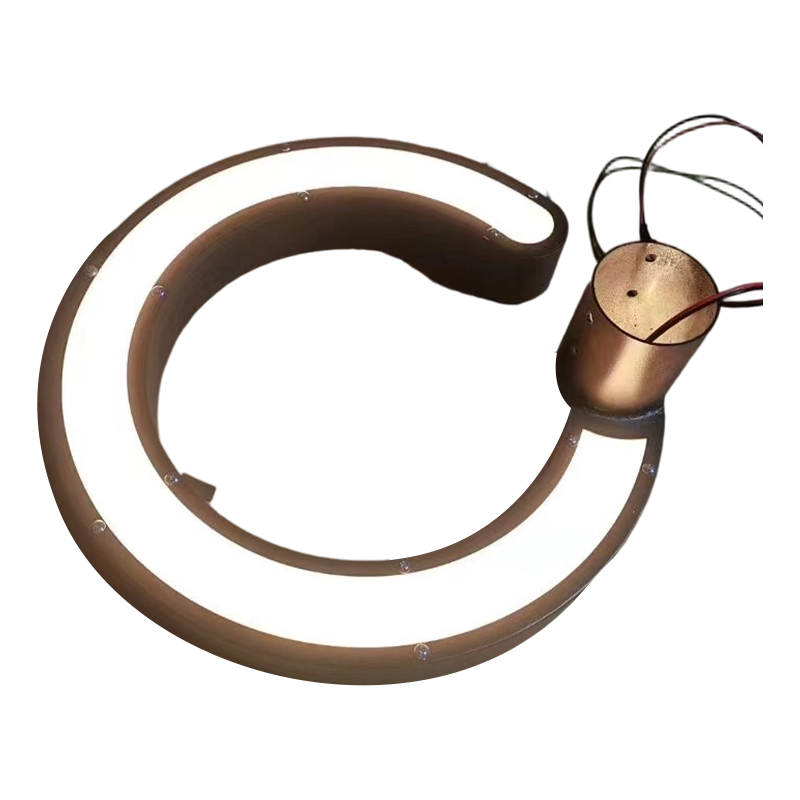
Unlike conventional garden luminaires that often rely on enclosed lanterns, cylindrical housings, or repetitive rectangular forms, this product is built around a curved, open silhouette. The result is a light fitting with a strong artistic presence but a restrained visual language. When illuminated, the ring appears to float as a luminous halo, creating a refined focal point along garden paths, courtyards, plazas, hotel grounds, residential developments, and urban landscape routes.
The product combines decorative value with practical lighting performance. Its integrated high-brightness LED module is paired with a thickened light-diffusing cover to produce uniform illumination with reduced glare and a comfortable visual effect. The aluminum alloy body provides a durable foundation, while the industrial-grade coating supports long-term resistance to oxidation, wear, and outdoor exposure. With an IP65 rating, a broad operating-temperature range, high luminous efficacy, multiple color-temperature options, dimming compatibility, and a five-year warranty, the C-Shape ring light is positioned as a versatile solution for projects that require both design distinction and reliable operation.
C-Shape ring garden landscape light
1. Product Concept and Design Identity
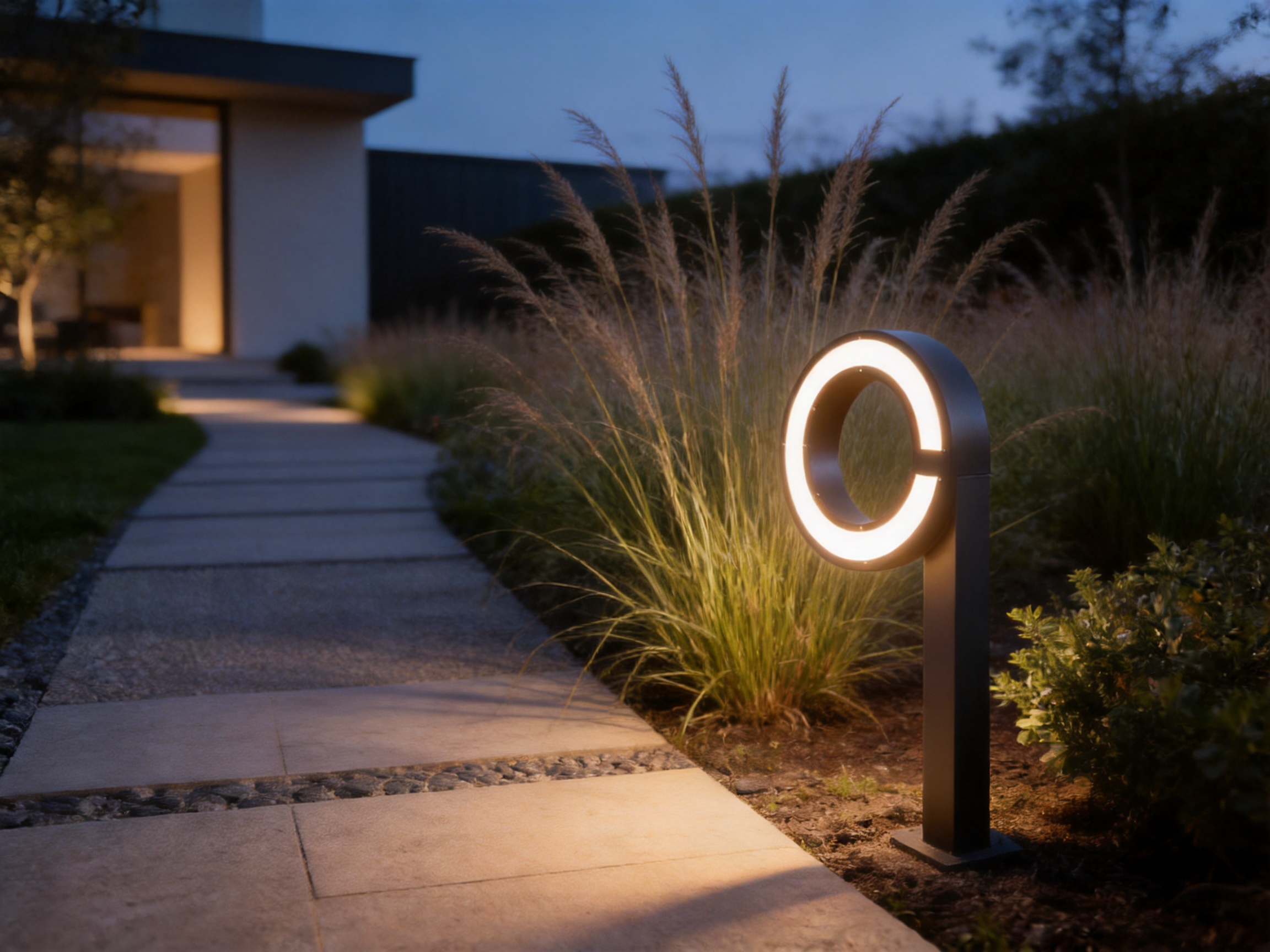
The most recognizable characteristic of the C-Shape ring garden landscape light is its open-ring geometry. The form is neither a completely enclosed circle nor a conventional linear fixture. Instead, the interrupted ring creates a visual sense of movement and openness. This design gives the luminaire an architectural quality that can complement contemporary landscapes without overwhelming surrounding planting, paving, or building façades.
In daylight, the curved body functions as a sculptural element. It can be viewed as a simple geometric accent positioned along a path or within a garden composition. At night, the LED module transforms the same structure into a glowing visual marker. This day-and-night transformation gives the product greater design value than a fixture that is intended to disappear entirely after installation.
The open profile also reduces the visual heaviness commonly associated with bulky outdoor luminaires. Traditional enclosed products may appear solid, dense, or mechanical, particularly when installed in groups. The C-Shape design creates more negative space, allowing the surrounding environment to remain visible. This can be especially useful in landscaped areas where designers want to preserve views of vegetation, paving patterns, water features, sculptures, or architectural details.
The product’s minimalist geometry supports a wide range of design themes. It can be used in modern residential communities, commercial courtyards, resort gardens, cultural venues, municipal paths, technology parks, office campuses, and hospitality environments. Its futuristic appearance is suitable for projects that seek a high-tech atmosphere, while its clean profile can also be integrated into more understated landscape schemes.
Geometric simplicity with a strong nighttime presence
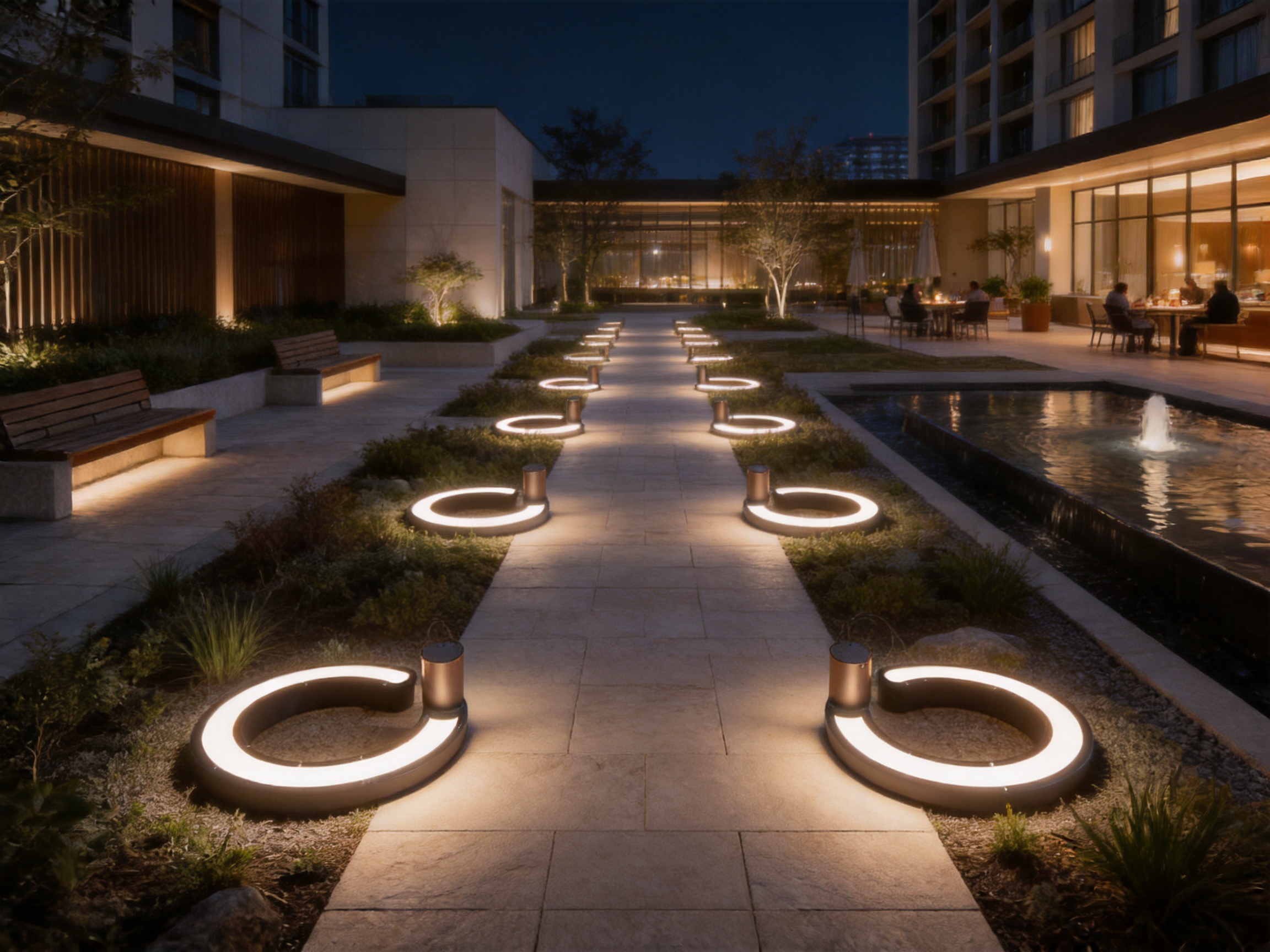
Good landscape lighting must be visible enough to establish orientation and atmosphere without becoming visually distracting. The C-Shape ring light achieves this balance through a clear but uncomplicated form. The luminous ring can define the edge of a pathway, emphasize an entrance, or create a rhythm along a pedestrian route. Repeated installation produces a sequence of glowing forms that guides movement through the landscape.
Because the ring is open, the product can create a different visual impression from different viewing angles. From the front, it presents a recognizable halo-like outline. From the side, its slim construction can appear lighter and less intrusive. This adaptability helps designers use the product in locations where the luminaire must be attractive from multiple directions.
Integration into landscape compositions
The C-Shape ring light is not limited to one type of landscape arrangement. Individual units can be placed near entrances, benches, planting beds, or feature walls. Multiple units can be aligned along a path to create rhythm and continuity. They may also be positioned at different intervals or orientations to introduce variation while preserving a consistent visual language.
For hospitality and commercial projects, the light can contribute to a memorable nighttime identity. In residential developments, it can make shared gardens and pedestrian areas feel more refined and secure. In public landscapes, it can support wayfinding by creating recognizable illuminated points at transitions, intersections, and activity zones.
2. Optical Performance and Visual Comfort
A landscape light must do more than look attractive. It must deliver useful illumination, maintain visual comfort, and perform consistently over time. The C-Shape ring garden landscape light uses an integrated high-brightness LED module and a thickened light-diffusing cover to address these requirements.
The diffuser helps distribute light across the luminous area rather than concentrating it into harsh points. This produces a more continuous and uniform appearance along the ring. Uniformity is particularly important for decorative fixtures because uneven brightness can reduce the perceived quality of the product and create distracting hot spots.
The gentle, flicker-free illumination is suitable for nighttime pedestrian environments. Paths, courtyards, and garden routes require lighting that allows users to recognize changes in surface level, direction, and surrounding obstacles. At the same time, excessive brightness or uncomfortable glare can negatively affect the atmosphere. The product is designed to provide a softer visual experience that supports both safety and ambiance.
High luminous efficacy
The stated lamp luminous efficacy is 140 lumens per watt. This level indicates that the product can convert electrical energy into visible light efficiently, helping project owners balance lighting performance and operating costs. High efficacy is particularly valuable in installations with many luminaires or extended nightly operating hours.
Energy efficiency does not depend solely on the LED module. The optical cover, heat dissipation structure, driver quality, installation position, operating schedule, and control strategy also influence overall performance. The C-Shape product’s aluminum body supports heat transfer away from the LED module, while its dimming compatibility allows the lighting level to be adjusted according to project requirements.
Color-temperature options
The product supports color temperatures from 3000K to 6000K. This range gives designers the ability to select a light appearance suitable for different environments.
A 3000K setting produces a warmer and more welcoming atmosphere. It can work well in residential gardens, restaurants, resorts, heritage-style landscapes, and leisure areas where comfort and relaxation are priorities. Warmer light can also complement timber, brick, warm-colored paving, and dense planting.
Intermediate color temperatures may be suitable for commercial developments, office campuses, mixed-use districts, and contemporary public spaces. They can provide a balanced appearance that is neither strongly warm nor strongly cool.
A cooler setting toward 6000K creates a crisper, more energetic visual effect. It may be selected for technology parks, modern plazas, security-sensitive routes, or projects seeking a distinctly contemporary atmosphere. Final color-temperature selection should be coordinated with surrounding façade lighting, planting, pavement color, and local environmental considerations.
Color rendering and visual recognition
The product has a stated color rendering index of Ra 70. This level is suitable for many general outdoor circulation and landscape applications. It allows common materials, paving, vegetation, and architectural surfaces to appear with recognizable color while maintaining efficient lighting performance.
For projects involving artwork, high-end retail displays, food presentation, or spaces where extremely accurate color appearance is essential, the lighting designer should evaluate the complete visual brief and confirm whether a higher color-rendering specification is required. For pathways, gardens, public routes, and general landscape illumination, the stated specification provides a practical balance between performance and efficiency.
3. Structural Construction and Outdoor Durability
Outdoor lighting equipment must withstand moisture, temperature variation, dust, ultraviolet exposure, wind, and repeated thermal cycling. The C-Shape ring garden landscape light uses aluminum alloy for the lamp body, combining relatively low weight with mechanical strength and effective heat dissipation.
Aluminum alloy is widely used in professional outdoor luminaires because it offers a favorable relationship between durability, manufacturability, and weight. A lighter fixture can simplify handling and installation, while the metal body helps transfer heat from the LED module into the surrounding environment. Efficient thermal management is important because excessive heat can reduce LED performance, accelerate component aging, and shorten service life.
Corrosion-resistant material and coating
The lamp body is described as corrosion-resistant aluminum alloy with a refined industrial-grade paint finish. The coating provides an additional protective layer against oxidation, abrasion, and environmental exposure. It also contributes to the product’s appearance by creating a consistent surface texture suitable for high-visibility landscape applications.
Surface treatment is not merely decorative. In outdoor projects, coating quality can influence how well the luminaire maintains its appearance after years of exposure. A properly prepared and coated aluminum housing is better positioned to resist peeling, fading, and surface deterioration than an inadequately treated metal body.
Project conditions still need to be considered. Coastal environments, industrial zones, areas exposed to de-icing chemicals, and locations with high airborne pollutants may require a detailed corrosion-protection review. Appropriate cleaning, inspection, and installation practices should be included in the project maintenance plan.
IP65 protection
The product carries an IP65 rating. The first digit indicates protection against dust ingress, while the second digit indicates protection against water projected from multiple directions. This rating makes the luminaire suitable for many outdoor landscape applications, including gardens, pathways, courtyards, and urban routes exposed to rain and airborne dust.
An IP rating is achieved through the complete construction of the product, including housing joints, seals, covers, cable entries, and installation interfaces. Correct installation is therefore essential. Cable glands must be properly secured, covers must remain intact, and field modifications should not compromise the sealed structure.
IP65 does not mean that the product should be submerged or installed in a location subject to permanent standing water. Drainage, mounting height, cable routing, and local site conditions should be assessed before installation.
Operating-temperature range
The stated operating-temperature range is -35°C to 65°C. This broad range supports deployment in many climatic regions, from cold winter environments to hot summer conditions. It also provides useful tolerance for projects where outdoor equipment is exposed to seasonal temperature variation.
Actual performance depends on installation conditions, including direct solar exposure, ventilation around the housing, local humidity, driver placement, and electrical stability. Proper system design should ensure that the luminaire is not enclosed in a way that prevents heat from dissipating.
4. Electrical Flexibility and Lighting Control
The C-Shape ring garden landscape light accepts an input voltage of AC85-265V. This broad voltage range allows the product to accommodate electrical systems with different nominal supply conditions and provides flexibility for international project applications.
Voltage compatibility can simplify specification work when a project includes multiple regions, building zones, or supply conditions. Nevertheless, every installation should be checked against local electrical regulations, circuit protection requirements, grounding provisions, and driver installation instructions.
Dimming support
The product supports DC 0-10V and DALI dimming. These interfaces are important for projects that require more than simple on-and-off switching. With suitable control equipment, the lighting level can be adjusted according to operating hours, pedestrian activity, seasonal conditions, or programmed scenes.
For example, a garden path may operate at a higher output during the evening peak period and reduce to a lower level later at night. A hotel courtyard may use one lighting scene for regular circulation and another for events. A commercial development may coordinate landscape lighting with façade lighting and public-area controls.
Adjustable output can reduce energy consumption and help limit unnecessary nighttime brightness. It may also support responsible lighting design by lowering illumination during low-activity periods while maintaining orientation and basic visibility.
Control-system planning
When specifying DALI or 0-10V control, the project team should confirm compatibility between the luminaire driver, control system, wiring method, maximum circuit length, addressing requirements, and commissioning process. A control strategy should be established before installation so that the electrical contractor, lighting designer, and facility operator share the same expectations.
In large landscape projects, control zoning can be organized by path, courtyard, entrance, planting area, or operating schedule. This allows different areas to respond to their actual use rather than operating all luminaires at the same level throughout the night.
5. Advantages Over Conventional Landscape Lighting
The C-Shape ring light offers several advantages when compared with ordinary garden luminaires that focus only on basic illumination.
| Evaluation area | C-Shape ring garden landscape light | Typical conventional fixture | Project benefit |
|---|---|---|---|
| Visual form | Open geometric ring with a floating halo effect | Enclosed lantern, box, or simple cylinder | Creates stronger architectural identity and visual rhythm |
| Light distribution | Integrated LED module with thickened diffuser | May rely on exposed points or less uniform optics | Supports softer and more consistent illumination |
| Material | Corrosion-resistant aluminum alloy | May use heavier or less thermally efficient materials | Balances durability, heat management, and installation convenience |
| Efficiency | Up to 140 lm/W stated efficacy | Performance varies widely by product | Can reduce energy demand for comparable lighting output |
| Control | DC 0-10V and DALI dimming support | Often limited to fixed output or basic switching | Enables scheduling, zoning, and adaptive operation |
| Environmental protection | IP65 rating and -35°C to 65°C operating range | May have narrower environmental specifications | Supports reliable use across varied outdoor conditions |
| Customization | 3000K-6000K color-temperature range | Often available in fewer standard options | Allows better coordination with landscape and architecture |
| Warranty | Five-year warranty period | Warranty terms vary by supplier | Provides greater planning confidence for project owners |
The most important competitive advantage is the combination of design and engineering. Some decorative lights offer an attractive shape but lack efficient optics, durable materials, or professional controls. Conversely, some technically capable fixtures provide reliable illumination but add little to the character of the site. The C-Shape product is designed to combine these two dimensions in a single fixture.
Its open-ring form provides differentiation in a crowded lighting market. The product can help a landscape project avoid a generic appearance, particularly when multiple fixtures are visible from pedestrian routes, building entrances, or public gathering areas. At the same time, its IP65 protection, broad voltage range, aluminum housing, dimming support, and high efficacy address the practical requirements expected from professional outdoor lighting.
6. Manufacturing Quality and Production Capability
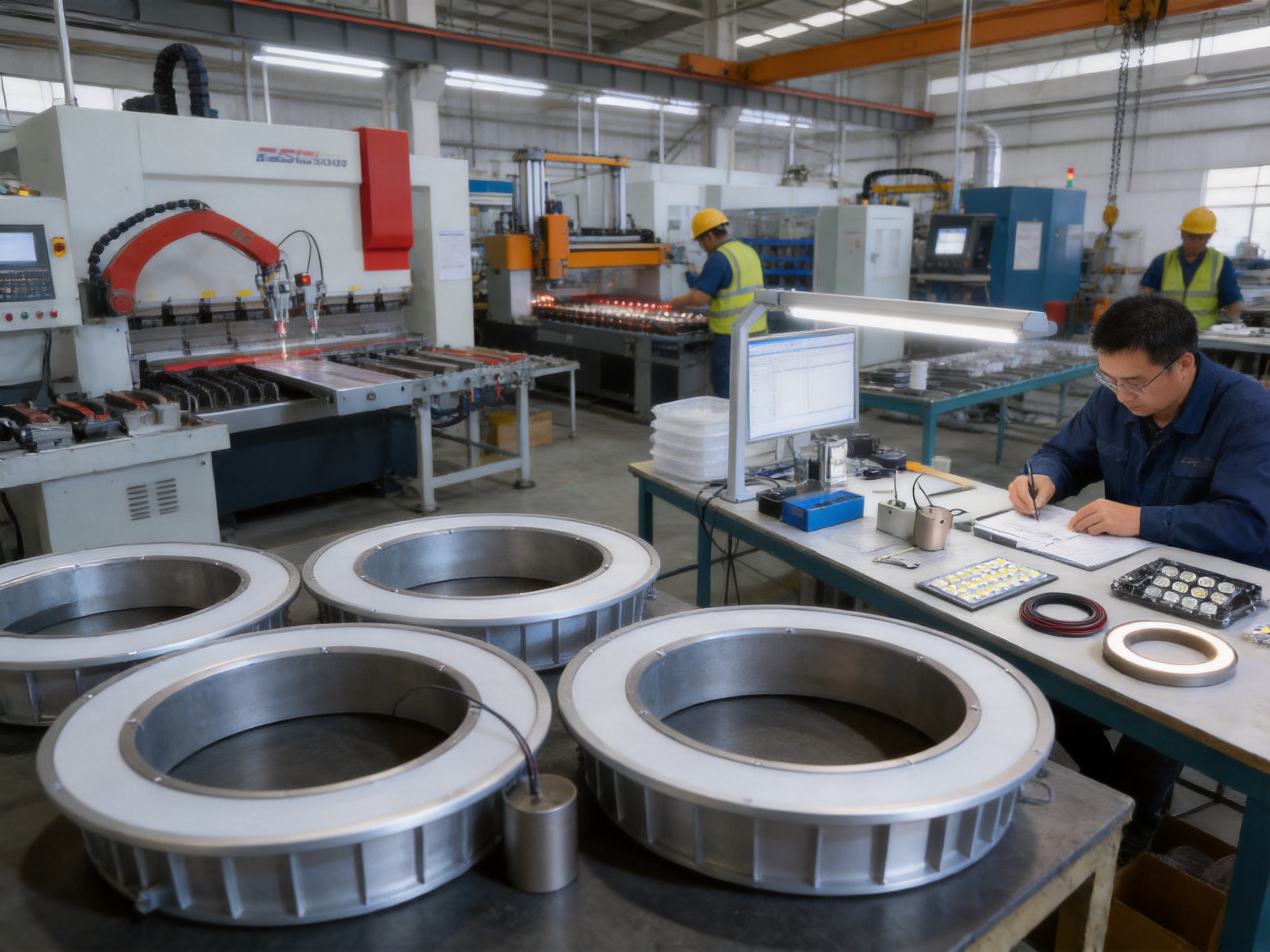
Product performance depends not only on design specifications but also on the consistency of manufacturing. The supplier’s production capabilities include material preparation, CNC bending, precision cutting, automated welding and cutting, powder electrostatic painting, and other industrial processes. These capabilities support stable production for both individual projects and larger-scale orders.
Material availability and project continuity
The manufacturing operation supports material options including Q235B, Q345B, S275JR, S355JR, Q460, A36, A572, GR56, and GR50, among others. Although the C-Shape ring light itself is based on aluminum alloy, this broader material capability reflects the supplier’s experience in outdoor lighting structures, poles, brackets, and related infrastructure.
Maintaining extensive material stock can help reduce delays caused by limited availability or long procurement cycles. For project buyers, material continuity is especially important when multiple lighting products, poles, brackets, and custom components must be coordinated according to one installation schedule.
Material selection should always be matched to the specific component, structural requirement, regional standard, and environmental condition. A professional manufacturing process begins with a clear review of drawings, material grades, surface requirements, and applicable specifications.
Precision CNC bending
Precision CNC bending supports repeatable forming of metal components. Consistent bending helps maintain dimensional accuracy, structural integrity, and installation compatibility. It also reduces the need for manual correction after forming.
For a product with a distinctive curved profile, controlled bending is particularly important. Irregular curvature could affect the visual symmetry of the ring, the fit of the diffuser, the alignment of the LED module, or the connection between the luminaire and its bracket. CNC-controlled production helps reduce variation from one unit to another.
Improved repeatability also benefits large projects. When dozens or hundreds of fixtures are installed across a site, consistent dimensions help contractors work more efficiently and reduce the risk of alignment problems.
Precision cutting
The production description identifies cutting accuracy of 0.01 millimeters. Such precision supports clean edges and exact dimensions in applicable manufacturing operations. Accurate cutting can improve the fit between housing components, mounting parts, covers, and structural interfaces.
Clean, consistent edges can also reduce finishing work and minimize potential weak points where coating quality might otherwise be affected. In a professional production environment, precision cutting works together with bending, welding, grinding, coating, and assembly controls to create a more reliable finished product.
Automated welding and manufacturing lines
Automated lines can improve production speed, consistency, and process control. Automated welding and cutting equipment helps maintain repeatable joints and dimensions while reducing dependence on manual variation. This is important for products that must maintain both structural strength and visual quality.
Automation can also support more efficient use of materials and energy. Shorter production cycles and controlled processing may reduce waste and help lower manufacturing costs. These savings can benefit project owners through more competitive pricing without requiring a reduction in essential product quality.
Experienced certified welders
Automation does not eliminate the value of skilled personnel. Complex assemblies, custom configurations, inspections, and project-specific components still require experienced technicians. The supplier’s team of certified welders combines technical training with many years of practical experience.
Professional welding quality affects the mechanical strength, alignment, appearance, and durability of a metal assembly. Consistent welds are especially important in outdoor lighting infrastructure, where components may experience wind, vibration, handling during transportation, and repeated thermal expansion.
A combination of automated production and skilled manual work allows the manufacturer to select the most appropriate method for each component. Repetitive operations can benefit from automation, while specialized or customized operations can be managed by experienced technicians.
Powder electrostatic painting
Powder electrostatic painting is identified as part of the production capability. In this process, electrically charged powder is applied to a prepared metal surface and then cured to form a protective finish. The method can provide an even coating with a consistent appearance and strong adhesion when the pretreatment and curing stages are properly controlled.
For outdoor lighting, the coating must be more than visually attractive. It should support resistance to moisture, surface abrasion, oxidation, and environmental exposure. Proper cleaning, pretreatment, powder application, curing temperature, and inspection all influence the final result.
The paint finish also allows the C-Shape ring light to coordinate with different landscape palettes. Depending on project requirements, color customization may help the fixture blend into a dark planting environment, match architectural metalwork, or establish a contrasting visual element.
7. Engineering and Customization Services
Outdoor lighting projects often involve more than selecting a standard catalog product. Site dimensions, pathway widths, pole heights, mounting positions, illumination targets, wind conditions, foundation details, and local regulations can all affect the final specification. The supplier provides several technical and design services intended to support the complete project process.
CAD design
CAD design allows the project team to review dimensions, interfaces, mounting details, and component relationships before production. Accurate drawings can reduce misunderstandings between the lighting designer, contractor, manufacturer, and installation team.
For the C-Shape ring light, CAD information can be used to confirm bracket compatibility, fixture orientation, cable routing, mounting clearances, and the relationship between the ring form and surrounding structures.
Three-dimensional product simulation
Three-dimensional product simulation provides a more intuitive view of the fixture than two-dimensional drawings alone. Designers and project owners can evaluate proportions, surface finishes, installation positions, and visual relationships before committing to production.
This service is helpful when the light is being integrated into a highly designed environment. A small change in orientation, mounting height, or spacing can influence how the ring appears from nearby buildings, pedestrian routes, and public gathering areas. Early visualization can help the project team make those decisions before installation.
Three-dimensional scene simulation
Scene simulation places the product into a broader digital representation of the landscape. It can help illustrate the expected nighttime rhythm of multiple fixtures, the appearance of different color temperatures, and the relationship between lighting levels and surrounding architectural elements.
Such simulations are useful for design presentations, client approvals, and coordination among project stakeholders. They can also help identify potential visual conflicts, such as excessive fixture density, unbalanced spacing, or unwanted brightness near adjacent properties.
Specification and color customization
Customization may include color selection, dimensions, mounting configuration, control requirements, or other project-specific parameters, subject to engineering review. The ability to coordinate the luminaire with a project’s architectural and landscape palette can improve design consistency.
Customization should be finalized through approved drawings and documented technical specifications. This ensures that aesthetic changes do not compromise thermal management, electrical safety, IP protection, structural performance, or maintenance access.
Mechanical calculation for wind and foundation design
Where the product is installed on poles or elevated structures, wind loading and foundation design require careful consideration. The supplier offers mechanical calculation support related to wind and foundation requirements. This can assist engineering teams in evaluating the suitability of a proposed installation.
Final structural decisions should be based on the actual site, local wind code, soil condition, mounting height, exposed surface area, foundation material, and installation method. Proper engineering is particularly important for public spaces and large-scale developments where long-term safety is a fundamental requirement.
Overseas installation guidance
International projects may involve different electrical standards, construction practices, climate conditions, and coordination procedures. Overseas onsite installation guidance can help contractors understand product assembly, bracket positioning, cable connection, sealing, commissioning, and maintenance requirements.
Clear installation guidance can reduce rework and help ensure that the finished system performs as intended. It also supports communication between the manufacturer and local project teams when the product is deployed in unfamiliar markets.
8. Recommended Applications
Garden pathways and pedestrian routes
The C-Shape ring light is naturally suited to garden paths, walkways, and circulation routes. Its soft, uniform output can support safe movement while its distinctive form creates a clear visual sequence. Fixtures can be placed at regular intervals or concentrated near changes in direction, steps, entrances, and intersections.
Residential communities
In residential developments, the light can enhance shared gardens, internal roads, entrance plazas, clubhouses, and pedestrian corridors. The 3000K option may provide a warm atmosphere that feels comfortable for residents returning home in the evening. Dimming support can help reduce output during late-night hours while preserving basic orientation.
Hotels and resorts
Hospitality environments depend heavily on visual identity and guest experience. The halo-like ring can add a memorable design element to arrival zones, courtyards, garden restaurants, poolside paths, and outdoor event areas. The product’s color-temperature range allows coordination with architectural lighting and landscape planting.
Commercial and office campuses
Business parks, office campuses, and mixed-use developments require reliable illumination along pedestrian routes and outdoor gathering areas. The C-Shape light can distinguish entrances, frame plazas, and create a consistent visual language across multiple buildings.
Urban landscape paths
The product’s road application specification indicates suitability for certain urban circulation and landscape environments. It may be used along city paths, public gardens, promenades, and landscaped edges where decorative appearance and dependable outdoor protection are both required.
Cultural and public spaces
Museums, exhibition areas, libraries, civic plazas, and cultural parks often require lighting that contributes to the identity of the site. The open-ring form can be used as a subtle sculptural element, especially when the design concept emphasizes geometry, innovation, or contemporary public art.
9. Installation and Maintenance Considerations
Correct installation is essential for achieving the product’s intended performance. Before installation, the project team should confirm the mounting surface, bracket compatibility, power supply, grounding arrangement, cable route, control method, and required clearances.
The lamp should be installed according to approved technical drawings. Brackets must be tightened securely, and the luminaire should be aligned consistently with adjacent fixtures. Uneven rotation or inconsistent height can reduce the visual quality of a repeated installation.
Electrical connections should be completed by qualified personnel. The AC85-265V input range provides flexibility, but the actual circuit must still include suitable protection against overload, short circuit, surge, and other site-specific risks. Dimming systems should be tested before final commissioning.
The IP65 protection level depends on the integrity of the housing and cable-entry points. Installers should avoid drilling unapproved holes, damaging seals, or leaving covers improperly secured. Cable loops should be arranged to prevent water from traveling toward connection points.
Routine maintenance
Routine maintenance may include visual inspection, surface cleaning, checking bracket tightness, reviewing cable conditions, and confirming control-system operation. Dust, leaves, pollution, or biological growth should be removed when they begin to affect appearance or light output.
Cleaning methods should be compatible with the aluminum finish, diffuser, and seals. Harsh abrasives or aggressive chemicals may damage the coating or reduce optical clarity. Maintenance personnel should follow the supplier’s recommendations and local safety procedures.
Because the product uses an integrated LED module, maintenance planning should consider the intended service strategy for the complete luminaire. Project owners should retain product records, installation dates, circuit information, and warranty documentation to simplify future service decisions.
10. Sustainability and Lifecycle Value
Sustainable outdoor lighting involves more than selecting an efficient LED. It includes energy use, product longevity, maintenance requirements, material selection, manufacturing efficiency, and responsible operation.
The stated 140 lm/W efficacy can help reduce electricity consumption when compared with less efficient lighting technologies delivering similar illumination. Dimming through 0-10V or DALI control can further reduce energy use by matching output to actual occupancy and operating schedules.
The aluminum housing contributes to heat management and is a material with established recycling value. A durable coating and IP65 construction can help preserve the fixture’s useful life in demanding outdoor environments. Longer service life reduces the frequency of replacement, transportation, packaging, and installation activities.
Automated production lines may also contribute to more efficient manufacturing by improving repeatability, reducing waste, and shortening production cycles. A well-controlled manufacturing process supports a more consistent product while helping maintain competitive project pricing.
Responsible lighting design should also consider light spill, glare, and nighttime environmental impact. The product’s dimming capability gives designers additional control over output. Final aiming, spacing, color temperature, and operating schedules should be selected in accordance with the surrounding ecology, neighboring properties, local ordinances, and project objectives.
11. Supplier Experience and Project Support
The manufacturing company behind the product is Yangzhou Jinyuan Lamps Co., Ltd., a professional lighting and engineering enterprise established in 2002. The company is affiliated with Jinshang Electric Group and specializes in street light poles, LED street lighting, solar street lighting, light fixtures, and related outdoor lighting products.
The company operates on a site area of more than 70,000 square meters and has more than 300 professional technicians. Its products are exported to more than 200 countries, indicating experience with international project coordination, overseas customer requirements, and varied application conditions.
Quality-management and environmental credentials listed for the company include ISO9001, ISO14001, and OHSAS18001-related standards. These standards reflect attention to quality management, environmental management, and occupational health and safety systems. Certification should be evaluated together with project-specific documentation, inspection records, and applicable local requirements.
The company’s broader product portfolio includes high mast lighting, solar lighting, smart street lighting, traffic facilities, photovoltaic power-generation systems, LED floodlights, LED street lighting, communication towers, and mid-mast lighting. This range provides useful supporting experience for projects that combine landscape lighting with roads, public infrastructure, renewable energy, or smart-city systems.
For buyers, the value of a supplier is not limited to the fixture itself. Design assistance, production capacity, inspection procedures, customization, logistics coordination, installation guidance, and after-sales support can influence the success of the complete project. The available CAD, simulation, structural calculation, customization, and onsite guidance services are therefore important parts of the product proposition.
12. How to Specify the C-Shape Ring Light
A clear specification should begin with the project’s functional and aesthetic objectives. The design team should identify whether the fixture is intended primarily for pathway safety, decorative illumination, visual wayfinding, architectural identity, or a combination of these purposes.
The required color temperature should be selected after reviewing nearby light sources, building materials, planting, user expectations, and environmental conditions. Warm light may support hospitality and residential comfort, while cooler light may suit technology-oriented or highly contemporary spaces.
The control requirement should be defined early. If the project needs scheduled dimming, zoning, or integration with a central lighting-management system, the 0-10V or DALI interface should be coordinated with the electrical design.
Mounting details should include pole or bracket dimensions, fixture orientation, cable access, installation height, spacing, and wind exposure. Where elevated mounting is proposed, mechanical calculations should be completed before final approval.
Procurement documents should identify the required input voltage, IP rating, operating-temperature range, luminous efficacy, color-rendering index, warranty period, finish, color temperature, and any approved customization. Samples or prototypes may be appropriate for projects where the appearance of the ring is a major design feature.
13. Frequently Asked Questions
What is the main design feature of the C-Shape ring garden landscape light?
The main feature is its open-ring silhouette. The curved form creates a floating halo effect when illuminated and gives the product a more artistic and contemporary appearance than many conventional enclosed garden lights.
Where can this product be used?
It can be used in gardens, courtyards, residential communities, hotels, resorts, office campuses, commercial developments, urban landscape paths, public plazas, and other outdoor pedestrian environments. The stated application is road, but the product’s design is also suitable for decorative landscape routes and circulation areas.
Does the light provide uniform illumination?
The integrated high-brightness LED module and thickened light-diffusing cover are designed to provide uniform, gentle, and flicker-free illumination. Final uniformity will also depend on fixture spacing, mounting height, output level, and site layout.
What input voltage does the product support?
The specified input voltage is AC85-265V. Electrical installation should still comply with local codes and include appropriate circuit protection and grounding.
What color temperatures are available?
The specified range is 3000K-6000K. This allows selection from warm white through cooler white tones according to the project’s architectural, landscape, and environmental requirements.
Can the light be dimmed?
Yes. The product supports DC 0-10V and DALI dimming. A compatible control system and properly coordinated wiring are required.
Is the product suitable for cold and hot climates?
The stated operating-temperature range is -35°C to 65°C. Site conditions, installation ventilation, direct solar exposure, humidity, and electrical stability should still be reviewed during design.
What does the IP65 rating mean?
IP65 indicates protection against dust ingress and water projected from multiple directions. It is suitable for many outdoor conditions, but it does not indicate suitability for permanent submersion. Correct installation and intact cable entries are essential.
What material is used for the lamp body?
The lamp body is made from aluminum alloy with a corrosion-resistant industrial-grade paint finish. The aluminum construction supports durability and heat dissipation while maintaining a relatively manageable installation weight.
What is the stated luminous efficacy?
The stated lamp luminous efficacy is 140 lumens per watt. Actual system energy use and illumination results also depend on operating level, controls, installation design, and electrical components.
What is the warranty period?
The listed warranty period is five years. Buyers should confirm the warranty scope, exclusions, installation conditions, and service procedures in the formal quotation and contract documents.
Can the product be customized?
Specification and color customization services are available subject to technical review. Customization should be documented through approved drawings and specifications to ensure that appearance changes do not affect performance or safety.
Does the supplier provide engineering assistance?
Available services include CAD design, three-dimensional product simulation, three-dimensional scene simulation, specification and color customization, mechanical calculations for wind and foundation conditions, and overseas onsite installation guidance.
How does this product compare with a standard garden lamp?
Its key differences are the open-ring design, halo-like nighttime appearance, integrated diffuser, stated 140 lm/W efficacy, broad color-temperature range, dimming support, aluminum alloy construction, IP65 protection, and five-year warranty. The most suitable comparison should be based on the complete technical specification of the competing product.
Conclusion
The C-Shape ring garden landscape light is designed for projects that require outdoor illumination with a stronger visual identity. Its open geometric form creates a distinctive halo effect, while its integrated LED module and thickened diffuser support soft, uniform, and comfortable illumination. The combination of 140 lm/W efficacy, 3000K-6000K color-temperature options, Ra 70 color rendering, AC85-265V input, 0-10V and DALI dimming, IP65 protection, a -35°C to 65°C operating range, and a five-year warranty gives the product a practical foundation for professional landscape applications.
Its advantages are reinforced by the manufacturer’s production capabilities. CNC bending, precision cutting, automated manufacturing lines, powder electrostatic painting, experienced welding personnel, material availability, and engineering support contribute to consistent product quality and project reliability. CAD design, 3D simulation, customization, structural calculations, and overseas installation guidance extend the supplier’s role beyond basic product delivery.
For landscape designers, developers, contractors, and lighting distributors, the product offers a balanced combination of artistic form, efficient LED performance, outdoor durability, control flexibility, and manufacturing support. When correctly specified and installed, it can help transform pathways, gardens, courtyards, and public landscapes into safer, more coherent, and more memorable nighttime environments.
References
1. Product technical information supplied for the C-Shape ring garden landscape light, including electrical, optical, material, environmental, and warranty specifications.
2. International Electrotechnical Commission. Degrees of Protection Provided by Enclosures, IP Code classification principles.
3. International Electrotechnical Commission. LED modules and general performance considerations for solid-state lighting equipment.
4. International Organization for Standardization. Quality management systems and principles for consistent manufacturing operations.
5. International Organization for Standardization. Environmental management systems and lifecycle considerations for industrial production.
6. General outdoor lighting design principles for pedestrian safety, glare control, color temperature selection, dimming, and landscape integration.
7. Manufacturer-provided information regarding CAD design, three-dimensional product simulation, mechanical calculation, production equipment, customization, and installation guidance.