


JINYUAN
JINYUAN
JINYUAN
JINYUAN
JINYUAN
JINYUAN
JINYUAN
JINYUAN
JINYUAN
JINYUAN
JINYUAN
JINYUAN
JINYUAN
JINYUAN
JINYUAN
JINYUAN
Content
- 1 Understanding Retractable High-Mast Lighting Systems
- 2 Why Airports and Ports Need Advanced High-Mast Lighting
- 3 Structural Design and Engineering Advantages
- 4 Maintenance Safety and Lifecycle Efficiency
- 5 Customizable Floodlight Configuration
- 6 Protection for Challenging Outdoor Environments
- 7 Advanced Manufacturing Capabilities
- 8 Quality Assurance and International Project Support
- 9 Competitive Advantages Compared with Conventional Solutions
- 10 Project Planning Considerations
- 11 Recommended Maintenance Program
- 12 Manufacturing Strengths of Yangzhou Jinyuan Lamps Co., Ltd.
- 13 How to Select the Right System
- 14 Q&A: Retractable High-Mast Lighting Systems
- 14.1 What is a retractable high-mast lighting system?
- 14.2 Where can this type of system be installed?
- 14.3 Why use a high mast instead of many conventional light poles?
- 14.4 How does the retractable platform improve maintenance safety?
- 14.5 Can the floodlights be customized?
- 14.6 Are the floodlights suitable for ports and coastal locations?
- 14.7 Does the system include lightning protection?
- 14.8 What materials can be used for the pole?
- 14.9 Can the pole be designed for high-wind or seismic areas?
- 14.10 What manufacturing processes support product quality?
- 14.11 Can the supplier provide design assistance?
- 14.12 How should buyers compare suppliers?
- 15 Conclusion
- 16 References
- 17 Product: Retractable High-Mast Lighting Systems
Large transportation hubs and industrial sites require lighting systems that deliver exceptional coverage, structural reliability, operational flexibility, and safe maintenance. Airports, seaports, logistics terminals, container yards, railway freight centers, military facilities, sports complexes, and industrial parks often cover tens of thousands of square meters. These locations must remain clearly illuminated throughout the night, during poor weather, and during periods of high operational activity. Conventional streetlights may require a large number of poles to achieve adequate coverage, while fixed high-mast systems can create challenges when floodlights need inspection, cleaning, adjustment, or replacement.
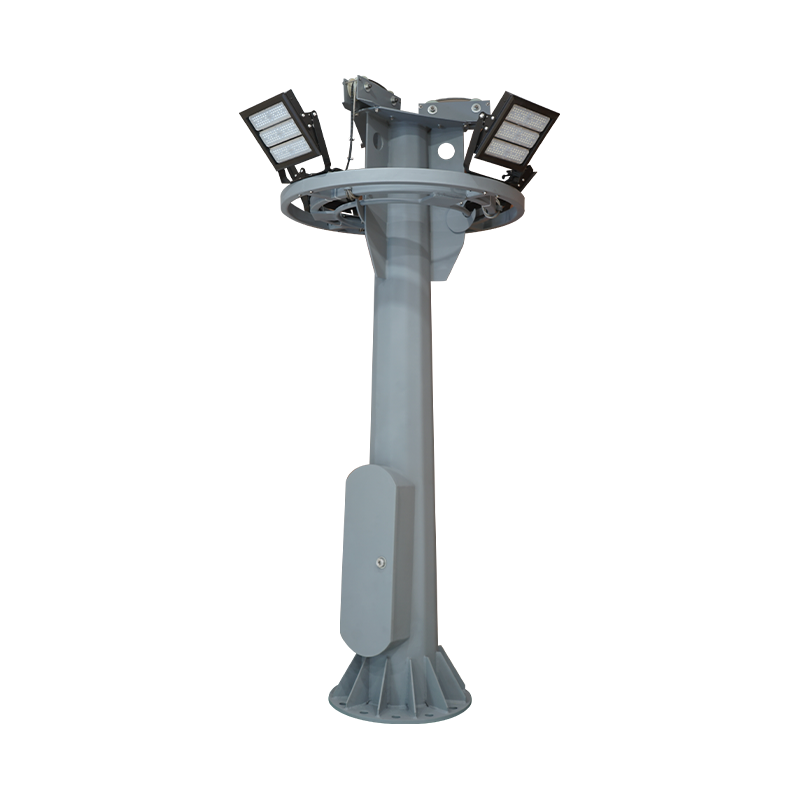
Retractable high-mast lighting systems provide an efficient solution to these challenges. By combining a tall conical pole, an automated lifting platform, multiple high-power floodlights, an integrated winch, and a secure latching mechanism, the system concentrates powerful illumination at a strategic height while allowing maintenance teams to lower the lighting platform to ground level. This design reduces the need for elevated work, minimizes maintenance disruption, and supports consistent illumination across large open areas.
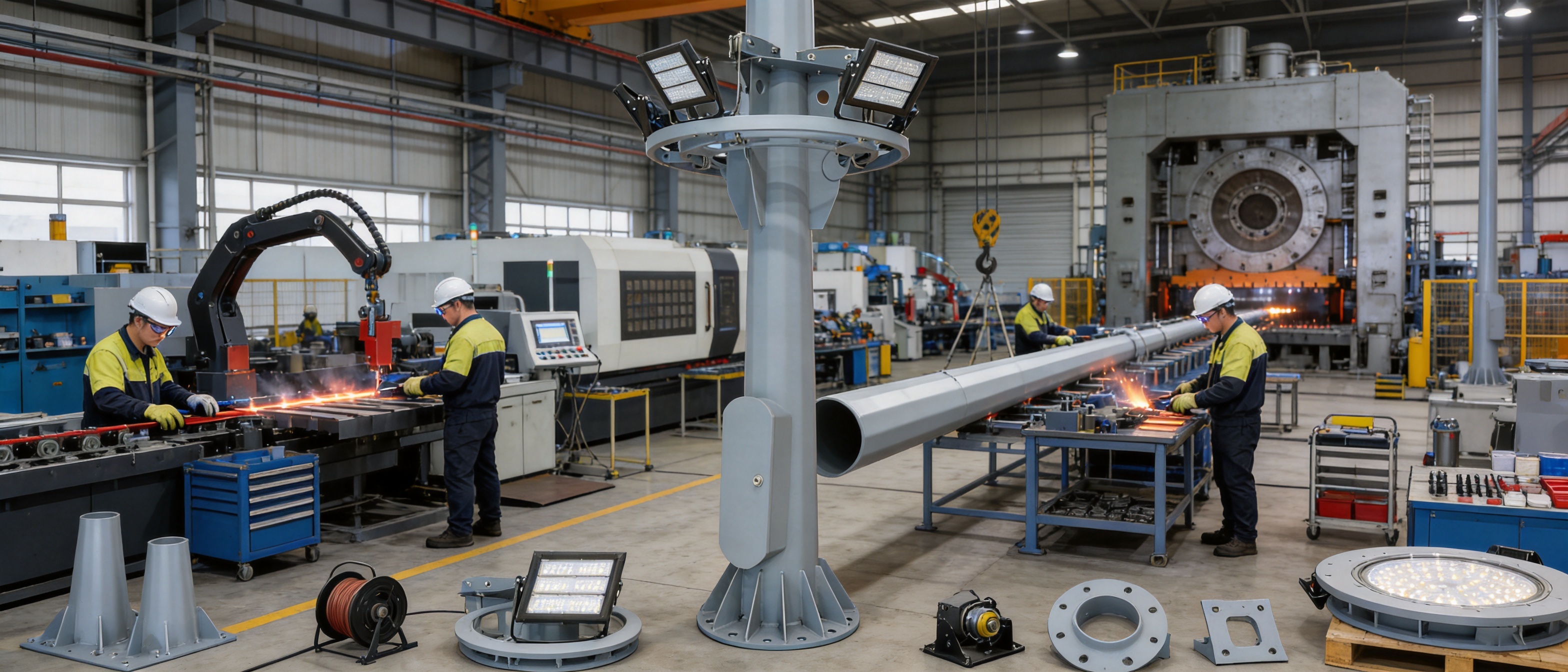
Yangzhou Jinyuan Lamps Co., Ltd. develops and manufactures large-scale lighting products, including high-mast lighting systems, streetlight poles, LED lighting equipment, solar lighting products, traffic facilities, and related infrastructure. With production, engineering, design, and project-support capabilities, the company is positioned to provide customized lighting solutions for demanding airport and port environments. Its manufacturing operations include CNC bending, precision cutting, automated welding, electrostatic powder coating, die casting, and integrated quality control processes.
Understanding Retractable High-Mast Lighting Systems
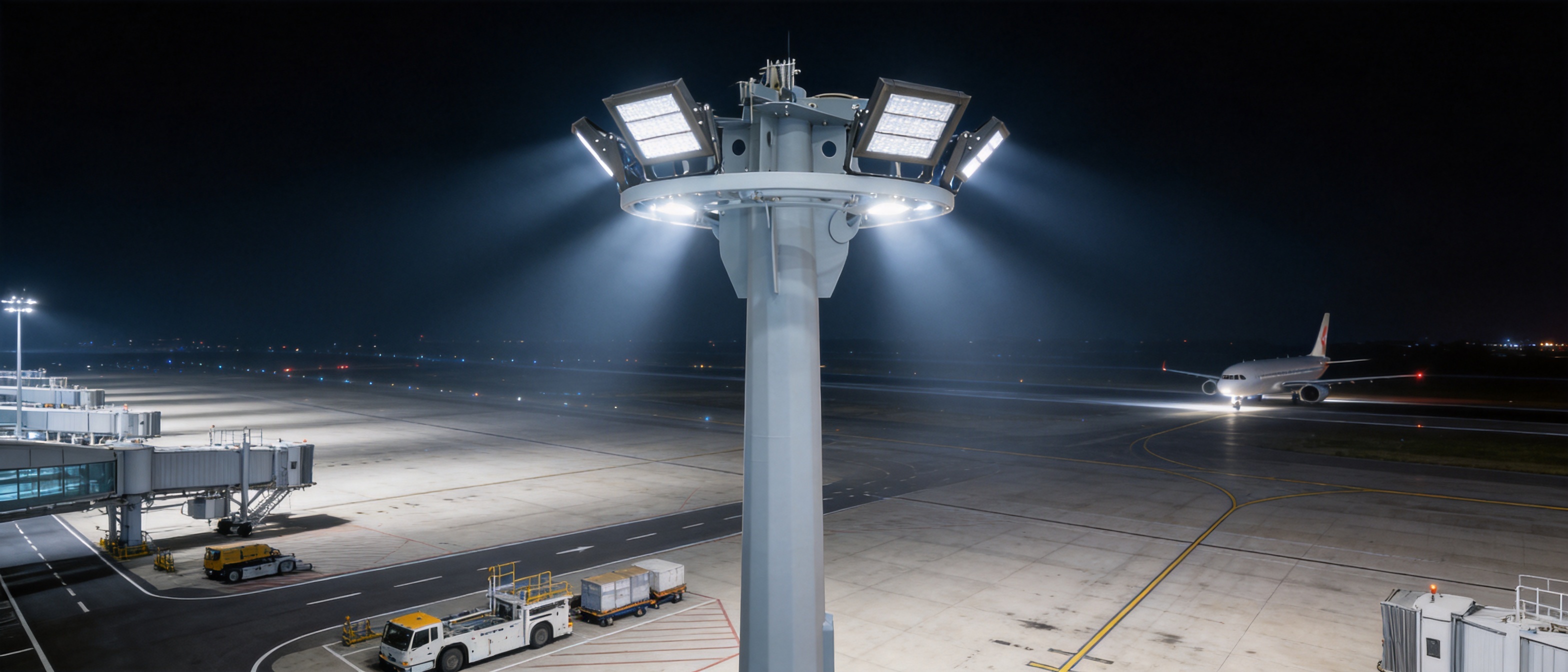
A retractable high-mast lighting system is a centralized outdoor lighting structure designed to illuminate extensive areas from a single elevated position. Unlike a standard streetlight, which usually directs light along a roadway or pedestrian path, a high-mast system is designed for wide-area illumination. Its raised light platform can support several floodlights arranged around a circular frame, allowing the system to provide broad or full-perimeter coverage.
The primary pole is generally fabricated from several interlocking steel sections. These sections form a tall, tapered structure that combines reduced wind resistance with high vertical strength. At the top of the pole, a lifting platform carries multiple floodlights. The platform is connected to an internal or external lifting mechanism that allows it to travel between its operating position and a lower maintenance position.
The core lifting equipment typically includes a motorized winch, steel lifting cables, pulleys, guide components, and an automated latching arrangement. When the lighting platform reaches its operating height, the latching mechanism secures the platform against the pole or supporting structure. This arrangement reduces the continuous load placed on the winch and cables during normal operation. For maintenance, authorized personnel can release the latches and lower the platform to a manageable working height.
This maintenance-oriented design is one of the most important differences between a retractable high-mast system and a conventional fixed high mast. Instead of relying on a crane, elevated work platform, or rope-access team for every service task, maintenance personnel can inspect and repair the lighting assembly closer to ground level. The result can be a safer, more predictable, and more economical maintenance process.
Why Airports and Ports Need Advanced High-Mast Lighting
Airports and ports operate under strict safety and efficiency requirements. Aircraft movement areas, apron zones, runways, taxiway surroundings, cargo yards, loading areas, container stacks, access roads, and security perimeters must be visible at night. Lighting must support personnel movement, equipment operation, surveillance, traffic management, and emergency response without creating unnecessary glare or excessive dark zones.
At an airport, lighting must help ground crews work around aircraft while preserving visibility for pilots and air traffic operations. Lighting positions must be carefully planned to limit glare, avoid confusing visual signals, and maintain appropriate illumination levels around aircraft stands and service roads. The same principle applies to ports, where lighting must support crane operations, container handling, truck circulation, customs inspection, and worker safety.
Large sites also face significant space and infrastructure constraints. Installing many low-height poles can increase foundation work, cable routes, maintenance points, and visual obstruction. A strategically positioned high-mast system can cover a large area from a smaller number of locations. This may reduce the overall complexity of the lighting layout while providing a more uniform distribution of illumination.
High-mast lighting is especially valuable in locations where unobstructed visibility is essential. A tall installation can project light over vehicles, cargo, containers, machinery, and temporary structures. By placing several floodlights on one elevated platform, operators can create overlapping lighting zones and reduce the risk of deep shadows.
Typical Application Areas
Retractable high-mast lighting systems can be used in airport aprons, aircraft maintenance zones, cargo terminals, parking areas, security boundaries, and emergency access areas. They are also suitable for seaports, container terminals, bulk cargo yards, shipyards, logistics parks, customs inspection zones, and intermodal transportation facilities.
Other applications include large industrial compounds, mining areas, stadiums, exhibition grounds, railway yards, military bases, highway interchanges, municipal squares, and open storage facilities. Wherever a large area must be illuminated from an elevated position, a retractable high-mast system can be considered as part of the lighting design.
Retractable High-Mast Lighting Systems
Structural Design and Engineering Advantages
Conical Multi-Section Pole Construction
The pole is formed from multiple steel sections that are engineered to interlock or connect into a continuous tapered structure. The conical form provides a practical balance between strength, material efficiency, and wind resistance. The larger cross-section near the base supports the greatest structural loads, while the smaller upper sections reduce unnecessary weight at elevation.
Multi-section construction also offers logistical advantages. Very tall poles can be difficult to transport as one piece, particularly when projects are located far from the manufacturing facility or require international shipping. Dividing the pole into sections simplifies packaging, transportation, handling, and site assembly. Properly designed joints and connection details preserve structural integrity after installation.
The structural design must account for dead load, wind pressure, dynamic effects, equipment weight, maintenance loads, cable forces, and local environmental conditions. In regions exposed to strong winds, storms, seismic activity, or corrosive marine air, the pole and foundation design must be adapted to site-specific requirements. Engineering support can include wind and foundation calculations, connection review, and customized configuration based on local standards.
Seismic and Wind Resistance
High-mast poles are exposed to significant wind loads because of their height and the surface area of the lighting platform and floodlights. The design must consider not only the pole itself but also the aerodynamic influence of the luminaires, brackets, cables, and lifting platform. A properly engineered taper, wall thickness, section connection, base flange, and anchor-bolt arrangement contributes to long-term stability.
Where seismic conditions are important, the pole must be evaluated for lateral movement, vibration, connection stress, and foundation response. The use of multiple interlocking sections, carefully controlled welding, and accurate dimensional fabrication helps ensure that the assembled structure performs as intended. Site-specific mechanical calculations are particularly valuable for airports and ports because these locations may combine high wind exposure, heavy equipment movement, and critical operational requirements.
Automated Lifting Platform
The circular lighting platform is designed to carry multiple floodlights in a balanced configuration. Its geometry supports perimeter illumination and allows fixtures to be aimed in different directions. The number, wattage, beam angle, and mounting arrangement of the floodlights can be customized according to the area to be illuminated and the required lighting performance.
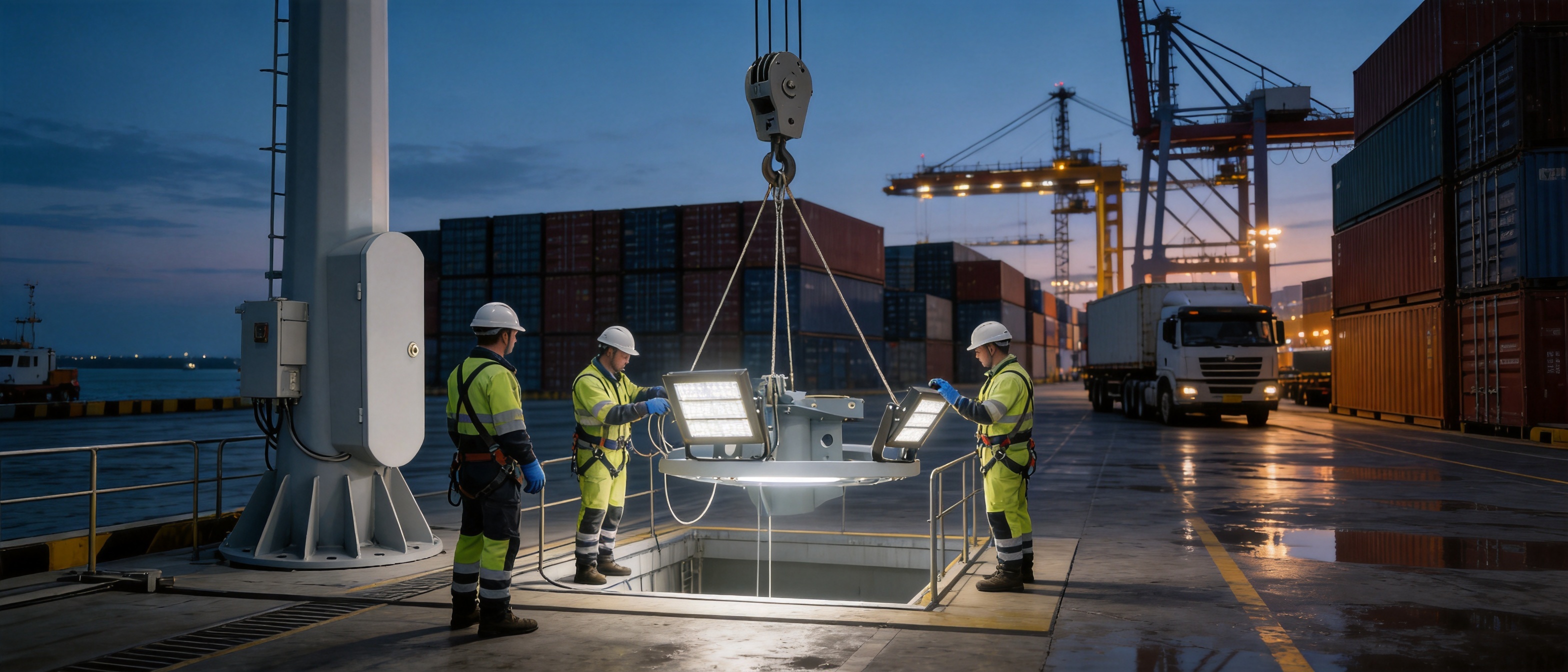
The platform is raised and lowered by a motorized winch system. During operation, the platform is secured by the automated latching mechanism. During maintenance, it can be lowered to a safer working level. This approach helps reduce exposure to height-related risks and may decrease the need for specialized access equipment.
The lifting system should be operated according to a documented maintenance and safety procedure. Limit switches, cable inspection, brake performance, latch engagement, motor operation, and control components should be checked at appropriate intervals. Where required, manual override and emergency stopping functions can be incorporated into the control arrangement.
Maintenance Safety and Lifecycle Efficiency
Maintenance access is a defining advantage of retractable high-mast lighting. Traditional fixed high-mast systems may require a crane or an elevated work platform when a floodlight fails. Such equipment can be expensive to mobilize, especially in remote ports, restricted airport zones, or facilities that operate continuously. The work may also require traffic control, temporary closure of operating areas, and additional safety personnel.
With a retractable platform, the floodlights can be brought down for inspection, cleaning, adjustment, driver replacement, wiring checks, and fixture renewal. This can simplify work planning and reduce service time. Maintenance teams can perform many tasks from a stable ground-level position rather than working at the top of a tall pole.
Lowering the platform may also improve the quality of maintenance. Technicians can access housings, lenses, brackets, connectors, and protective devices more easily. They can inspect the equipment under better conditions and identify loose connections, corrosion, water ingress, or mechanical damage before these problems become serious failures.
Lifecycle efficiency is influenced by more than the initial purchase price. The total cost of ownership includes energy use, inspection, replacement parts, access equipment, downtime, labor, and the expected service life of the pole and luminaires. A lighting system that simplifies maintenance and reduces interruptions may deliver greater long-term value than a less expensive system that is difficult to service.
| Design Feature | Operational Benefit | Project Value |
|---|---|---|
| Elevated circular lighting platform | Supports wide-area and perimeter illumination | Fewer lighting positions may be required for large sites |
| Motorized winch system | Raises and lowers the lighting assembly | Improves maintenance access and work planning |
| Automated latching mechanism | Secures the platform at operating height | Reduces continuous dependence on lifting cables |
| Multi-section conical pole | Combines transportability with structural strength | Supports efficient fabrication, shipping, and installation |
| Configurable LED floodlights | Allows wattage and beam angles to match site needs | Supports tailored illumination and energy management |
| IP66 or higher protection | Resists dust and powerful water jets | Improves suitability for exposed outdoor environments |
| Secondary lightning protection | Adds protection for equipment in exposed locations | Helps improve system resilience during storms |
Customizable Floodlight Configuration
Different sites require different lighting patterns. A container yard may need long-throw illumination between rows of containers, while an aircraft apron may require controlled light distribution around aircraft stands. A port loading zone may need high uniformity for workers and machinery, whereas a security perimeter may prioritize directional coverage and reduced spill light.
The lighting platform can be fitted with LED floodlights in different wattages and beam angles. Narrow beams may be used for long-distance illumination, while medium or wide beams can provide broader coverage over open areas. The final arrangement should be based on photometric calculations, mounting height, pole spacing, target illuminance, uniformity, glare control, and the presence of obstacles.
LED technology offers several advantages for high-mast applications. LED floodlights can provide high luminous output with lower energy consumption than many traditional discharge lamps. They also offer long service life, rapid startup, stable operation, and flexible optical options. Because LEDs can be controlled and directed more precisely, they can help reduce wasted light outside the target area.
Lighting controls may include individual circuit switching, group control, time scheduling, photocell activation, dimming, or integration with a broader smart lighting platform. For ports and airports, control zones can be useful because different operating areas may have different schedules and lighting requirements. For example, a cargo zone can operate at full output during active loading and use a reduced level during low-traffic periods, subject to applicable safety requirements.
Uniform Illumination Across Large Areas
Uniformity is a critical performance objective. Excessively bright areas next to dark zones can create visual discomfort and reduce the ability of personnel or cameras to detect hazards. By arranging multiple floodlights around the platform and aiming them toward overlapping target zones, the system can distribute light more evenly.
Photometric simulation should be completed before production whenever possible. A digital lighting model can evaluate mounting height, fixture output, beam angle, pole locations, tilt angles, and target illuminance. Adjustments made during the design phase are generally more economical than changes made after installation.
Jinyuan Lamps provides CAD design, three-dimensional product simulation, three-dimensional scene simulation, and specification and color customization services. These capabilities can assist project owners, consultants, and contractors in visualizing the proposed system and coordinating it with site requirements.
Protection for Challenging Outdoor Environments
IP66 or Higher Enclosures
Airports, ports, and industrial areas expose lighting equipment to dust, rain, spray, humidity, and windborne contamination. Fixtures with an IP66 or higher protection rating are designed to resist dust ingress and powerful water jets. This protection helps maintain the reliability of LED modules, drivers, internal wiring, and control components.
Ingress protection is only one part of environmental durability. The fixture housing, lens, seals, cable glands, fasteners, and mounting brackets must work together as a complete enclosure system. Correct installation is also essential. Damaged seals, loose glands, improper cable entries, or incorrect maintenance procedures can reduce the practical protection level of the fixture.
Corrosion Protection
Marine and industrial atmospheres can accelerate corrosion. Salt spray, moisture, chemicals, and airborne pollutants may affect steel poles, brackets, bolts, electrical enclosures, and lifting components. A suitable surface-treatment system is therefore essential for port lighting and other exposed applications.
Protective options may include hot-dip galvanizing, powder coating, primer systems, or combinations of treatments selected according to the site environment. Automated electrostatic powder coating can provide consistent coverage and an attractive, durable finish when the surface is properly prepared. The coating process should be supported by inspection of surface cleanliness, coating thickness, adhesion, and visible defects.
Jinyuan Lamps uses powder electrostatic painting equipment and automated production processes to support consistent anti-corrosion performance. Faster production cycles combined with quality control can help improve coating repeatability and reduce variation between products.
Lightning Protection
Tall metal structures are exposed to lightning events, particularly in open areas and high-altitude or storm-prone environments. The system can be equipped with a secondary lightning protection module to provide an additional layer of protection for the lighting equipment. The complete protection strategy should also address grounding, bonding, surge protection, cable routing, and coordination with the site electrical system.
Lightning protection design must comply with the applicable local electrical and safety requirements. A secondary module does not replace proper grounding or an engineered site protection system. Instead, it contributes to a coordinated approach intended to reduce the risk of damage to LED fixtures, drivers, control devices, and lifting-system components.
Advanced Manufacturing Capabilities
The performance of a retractable high-mast system depends heavily on manufacturing precision. Small dimensional variations in pole sections, flange plates, brackets, cable guides, or platform components can affect assembly, alignment, lifting performance, and structural behavior. For this reason, advanced production equipment and experienced personnel are essential.
Material Selection
Available structural material options include Q235B, Q345B, S275JR, S355JR, Q460, A36, A572, GR56, and GR50, subject to project requirements and applicable standards. The selected material should be evaluated according to yield strength, tensile strength, weldability, availability, corrosion-protection requirements, local codes, and structural calculations.
Maintaining an extensive material inventory can help reduce procurement delays and support faster production scheduling. It also allows the manufacturer to coordinate material selection with the engineering requirements of different markets. Material certificates and incoming inspection procedures should be used to verify grade, dimensions, and quality before fabrication.
CNC Bending
Precise bending is important when manufacturing tapered pole sections. CNC bending equipment enables consistent angles, controlled radii, and repeatable dimensions across production batches. Consistent bending improves the fit between connected sections and reduces the amount of post-production adjustment required during assembly.
Accurate bending also supports the intended structural geometry. Uneven or uncontrolled bending can create local stress concentrations, misalignment, or difficulty during welding. By using controlled CNC processes, the manufacturer can improve dimensional consistency and help maintain the designed taper and circular or polygonal form of the pole.
High-Precision Cutting
Cutting accuracy affects the fit of plates, brackets, access doors, flanges, stiffeners, and other components. The stated cutting capability can reach 0.01 millimeter accuracy under suitable process conditions. Precise cutting produces clean edges and exact dimensions, supporting better assembly and reducing the need for corrective work.
Clean cutting edges are also valuable for welding and finishing. Reduced burrs and distortion can improve joint preparation and help technicians achieve more consistent weld quality. Accurate component preparation contributes to faster production and a more predictable final product.
Automated Welding and Certified Welders
Welding is central to the structural reliability of steel poles, lighting platforms, brackets, and base components. Automated welding lines can improve repeatability for standardized joints, while certified welders provide the experience required for complex assemblies, special configurations, and project-specific fabrication.
Experienced welding personnel help control joint preparation, heat input, penetration, alignment, and visual quality. Welding inspections may include dimensional checks, visual examination, and additional non-destructive testing where required by the project specification. A combination of automation and skilled workmanship supports both production efficiency and structural consistency.
Jinyuan Lamps reports that its certified welding team has many years of experience and is equipped to support large-scale projects. This is particularly relevant for high-mast systems because the pole, platform, winch supports, and fixture brackets must work together as a coordinated structural assembly.
Die Casting and Component Production
A 1250-ton die-casting machine supports the production of selected metal components requiring repeatable shapes, dimensional stability, and efficient large-volume manufacturing. Die casting can be useful for housing parts, structural accessories, electrical component enclosures, and other products where accurate geometry is important.
Automated lines can increase production consistency while reducing material waste and labor variation. When combined with inspection procedures, process documentation, and equipment maintenance, automation helps manufacturers deliver more predictable products at competitive prices.
Electrostatic Powder Coating
Electrostatic powder coating applies charged powder particles to prepared metal surfaces. The particles adhere to the component before curing in an oven, forming a continuous protective layer. The process can provide a uniform finish and supports a broad range of color options for project coordination.
For large outdoor poles and platforms, coating quality depends on surface preparation, grounding, powder selection, curing temperature, curing time, and handling. Automated equipment helps maintain process stability, while quality inspections verify the finished result.
Quality Assurance and International Project Support
Quality assurance for high-mast systems begins during design and continues through material procurement, fabrication, coating, assembly, inspection, packaging, installation, and commissioning. A strong quality program should address both individual components and the performance of the completed system.
Important inspection areas may include steel grade, pole dimensions, flange flatness, weld appearance, coating condition, fastener quality, cable routing, winch operation, latch engagement, floodlight output, grounding continuity, and electrical insulation. Factory acceptance testing can be arranged according to project requirements.
The company identifies ISO9001, ISO14001, and OHSAS18001 among its quality and management credentials. These standards and systems indicate an emphasis on quality management, environmental management, and occupational health and safety. Project documentation can be prepared to support customer review, installation, inspection, and future maintenance.
International projects often require coordination across multiple parties. Owners, engineering consultants, electrical contractors, civil contractors, logistics providers, and local installation teams may all contribute to the project. Clear drawings, technical data, packing lists, installation instructions, foundation information, and inspection records help reduce misunderstandings.
Design and Simulation Services
Project support can begin with a site discussion covering the area dimensions, desired illumination levels, environmental conditions, pole locations, access restrictions, power supply, control requirements, and local standards. Based on this information, the manufacturer can prepare CAD drawings and preliminary equipment selections.
Three-dimensional product simulation can show the relationship between the pole, platform, winch, floodlights, and accessories. Three-dimensional scene simulation can place the system in a representative airport, port, yard, or industrial environment. This helps stakeholders review appearance, mounting orientation, clearance, and coverage before manufacturing begins.
Mechanical calculations for wind and foundations provide additional support for civil and structural coordination. The final foundation design must be confirmed according to soil conditions, wind loads, seismic requirements, anchor-bolt arrangement, drainage, and local engineering practice.
Installation Guidance
High-mast installation requires appropriate lifting equipment, trained personnel, foundation readiness, electrical preparation, and safety controls. The pole sections must be assembled in the correct sequence, aligned accurately, and secured using the specified connection method. The lighting platform and lifting cables must be installed according to the approved drawings.
Overseas onsite installation guidance can help local teams understand assembly procedures, electrical connections, winch operation, latch testing, fixture aiming, and commissioning. Depending on the project, guidance may be provided through documentation, remote technical support, or onsite assistance.
Competitive Advantages Compared with Conventional Solutions
Reduced Number of Lighting Poles
Because a single high-mast platform can carry multiple floodlights, the system may cover a larger area than a conventional low-height lighting arrangement. Fewer poles can reduce the number of foundations, cable runs, distribution points, and maintenance locations. This may be particularly valuable in open yards where additional foundations could interfere with vehicle movement or cargo handling.
The actual number of required poles depends on photometric calculations, site geometry, fixture selection, and lighting standards. The advantage is not simply the height of the pole but the coordinated use of several high-output fixtures from one elevated platform.
Improved Maintenance Access
Fixed high-mast systems often require lifting equipment for routine service. A retractable system is designed around the maintenance process from the beginning. The platform can be lowered, allowing technicians to work at ground level or at a lower, controlled height. This can reduce access costs and help shorten operational interruptions.
Flexible Lighting Performance
The platform can be configured with different numbers of floodlights, wattages, beam angles, color temperatures, and control arrangements. This flexibility makes it easier to adapt the system to different areas within the same project. A port may use one configuration for container storage and another for truck inspection, while an airport may need different arrangements for aircraft stands and service roads.
Manufacturing Integration
A manufacturer with pole fabrication, LED lighting, coating, electrical assembly, design, and project-support capabilities can coordinate the major elements of the system more effectively. Integrated manufacturing may reduce communication gaps between separate suppliers and provide a clearer path for technical changes, quality control, and after-sales support.
Scalability for Large Projects
Large infrastructure projects often require dozens or hundreds of lighting structures, sometimes delivered in phases. A production facility with extensive floor space, specialized machinery, material inventory, automated lines, and experienced technicians can support larger orders while maintaining a consistent product specification.
Yangzhou Jinyuan Lamps Co., Ltd. reports a site area exceeding 70,000 square meters, more than 300 professional technicians, and exports to over 200 countries. These resources indicate experience with international supply requirements and the ability to support projects beyond a single local installation.
Project Planning Considerations
Selecting a retractable high-mast lighting system requires more than choosing a pole height and fixture wattage. The lighting designer should evaluate the complete site, including operational zones, traffic routes, aircraft or vessel movement, cargo storage, security requirements, maintenance access, environmental exposure, and future expansion.
Site and Environmental Data
Important data includes geographical location, basic wind speed, exposure category, seismic classification, soil bearing capacity, corrosion environment, temperature range, rainfall, lightning frequency, and elevation. Ports may require special attention to salt spray and humidity, while inland industrial sites may be affected by dust, chemicals, or vibration.
Lighting Requirements
The project specification should define the target illuminance, uniformity, glare limitations, color rendering, color temperature, emergency lighting requirements, and control schedule. Photometric calculations should verify that the proposed fixture arrangement can meet the requirements without excessive spill light or unwanted glare.
Electrical and Control Integration
The power supply must be compatible with the LED drivers, control equipment, surge protection, and lifting system. Cable sizing, voltage drop, grounding, earthing, circuit protection, and isolation arrangements should be reviewed by qualified electrical professionals.
Where smart lighting is required, the high-mast system can be evaluated for compatibility with centralized monitoring, remote switching, fault reporting, energy metering, and scheduled dimming. Control integration should not compromise the safety functions of the winch, latch, or emergency stop system.
Foundation and Civil Works
The foundation transfers the loads from the pole into the ground. Its dimensions and reinforcement depend on pole height, wind loading, soil conditions, anchor-bolt design, and local structural requirements. Foundation calculations should be completed before civil construction begins so that bolt placement, cable ducts, drainage, and access arrangements are coordinated correctly.
Transport and Installation Logistics
Sectional poles simplify transportation, but the project team must still confirm container dimensions, package weights, lifting points, route restrictions, unloading requirements, and storage conditions. Components should be protected from impact, moisture, contamination, and coating damage during transport and onsite handling.
Recommended Maintenance Program
A planned maintenance program helps preserve both lighting performance and mechanical reliability. Inspection frequency should reflect the operating environment, local regulations, manufacturer instructions, and the importance of the installation.
| Maintenance Area | Recommended Inspection Focus | Purpose |
|---|---|---|
| LED floodlights | Lens cleanliness, output, flicker, housing damage, driver condition | Maintain illumination and identify electrical faults |
| Lighting platform | Structural condition, brackets, fasteners, balance, corrosion | Support safe and stable operation |
| Winch system | Motor, brake, gearbox, cable winding, limit switches | Ensure reliable raising and lowering |
| Lifting cables | Fraying, corrosion, deformation, tension, termination points | Prevent mechanical failure |
| Latching mechanism | Engagement, release, alignment, wear, sensor operation | Secure the platform at operating height |
| Pole and flange | Welds, bolts, coating, deformation, vibration signs | Protect structural integrity |
| Grounding and surge protection | Continuity, connections, surge devices, lightning protection | Reduce electrical and storm-related risks |
The platform should be lowered only by authorized personnel using the correct operating procedure. Before lowering, the area around the pole must be cleared of people, vehicles, and obstructions. After maintenance, technicians should confirm that all tools have been removed, cables are correctly routed, fixtures are secure, and the latching mechanism has fully engaged.
Cleaning schedules depend on local dust, pollution, salt, and weather conditions. Dirty lenses reduce light output and may change the intended beam distribution. In coastal or industrial environments, regular inspection can identify corrosion before it spreads to structural or electrical components.
Manufacturing Strengths of Yangzhou Jinyuan Lamps Co., Ltd.
Yangzhou Jinyuan Lamps Co., Ltd. was established in 2002 and is affiliated with Jinshang Electric Group. The company operates as a production, design, and engineering enterprise serving the road illumination and outdoor lighting industries. Its product range includes streetlight poles, LED streetlights, solar streetlights, lighting fixtures, high-mast systems, traffic facilities, and related infrastructure products.
The company’s manufacturing resources cover the major stages required for large outdoor lighting equipment. Steel materials can be prepared and processed through CNC bending and precision cutting. Components can be welded through automated lines and by experienced certified welders. Finished metal parts can receive electrostatic powder coating, while selected components can be produced using a 1250-ton die-casting machine.
This combination of equipment and personnel supports efficient production without treating quality as an afterthought. Automated processes improve consistency and throughput, while experienced technicians remain essential for engineering judgment, inspection, welding quality, assembly, and problem solving.
The company states that its products are supplied to domestic and overseas customers and meet international management and quality standards including ISO9001, ISO14001, and OHSAS18001. Its reported export reach of more than 200 countries reflects experience in adapting product documentation, packaging, communication, and project support to international markets.
For customers seeking a complete high-mast solution, the company can support consultation, CAD design, 3D product simulation, 3D scene simulation, mechanical calculations, specification customization, color selection, and overseas onsite installation guidance. This broader service model can be valuable when a lighting project involves multiple technical disciplines and a demanding delivery schedule.
How to Select the Right System
The appropriate system should be selected through a structured process. First, define the area to be illuminated and divide it into functional zones. Next, determine the required lighting criteria for each zone. After that, evaluate pole positions, fixture types, platform configuration, electrical supply, controls, foundation conditions, and maintenance access.
Potential buyers should request technical information that clearly identifies pole dimensions, steel grade, surface treatment, fixture specifications, ingress protection, wind design parameters, lifting capacity, winch characteristics, cable type, latch design, control method, grounding provisions, and inspection procedures.
It is also useful to review how the supplier manages design changes. Large projects often evolve after the initial quotation. A supplier with in-house design and production capabilities may be able to respond more quickly to changes in pole height, floodlight selection, flange details, color, control equipment, or packaging requirements.
Cost comparison should include the entire installed and operational lifecycle. A quotation with a lower initial price may not provide the same platform capacity, corrosion protection, access method, control flexibility, or engineering documentation. Buyers should compare equivalent technical specifications rather than focusing only on the unit price.
Q&A: Retractable High-Mast Lighting Systems
What is a retractable high-mast lighting system?
It is a tall outdoor lighting structure with a raised platform carrying multiple floodlights. A motorized winch allows the platform to be lowered for inspection and maintenance, while an automated latch secures it at operating height.
Where can this type of system be installed?
Typical applications include airports, ports, container yards, logistics terminals, industrial parks, railway yards, stadiums, military facilities, mining areas, highway interchanges, and other large open sites.
Why use a high mast instead of many conventional light poles?
A high mast can distribute light across a large area from an elevated platform. Depending on the photometric design, this may reduce the number of poles, foundations, cable routes, and maintenance points required.
How does the retractable platform improve maintenance safety?
The platform can be lowered closer to ground level, reducing the need for technicians to work at the top of a tall pole. This can reduce dependence on cranes and elevated work platforms and make inspection and repair more controlled.
Can the floodlights be customized?
Yes. The platform can be configured with different numbers of LED floodlights, wattages, beam angles, mounting arrangements, and control options. The final selection should be based on photometric calculations and the operating requirements of the site.
Are the floodlights suitable for ports and coastal locations?
Floodlights with an IP66 or higher rating are designed for demanding outdoor conditions. Coastal projects should also specify suitable corrosion protection for the pole, brackets, fasteners, electrical housings, and lifting components.
Does the system include lightning protection?
The described system can be equipped with a secondary lightning protection module. It should be coordinated with the site grounding, bonding, surge protection, and overall lightning protection design.
What materials can be used for the pole?
Material options include Q235B, Q345B, S275JR, S355JR, Q460, A36, A572, GR56, and GR50, subject to structural requirements, applicable standards, and material availability.
Can the pole be designed for high-wind or seismic areas?
Yes. Wind and foundation calculations can be prepared according to the site location, environmental loads, pole height, fixture arrangement, soil conditions, and applicable engineering standards.
What manufacturing processes support product quality?
Key processes include material inspection, CNC bending, high-precision cutting, automated welding, certified manual welding, electrostatic powder coating, die casting, assembly inspection, and final quality control.
Can the supplier provide design assistance?
Design assistance may include CAD drawings, three-dimensional product simulation, three-dimensional scene simulation, specification customization, color selection, mechanical calculations, and installation guidance.
How should buyers compare suppliers?
Buyers should compare structural calculations, material grades, corrosion protection, lifting-system design, fixture quality, control options, documentation, testing, warranty terms, production capacity, installation support, and lifecycle cost rather than comparing purchase price alone.
Conclusion
Retractable high-mast lighting systems combine the broad coverage of elevated floodlighting with a maintenance strategy designed for safer and more efficient service. Their conical multi-section poles provide a practical foundation for large-area illumination, while the circular platform supports several high-power LED floodlights arranged for perimeter or directional coverage. The integrated winch and automated latching mechanism distinguish the system from many conventional fixed high-mast solutions by making the lighting assembly more accessible for inspection and repair.
For airports, ports, logistics facilities, and other large infrastructure sites, the system can help reduce the number of lighting positions, improve visibility, support operational safety, and simplify maintenance planning. IP66 or higher fixture protection, corrosion-resistant finishing, secondary lightning protection, and site-specific structural calculations further support reliable outdoor operation.
The manufacturing process is equally important. Accurate CNC bending, precision cutting, automated and skilled welding, electrostatic powder coating, die casting, material management, and quality inspection all contribute to the final performance of the system. With design simulation, mechanical calculation, customization, and overseas installation guidance, Yangzhou Jinyuan Lamps Co., Ltd. offers a project-oriented approach for customers requiring engineered lighting infrastructure rather than a standard off-the-shelf fixture.
When selected through proper photometric, structural, electrical, and maintenance planning, a retractable high-mast lighting system can provide a durable, flexible, and cost-conscious solution for illuminating the most demanding large-area environments.
References
1. International Electrotechnical Commission. Degrees of Protection Provided by Enclosures for Electrical Equipment.
2. International Organization for Standardization. Quality Management Systems—Requirements.
3. International Organization for Standardization. Environmental Management Systems—Requirements with Guidance for Use.
4. International Commission on Illumination. Principles of Outdoor and Area Lighting Design.
5. International Commission on Illumination. Lighting Requirements for Transport and Industrial Environments.
6. European Committee for Standardization. Structural Design Actions and Wind Load Assessment Principles.
7. American Society of Civil Engineers. Minimum Design Loads and Associated Criteria for Buildings and Other Structures.
8. National Fire Protection Association. Standard Practices for Lightning Protection Systems.
9. Manufacturer technical information for retractable high-mast lighting systems, LED floodlights, steel poles, lifting platforms, and outdoor lighting controls.