


JINYUAN
JINYUAN
JINYUAN
JINYUAN
JINYUAN
JINYUAN
JINYUAN
JINYUAN
JINYUAN
JINYUAN
JINYUAN
JINYUAN
JINYUAN
JINYUAN
JINYUAN
JINYUAN
Content
- 1 Responding to the Limitations of Conventional Base Station Construction
- 2 Complete System Configuration
- 3 Rapid Deployment in Four Hours
- 4 Deployment on Multiple Types of Terrain
- 5 Structural Stability and Wind Performance
- 6 Hydraulic and Mechanical Lifting Options
- 7 Applications Across Emergency and Temporary Communication Projects
- 8 Mobility and Transportation Advantages
- 9 Cost Efficiency and Total Ownership Value
- 10 Advanced Manufacturing and Quality Assurance
- 11 Engineering Design and Customization Services
- 12 Comparison with Permanent Communication Towers
- 13 Operational Planning and Safety Considerations
- 14 Maintenance and Relocation Procedures
- 15 Manufacturer Capabilities and Industry Experience
- 16 How to Select the Appropriate Configuration
- 17 Benefits for Network Operators and Project Owners
- 18 Frequently Asked Questions
- 18.1 What is a portable mobile communication base station?
- 18.2 How quickly can the system be deployed?
- 18.3 Does installation require a traditional concrete foundation?
- 18.4 What types of terrain can support deployment?
- 18.5 What tower heights are available?
- 18.6 Is the lifting system hydraulic or mechanical?
- 18.7 How does the PLC control system improve operation?
- 18.8 How stable is the tower in windy conditions?
- 18.9 Can the system be moved to another location?
- 18.10 What are the main applications?
- 18.11 Can the product be customized?
- 18.12 What manufacturing capabilities support the product?
- 18.13 Does the manufacturer provide installation assistance?
- 18.14 How should the system be maintained?
- 19 Conclusion
- 20 References
- 21 Product: Portable Mobile Communication Base Station
Modern communication networks must be capable of responding quickly to changing demand. Emergency events, temporary construction projects, major public gatherings, traffic diversions, disaster recovery operations, and network expansion programs can all create an immediate need for additional communication capacity. Traditional base station construction is often not well suited to these situations because it commonly requires foundation excavation, extended civil engineering work, heavy site preparation, and a significant investment in permanent infrastructure.
The Portable Mobile Communication Base Station Series provides a practical alternative. It is engineered as a rapidly deployable communication tower system that can be installed on a variety of surfaces without traditional foundation excavation. By combining a tower body, equipment room frame, steel-concrete counterweights, and a lifting structure system, the product creates a complete mobile platform for temporary or semi-permanent communication applications.
Its main value lies in its combination of mobility, structural stability, rapid installation, reusable components, and adaptable lifting technology. Depending on the project configuration, the system can be installed on concrete, hard soil, soft soil, or grassy terrain. It can be transported by standard semi-trailer, positioned at a selected location, assembled, lifted, and placed into operation in as little as four hours under suitable site and project conditions.
Unlike a conventional communication tower that depends on a permanent reinforced-concrete foundation, this portable system uses engineered steel-concrete counterweights and a stable base frame. The approach reduces excavation requirements, minimizes disturbance to the surrounding site, and makes relocation possible when communication needs change. These characteristics make the product particularly valuable for emergency communications, temporary network coverage, base station site selection testing, and traffic management in areas with fluctuating demand.
Responding to the Limitations of Conventional Base Station Construction
Traditional base station construction usually involves multiple stages, including land preparation, excavation, foundation reinforcement, concrete pouring, curing, tower erection, equipment installation, power coordination, and final commissioning. Each stage can introduce delays, especially in urban areas, remote locations, environmentally sensitive areas, or sites where underground utilities are present.
Foundation construction may also require access for excavators, concrete trucks, cranes, and other large machines. In locations with restricted access, these requirements can increase project costs and complicate logistics. If the base station is needed only temporarily, a permanent foundation may also become an inefficient use of capital and land.
The Portable Mobile Communication Base Station Series addresses these limitations through a foundation-free or excavation-free deployment concept. Its base frame and counterweight arrangement are designed to provide a stable support platform while avoiding the need for conventional deep foundation work. This can shorten the time between site arrival and operational readiness and can reduce the amount of restoration required when the system is removed.
The product is especially suitable for projects where the exact long-term location of a communication installation has not yet been confirmed. A network operator can use the portable base station to test coverage, evaluate signal quality, observe traffic patterns, and assess equipment performance before making a decision about permanent construction.
This testing capability can improve long-term investment decisions. Instead of committing immediately to a fixed tower, operators can collect real-world data from a temporary location. The results may support decisions related to tower height, antenna orientation, equipment capacity, local interference, user demand, and future site development.
Complete System Configuration
The portable base station is composed of four primary components: the tower body, the equipment room frame, the steel-concrete counterweights, and the lifting structure system. Each component has a specific role, and the combined arrangement provides a coordinated solution rather than a collection of unrelated parts.
Tower Body
The tower body supports communication antennas, transmission equipment, and related accessories at the required elevation. The system can be configured for heights ranging from 15 meters to 35 meters, allowing users to select a suitable elevation according to coverage objectives, terrain, surrounding structures, antenna requirements, and local engineering conditions.
The tower is connected to the base frame with high-strength bolts. This bolted connection supports efficient assembly and disassembly while maintaining a firm structural relationship between the tower and its supporting platform. Because the tower is not permanently embedded in a foundation, it can be removed, transported, and redeployed when project conditions change.
The structural design is intended to provide a clean and orderly appearance. This is important in urban environments, public spaces, temporary event areas, and roadside locations where the visual impact of infrastructure must be controlled. A well-organized tower and equipment arrangement can also simplify inspection, maintenance, and future adjustment.
Equipment Room Frame
The equipment room frame provides an organized area for communication equipment, power systems, control components, and other associated devices. By integrating the equipment area into the portable platform, the system can be deployed as a coordinated unit rather than requiring a separately constructed equipment shelter at every site.
The equipment room arrangement can help protect installed devices from unnecessary exposure and can make cable routing, equipment access, and routine service more manageable. The exact equipment configuration may vary according to the communication application, operator requirements, power architecture, environmental conditions, and local safety standards.
For temporary applications, the equipment room frame can also simplify decommissioning. Once the communication task is complete, equipment can be removed, the tower can be lowered, and the entire system can be prepared for transportation to another location.
Steel-Concrete Counterweights
The counterweight system is a key feature of the portable base station. It provides the mass required to support the base frame and resist movement under operational loading. Steel and concrete are combined to create reusable counterweights that can be installed, removed, transported, and used again at another project location.
Reusable counterweights offer an important advantage over permanent civil works. A fixed concrete foundation generally remains at the original site and may require demolition or abandonment when a tower is removed. By contrast, the counterweight arrangement is designed to support repeated deployment cycles, which can reduce the total cost of ownership for operators managing multiple temporary sites.
The counterweight design must be selected and arranged according to tower height, equipment loading, antenna configuration, wind conditions, surface characteristics, and applicable engineering calculations. Proper placement, inspection, and securing of the counterweights are essential to the safe operation of the system.
Lifting Structure System
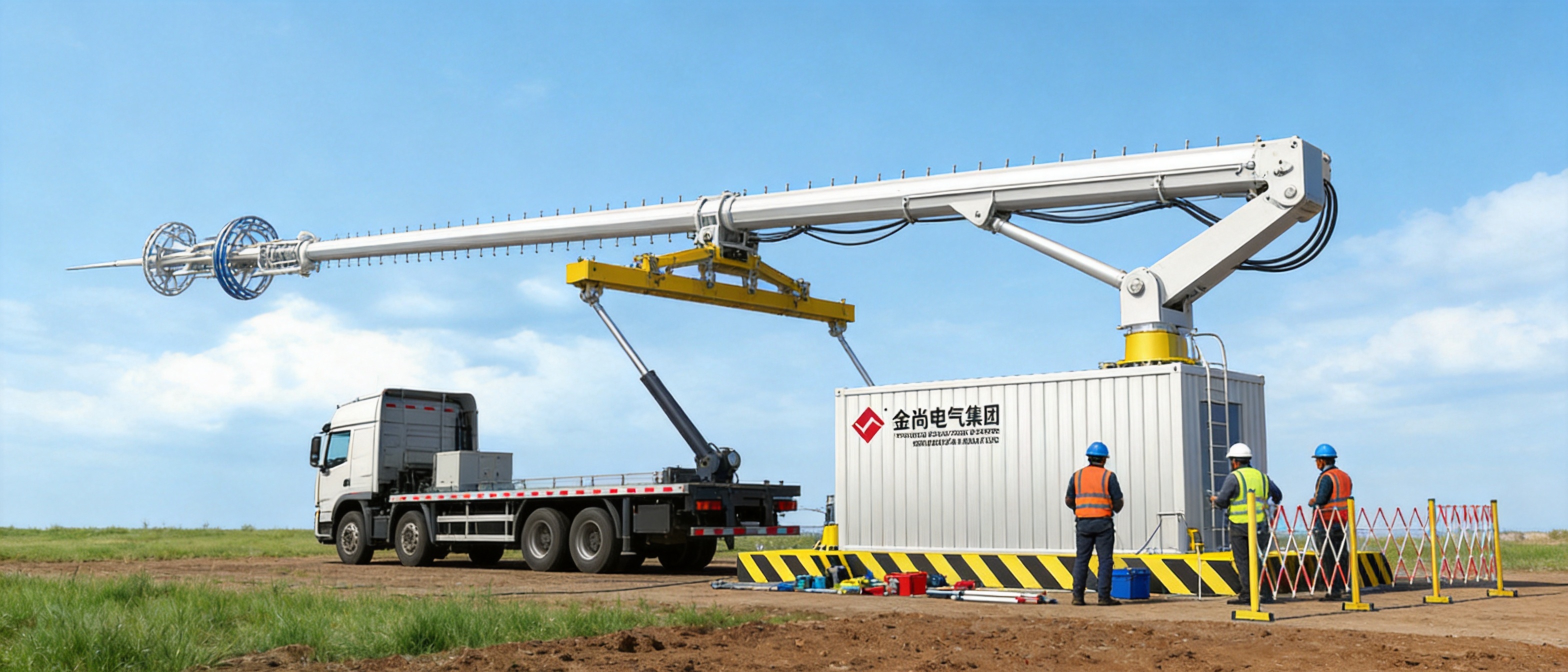
The lifting structure system enables the tower to be raised from its transport or assembly position to its operating position. Hydraulic and mechanical lifting configurations are available, allowing the system to be adapted to different project preferences and operating environments.
A programmable logic controller, or PLC, can be incorporated into the lifting system for automatic control and stepless speed regulation. This provides smoother lifting movement than a basic uncontrolled mechanism and allows the operator to manage the raising and lowering process with greater precision.
Stepless speed regulation is especially useful during the beginning and end of a lifting cycle, when controlled movement can help reduce sudden loads and improve operational stability. The control system can also support a more consistent procedure among different deployment teams, provided that personnel follow the relevant operating instructions and safety requirements.
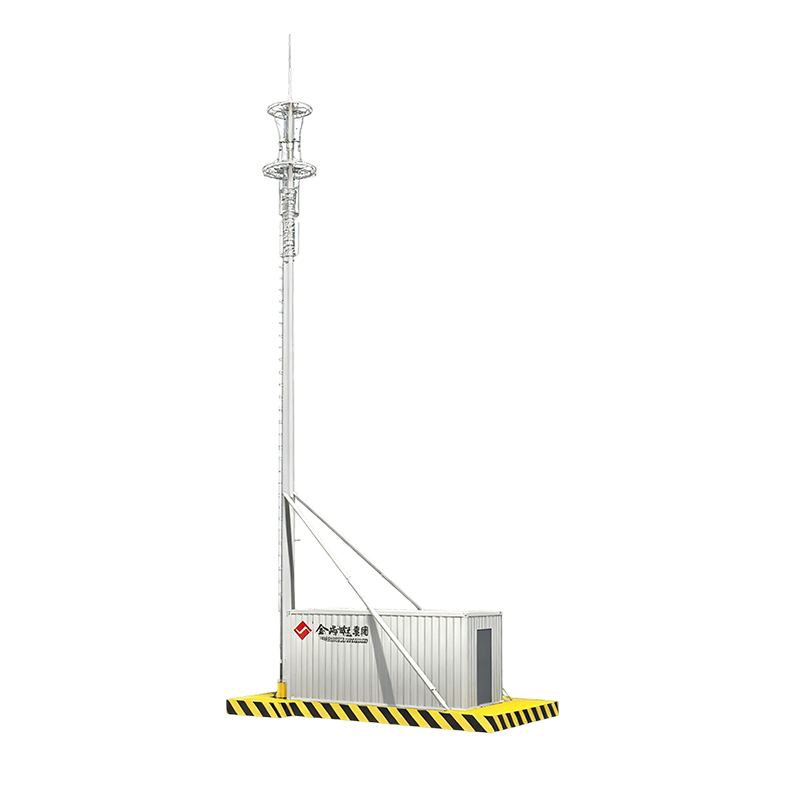
Portable Mobile Communication Base Station
Rapid Deployment in Four Hours
One of the most significant advantages of the Portable Mobile Communication Base Station Series is its ability to become operational in as little as four hours under appropriate conditions. The actual time will depend on transportation distance, site access, weather, surface conditions, equipment configuration, crew experience, lifting system selection, and required testing procedures. Nevertheless, the rapid-deployment concept provides a major improvement over conventional foundation-based construction.
A typical deployment process begins with site confirmation and delivery. The selected location is checked for access, ground conditions, overhead obstructions, underground risks, nearby structures, and required working clearances. The semi-trailer then delivers the system or its main modules to the site.
After positioning, the base frame is placed and leveled as required. The steel-concrete counterweights are installed according to the approved arrangement. The tower body, equipment room frame, and lifting system are then assembled or connected. High-strength bolts are tightened and inspected, and the system is checked before lifting.
The tower is raised using the hydraulic or mechanical lifting system. With the PLC-controlled configuration, the operator can regulate the lifting speed smoothly and monitor the process. After the tower reaches the operating position, the tower connection, base frame, lifting mechanism, counterweights, equipment, cables, and safety components are checked again.
Communication equipment can then be installed, connected, powered, and tested. Final commissioning may include antenna inspection, transmission verification, signal testing, grounding checks, equipment configuration, and communication with the network control center. Once these procedures are complete, the portable base station can support the intended emergency, temporary, or testing application.
Rapid installation does not mean that engineering discipline should be reduced. A fast deployment still requires a controlled plan, trained personnel, appropriate lifting procedures, and a documented inspection process. The product’s purpose is to reduce unnecessary construction time while preserving a professional approach to structural and operational safety.
Deployment on Multiple Types of Terrain
The system is designed for use on concrete, hard soil, soft soil, and grassy areas. This adaptability expands the number of locations where temporary communication coverage can be established. However, terrain flexibility should not be confused with unrestricted installation. Every site must still be assessed for bearing capacity, flatness, drainage, slope, settlement risk, accessibility, and local environmental conditions.
Concrete Surfaces
Concrete surfaces are often found in urban plazas, industrial yards, parking areas, transportation facilities, and event venues. These surfaces can provide a firm working platform with limited preparation. The portable system can be positioned without cutting open the slab for a permanent foundation, which helps preserve the original site and reduces restoration work after removal.
Hard Soil
Hard soil sites may be available near construction projects, rural roads, temporary facilities, or infrastructure corridors. The main requirements are adequate bearing capacity, a reasonably level surface, and sufficient space for the base frame, counterweights, equipment access, and lifting operation.
Soft Soil
Soft soil requires greater attention to settlement and load distribution. Before deployment, the ground should be evaluated by qualified personnel. Where necessary, temporary ground improvement, load-spreading measures, leveling materials, or other engineering controls may be used. The portable design can reduce excavation, but it does not eliminate the need for professional site assessment.
Grass and Open Areas
Grass-covered areas may be used for emergency communication, temporary public events, disaster response, or testing. The system can limit the amount of permanent disturbance compared with a conventional foundation. Site preparation should still address drainage, vegetation protection, access routes, surface stability, and restoration requirements.
The ability to use several terrain types gives network planners more flexibility when selecting a location. It can be particularly helpful when existing infrastructure is damaged, when access to permanent sites is restricted, or when communication services must be restored before conventional construction can begin.
Structural Stability and Wind Performance
Communication towers must be designed and operated with careful attention to wind loading. The Portable Mobile Communication Base Station Series is designed to maintain stability in average wind speeds of approximately 35 meters per second, subject to the applicable configuration, engineering calculations, site conditions, and operating requirements.
Wind performance depends on more than tower height alone. Important factors include tower geometry, antenna size, equipment weight, antenna arrangement, exposed surface area, wind direction, gust effects, counterweight placement, ground condition, connection quality, and local design standards. For this reason, the final system configuration should be reviewed according to the actual project parameters.
The high-strength bolted connection between the tower and the base frame contributes to structural reliability while allowing the system to be disassembled for relocation. Bolted construction also supports repeatable installation procedures and makes inspection more straightforward than some permanently integrated arrangements.
Before operation, personnel should inspect the tower body, base frame, counterweights, bolts, lifting system, equipment room, cables, and safety devices. Inspections should also be repeated after severe weather, relocation, unusual loading, or any maintenance activity that may affect structural integrity.
When the tower is not required, the lifting structure allows it to be lowered in a controlled manner. Lowering the tower can reduce exposure during transportation, maintenance, or severe weather preparations. The equipment can then be disconnected or secured, and the system can be prepared for its next assignment.
Hydraulic and Mechanical Lifting Options
Different users may have different preferences regarding lifting technology, maintenance capability, available power, and deployment procedures. For this reason, the product series supports hydraulic or mechanical lifting configurations.
Hydraulic Lifting
A hydraulic lifting system can provide controlled movement and high lifting force within a compact arrangement. It can be suitable for projects where smooth operation, centralized control, and automated movement are important. Hydraulic systems must be maintained properly, with attention to fluid condition, hoses, seals, cylinders, valves, and control components.
Mechanical Lifting
A mechanical lifting system provides an alternative approach that may be preferred for certain sites, maintenance programs, or operating environments. Mechanical components can be inspected and serviced according to a structured maintenance plan. The final selection depends on the project’s technical requirements, available power, crew capability, and expected deployment frequency.
PLC Automatic Control
The PLC programmable automatic control system adds intelligence to the lifting process. It can coordinate operating steps and provide stepless speed regulation, helping users raise or lower the tower in a more controlled way. The control logic can be adapted to the system design and project requirements by qualified technical personnel.
Automation does not replace operator responsibility. The lifting area should be controlled during operation, unauthorized personnel should remain clear of moving components, and the operator should be able to stop the process when an abnormal condition is detected. Clear procedures and training are essential for safe use.
Applications Across Emergency and Temporary Communication Projects
Emergency Communications
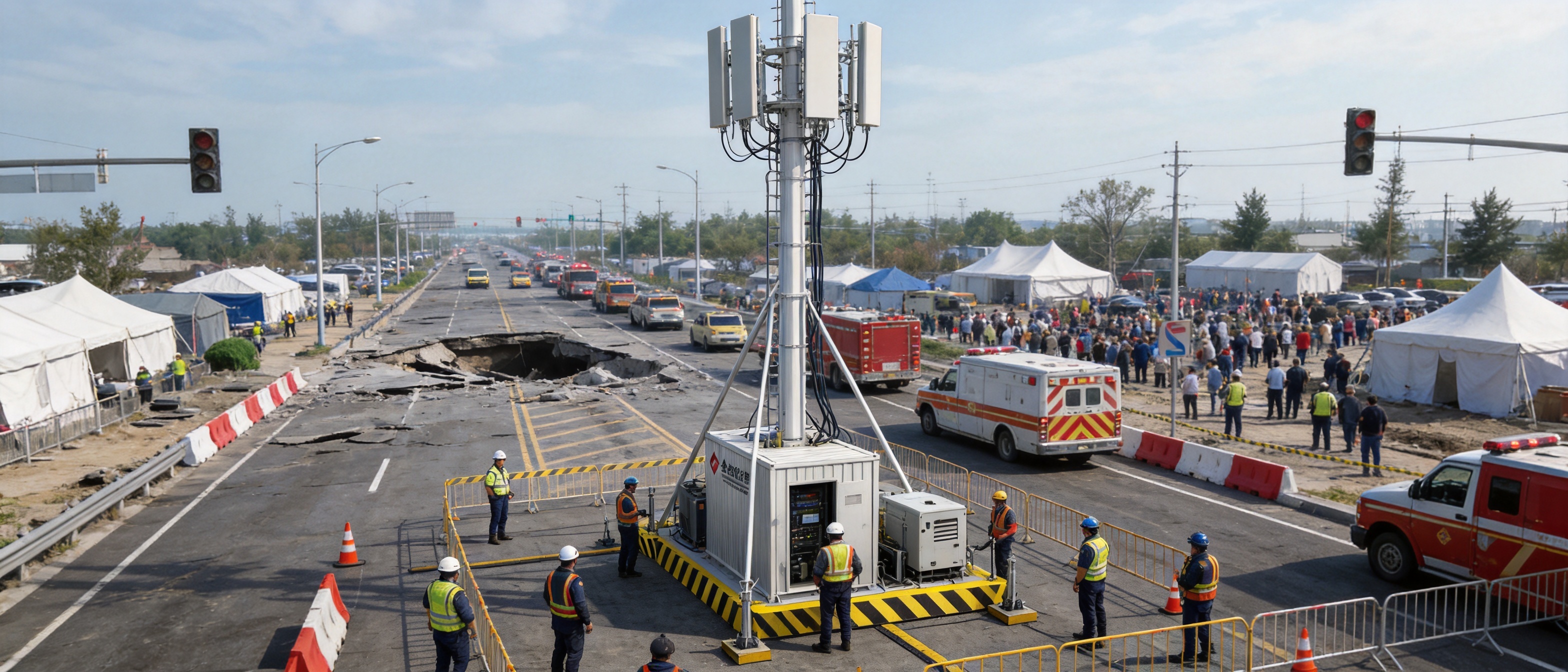
Natural disasters, severe storms, major accidents, industrial incidents, and infrastructure failures can interrupt normal communication services. In such situations, a rapidly deployable base station can help restore or supplement communication coverage while permanent facilities are repaired.
The mobile system can be transported to a response area, positioned on an available surface, lifted, and connected to the required communication equipment. Its reduced dependence on foundation construction is especially useful when roads, utilities, and civil engineering resources are already under pressure.
Emergency deployments may require coordination with public safety agencies, telecommunications operators, local authorities, medical teams, transportation departments, and utility providers. The portable tower can form part of a larger emergency communications plan that includes power supply, backhaul, antennas, network configuration, security, and site access control.
Base Station Site Selection Testing
Before constructing a permanent tower, network planners need reliable information about a proposed location. A portable tower allows the operator to test the site under real operating conditions. This can help determine whether the height is sufficient, whether the antenna position provides the expected coverage, and whether local obstructions or interference affect performance.
Testing can also compare several possible locations. The system can be moved between sites, allowing network planners to evaluate coverage and operational performance without building a permanent foundation at every candidate location. This supports more informed capital planning and can reduce the risk of choosing an unsuitable site.
Traffic Diversion and High-Demand Areas
Temporary increases in communication demand may occur during road closures, infrastructure construction, public events, seasonal travel, festivals, sporting activities, exhibitions, and other high-density gatherings. A portable mobile base station can provide additional communication capacity near these areas and can be removed after demand returns to normal.
Traffic diversion projects may also require temporary infrastructure along alternative routes. The portable tower can support communication between transportation teams, emergency responders, traffic management centers, and road users, depending on the selected network configuration.
Construction and Industrial Projects
Large construction sites, mining operations, energy projects, and industrial developments may be located far from existing communication infrastructure. A portable tower can be deployed during the construction phase and relocated as the project progresses. This can provide communications for workers, logistics, security, equipment monitoring, and coordination between work areas.
Temporary Public and Commercial Facilities
Temporary campuses, exhibitions, outdoor venues, logistics yards, and seasonal facilities may need reliable coverage for a defined period. A mobile tower can be installed without committing the site owner to permanent civil works. When the facility closes or moves, the system can be removed and reused elsewhere.
Mobility and Transportation Advantages
Mobility is one of the defining features of this product series. The system is designed to be transported and relocated using standard semi-trailers, which can simplify logistics and reduce dependence on specialized transportation equipment.
Transportation planning still requires attention to total weight, module dimensions, loading arrangement, route restrictions, bridge limits, road conditions, permits, and unloading space. The reusable counterweights may be transported with the system or managed through a project-specific logistics plan. A detailed transportation method should be developed before dispatch.
Once delivered, the system can be redeployed at a new location without repeating the full cycle of excavation, reinforcement, concrete pouring, curing, and permanent restoration. This makes it suitable for organizations that operate communication infrastructure across multiple regions or that need to respond to changing demand.
Relocation also supports phased network planning. A company may initially use the tower for a temporary trial, move it to support a short-term event, and later assign it to an emergency reserve. This flexibility can improve asset utilization and help reduce the number of separate towers required for intermittent projects.
Cost Efficiency and Total Ownership Value
The cost advantages of a portable communication base station extend beyond the initial purchase price. Traditional construction can include land preparation, excavation, reinforcement, concrete, curing time, heavy machinery, labor, permits, environmental restoration, and demolition. When a tower is temporary, these costs can represent a large portion of the total project budget.
By reducing or eliminating traditional foundation excavation, the portable system can shorten civil construction activities and reduce associated labor and equipment requirements. The reusable counterweights further improve cost efficiency because they can support multiple deployments instead of remaining at a single permanent site.
Another economic advantage is the ability to test a site before committing to permanent infrastructure. A temporary test installation can reveal technical or operational problems early, reducing the risk of investing in a permanent tower that does not achieve the expected coverage or capacity.
Relocation can also help operators respond to changes in demand. A fixed tower may become underutilized when a construction project ends, an event concludes, or a traffic pattern changes. A portable system can be moved to a higher-priority location, potentially improving the return on the original investment.
Cost efficiency should always be evaluated together with engineering requirements. Counterweight design, wind conditions, transportation, equipment loading, maintenance, power supply, and local regulations all influence the final project cost. Even so, the product’s reusable and mobile architecture creates more opportunities for cost control than a single-use permanent foundation system.
Advanced Manufacturing and Quality Assurance
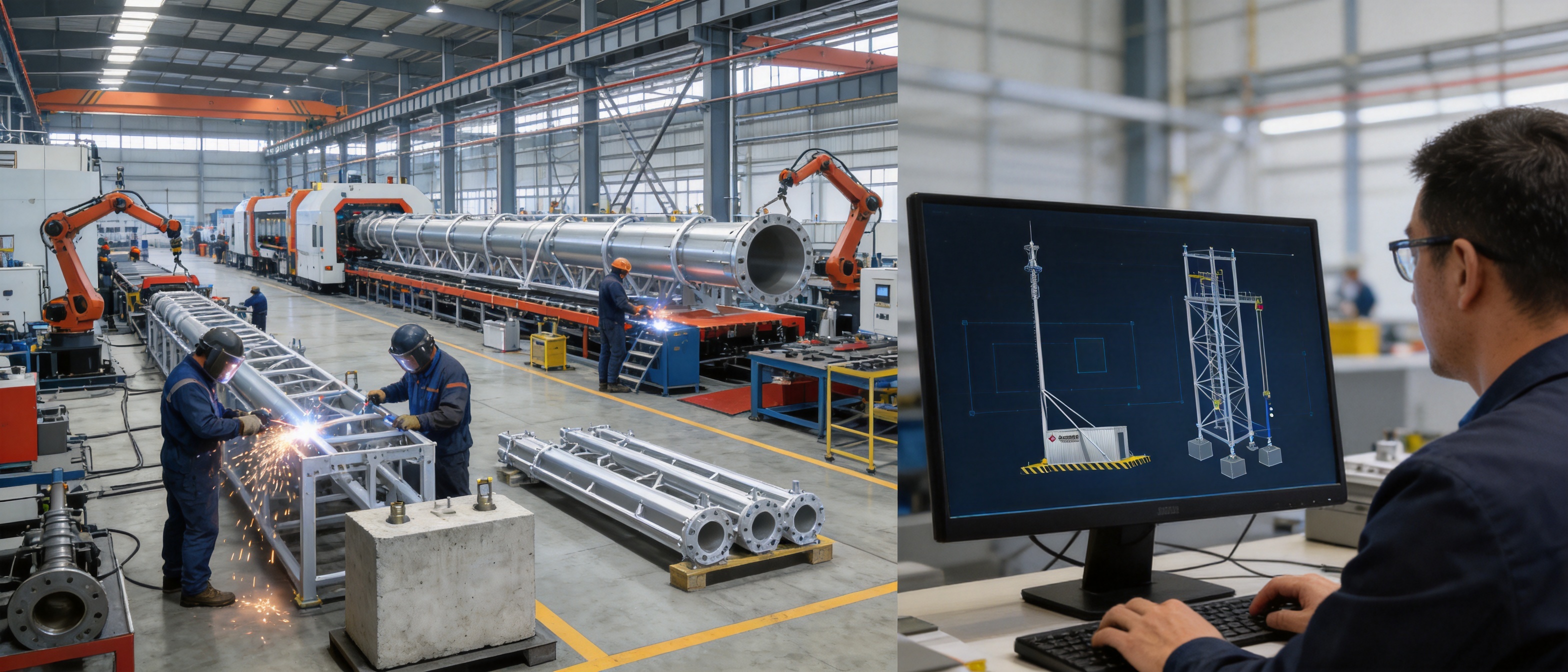
The performance of a portable communication tower depends on the quality of its structural components, connections, lifting system, and protective finish. Yangzhou Jinyuan Lamps Co., Ltd. supports production through advanced manufacturing equipment, experienced technical personnel, and controlled fabrication processes.
Material Options
Available material options include Q235B, Q345B, S275JR, S355JR, Q460, A36, A572, GR56, GR50, and other grades subject to project requirements. Material selection can be coordinated with structural calculations, regional standards, customer specifications, welding requirements, corrosion conditions, and procurement availability.
Maintaining an extensive stock of materials can help reduce production delays. Material availability is particularly important for projects with tight deployment schedules, where late fabrication may affect transportation and installation planning. Each material should be handled and identified according to the company’s quality management procedures.
CNC Bending
Precise CNC bending supports consistent component geometry and repeatable manufacturing. Accurate bending can improve structural alignment, reduce the need for post-production adjustment, and help components fit together correctly during assembly.
For a portable tower, dimensional consistency is valuable because the system may be assembled and disassembled repeatedly. Components that maintain predictable geometry can make field installation more efficient and can reduce unnecessary correction work at the site.
High-Accuracy Cutting
The manufacturing process provides cutting accuracy of up to 0.01 millimeter for applicable operations. Accurate cutting produces clean edges and exact dimensions, supporting better fit-up, more consistent welding, and improved component quality.
Cutting quality can also influence the efficiency of downstream processes. When parts are produced accurately, fabrication teams can spend less time correcting mismatched dimensions and more time completing controlled assembly and inspection activities.
Automated Welding and Experienced Welders
Automated production lines can support consistent fabrication while improving production speed and quality control. At the same time, certified welders with many years of welding experience provide the expertise required for complex assemblies, project-specific requirements, and quality verification.
The combination of automation and skilled personnel is important for structural products. Automated equipment can improve repeatability, while experienced welders can identify practical issues related to joint preparation, fit-up, heat control, distortion, access, and inspection.
Corrosion Protection
Communication towers are exposed to outdoor weather, moisture, temperature changes, dust, ultraviolet radiation, and atmospheric pollutants. A suitable protective finish is therefore essential for long-term service life. The company uses powder electrostatic painting equipment and other controlled finishing processes to support corrosion resistance and appearance quality.
Proper surface preparation, coating thickness, curing, handling, and inspection all contribute to the anti-corrosion performance of the finished product. The selected coating system should be matched to the local environment, including coastal, industrial, humid, or high-pollution conditions.
Die Casting and Supporting Production Capacity
The company operates advanced equipment, including a 1250-ton die casting machine, automatic welding and cutting machines, bending machines, and powder electrostatic painting equipment. This production capability supports a broad range of lighting, pole, tower, and related infrastructure products.
Integrated manufacturing resources can help coordinate design, fabrication, finishing, assembly, and quality control. This can be especially helpful for customers requiring customized dimensions, colors, structural configurations, equipment arrangements, or installation support.
Engineering Design and Customization Services
A portable communication tower must be adapted to the actual application rather than selected only by nominal height. The company provides technical services intended to support customers from initial consultation through project completion.
CAD Design
CAD design can be used to develop accurate component drawings, connection details, equipment layouts, lifting arrangements, and assembly information. Clear drawings help customers review the proposed system before production begins and provide field teams with useful installation references.
Three-Dimensional Product Simulation
Three-dimensional product simulation can help visualize the tower, base frame, equipment room, counterweights, and lifting structure as an integrated system. This supports design review and can reveal potential interference between components before fabrication.
Three-Dimensional Scene Simulation
Scene simulation places the proposed tower into a representative environment. It can help customers evaluate the relationship between the tower and nearby buildings, roads, equipment areas, public spaces, or landscape features. This is useful when appearance, access, safety clearance, and site organization are important considerations.
Specification and Color Customization
Customers may require different specifications, tower heights, equipment room arrangements, coating colors, access features, or structural details. Customization can be coordinated with the intended application, local engineering standards, network equipment, transportation method, and project budget.
Mechanical Calculation and Wind and Foundation Review
Mechanical calculation and wind review are important for confirming the suitability of the tower and support arrangement. Even though the portable base station avoids traditional foundation excavation, the ground and counterweight system still require engineering evaluation. Calculations may consider tower height, antenna loading, equipment weight, wind pressure, overturning resistance, connection forces, and ground bearing conditions.
A project-specific design review helps ensure that the selected configuration corresponds to the actual operating environment. Customers should provide accurate information about antenna dimensions, equipment loading, local wind conditions, terrain, installation height, and intended operating period.
Overseas Onsite Installation Guidance
For international projects, overseas onsite installation guidance can help customers coordinate unloading, assembly, counterweight positioning, lifting, inspection, and commissioning. Technical guidance can improve communication between the manufacturer, local contractors, network operators, and site managers.
Onsite guidance should be supported by appropriate documentation, including drawings, assembly instructions, lifting procedures, inspection checklists, maintenance recommendations, and safety requirements. The exact service arrangement depends on project scope, location, local regulations, and customer needs.
Comparison with Permanent Communication Towers
| Evaluation Factor | Portable Mobile Communication Base Station | Traditional Permanent Base Station |
|---|---|---|
| Foundation approach | Uses a base frame and reusable steel-concrete counterweights, minimizing traditional excavation requirements. | Usually requires a permanent reinforced-concrete foundation and extended civil construction. |
| Deployment speed | Can be deployed and become operational in as little as four hours under suitable conditions. | Often requires a longer construction schedule because of excavation, concrete work, curing, and tower erection. |
| Mobility | Can be transported by standard semi-trailer and relocated to another site. | Designed primarily for long-term use at one fixed location. |
| Site selection testing | Well suited to temporary coverage tests and real-world site evaluation. | Testing may require a significant initial investment before the final site is confirmed. |
| Temporary projects | Suitable for emergency response, events, traffic diversion, and construction projects. | May be less economical when the required service period is short. |
| Asset reuse | Counterweights and major structural components can be reused across multiple deployments. | Foundation and certain site works generally remain at the original location. |
| Appearance and organization | Integrated tower, equipment frame, and lifting arrangement provide a coordinated appearance. | Typically includes separately constructed foundation and equipment infrastructure. |
| Engineering requirements | Requires review of wind, ground, counterweight, equipment, and lifting conditions. | Requires permanent foundation, tower, soil, wind, and construction engineering. |
This comparison does not mean that a portable tower should replace every permanent base station. Permanent towers remain appropriate for long-term, high-capacity, or strategically fixed network locations. The portable product is most valuable when speed, flexibility, relocation, testing, and reduced civil construction are priorities.
Operational Planning and Safety Considerations
Successful deployment requires more than a high-quality tower. Customers should develop a complete operating plan covering transportation, site preparation, lifting, equipment installation, power, communications backhaul, grounding, weather monitoring, inspection, maintenance, and removal.
The site should provide enough space for the semi-trailer, unloading activity, counterweight placement, tower movement, equipment access, and safe working zones. Overhead power lines, trees, buildings, cranes, and other obstacles should be identified before the lifting operation begins.
Ground conditions should be checked for bearing capacity, settlement, slope, drainage, underground voids, and instability. Soft or uneven terrain may require additional engineering measures to distribute loads and maintain a level base. Water accumulation should be prevented around the equipment area and supporting structure.
The lifting system should be operated only by trained personnel. The hydraulic or mechanical system must be inspected before use, and the PLC control system should be checked for correct operation. Personnel should remain outside restricted areas during raising and lowering, and the process should be stopped immediately if abnormal noise, vibration, movement, leakage, obstruction, or control behavior is observed.
Bolted connections require appropriate tightening and inspection. Counterweights must be positioned exactly according to the approved arrangement and secured against unintended movement. Antennas, cables, equipment cabinets, and accessories should be installed in a way that does not exceed the design loading or create unapproved wind-exposed surfaces.
Weather conditions should be monitored before and during deployment. High winds, lightning, heavy rain, flooding, poor visibility, and other severe conditions may make lifting or installation unsafe. Operating limits should be established according to engineering documentation and local regulations.
Maintenance and Relocation Procedures
Routine maintenance helps preserve structural performance and service reliability. Inspection activities may include checking coating condition, corrosion, welds, bolts, base frame alignment, counterweights, lifting components, hydraulic lines, mechanical drives, control cabinets, cables, grounding, and equipment room integrity.
Maintenance frequency should reflect the environment and usage pattern. Coastal areas, industrial locations, humid climates, dusty sites, and regions with frequent storms may require more frequent inspection. Systems that are repeatedly transported and redeployed should also be checked after every relocation.
Before relocation, communication equipment should be shut down or transferred according to the network operator’s procedure. Power connections, transmission links, antennas, cables, and accessories should be disconnected or secured. The tower should be lowered through the approved lifting process, and the structure should be locked in its transport position.
Counterweights and detachable components should be removed or secured for transportation. Loading should distribute weight appropriately and prevent movement during transit. After arrival at the new location, the system should undergo a complete inspection before it is returned to service.
Proper maintenance can extend the useful life of the product and preserve the economic benefit of reusable deployment. It also helps identify minor issues before they develop into serious structural or operational problems.
Manufacturer Capabilities and Industry Experience
Yangzhou Jinyuan Lamps Co., Ltd. is affiliated with Jinshang Electric Group and operates as a professional production, design, and engineering company in China’s road illumination and outdoor infrastructure industry. Established in 2002, the company has developed experience in street light poles, LED street lights, solar street lights, light fixtures, communication towers, and related products.
The company covers a site area of more than 70,000 square meters and has more than 300 professional technicians. Its products are exported to more than 200 countries, giving the organization experience in serving customers with different technical specifications, environmental conditions, quality expectations, and project requirements.
Its quality management credentials include ISO9001, ISO14001, and OHSAS18001-related standards and systems. These standards reflect attention to quality management, environmental management, and occupational health and safety. For large infrastructure projects, such systems can provide customers with greater confidence in production control and supplier reliability.
The company’s manufacturing equipment includes CNC bending machines, powder electrostatic painting equipment, automatic welding and cutting machines, and a 1250-ton die casting machine. These resources support the production of structural and lighting products at different scales while helping maintain consistency across large orders.
The company’s broader product portfolio also creates opportunities for coordinated infrastructure supply. Customers involved in roadway, municipal, solar, communication, and outdoor lighting projects may be able to source multiple related products from one experienced manufacturer. This can simplify technical coordination, procurement, quality communication, and project management.
For the portable communication base station, the combination of engineering design, fabrication, surface treatment, customization, and installation guidance provides a complete project-oriented service. The customer receives more than an individual tower component; the objective is to obtain a deployable communication infrastructure solution adapted to the intended site and operating purpose.
How to Select the Appropriate Configuration
Configuration selection should begin with the communication objective. Emergency response, coverage testing, traffic diversion, construction support, and event deployment may each require different heights, antenna arrangements, equipment loads, deployment durations, and transportation plans.
The desired tower height is an important starting point. The available range of 15 to 35 meters allows the system to be matched to different coverage requirements and site conditions. Higher towers may provide greater elevation but may also create greater wind loading, transportation requirements, and counterweight demands.
Customers should also provide information about the antennas and equipment to be installed. Important details may include antenna type, quantity, dimensions, weight, mounting position, cable arrangement, cabinet size, battery systems, power supply, and backhaul equipment. Accurate information supports better mechanical calculation and more reliable system selection.
Local environmental conditions should be reviewed as well. Coastal salt exposure, industrial pollution, high humidity, freezing temperatures, strong winds, heavy rain, and dusty conditions may influence material, coating, maintenance, and operating procedures.
Finally, the deployment team should consider transportation and site access. The selected system must be compatible with the available trailer, road route, unloading equipment, working area, and local permits. Early coordination can prevent delays and reduce unexpected field costs.
Benefits for Network Operators and Project Owners
Network operators benefit from the system’s ability to add coverage or capacity quickly. When demand rises unexpectedly, a portable tower can provide a practical response without waiting for a permanent construction program.
Project owners benefit from reduced site disruption. Because the system minimizes conventional excavation, it can help preserve paved areas, grass, public spaces, and temporary work zones. Removal can also be more straightforward when the project is complete.
Engineering teams benefit from the opportunity to test proposed sites using a real elevated communication platform. This can support more accurate network planning and reduce the risk of premature permanent construction.
Procurement teams benefit from the manufacturer’s integrated design and production capabilities. CAD design, three-dimensional simulation, mechanical calculation, material selection, fabrication, coating, and installation guidance can be coordinated through one supplier relationship.
Operations teams benefit from the system’s mobility and reusable components. The same tower can be assigned to different projects over its service life, helping organizations create a flexible reserve of communication infrastructure.
Frequently Asked Questions
What is a portable mobile communication base station?
A portable mobile communication base station is a relocatable tower and equipment platform designed to provide temporary or semi-permanent communication coverage. It combines a tower body, equipment room frame, steel-concrete counterweights, and a lifting structure system.
How quickly can the system be deployed?
Under suitable site, weather, transportation, equipment, and workforce conditions, the system can be deployed and become operational in as little as four hours. The actual schedule should be confirmed through a project-specific installation plan.
Does installation require a traditional concrete foundation?
The system is designed to avoid traditional foundation excavation by using a base frame and reusable steel-concrete counterweights. Site assessment and engineering review are still required to confirm ground suitability and the correct support arrangement.
What types of terrain can support deployment?
The system can be deployed on concrete, hard soil, soft soil, and grassy areas when the site is properly assessed and prepared. Soft or unstable ground may require additional load distribution, leveling, or ground improvement measures.
What tower heights are available?
The lifting system supports configurations from approximately 15 meters to 35 meters. The appropriate height depends on coverage objectives, antenna loading, wind conditions, surrounding structures, and engineering calculations.
Is the lifting system hydraulic or mechanical?
Both hydraulic and mechanical lifting configurations are available. The selection depends on project requirements, operating preferences, maintenance resources, power availability, and site conditions.
How does the PLC control system improve operation?
The PLC programmable automatic control system can provide controlled lifting and lowering with stepless speed regulation. This supports smoother movement and more consistent operation when used by trained personnel following approved procedures.
How stable is the tower in windy conditions?
The structural design is intended to maintain stability in average wind speeds of approximately 35 meters per second, subject to the selected configuration and project conditions. Final wind performance depends on tower height, antenna loading, counterweights, terrain, connections, and local engineering standards.
Can the system be moved to another location?
Yes. The system is designed for transportation and relocation by standard semi-trailer. The tower must be lowered, equipment disconnected or secured, counterweights managed safely, and all components inspected before and after transportation.
What are the main applications?
Main applications include emergency communications, base station site selection testing, traffic diversion, temporary high-demand areas, construction sites, industrial projects, public events, and other situations requiring rapidly deployable coverage.
Can the product be customized?
Customization can include specifications, tower height, equipment room arrangement, coating color, structural details, and other project-related requirements. Customers should provide accurate technical information so that the design can be reviewed properly.
What manufacturing capabilities support the product?
The manufacturer uses CNC bending, high-accuracy cutting, automated welding and cutting equipment, powder electrostatic painting equipment, and a 1250-ton die casting machine. Certified welders and experienced technical personnel support fabrication and quality control.
Does the manufacturer provide installation assistance?
Services may include CAD design, three-dimensional product simulation, three-dimensional scene simulation, specification and color customization, mechanical calculation, wind and foundation review, and overseas onsite installation guidance, depending on the project scope.
How should the system be maintained?
Maintenance should include inspection of the tower, base frame, counterweights, bolts, welds, coating, lifting system, control components, cables, grounding, and equipment room. Systems should also be inspected after severe weather and every relocation.
Conclusion
The Portable Mobile Communication Base Station Series offers a flexible response to the growing need for rapid and adaptable communication infrastructure. Its foundation-free deployment concept, reusable counterweights, standard semi-trailer mobility, adjustable 15-to-35-meter height range, hydraulic or mechanical lifting options, and PLC-controlled operation distinguish it from conventional fixed tower construction.
For emergency communications, site testing, traffic diversion, temporary events, construction projects, and high-demand areas, the system can reduce the time and disruption associated with permanent civil works. It can be installed on several types of terrain, relocated when priorities change, and reused across multiple projects.
The product’s advantages are supported by the manufacturer’s engineering and production capabilities. Material options, CNC bending, high-accuracy cutting, automated production lines, certified welding, corrosion-protection processes, mechanical calculation, customization, and installation guidance all contribute to a more complete infrastructure solution.
Customers should select the final configuration according to tower height, antenna loading, equipment requirements, terrain, wind conditions, transportation, local regulations, and intended service duration. With proper engineering review, trained operation, and regular maintenance, the portable base station can provide a practical balance of speed, stability, mobility, and long-term economic value.
References
1. Product technical description for the Portable Mobile Communication Base Station Series.
2. Manufacturer-provided information on tower construction, lifting systems, counterweights, deployment conditions, and service capabilities.
3. Manufacturer-provided information on material grades, CNC bending, cutting accuracy, welding, coating, automated production, and quality assurance.
4. Manufacturer-provided information on CAD design, three-dimensional simulation, mechanical calculation, wind review, customization, and overseas installation guidance.
5. General engineering principles for temporary tower deployment, wind loading evaluation, ground assessment, lifting operations, structural inspection, and equipment maintenance.