


JINYUAN
JINYUAN
JINYUAN
JINYUAN
JINYUAN
JINYUAN
JINYUAN
JINYUAN
JINYUAN
JINYUAN
JINYUAN
JINYUAN
JINYUAN
JINYUAN
JINYUAN
JINYUAN
Content
- 1 1. The Changing Requirements of Urban Communication Infrastructure
- 2 2. Product Concept and Design Philosophy
- 3 3. Structural Materials and Engineering Performance
- 4 4. Protective Coatings and Long-Term Durability
- 5 5. Telecommunications Compatibility
- 6 6. Advantages Over Conventional Communication Tower Solutions
- 7 7. Comparison with Alternative Tower Types
- 8 8. Manufacturing Capabilities Behind the Product
- 9 9. Engineering and Customization Services
- 10 10. Applications in Modern Urban and Industrial Environments
- 11 11. Installation Planning and Project Workflow
- 12 12. Quality Assurance and International Project Support
- 13 13. Sustainability and Lifecycle Value
- 14 14. Buyer Considerations Before Ordering
- 15 15. Q&A: Frequently Asked Questions
- 15.1 Q1. What is a landscape ground-mounted communication tower?
- 15.2 Q2. What height range is available?
- 15.3 Q3. What diameter options are available?
- 15.4 Q4. Can the tower support future antenna upgrades?
- 15.5 Q5. Can the tower color be customized?
- 15.6 Q6. Is the tower suitable for urban business districts?
- 15.7 Q7. Does the tower include lightning protection and grounding provisions?
- 15.8 Q8. How does the product compare with an open lattice tower?
- 15.9 Q9. What materials can be used?
- 15.10 Q10. What manufacturing processes are used?
- 15.11 Q11. Can the supplier provide foundation calculations?
- 15.12 Q12. Is overseas installation assistance available?
- 15.13 Q13. What industries and locations can use this tower?
- 15.14 Q14. How should the coating system be selected?
- 15.15 Q15. What information is needed for a quotation?
- 16 16. Conclusion
- 17 References
- 18 Product: Modern Style Landscape Ground-Mounted Communication Tower
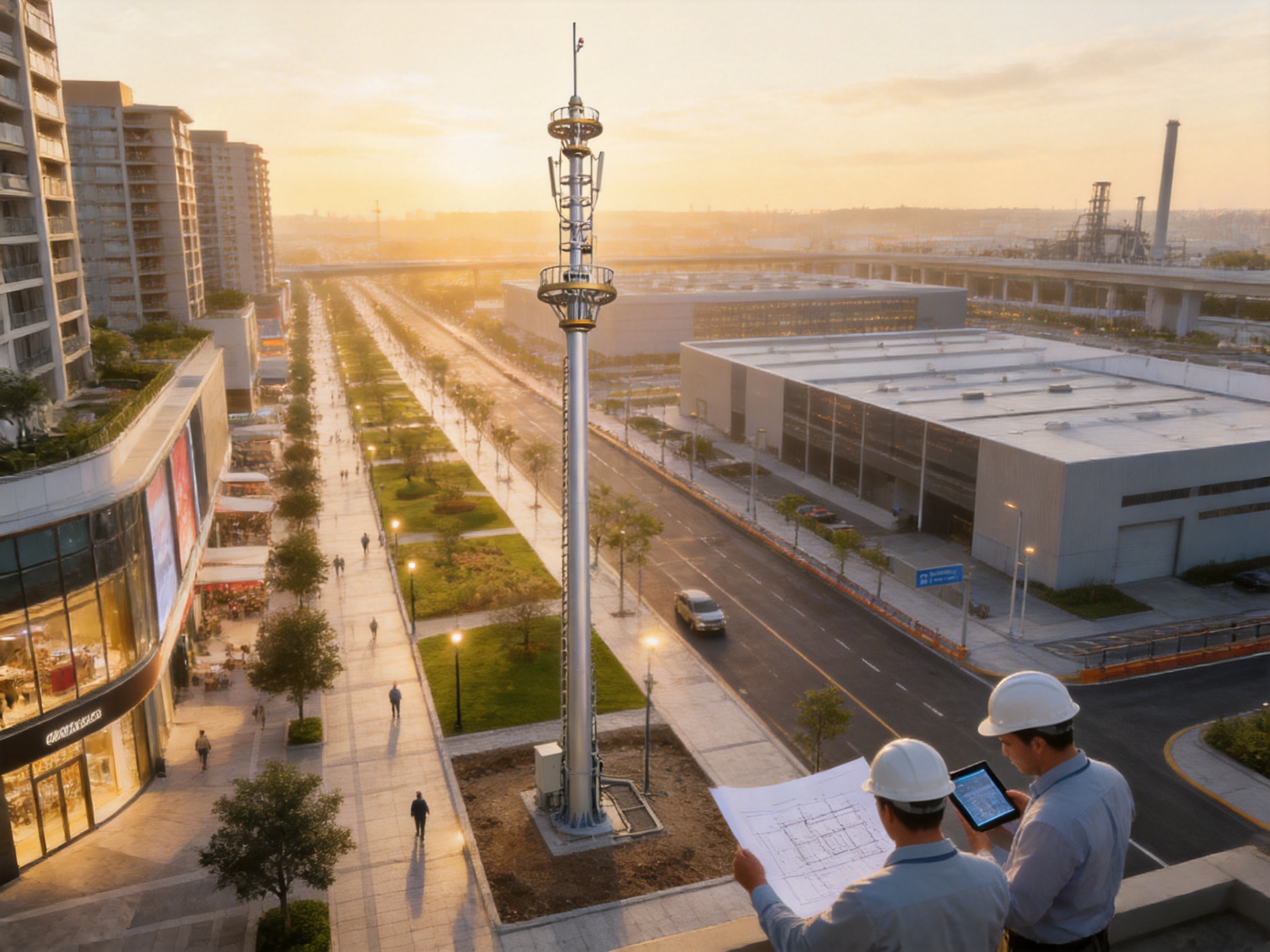
Communication infrastructure is becoming increasingly important in modern cities, industrial parks, commercial districts, residential developments, and transportation environments. As mobile networks expand and data traffic continues to grow, operators require more antenna locations, improved network coverage, and dependable support structures. At the same time, municipalities, developers, architects, and property owners are demanding infrastructure that respects the visual character of its surroundings.
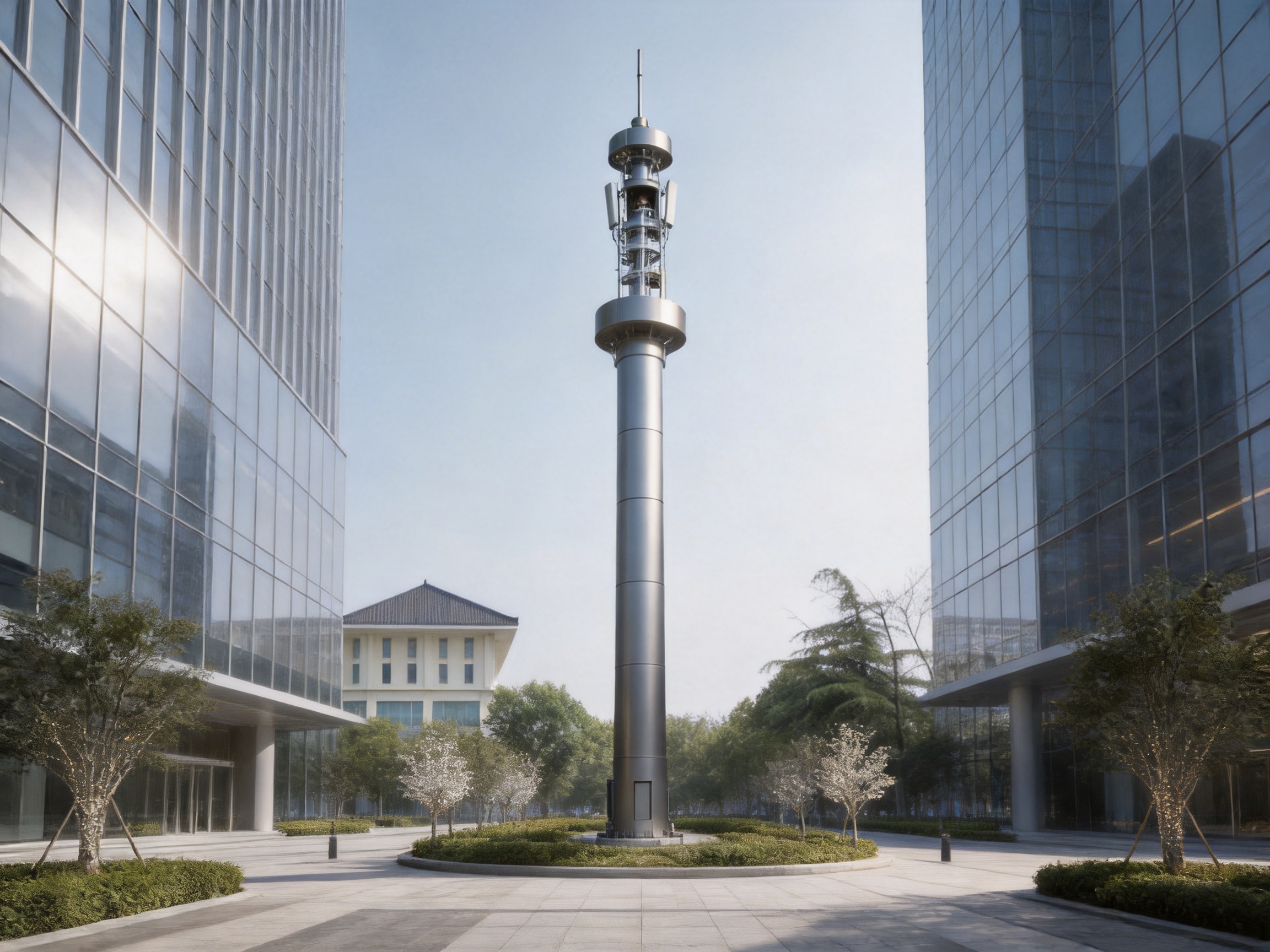
The Modern Style Landscape Ground-Mounted Communication Tower is designed to address both requirements. It combines the structural and telecommunications functions of a professional communication tower with the clean appearance of contemporary architectural equipment. Instead of presenting a conventional open truss structure as a dominant industrial object, the tower uses a streamlined, modular body that can be integrated into carefully planned urban landscapes.
This approach makes the product suitable for locations where network performance, structural safety, visual quality, and long-term maintainability must be considered together. Its design range covers diameters from 2.4 meters to 3.6 meters and overall heights from 10 meters to 50 meters. The tower can be adapted to different antenna configurations, communication equipment requirements, site conditions, color schemes, and project standards.
Manufactured by a company with extensive experience in road illumination products, steel structures, engineering design, and export-oriented production, the product benefits from advanced fabrication equipment, experienced technical personnel, strict quality control, and project support services. These capabilities help provide a practical alternative to conventional communication towers while maintaining the performance expected from modern telecommunications infrastructure.
1. The Changing Requirements of Urban Communication Infrastructure
Traditional communication towers are usually designed primarily around structural efficiency. Open lattice towers, monopoles, and rooftop support systems can provide excellent antenna elevation and loading capacity, but their visual impact may be substantial. In dense urban environments, a tower can become a prominent feature in a streetscape, residential neighborhood, commercial center, or landscaped public area.
Urban development has therefore created a more complicated set of expectations. A communication structure may need to satisfy several parties at the same time:
Network operators need dependable antenna support, appropriate elevation, cable routing, equipment access, grounding, and future expansion capacity.
Structural engineers require a safe and durable system capable of resisting wind, equipment loads, vibration, corrosion, and long-term environmental exposure.
Architects and landscape designers seek a structure with an appropriate visual profile, consistent proportions, and a finish that can complement surrounding buildings and public spaces.
Municipal authorities often prefer infrastructure that reduces visual clutter and contributes positively to the appearance of a city.
Property owners and developers may require compact site planning, rapid installation, low maintenance, and a solution that supports reliable communication without reducing the value of the surrounding environment.
The Modern Style Landscape Ground-Mounted Communication Tower responds to this combined demand. Its primary purpose remains telecommunications support, but its appearance and configuration are treated as important engineering considerations rather than secondary details.
2. Product Concept and Design Philosophy
The central design philosophy is functional integration. The tower is not simply a standard industrial structure covered with decorative materials. Instead, the body, antenna accommodation, maintenance access, protective systems, finish, and visual proportions are considered as a unified product.
The streamlined body creates a simpler silhouette than many conventional lattice towers. This can help the structure blend more naturally into contemporary environments, especially when it is installed near office buildings, shopping centers, premium residential areas, landscaped boulevards, and modern industrial parks.
Its modular construction also supports changing telecommunications requirements. Communication networks are not static. Operators may add antennas, alter equipment arrangements, upgrade feeder systems, or introduce new technologies over the operating life of a site. A fixed structure with limited access and low expansion capacity can create significant future costs. The modular concept of this tower is intended to make upgrades and additions more manageable.
The tower can also be color-matched to surrounding architecture or landscape design. A carefully selected coating color may reduce contrast between the structure and nearby buildings, walls, vegetation, or other urban elements. This supports a “low visual impact” strategy without compromising the structural function of the installation.
2.1 Contemporary Appearance
The product uses a minimalist design language characterized by clean lines, controlled proportions, and a visually organized exterior. This appearance is particularly valuable in environments where exposed mechanical complexity would be undesirable.
Compared with open truss structures, the streamlined form can create a more architectural impression. Compared with ordinary monopoles, it can offer additional opportunities for equipment integration, visual treatment, and modular access planning. The result is a communication tower that can be considered part of the site design rather than an isolated technical object.
2.2 Functional Integration
Aesthetic treatment is only valuable when it does not interfere with communication performance or maintenance. For this reason, the tower is designed with internal arrangements that support antenna and feeder systems while retaining access for inspection and servicing.
The structure includes provisions for lightning protection, grounding, and maintenance paths. These features are essential because communication equipment is exposed to electrical, environmental, and mechanical risks. The integration of these systems reduces the need for improvised site modifications after installation.
2.3 Adaptability to Different Sites
With heights from 10 meters to 50 meters and diameters from 2.4 meters to 3.6 meters, the product can be configured for a broad range of applications. A lower tower may be appropriate for a landscaped commercial area or a local coverage enhancement project, while a taller design may be used where greater antenna elevation is required.
The final design should be determined through project-specific structural calculations, wind assessments, antenna loading information, foundation analysis, local regulations, and installation requirements. This allows the tower to be adapted responsibly rather than selected solely by appearance or nominal dimensions.
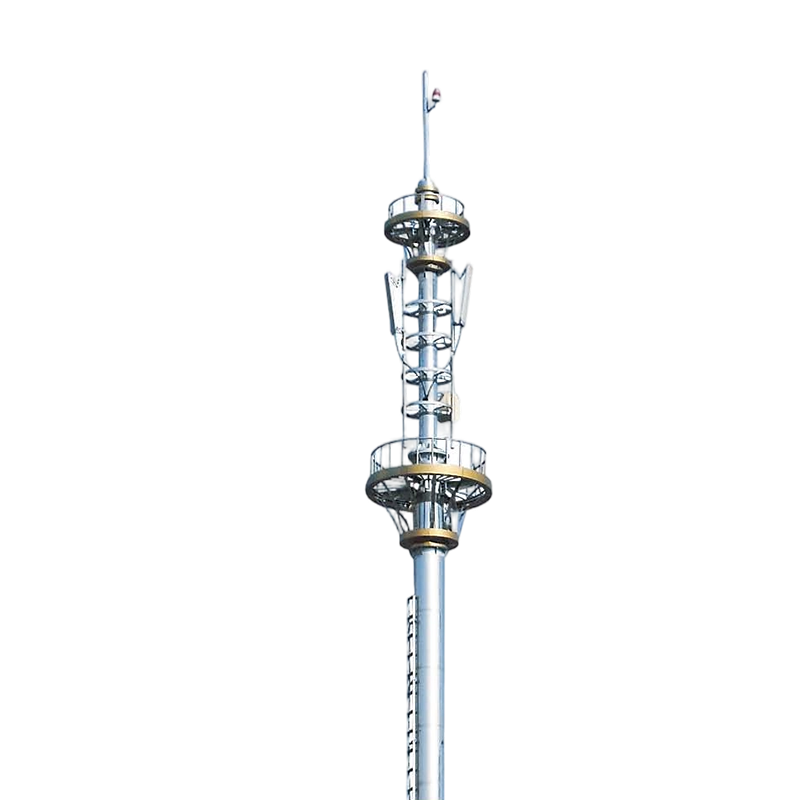
Modern Style Landscape Ground-Mounted Communication Tower
3. Structural Materials and Engineering Performance
The tower body is manufactured from high-strength steel selected according to the project’s structural and environmental requirements. Available material options include Q235B, Q345B, S275JR, S355JR, Q460, A36, A572, GR56, and GR50, subject to design requirements, availability, and applicable standards.
The use of suitable steel grades offers several advantages. First, the material provides a reliable foundation for carrying tower self-weight, antenna loads, wind pressure, maintenance loads, and other design forces. Second, material selection can be adjusted according to strength, weldability, availability, and project specifications. Third, standardized steel materials help support consistent procurement and quality control across large-scale projects.
High-strength steel also supports the development of a structure that balances strength and visual lightness. A tower does not need to appear excessively heavy to provide dependable performance. Through appropriate section design, CNC forming, accurate cutting, and controlled welding, the manufacturer can create a strong body with clean and consistent geometry.
3.1 Precision CNC Welding
Precision CNC welding is an important part of the production process. Accurate welding helps maintain dimensional consistency, joint quality, and overall structural alignment. It also reduces the risk of irregular deformation that could complicate assembly or require extensive post-production adjustment.
Welded steel structures must be produced with careful control of heat input, joint preparation, weld sequence, and inspection. The company’s certified welders bring many years of practical experience to this process. Their work combines automated or controlled production methods with professional judgment in areas where different components, thicknesses, or geometries require careful handling.
For customers, consistent welding provides several practical benefits. It can support easier installation, more predictable fit-up, improved structural appearance, and reduced risk of delays during project assembly. Reliable welding is especially important for modular towers, where multiple sections must align accurately in the field.
3.2 CNC Bending and Forming
Controlled CNC bending helps produce repeatable shapes and consistent structural components. The manufacturer emphasizes precise bending to improve structural integrity and reduce post-production adjustments. Accurate forming is also important for maintaining the clean appearance expected from a landscape-oriented communication tower.
In a visually prominent installation, uneven bends, inconsistent transitions, or mismatched sections may be noticeable from a considerable distance. CNC-controlled forming helps reduce these variations and supports a more professional finished appearance.
3.3 High-Accuracy Cutting
The production process includes cutting equipment capable of approximately 0.01 millimeter cutting accuracy under suitable operating conditions. High cutting accuracy helps create exact component dimensions, clean edges, and reliable interfaces between parts.
Accurate cutting is beneficial for both structural and aesthetic reasons. It helps reduce gaps, misalignment, and excess material at joints. It also supports more efficient material use and can shorten preparation time before welding, coating, and assembly.
4. Protective Coatings and Long-Term Durability
Outdoor communication towers are exposed to rain, humidity, ultraviolet radiation, temperature changes, airborne pollutants, and potentially corrosive coastal or industrial atmospheres. Without an appropriate protective system, steel surfaces may deteriorate, reducing service life and increasing maintenance requirements.
The Modern Style Landscape Ground-Mounted Communication Tower can use advanced painting or weather-resistant coating processes. The selected treatment should be matched to the site environment, project specification, required service life, and maintenance plan.
Protective coating offers several advantages:
It helps separate the steel surface from moisture and corrosive contaminants.
It can improve resistance to ultraviolet exposure and weathering.
It provides a controlled visual finish that can be matched to surrounding architecture.
It helps preserve the tower’s appearance over long periods of outdoor use.
It supports a “stealth” or low-contrast installation strategy when the tower must blend into a developed environment.
Production quality is particularly important during surface treatment. Proper cleaning, preparation, coating thickness, curing, and inspection all influence the performance of the finished system. The company’s coating and powder electrostatic painting capabilities support consistent treatment across a range of products and project sizes.
For harsh environments, buyers should request a detailed coating specification. This may include surface preparation grade, primer type, topcoat system, dry film thickness, color standard, adhesion requirements, salt spray expectations, and inspection procedures. A properly documented coating system allows the product to be evaluated objectively and maintained appropriately.
5. Telecommunications Compatibility
A landscape communication tower must preserve the essential function of a telecommunications structure. The visual enclosure or streamlined form cannot obstruct antenna performance, create unacceptable signal interference, or make equipment maintenance impractical.
The internal structure of this product is optimized for the routing and support of communication systems. The design is intended to support mobile communication signals when equipment is integrated within or around aesthetic shrouds. Final performance will depend on antenna type, frequency band, radome or enclosure material, equipment arrangement, cable routing, surrounding buildings, and site-specific radio planning.
The product can accommodate antenna and feeder systems and is designed with future upgrade considerations in mind. This provides an advantage over structures that have been designed for only one fixed equipment configuration.
5.1 Antenna and Feeder Accommodation
Communication towers often carry several types of equipment, including sector antennas, microwave dishes, remote radio units, small-cell equipment, feeder cables, and associated accessories. The exact configuration varies according to operator requirements and network architecture.
A modular tower body can make it easier to plan attachment points, cable routes, maintenance access, and future capacity. It also helps avoid the appearance of unplanned brackets and exposed cables that can reduce the visual quality of an urban installation.
5.2 Lightning Protection and Grounding
Lightning protection and grounding are essential elements of a safe communication installation. The tower and connected equipment must be integrated into a properly designed grounding network that follows applicable electrical and telecommunications standards.
The product includes comprehensive provisions for lightning protection and grounding. These systems help direct lightning-related current and fault energy through controlled paths rather than allowing it to damage sensitive communications equipment or create unsafe touch and step voltages.
Because grounding performance depends on soil conditions, foundation design, bonding details, cable routing, and local electrical requirements, project-specific engineering remains necessary. The tower provides a structured basis for this work, while the final installation should be verified by qualified professionals.
5.3 Maintenance Access
Reliable telecommunications infrastructure requires safe and practical maintenance. Technicians may need to inspect antenna connections, replace equipment, examine coating conditions, check fasteners, repair cables, or perform upgrades.
The tower includes accessible maintenance paths intended to support regular service activity. A well-planned access system can reduce downtime, improve worker efficiency, and reduce the temptation to make unsafe modifications after installation.
Maintenance planning should cover ladders, platforms, guardrails, access doors, internal lighting if required, fall-protection provisions, lifting arrangements, and equipment handling procedures. These details should be confirmed during the design stage according to local safety regulations and the equipment package.
6. Advantages Over Conventional Communication Tower Solutions
The Modern Style Landscape Ground-Mounted Communication Tower is not intended to replace every type of communication structure. Conventional lattice towers, monopoles, rooftop poles, and camouflage systems each have appropriate applications. However, the landscape tower offers particular advantages when a project must combine telecommunications capability with architectural sensitivity.
6.1 Lower Visual Impact Than Open Lattice Structures
Open lattice towers can be structurally efficient, but their complex geometry may appear visually busy, especially in high-value urban settings. The streamlined form of this product presents a more controlled silhouette and may be easier to integrate with modern buildings and public spaces.
This can be valuable in business districts, premium residential areas, shopping centers, and landscaped developments where residents, visitors, and local authorities may be sensitive to visual clutter.
6.2 More Architectural Flexibility Than Basic Monopoles
A basic monopole offers a relatively simple appearance, but it may have limited space for concealed equipment integration, internal maintenance paths, or customized architectural treatment. The landscape tower’s modular body and larger design diameter create additional opportunities for equipment planning and visual customization.
Its diameter range of 2.4 meters to 3.6 meters allows the project team to balance internal space, structural requirements, visual proportions, and site limitations.
6.3 More Suitable for High-Value Urban Sites
In some locations, acquiring a communication site is difficult because the installation must be accepted by developers, property owners, nearby residents, or planning departments. A visually considered tower can improve the basis for discussions by presenting the infrastructure as an integrated architectural element rather than a purely industrial installation.
Although no design can eliminate all planning requirements, lower visual impact can support better coordination and reduce objections related to appearance.
6.4 Designed for Future Expansion
Network requirements change over time. A tower that supports modular additions can offer better long-term value than a structure that must be replaced when a new antenna or feeder arrangement is required.
The product is designed to allow upgrades and expansion of antenna and feeder systems. This can help operators protect their initial investment and reduce disruption during network modernization.
6.5 Customized Color and Finish
Many conventional towers are supplied with a limited range of standard finishes. This product can be color-matched to the surrounding environment, making it easier to coordinate with a building façade, landscape concept, municipal palette, or corporate development standard.
Color customization is not merely decorative. It can help reduce visual contrast, reinforce a planned identity, and improve the perceived quality of the entire site.
7. Comparison with Alternative Tower Types
| Evaluation Area | Modern Landscape Ground-Mounted Tower | Open Lattice Tower | Basic Monopole | Rooftop Support Structure |
|---|---|---|---|---|
| Visual integration | Designed for contemporary architectural and landscape environments | Highly technical and visually prominent | Simple silhouette but limited architectural treatment | Can be discreet but depends strongly on the host building |
| Typical application | Urban districts, commercial sites, premium developments, and industrial parks | Large coverage sites and locations with sufficient setback distance | General urban and suburban communication installations | Dense areas where ground space is limited |
| Customization | Diameter, height, color, antenna arrangement, and modular configuration | Usually customized structurally, with limited aesthetic options | Moderate structural customization and limited visual integration | Dependent on building layout and structural capacity |
| Future expansion | Designed for antenna and feeder upgrades | Usually good, subject to loading capacity | Subject to pole diameter and attachment limitations | Limited by rooftop space and building structure |
| Maintenance planning | Integrated maintenance paths and equipment access planning | Requires climbing systems and open-structure access | Access depends on pole design and external equipment | Access depends on the host building |
| Architectural suitability | Strong suitability for visually sensitive sites | Usually lower suitability in premium urban areas | Moderate suitability | Potentially strong, but dependent on concealment options |
This comparison should be interpreted as a project-planning guide rather than a universal ranking. Wind conditions, antenna loading, height, foundation requirements, site ownership, local regulations, and total cost must be evaluated before selecting a tower type.
8. Manufacturing Capabilities Behind the Product
The quality of a communication tower depends heavily on the manufacturing system used to produce it. A well-designed concept can fail to deliver its intended benefits if material control, forming accuracy, welding quality, coating consistency, or inspection procedures are inadequate.
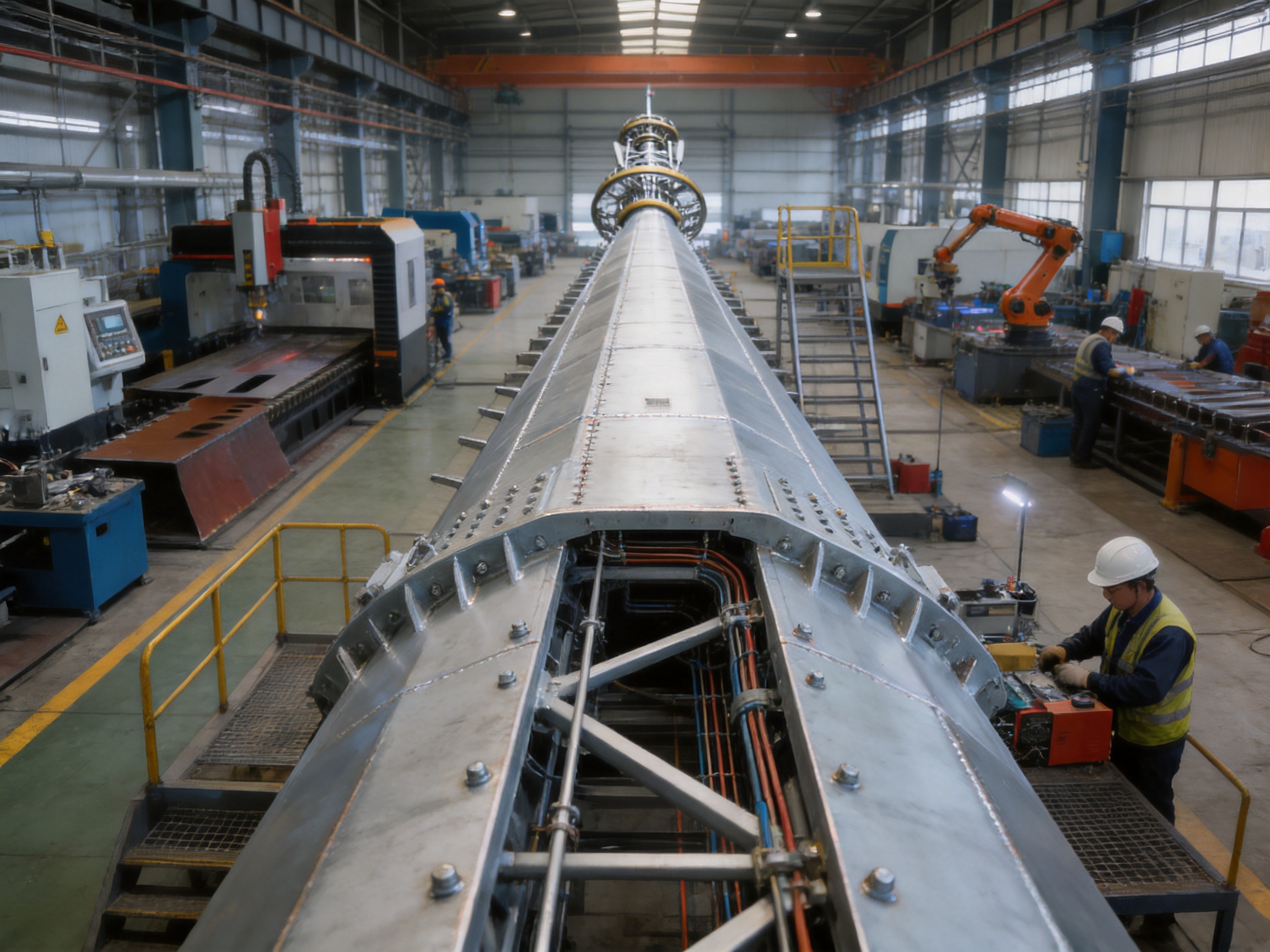
The manufacturer operates a large production and engineering organization serving the road illumination and steel structure industries. Its facilities cover more than 70,000 square meters and include equipment for bending, cutting, automatic welding, powder electrostatic painting, and die casting.
The company has more than 300 professional technicians and has been active in the industry since 2002. Its experience includes street light poles, LED street lighting, solar street lights, fixtures, structural products, and related engineering services. This background is relevant because communication towers and lighting poles share several core manufacturing requirements, including steel preparation, large-component forming, welding, corrosion protection, structural calculations, and outdoor durability.
8.1 Material Availability
Extensive material stock can reduce the risk of production delays. When commonly specified steel grades are available in advance, the manufacturer can respond more efficiently to urgent project schedules and maintain greater control over material selection.
Material availability also supports production planning. For large developments requiring multiple towers or mixed infrastructure products, the ability to coordinate steel procurement and fabrication can simplify project management.
8.2 Integrated Production Equipment
Integrated equipment reduces dependence on fragmented subcontracting. CNC bending, high-accuracy cutting, automated welding, coating lines, and assembly capabilities can be coordinated within one production system.
This supports better process traceability and more consistent communication between design, production, quality control, and engineering teams. It can also reduce transportation between separate workshops and help control overall lead times.
8.3 Certified Welding Personnel
Automated equipment improves repeatability, but experienced welding personnel remain essential for complex structures. Certified welders can manage joint preparation, component fit-up, welding sequences, inspection requirements, and adjustments caused by different steel sections or custom configurations.
The company’s experienced welding team is positioned to support both quality and production speed. This is particularly important for large projects where multiple towers must be delivered consistently and on schedule.
8.4 Automated Production and Cost Control
Automated production lines can improve consistency while reducing labor-intensive handling and material waste. These efficiencies may contribute to competitive pricing without requiring the customer to compromise on basic structural quality.
Automation can also support environmental objectives by improving material utilization, reducing unnecessary rework, and controlling coating application. For international customers, efficient production is valuable because it helps balance factory quality, delivery schedules, and total project cost.
9. Engineering and Customization Services
A communication tower should not be treated as a standard catalog item when it is installed in a demanding urban or industrial environment. The manufacturer provides design and engineering services intended to support project-specific adaptation.
9.1 CAD Design
CAD design allows the tower geometry, equipment arrangement, component dimensions, access points, connection details, and foundation interface to be developed before production. It also provides a common technical reference for the customer, structural engineer, installer, and manufacturing team.
Early CAD coordination can identify conflicts between antenna equipment, maintenance paths, cable routes, access doors, platforms, and surrounding site features. This can reduce costly revisions during fabrication or installation.
9.2 Three-Dimensional Product Simulation
Three-dimensional product simulation provides a more complete understanding of the tower’s appearance and component relationships. It can be used to review proportions, equipment placement, access arrangements, connection details, and the visual effect of different finishes.
For a landscape-oriented communication tower, three-dimensional review is especially useful because appearance is part of the product’s value. Stakeholders can examine how the tower may look from different perspectives before manufacturing begins.
9.3 Three-Dimensional Scene Simulation
Scene simulation places the proposed tower into a representation of the surrounding environment. This allows architects, developers, authorities, and site owners to review its relationship with buildings, roads, trees, signs, public spaces, and other infrastructure.
Scene simulation may help identify whether the selected height, diameter, color, and position achieve the desired level of visual integration. It can also support planning presentations and coordination meetings.
9.4 Specification and Color Customization
Customization can cover structural dimensions, equipment interfaces, coating colors, access features, connection arrangements, and other project requirements. The available material options allow the engineering team to select steel grades appropriate to the loading and applicable standard.
Color customization is particularly important for landscape applications. The finish may be chosen to complement glass and steel architecture, concrete structures, natural vegetation, branded commercial developments, or municipal design guidelines.
9.5 Mechanical Calculation, Wind Analysis, and Foundation Support
Wind loading is one of the most important design factors for communication towers. Tower height, diameter, equipment area, local wind speed, terrain category, exposure, gust effects, and dynamic behavior all influence structural requirements.
The manufacturer provides mechanical calculation and wind and foundation support services. These services help ensure that the tower design is evaluated according to the actual project conditions rather than relying only on generic dimensions.
Foundation design may require information about soil bearing capacity, groundwater, frost conditions, seismic conditions, anchor bolt arrangement, overturning moment, uplift, and local construction methods. The tower supplier can provide relevant design information and coordination support, while final approval should be completed by qualified engineers in accordance with local regulations.
9.6 Overseas On-Site Installation Guidance
International projects may involve different construction practices, equipment availability, languages, standards, and site conditions. Overseas on-site installation guidance can help local contractors understand component sequencing, connection details, assembly methods, lifting requirements, coating protection, grounding arrangements, and final inspection procedures.
Installation guidance is valuable because even a high-quality tower can perform poorly if it is assembled incorrectly. Clear documentation, marked components, installation drawings, and technical communication help reduce errors and improve project efficiency.
10. Applications in Modern Urban and Industrial Environments
10.1 Central Business Districts
Central business districts contain dense buildings, high pedestrian activity, premium public spaces, and strict expectations regarding visual quality. A communication tower in such an environment must provide network support without appearing inconsistent with the surrounding architecture.
The modern streamlined design can be integrated into a plaza, landscaped setback, service area, or dedicated infrastructure zone. Color matching and scene simulation can help the project team select a configuration that is visually compatible with nearby buildings.
10.2 Premium Residential Areas
Residential developments often require improved mobile coverage, smart security connectivity, emergency communication, and reliable data services. At the same time, residents may be concerned about the appearance of technical infrastructure.
The landscape tower can provide a more carefully considered alternative to an exposed truss tower. Its visual treatment, controlled proportions, and maintenance planning can support a cleaner development environment.
10.3 Shopping Malls and Commercial Complexes
Shopping malls and large commercial complexes depend on reliable communications for customers, tenants, security systems, building management, public safety, and operational coordination. A ground-mounted tower can support communication systems while being integrated into the broader property design.
The tower may be positioned near service roads, parking areas, landscaped boundaries, or utility zones. Its modular configuration can support present requirements while leaving room for future equipment changes.
10.4 Modern Industrial Parks
Industrial parks increasingly rely on wireless networks for logistics, automation, surveillance, asset tracking, worker communication, and industrial Internet applications. A robust tower can support broad site coverage and provide an organized location for network equipment.
Industrial parks may also contain contemporary offices, visitor centers, landscaped entrances, and public-facing facilities. The modern appearance of this product can be more appropriate than a visually complex tower in areas where industrial operations coexist with commercial and administrative buildings.
10.5 Transportation and Public Infrastructure Areas
Communication systems are essential around transport facilities, public spaces, road networks, and municipal infrastructure. A carefully designed tower can support mobile communications, monitoring systems, emergency response, and data services while maintaining a coordinated visual environment.
Specific applications must be reviewed for aviation restrictions, road safety, electromagnetic requirements, access control, and other local regulations. The product’s height and equipment configuration should be selected according to the operational purpose of the site.
11. Installation Planning and Project Workflow
A successful communication tower project involves more than manufacturing the steel body. Planning should begin with a clear understanding of network objectives, site limitations, structural loads, visual requirements, and future expansion expectations.
11.1 Site Assessment
The project team should review available land, access roads, nearby buildings, underground utilities, drainage, vegetation, property boundaries, public circulation, and maintenance vehicle access. The site should also be evaluated for wind exposure, corrosion conditions, seismic risk, and soil characteristics.
11.2 Equipment Definition
Before finalizing the tower, the customer should provide information about antenna types, quantities, dimensions, weights, wind areas, feeder cables, microwave dishes, remote radio units, maintenance requirements, and possible future additions.
Accurate equipment data is essential for structural calculations and for ensuring that internal spaces, access paths, brackets, and cable routes are suitable.
11.3 Design Review
CAD drawings, three-dimensional product simulations, and scene simulations can be reviewed by all relevant stakeholders. At this stage, the project team can confirm height, diameter, finish, access provisions, antenna arrangement, foundation interface, and visual integration.
11.4 Manufacturing and Quality Control
After design approval, production proceeds through material preparation, cutting, bending, welding, inspection, surface treatment, component marking, and final preparation for shipment. Quality control should include material verification, dimensional checks, weld inspection, coating inspection, hardware verification, and documentation review.
11.5 Delivery and Installation
Modular components should be packed and marked to support efficient site assembly. Installation planning should address lifting equipment, temporary storage, foundation readiness, anchor bolt alignment, weather conditions, worker safety, grounding, and final equipment installation.
11.6 Commissioning and Handover
After installation, the project team should inspect structural connections, access systems, coating condition, grounding continuity, lightning protection, cable routes, antenna alignment, and equipment functionality. Handover documents may include drawings, material records, inspection reports, coating information, maintenance recommendations, and warranty documentation.
12. Quality Assurance and International Project Support
International customers often require more than a physical product. They need documentation, communication, predictable manufacturing, quality records, packaging coordination, and technical support throughout the project lifecycle.
The manufacturer’s management and production systems are associated with international quality and environmental standards, including ISO9001, ISO14001, and OHSAS18001. These certifications and management frameworks indicate an emphasis on quality processes, environmental responsibility, and occupational health and safety. Customers should confirm the current certification scope and validity for the specific project.
The company exports products to more than 200 countries and has experience serving domestic and overseas customers. This international exposure can help the project team understand different packaging requirements, documentation expectations, shipping arrangements, inspection procedures, and communication needs.
Support from consultation through project completion is another important strength. Customers may require assistance with product selection, drawing review, three-dimensional design, color selection, structural calculations, foundation coordination, production scheduling, installation guidance, and after-sales service.
13. Sustainability and Lifecycle Value
Although the tower is primarily a telecommunications product, lifecycle sustainability should be considered. A durable steel structure with a well-designed coating system can remain functional for many years, reducing the need for frequent replacement.
Modular expansion can also improve lifecycle value. If the tower can accommodate new antennas and feeder systems, network operators may avoid replacing the entire structure when technology or coverage requirements change.
Manufacturing efficiency contributes to sustainability by reducing rework, optimizing material use, and controlling production waste. Automated lines and modern equipment can support more consistent resource use than fragmented manual processes.
Steel is also a material with established recycling pathways. At the end of its useful life, many steel components can be recovered and recycled, subject to local handling and environmental requirements.
Environmental performance should be evaluated across the complete lifecycle, including raw materials, manufacturing, coating, transportation, installation, operation, maintenance, and eventual recovery. Selecting a durable and adaptable structure is often more sustainable than repeatedly replacing an inadequate installation.
14. Buyer Considerations Before Ordering
Customers should prepare a complete technical brief before requesting a quotation. This helps the manufacturer provide an accurate design and reduces the risk of later changes.
Important information includes the required tower height, location, local wind speed, terrain category, seismic conditions, antenna loading, equipment weight, feeder arrangement, access requirements, desired color, coating environment, foundation conditions, applicable standards, delivery destination, installation method, and expected expansion capacity.
Buyers should also clarify whether the quoted scope includes structural calculations, foundation drawings, anchor bolts, access systems, lightning protection components, grounding materials, internal brackets, platforms, lifting accessories, packaging, installation guidance, and on-site service.
For visually sensitive projects, customers should provide architectural references, surrounding color samples, landscape plans, building elevations, or three-dimensional site models. This enables the manufacturer to recommend proportions and finishes that are consistent with the overall development.
15. Q&A: Frequently Asked Questions
Q1. What is a landscape ground-mounted communication tower?
It is a ground-mounted telecommunications support structure designed to combine antenna and equipment functionality with a more refined architectural appearance. It is intended for locations where conventional industrial tower designs may create excessive visual impact.
Q2. What height range is available?
The stated overall height range is from 10 meters to 50 meters. The final height should be selected according to network coverage requirements, antenna elevation, site conditions, local regulations, structural calculations, and surrounding development.
Q3. What diameter options are available?
The design diameter ranges from 2.4 meters to 3.6 meters. The most appropriate diameter depends on internal equipment requirements, structural loading, access arrangements, appearance, and available site area.
Q4. Can the tower support future antenna upgrades?
Yes. Its modular design philosophy is intended to support upgrades and expansion of antenna and feeder systems. Future loading should be identified during the initial design stage whenever possible so that adequate capacity and access provisions can be included.
Q5. Can the tower color be customized?
Yes. The surface can be color-matched to the surrounding architectural or landscape environment. Customers should provide a recognized color standard or project sample to help ensure accurate production.
Q6. Is the tower suitable for urban business districts?
It is particularly suitable for visually sensitive urban applications such as central business districts, premium residential developments, commercial complexes, shopping malls, and modern industrial parks. Site planning and local approval requirements must still be completed before installation.
Q7. Does the tower include lightning protection and grounding provisions?
The product is equipped with provisions for comprehensive lightning protection and grounding systems. The final grounding design must be coordinated with soil conditions, foundation engineering, electrical standards, and local installation requirements.
Q8. How does the product compare with an open lattice tower?
The landscape tower generally offers a cleaner and more architectural appearance, making it more suitable for visually prominent urban locations. An open lattice tower may remain preferable for certain high-capacity, remote, or cost-sensitive applications. The correct choice depends on structural, operational, planning, and budget requirements.
Q9. What materials can be used?
Available options include Q235B, Q345B, S275JR, S355JR, Q460, A36, A572, GR56, and GR50, subject to project specifications and applicable standards. The engineering team can help determine the appropriate grade.
Q10. What manufacturing processes are used?
The manufacturing system includes material preparation, CNC cutting, CNC bending, precision welding, automated production, surface treatment, powder electrostatic painting, inspection, and assembly preparation. The exact process sequence depends on the approved design and coating specification.
Q11. Can the supplier provide foundation calculations?
Mechanical calculations, wind analysis, and foundation support are available as part of the engineering service scope. Final foundation approval should be completed by qualified engineers using verified local soil and environmental data.
Q12. Is overseas installation assistance available?
Overseas on-site installation guidance is available for projects requiring technical coordination. Support may include assembly instructions, component identification, connection review, installation sequencing, and communication with local contractors.
Q13. What industries and locations can use this tower?
Potential applications include telecommunications networks, commercial real estate, residential developments, industrial parks, public infrastructure, transportation environments, shopping centers, and landscaped urban areas.
Q14. How should the coating system be selected?
The coating system should be selected according to humidity, salinity, industrial pollution, ultraviolet exposure, required service life, maintenance access, and local standards. Customers should request a documented surface preparation and coating specification for the intended environment.
Q15. What information is needed for a quotation?
The supplier generally needs the desired height and diameter, site location, wind conditions, antenna and equipment data, foundation information, finish requirements, applicable standards, delivery destination, quantity, and installation scope. More complete information leads to a more accurate proposal.
16. Conclusion
The Modern Style Landscape Ground-Mounted Communication Tower represents a practical response to the changing demands of urban telecommunications infrastructure. It provides a structure for antennas and communication equipment while addressing the visual and planning challenges associated with modern development.
Its principal advantages include a streamlined contemporary appearance, modular upgrade capability, customizable diameter and height, color-matching options, integrated lightning and grounding provisions, accessible maintenance paths, and compatibility with project-specific engineering. These features make it especially appropriate for central business districts, premium residential areas, shopping malls, industrial parks, and other locations where infrastructure must coexist with a carefully designed environment.
The product is further supported by advanced manufacturing capabilities, including CNC bending, high-accuracy cutting, precision welding, automated production, powder electrostatic painting, and experienced technical personnel. Material options such as Q235B, Q345B, S275JR, S355JR, Q460, A36, A572, GR56, and GR50 provide flexibility for different structural and international project requirements.
Engineering services add further value. CAD design, three-dimensional product simulation, three-dimensional scene simulation, specification and color customization, wind and foundation calculations, and overseas installation guidance allow the tower to be developed as part of a complete project rather than treated as an isolated steel component.
When communication performance, structural safety, visual integration, and long-term adaptability are all important, this product offers a high-value alternative to conventional tower solutions. Proper site assessment, professional structural design, accurate equipment information, and qualified installation remain essential, but the combination of architectural design and telecommunications functionality provides a strong foundation for future-ready urban connectivity.
References
1. International Organization for Standardization. Quality Management Systems: Principles and Process-Based Quality Control.
2. International Organization for Standardization. Environmental Management Systems and Lifecycle Considerations.
3. Structural Steel Design Practice. Guidance on Material Selection, Welding, Connections, and Load Evaluation.
4. Telecommunications Infrastructure Engineering. Principles of Antenna Support Structures, Feeder Routing, and Maintenance Access.
5. Outdoor Steel Corrosion Protection. General Practices for Surface Preparation, Protective Coatings, and Environmental Exposure.
6. Wind Engineering for Communication Structures. Considerations for Height, Terrain, Equipment Loading, and Dynamic Effects.
7. Lightning Protection and Grounding Practice. General Principles for Towers, Antennas, Electrical Bonding, and Equipment Safety.
8. Urban Landscape and Infrastructure Integration. Planning Approaches for Reducing the Visual Impact of Technical Facilities.