


JINYUAN
JINYUAN
JINYUAN
JINYUAN
JINYUAN
JINYUAN
JINYUAN
JINYUAN
JINYUAN
JINYUAN
JINYUAN
JINYUAN
JINYUAN
JINYUAN
JINYUAN
JINYUAN
Content
- 1 1. The Role of Dual-Arm Street Poles in Modern Infrastructure
- 2 2. Design Philosophy: Minimalist Form with Engineering Purpose
- 3 3. Structural Construction and Material Selection
- 4 4. Modular Assembly and Installation Efficiency
- 5 5. Lighting System Compatibility and Performance
- 6 6. Intelligent Dimming and Smart-City Readiness
- 7 7. Manufacturing Capabilities Behind the Product
- 8 8. Competitive Advantages Compared with Conventional Alternatives
- 9 9. Customization and Engineering Services
- 10 10. Application Planning for Different Road Environments
- 11 11. Quality Assurance and Project Reliability
- 12 12. Sustainability and Life-Cycle Value
- 13 13. Recommended Specification Workflow
- 14 14. Maintenance Considerations
- 15 15. Why This Product Is Suitable for International Projects
- 16 16. Frequently Asked Questions
- 16.1 What is a Modular Dual-Arm Street Pole?
- 16.2 Where is a dual-arm pole most useful?
- 16.3 What pole heights are available?
- 16.4 Which materials can be used?
- 16.5 Is the pole suitable for high-wind locations?
- 16.6 What type of light source does the system use?
- 16.7 Does the lighting system support dimming?
- 16.8 What does IP65 mean?
- 16.9 Can the color and specifications be customized?
- 16.10 Can the pole be designed for a particular foundation?
- 16.11 How does the modular design help installation?
- 16.12 What services are available before production?
- 16.13 Is overseas installation assistance available?
- 16.14 What is the warranty period?
- 16.15 How should the pole be maintained?
- 17 17. Purchasing and Project-Coordination Checklist
- 18 18. Conclusion
- 19 References
- 20 Product: Modular Dual-Arm Street Pole
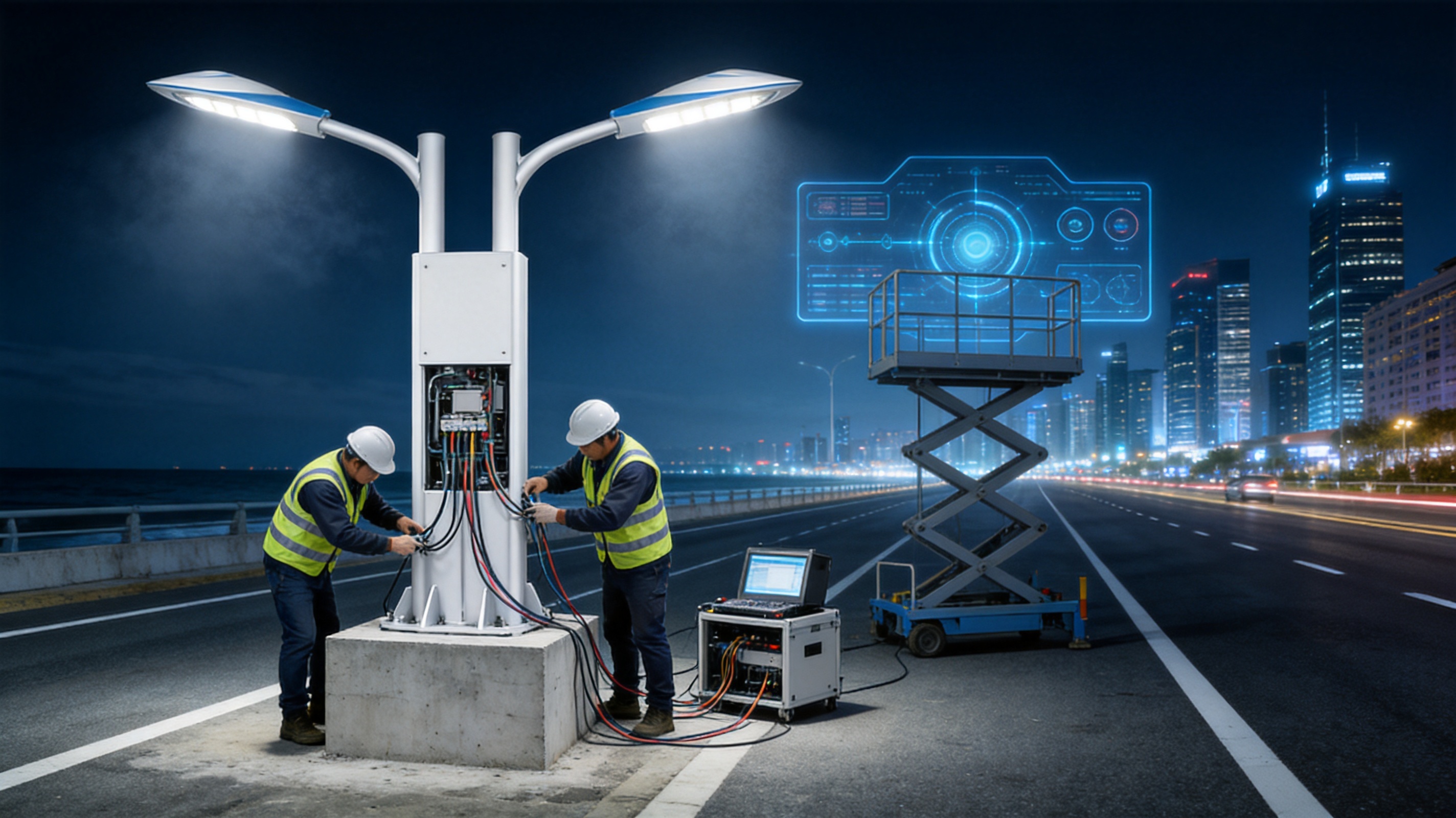
Modern road infrastructure requires more than a simple support structure for luminaires. A contemporary street pole must combine structural strength, lighting performance, visual appeal, installation efficiency, long-term corrosion resistance, and adaptability to different project conditions. The Modular Dual-Arm Street Pole is designed to address these requirements through a balanced combination of high-strength steel construction, fluid architectural form, modular assembly, reinforced foundation connection, and compatibility with efficient LED lighting systems.
Developed for dual-carriage roads, wide boulevards, large intersections, urban plazas, commercial districts, and other expansive outdoor environments, this double-arm street lighting structure provides symmetrical illumination from a single central pole. Its continuous curved transition from the shaft to the lighting arms creates a refined appearance while also supporting aerodynamic performance. Compared with conventional poles that use separate angular brackets or visually heavy supports, the modular design offers a cleaner silhouette and a more integrated relationship between the pole, luminaires, and surrounding architecture.
The product is suitable for projects that require reliable illumination and a strong municipal identity. It can be supplied in heights from 6 to 10 meters, manufactured with steel grades such as Q235, Q355, SS400, GR65, and other specified materials, and configured with LED luminaires offering up to 140 lm/W luminous efficiency. Its lighting system supports AC85-265V input, operating temperatures from -35°C to 65°C, IP65 protection, and optional DC 0-10V or DALI dimming.
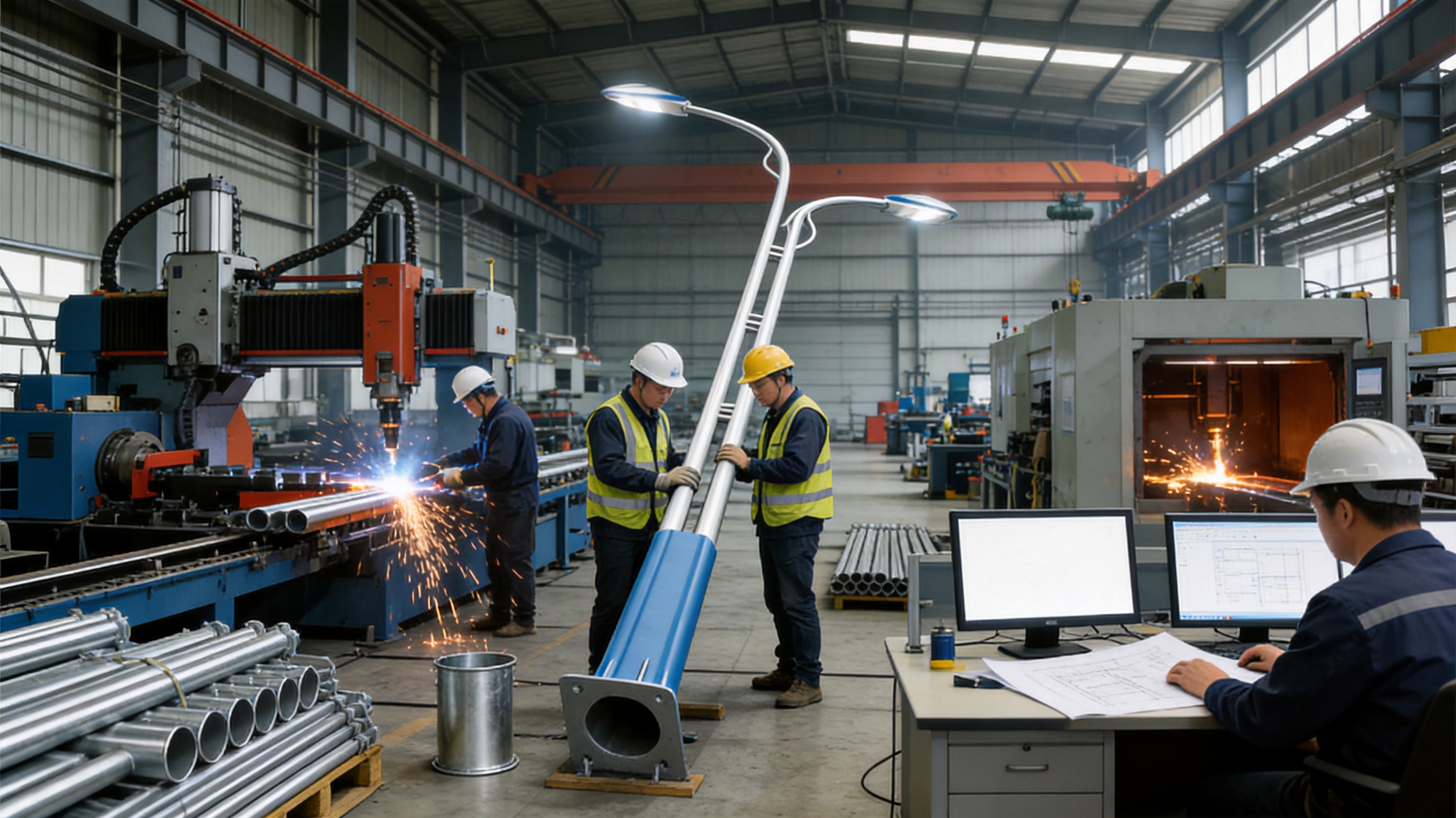
Behind the finished product is a complete manufacturing and engineering system. Yangzhou Jinyuan Lamps Co., Ltd. combines material inventory, CNC bending, precision cutting, automated welding, corrosion-control processes, engineering design, quality inspection, and overseas installation guidance. This integrated capability allows the company to support projects from initial consultation and design through manufacturing, delivery, commissioning, and technical assistance.
1. The Role of Dual-Arm Street Poles in Modern Infrastructure
Urban roads are becoming wider, busier, and more visually demanding. A single-arm pole may be suitable for a narrow local road, but major roadways often require illumination on both sides of a central median or across multiple traffic lanes. Installing separate poles for each direction can increase foundation work, occupy more public space, and create an inconsistent visual rhythm. A dual-arm street pole provides a more consolidated alternative.
By supporting two luminaires from one central shaft, the pole can illuminate opposite carriageways or two sides of a large public area. This arrangement can reduce the number of vertical structures required while maintaining a coordinated lighting layout. When properly engineered and positioned, dual-arm lighting also helps create consistent spacing and symmetry across long road corridors.
The Modular Dual-Arm Street Pole is particularly appropriate for the following applications:
• Dual-carriage roads and divided highways.
• Wide urban boulevards and arterial roads.
• Central medians with sufficient foundation width.
• Large intersections and roundabout approaches.
• Airport access roads and transportation terminals.
• Industrial parks, logistics zones, and port-adjacent roads.
• Commercial districts, civic plazas, and contemporary public spaces.
• Residential developments requiring a unified streetscape.
• Coastal and open-terrain areas exposed to strong wind conditions.
In each of these environments, the pole serves two purposes at once. It is a structural component that must withstand wind, vibration, equipment weight, and environmental exposure. It is also a visible urban design element that influences how a road, plaza, or development is perceived at night and during the day.
2. Design Philosophy: Minimalist Form with Engineering Purpose
The appearance of the Modular Dual-Arm Street Pole is based on a continuous, high-precision curvature. Instead of relying on sharply angled brackets fixed to a straight shaft, the design creates a smooth transition between the vertical pole and the two horizontal or gently rising arms. This produces a visually lighter and more coherent structure.
The minimalist form is not merely decorative. A continuous transition can reduce abrupt geometric changes and create a more streamlined profile. The smooth surface and aerodynamic shape can help limit unnecessary wind resistance compared with bulky, fragmented bracket arrangements. The final wind behavior of any installation still depends on pole height, arm configuration, luminaire size, foundation design, local wind speed, and project-specific calculations, but the product’s profile is intentionally developed with wind exposure in mind.
The curved arms also improve the visual integration of the luminaires. The light fixtures appear to extend naturally from the pole rather than being attached as independent components. This is valuable in municipal projects where repeated street furniture must contribute to a consistent architectural language. A clean and symmetrical pole arrangement can enhance the appearance of a road corridor even when the luminaires are not operating.
The design is especially suitable for contemporary urban settings. Its restrained geometry can complement glass-and-steel commercial buildings, modern transport facilities, landscaped boulevards, civic architecture, and large-scale development projects. At the same time, the structural concept remains practical enough for industrial roads, public infrastructure, and standard municipal applications.
Visual advantages over conventional angular poles
Traditional dual-arm poles may use welded or bolted brackets with visible changes in direction. While these arrangements can be functional, they may appear visually heavy and can create more exposed connection points. The Modular Dual-Arm Street Pole offers several design advantages:
• A continuous curved transition creates a more unified appearance.
• Symmetrical arms support a balanced view from both directions of the roadway.
• The streamlined profile supports a contemporary streetscape identity.
• Fewer visually prominent bracket changes can create a cleaner silhouette.
• The modular concept allows the pole arrangement to be adapted to project needs.
• The structure can be coordinated with different LED luminaire styles and road layouts.
3. Structural Construction and Material Selection
The pole is constructed from high-strength galvanized steel or from a specified structural steel grade selected for the project. Available material options include Q235, Q355, SS400, GR65, and comparable grades. The final material selection should be confirmed according to the applicable design code, local environmental conditions, pole height, arm geometry, luminaire weight, foundation arrangement, and required safety factor.
Steel remains a widely used material for outdoor lighting structures because it offers a practical balance of strength, manufacturability, availability, and cost. It can be cut, bent, welded, treated, and finished using industrial equipment. This makes it possible to produce different heights, shaft dimensions, arm lengths, flange configurations, access doors, and decorative treatments without changing the basic product concept.
High-strength steel contributes to the pole’s ability to resist bending and dynamic loading. This is important because street poles are exposed to repeated wind pressure, gusts, vibration from nearby traffic, and the weight of luminaires, brackets, cables, and accessories. The structural performance of the completed installation depends on the entire system, including the pole shaft, arms, base plate, anchor bolts, foundation, and soil conditions. For that reason, mechanical calculations and foundation assessments are important elements of responsible project planning.
Galvanization and outdoor durability
Outdoor steel products require effective protection against moisture, oxygen, salts, industrial pollutants, and other corrosive agents. Galvanized steel provides a protective zinc layer that helps isolate the underlying steel from the surrounding environment. This is especially relevant for roadside installations, where water, dust, deicing substances, vehicle emissions, and temperature changes can affect exposed metal surfaces.
For coastal or high-humidity projects, the corrosion-protection system should be selected according to local conditions. Additional surface treatments, powder coating, paint systems, inspection requirements, and maintenance procedures may be specified when the environment is particularly aggressive. The manufacturing process includes corrosion-control capabilities and quality checks designed to support a longer service life when the product is correctly specified and installed.
The pole’s smooth geometry can also support easier surface treatment and inspection. Areas with complicated overlaps, unnecessary recesses, or poorly finished welds may collect water and contaminants. A carefully formed and finished structure offers a more consistent surface for galvanizing, coating, visual inspection, and maintenance.
Reinforced base sleeve
A key structural feature is the reinforced base sleeve. The base region is one of the most important parts of a lighting pole because it transfers bending forces, shear forces, vibration, and vertical loads into the foundation. A weak or poorly designed base connection can compromise the performance of an otherwise strong shaft.
The reinforced sleeve adds support around the lower section and helps improve lateral stability. It is intended to reduce stress concentration and strengthen the connection between the shaft and the foundation interface. This is particularly valuable in high-wind areas, open terrain, coastal locations, and large-road environments where the structure may experience continuous dynamic loading.
The base design also supports modular installation. A modular pole can be manufactured, transported, and assembled in sections or with planned connection details that simplify handling at the project site. This approach can reduce the need to move an oversized, fully assembled structure through constrained streets or construction areas. It may also help contractors organize lifting, alignment, bolting, and final inspection more efficiently.

Modular Dual-Arm Street Pole
4. Modular Assembly and Installation Efficiency
Large street poles can present logistical challenges. Transportation height restrictions, narrow access roads, bridge clearances, lifting limitations, and site congestion may make it difficult to deliver a fully assembled structure. The Modular Dual-Arm Street Pole addresses these issues through a modular assembly concept that can be adapted to project requirements.
Modular construction allows selected components to be produced, transported, and assembled in a controlled sequence. Depending on the final configuration, the shaft, arms, sleeves, access components, and lighting fixtures may be handled in stages. This does not eliminate the need for proper lifting equipment and trained personnel, but it can make site operations more manageable.
Installation efficiency can provide important commercial benefits. Shorter installation times may reduce labor costs, traffic-management requirements, equipment rental periods, and disruption to public areas. A well-planned modular system can also make it easier to replace a component or perform future upgrades without removing the entire pole.
Typical installation considerations
Before installation, the project team should confirm the pole height, arm reach, luminaire type, road width, median dimensions, foundation size, anchor-bolt pattern, cable entry, access-door location, lifting method, and local wind design requirements. The foundation must be designed for the actual soil conditions and loading parameters rather than based only on a general product illustration.
During installation, the following steps are commonly considered:
• Inspecting the delivered components for transport damage.
• Confirming the foundation dimensions and anchor-bolt alignment.
• Checking the galvanizing or surface finish before assembly.
• Installing the base sleeve and shaft according to the approved drawing.
• Aligning the pole vertically and securing the connection hardware.
• Attaching the dual arms and verifying symmetry.
• Routing cables through the designated internal passages.
• Installing and orienting the LED luminaires.
• Testing electrical connections, dimming controls, and protective devices.
• Performing final torque checks and documenting completion.
Overseas onsite installation guidance is available as part of the company’s project-support capability. The exact scope of assistance depends on contract requirements, project location, and the selected service package. Engineering coordination before shipment is strongly recommended because many installation issues can be prevented through accurate drawings and clear interface details.
5. Lighting System Compatibility and Performance
The pole is designed to support LED street lighting systems for road and public-area applications. LED technology is widely used because it can provide high luminous efficiency, controllable operation, long operating life, and improved optical precision compared with older conventional light sources. The pole itself does not determine the complete photometric result; road width, mounting height, arm projection, luminaire optics, spacing, and dimming schedules must all be evaluated together.
The listed LED system provides a luminous efficiency of up to 140 lm/W. This figure indicates the amount of visible light produced for each watt of electrical input under the specified product conditions. High luminous efficiency can help reduce installed power or maintain required illumination while using less energy. Actual road performance should be confirmed through photometric files, lighting calculations, and applicable road-lighting standards.
The available color temperature range is 3000K to 6000K. A warmer 3000K appearance may be selected for residential districts, historic areas, hospitality environments, or locations where a softer visual atmosphere is preferred. Neutral or cooler settings may be considered for highways, industrial roads, security-sensitive areas, or projects seeking a brighter visual appearance. The choice should account for glare, visual comfort, surrounding ecology, traffic conditions, and local regulations.
A color rendering index of 70 is suitable for many general roadway applications. It provides a reasonable level of color recognition while maintaining an emphasis on efficient outdoor illumination. Projects with special requirements for architectural presentation, pedestrian areas, retail environments, or high color-identification needs may require a different luminaire specification.
Electrical and environmental specifications
| Item | Available specification | Project significance |
|---|---|---|
| Application | Road and public-area lighting | Suitable for carriageways, boulevards, intersections, and plazas |
| Input voltage | AC85-265V | Supports a broad range of common AC supply conditions |
| Light source | LED | Efficient, controllable, and suitable for modern roadway systems |
| Operating temperature | -35°C to 65°C | Supports use across demanding seasonal environments |
| Ingress protection | IP65 | Provides protection against dust and water jets when correctly assembled |
| Luminous efficiency | Up to 140 lm/W | Supports energy-conscious lighting design |
| Color temperature | 3000K-6000K | Allows visual appearance to be matched to the project environment |
| Color rendering index | Ra 70 | Appropriate for many general road-lighting applications |
| Dimming | DC 0-10V / DALI | Enables scheduled or intelligent lighting control |
| Warranty | 5 years | Provides a defined support period for the supplied system |
| Pole height | 6m-10m | Supports different road widths and mounting requirements |
The AC85-265V input range gives the lighting equipment flexibility across different power-distribution conditions. The appropriate driver, surge protection, earthing arrangement, cable size, and control equipment should be confirmed for each installation. Electrical work must be performed in accordance with local regulations by qualified personnel.
An IP65 rating indicates that the protected lighting enclosure is designed to resist dust ingress and water jets from multiple directions. This rating is useful for outdoor roads, but it does not mean that the product can be submerged or neglected during maintenance. Cable glands, covers, seals, connectors, and installation interfaces must remain correctly fitted to preserve the intended protection level.
The wide operating temperature range supports installations in cold winter regions and hot summer environments. However, local solar exposure, heat accumulation, driver placement, airflow, and luminaire thermal design should still be considered. Proper thermal management helps maintain LED performance and service reliability over time.
6. Intelligent Dimming and Smart-City Readiness
Road lighting systems are increasingly expected to operate more intelligently. Fixed-output lighting can consume unnecessary energy during periods of low traffic, while a controllable system can adapt illumination to schedules, traffic patterns, weather conditions, and safety requirements. The product supports DC 0-10V and DALI dimming, providing a foundation for more flexible lighting management.
DC 0-10V control is commonly used for straightforward dimming applications. It can allow the lighting level to be adjusted through a compatible controller or centralized system. DALI offers more advanced digital control and can support addressing, grouping, status monitoring, and programmed lighting scenes when the complete system is designed with compatible components.
For a dual-arm pole installed on a major road, separate control of the two luminaires may be considered where the project requires directional or time-based management. For example, one carriageway may experience different traffic patterns from the other. A suitable control architecture can help manage output more precisely, although the final arrangement depends on the driver, controller, communication network, and municipal operating strategy.
Dimming can contribute to:
• Lower energy consumption during low-traffic periods.
• Reduced operating costs over the life of the installation.
• More flexible response to seasonal and nighttime conditions.
• Integration with smart-city or centralized lighting platforms.
• Improved management of lighting levels across different road zones.
• More effective maintenance planning when monitoring functions are included.
The pole is also compatible with broader smart street lighting concepts, including networked controls, environmental sensors, traffic monitoring, wireless communication nodes, and public infrastructure equipment. Any additional equipment must be assessed for weight, wind area, electrical loading, access, and electromagnetic compatibility before installation.
7. Manufacturing Capabilities Behind the Product
A sophisticated street pole depends on more than a good drawing. Consistent manufacturing is necessary to ensure that every shaft, arm, base, weld, and surface treatment conforms to the intended design. The company’s manufacturing system includes material preparation, CNC bending, precision cutting, welding, automated production lines, surface treatment, and quality-control procedures.
Yangzhou Jinyuan Lamps Co., Ltd. was established in 2002 and operates as part of Jinshang Electric Group. The company specializes in street light poles, LED street lights, solar street lights, light fixtures, and related road-lighting products. Its production site covers more than 70,000 square meters and is supported by more than 300 professional technicians. The company reports exports to more than 200 countries, giving it experience with different project scales, climates, technical expectations, and delivery requirements.
The company’s quality-management and environmental systems include ISO9001, ISO14001, and OHSAS18001-related standards and practices. These systems are intended to support organized production, traceability, environmental responsibility, occupational safety, and continuous improvement. Certification and management systems are most effective when they are supported by practical inspection, trained personnel, accurate production records, and clear customer communication.
Material inventory and production continuity
Material availability can have a direct influence on project schedules. Delays in sourcing structural steel may interrupt cutting, bending, welding, galvanizing, and shipment. The company maintains extensive material stock and can offer multiple material options, including Q235B, Q345B, S275JR, S355JR, Q460, A36, A572, GR56, and GR50, subject to project confirmation and availability.
A broad material portfolio provides flexibility when customers require a specific grade for structural calculations, regional standards, environmental conditions, or procurement policies. It can also help the manufacturer respond efficiently to different project specifications without relying on a single material type.
Material inspection remains important even when stock is available. Relevant checks may include grade verification, thickness measurement, surface condition, dimensional inspection, and documentation review. For large infrastructure projects, material certificates and traceability records can support quality assurance and project handover requirements.
CNC bending and structural accuracy
The dual-arm configuration depends on controlled bending and consistent geometry. Inaccurate bending can affect arm alignment, luminaire orientation, visual symmetry, and load distribution. The company uses precision CNC bending equipment to create repeatable shapes and reduce variation between production batches.
Consistent CNC bending can improve structural integrity by reducing unnecessary rework and limiting irregular transitions. It can also support smoother curved profiles, which are central to the product’s minimalist appearance. A controlled bending process is particularly valuable when multiple poles must be installed along a long roadway and maintain the same visual alignment.
Precision cutting
Cutting accuracy affects the fit of shaft sections, base plates, sleeves, access openings, arm components, and connection parts. The company reports cutting accuracy of up to 0.01 mm under its production process. The practical tolerance for each component should be confirmed through the approved engineering drawing and applicable manufacturing standard, but high-precision cutting capability supports clean edges and accurate component preparation.
Accurate cutting can reduce gaps, misalignment, and post-production adjustments. It also supports more consistent welding preparation, which is important for joint quality. Clean edges can help improve the appearance of finished components and reduce unnecessary grinding or correction work.
Automated welding and certified personnel
Welding quality affects both the strength and appearance of a street pole. Arms, sleeves, flanges, access structures, and other components must be joined with suitable procedures. The company combines automated welding lines with experienced certified welders. Automation can improve repeatability and production speed, while skilled welders are valuable for complex joints, adjustments, inspection, and project-specific fabrication.
A sound welding process includes appropriate joint preparation, correct welding parameters, controlled heat input, suitable consumables, visual inspection, and additional testing where required. Welds should be free from visible defects that could compromise structural performance or surface treatment. After welding, appropriate cleaning and preparation help ensure a more uniform galvanizing or coating result.
The combination of equipment and personnel is a competitive advantage for large projects. Automated systems can support volume production, while experienced technicians can respond to custom dimensions, special interfaces, nonstandard arm lengths, and engineering modifications.
Surface treatment and corrosion control
Outdoor lighting poles require a surface-protection process that is compatible with their intended environment. Manufacturing capabilities include powder electrostatic painting and related corrosion-control procedures. Depending on the order, the pole may be supplied with galvanized protection, painted finishing, powder coating, or a combined treatment system.
Powder electrostatic painting can create a consistent decorative finish in selected colors. It is useful when the pole must coordinate with urban furniture, architectural elements, branding guidelines, or a municipal color standard. Color customization can be discussed during the design stage. The selected color and coating system should be evaluated for ultraviolet exposure, salt spray, humidity, temperature variation, impact, and maintenance requirements.
Quality control in surface treatment may include visual inspection, coating-thickness measurement, adhesion testing, surface preparation checks, and confirmation that drainage and internal surfaces have been properly treated. The precise inspection plan should be agreed upon according to the project specification.
Large-scale production equipment
The company’s production facilities include bending machines, automatic welding and cutting machines, powder electrostatic painting equipment, and a 1250-ton die-casting machine. These resources support the production of poles, luminaires, structural components, and related lighting products.
Large-scale equipment can provide several advantages:
• Greater capacity for high-volume infrastructure orders.
• More consistent forming and cutting across repeated components.
• Better control of production scheduling.
• Reduced dependence on manual operations for repetitive tasks.
• Improved ability to produce custom components.
• Potentially lower unit costs through efficient manufacturing.
• Better coordination between pole and luminaire production.
For customers, the value of this equipment is measured not only by machine size but also by the manufacturer’s ability to use it within a controlled process. Accurate drawings, inspection procedures, skilled operators, maintenance, and final quality checks remain essential.
8. Competitive Advantages Compared with Conventional Alternatives
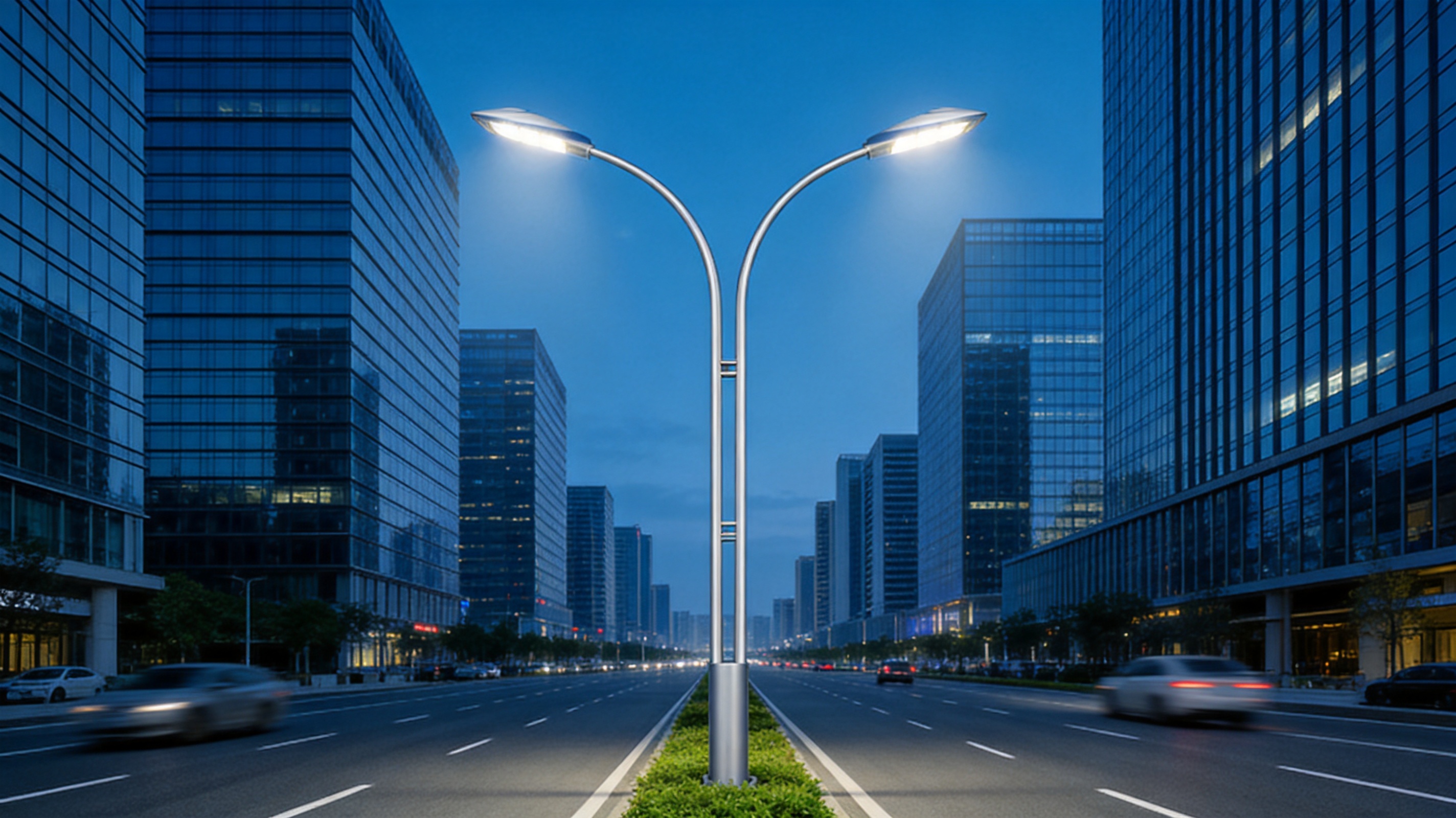
The Modular Dual-Arm Street Pole competes with several common alternatives, including standard straight poles with separate brackets, welded ornamental poles, single-arm poles installed in pairs, and basic unmodularized structures. Each alternative may be appropriate in certain circumstances, but the modular dual-arm design offers a distinct combination of appearance, structural planning, and installation flexibility.
Compared with single-arm poles installed in pairs
Using two independent single-arm poles may provide directional flexibility, but it requires two foundations, two vertical structures, and more installation points. On a central median or wide boulevard, this can increase material use and create a denser visual arrangement. A dual-arm pole can centralize the support structure and produce a more symmetrical road appearance.
A single central pole may also simplify alignment between opposite lighting directions. Instead of coordinating two separate poles at every location, the contractor can manage one central structural assembly supporting two luminaires. This advantage depends on the median width, road geometry, lighting calculation, and local structural requirements.
Compared with angular bracket designs
Angular brackets can be economical and familiar, but their separate junctions may create a heavier appearance and additional exposed connection details. The continuous curvature of the Modular Dual-Arm Street Pole gives the installation a more integrated architectural character. This can be important for city-center roads, commercial developments, and projects where public infrastructure is expected to support a distinctive visual identity.
The aerodynamic profile may also help reduce unnecessary wind exposure. It should not be assumed that a curved pole automatically performs better in every wind condition; engineering calculations are still required. Nevertheless, a smooth transition provides a thoughtful starting point for structural and aesthetic optimization.
Compared with non-modular poles
A non-modular pole may be straightforward for small local installations, but larger or taller structures can be difficult to transport and handle. A modular product can provide greater flexibility in logistics and site assembly. It may also simplify customization because selected sections can be adapted without redesigning the entire manufacturing system.
Modularity can be especially useful for international projects. Different markets may have different road widths, foundation practices, shipping constraints, and luminaire preferences. A modular approach allows the manufacturer and customer to coordinate these details more efficiently.
Compared with low-cost products with limited engineering support
Initial purchase price is only one part of a street-lighting project. Poorly coordinated drawings, insufficient material documentation, inconsistent welding, weak corrosion protection, and unclear installation interfaces can create hidden costs during construction and operation. A manufacturer that offers CAD design, 3D simulation, mechanical calculations, specification customization, and installation guidance can help reduce project uncertainty.
The company’s integrated engineering and production support allows the product to be developed as part of a complete lighting solution rather than treated as an isolated steel component. This is valuable for contractors, distributors, developers, municipal buyers, and engineering consultants seeking predictable project execution.
9. Customization and Engineering Services
Road-lighting projects rarely have identical requirements. Pole height, arm extension, luminaire weight, road classification, wind speed, corrosion category, foundation conditions, cable routing, color, and control strategy may vary from one site to another. The product is therefore supported by a range of design and customization services.
CAD design
CAD drawings can define the complete product geometry, including shaft dimensions, arm curvature, flange plates, sleeve reinforcement, access openings, cable entry, anchor-bolt arrangement, and luminaire interfaces. Accurate drawings help all parties review the design before fabrication. They also provide a reference for foundation design, transport planning, installation, and maintenance.
Three-dimensional product simulation
Three-dimensional product simulation can help customers evaluate the pole from different angles and identify potential interference between the arms, luminaires, cables, and nearby structures. It can also support review of proportions, arm spacing, mounting angles, and the overall relationship between the pole and the lighting fixtures.
Three-dimensional scene simulation
A product may look appropriate in isolation but appear different when installed along a real road. Three-dimensional scene simulation places the pole into a virtual roadway, plaza, median, or architectural environment. This allows the project team to review scale, repetition, spacing, visual rhythm, and compatibility with surrounding buildings and landscape elements.
Specification and color customization
Customers can discuss material grades, pole height, arm configuration, coating color, luminaire type, color temperature, control method, and other technical requirements. Customization should be completed before production so that structural calculations, procurement, manufacturing, and inspection remain aligned.
Mechanical calculation for wind and foundation
Wind and foundation calculations are essential for a safe installation. The required analysis may consider local basic wind speed, exposure category, topography, pole height, projected area, luminaire dimensions, arm shape, steel grade, anchor bolts, base plate, soil bearing capacity, and foundation depth. The manufacturer can support mechanical calculations for the pole and foundation, while final approval should be completed by the responsible local engineer where required.
Overseas onsite installation guidance
International projects may involve unfamiliar site procedures, language differences, local regulations, and coordination among several contractors. Overseas onsite installation guidance can help clarify assembly order, alignment, electrical interfaces, lifting practices, and final inspection. The exact service can be arranged according to project size and contract terms.
10. Application Planning for Different Road Environments
The same pole can serve different road environments, but its configuration should be tailored to the application. A six-meter version may be appropriate for smaller urban roads, residential developments, or pedestrian-oriented areas. Higher configurations within the 6-to-10-meter range may be selected for wider roads, larger setbacks, higher mounting requirements, or longer luminaire outreach.
For dual-carriage roads, the key planning factors include median width, carriageway separation, traffic direction, lighting class, pole spacing, luminaire optics, and maintenance access. The two arms should be positioned to support the intended lighting zones without creating excessive overhang or interference with traffic signs, trees, overhead utilities, or other road furniture.
For commercial plazas and civic spaces, the visual proportions of the pole may be more important than maximum roadway reach. The arms can be coordinated with plaza geometry, pedestrian circulation, landscape features, and architectural sightlines. Warmer color temperatures and carefully controlled dimming may be considered where comfort and ambience are priorities.
For industrial parks and logistics areas, durability, visibility, operating temperature, and maintenance access may receive greater emphasis. The lighting system may need to operate for long hours and withstand dust, vehicle movement, and vibration. IP65 protection, robust steel construction, and an accessible electrical design can support these requirements when correctly specified.
For coastal and open-terrain projects, wind and corrosion are primary considerations. The reinforced base sleeve and streamlined structure provide useful design features, but the project must still use local wind data and an appropriate corrosion-protection system. Stainless hardware, additional coatings, drainage details, and enhanced inspection may be specified where necessary.
11. Quality Assurance and Project Reliability
Reliability begins with the conversion of customer requirements into clear engineering documents. Before production, the supplier and customer should confirm the approved drawings, technical specifications, material grades, coating system, luminaire data, control method, packaging, inspection requirements, and delivery schedule.
During manufacturing, quality assurance can cover several stages:
• Incoming material verification.
• Dimensional inspection after cutting.
• Bend-radius and geometry verification after forming.
• Weld appearance and joint inspection.
• Base plate, sleeve, and flange alignment checks.
• Surface preparation and galvanizing or coating inspection.
• Luminaire electrical and photometric verification where applicable.
• Assembly checks for pole-to-arm and luminaire interfaces.
• Packaging inspection before loading.
Quality control is particularly important for dual-arm poles because errors may be more visible than on a simple single-arm structure. If the arms are not aligned, the luminaires may point in different directions, the road illumination may become uneven, and the visual symmetry of the entire roadway can be affected.
Consistent production also supports replacement and expansion. When a project uses a standardized design, future poles, arms, and luminaires can be matched more easily. This can help municipalities and property operators maintain a unified inventory and simplify spare-parts planning.
12. Sustainability and Life-Cycle Value
A street-lighting product should be evaluated over its complete operating life rather than only by its initial purchase price. Energy consumption, maintenance frequency, corrosion resistance, replacement needs, installation time, and disposal considerations all influence life-cycle cost.
LED luminaires with high luminous efficiency can reduce electricity demand compared with less efficient lighting technologies. Dimming controls can provide additional savings by reducing output when full illumination is not needed. The exact savings depend on operating hours, dimming schedules, electricity tariffs, lighting levels, and the efficiency of the complete system.
Durable steel construction and effective corrosion protection can reduce premature replacement. A pole that remains structurally sound and visually acceptable for a longer period can help reduce material consumption and construction disruption. Modular assembly may also support component replacement or upgrade, potentially extending the useful life of the installation.
The company’s ISO14001-related environmental management practices and automated production capabilities support a more organized approach to manufacturing efficiency. Automation can help reduce material waste, improve repeatability, and shorten production cycles. The environmental performance of the final project will also depend on responsible steel sourcing, coating materials, packaging, transport, energy use, and end-of-life recycling.
Steel is widely recyclable, and properly managed steel components can enter established recycling streams at the end of their service life. To maximize this advantage, project owners should retain material information and separate components appropriately during future removal or refurbishment.
13. Recommended Specification Workflow
Choosing the correct dual-arm street pole should begin with the application rather than with a standard catalog dimension. The project team should first identify the roadway classification, target illumination, available median or foundation space, mounting height, luminaire type, and local structural requirements.
A practical workflow includes the following stages:
Stage one: Application definition. Confirm whether the pole will serve a divided road, boulevard, plaza, industrial area, transport facility, or another location. Identify traffic conditions, pedestrian activity, surrounding buildings, and environmental exposure.
Stage two: Lighting analysis. Select the LED luminaire, optical distribution, power rating, color temperature, mounting angle, dimming function, and spacing. Use photometric calculations to confirm that the proposed arrangement can meet the required illumination and uniformity.
Stage three: Structural analysis. Confirm pole height, arm reach, material grade, luminaire projected area, local wind speed, foundation conditions, anchor-bolt design, and safety factors. Mechanical calculations should be reviewed by the appropriate engineer.
Stage four: Visual coordination. Review CAD drawings and three-dimensional simulations. Check the relationship between the pole, road, landscape, architecture, signs, trees, overhead lines, and other street furniture.
Stage five: Manufacturing confirmation. Approve dimensions, tolerances, welding details, galvanizing or coating requirements, color, access doors, cables, packaging, and inspection documents.
Stage six: Site preparation. Complete the foundation, conduit, anchor-bolt installation, access planning, lifting arrangements, and traffic-management measures before the pole arrives.
Stage seven: Installation and commissioning. Assemble the modular sections, align the arms, install the luminaires, connect the electrical system, program the controls, and complete safety and performance checks.
This workflow reduces the risk of treating the pole as an isolated product. It ensures that structural, electrical, architectural, and construction requirements are considered together.
14. Maintenance Considerations
Even durable lighting infrastructure requires periodic inspection. A maintenance program should check the pole shaft, arms, base sleeve, flange, anchor bolts, access door, cables, luminaires, seals, coating, and surrounding foundation. Inspections should be more frequent in coastal environments, areas with severe weather, locations exposed to road salt, or sites with frequent vehicle impact risk.
Visual checks can identify corrosion, coating damage, unusual deflection, loose fasteners, water entry, damaged cables, or changes in luminaire orientation. Any sign of structural distress should be evaluated by qualified personnel before the pole continues in normal service.
LED luminaires generally require less routine replacement than older lamps, but drivers, surge-protection devices, control modules, and connectors can still require attention. A modular pole arrangement can make access and component replacement more organized, particularly when the electrical components are clearly documented and accessible through planned service openings.
Dimming and smart-control systems should also be checked periodically. Software settings, communication devices, schedules, and sensors can influence lighting performance as much as the hardware. Maintaining accurate records of pole locations, luminaire types, driver specifications, control addresses, and installation dates can improve future service efficiency.
15. Why This Product Is Suitable for International Projects
International infrastructure projects often require a supplier capable of managing more than production. Technical communication, drawing approval, customization, documentation, packaging, shipping coordination, and installation support can all influence project success.
The company’s experience in exporting to more than 200 countries indicates familiarity with international order coordination and overseas customer requirements. Its product range covers street light poles, LED street lighting, solar street lights, light fixtures, and related road-lighting systems. This broader portfolio can help customers coordinate multiple components through one experienced supplier.
International projects may also require different steel grades, coating colors, electrical inputs, luminaire controls, documentation formats, and inspection standards. A manufacturer with multiple production processes and engineering services can respond more effectively to these variations than a supplier limited to one fixed product configuration.
The five-year warranty period for the listed lighting system provides a defined support framework. Warranty conditions should be reviewed carefully because coverage may depend on installation quality, electrical protection, operating conditions, maintenance, unauthorized modifications, and environmental exposure. Clear warranty documentation helps both the supplier and project owner understand their responsibilities.
16. Frequently Asked Questions
What is a Modular Dual-Arm Street Pole?
It is a street-lighting support structure with one central shaft and two integrated arms designed to carry luminaires in two directions. Its modular construction allows selected components to be manufactured, transported, and assembled according to project requirements.
Where is a dual-arm pole most useful?
It is most useful on divided roads, broad boulevards, central medians, large intersections, urban plazas, airport roads, industrial parks, and other areas requiring symmetrical illumination from a central support.
What pole heights are available?
The listed height range is 6 to 10 meters. The final height should be selected according to road width, luminaire optics, pole spacing, wind conditions, foundation design, and local lighting requirements.
Which materials can be used?
Available pole materials include Q235, Q355, SS400, GR65, and other specified structural steel grades. Additional material options such as Q235B, Q345B, S275JR, S355JR, Q460, A36, A572, GR56, and GR50 may be discussed for specific projects.
Is the pole suitable for high-wind locations?
The reinforced base sleeve and aerodynamic profile are intended to improve lateral stability and reduce unnecessary wind exposure. However, suitability must be confirmed through project-specific wind and foundation calculations using local design data.
What type of light source does the system use?
The lighting system uses LED technology. The listed performance includes luminous efficiency of up to 140 lm/W, a color-temperature range of 3000K to 6000K, and a color rendering index of Ra 70.
Does the lighting system support dimming?
Yes. The listed control options include DC 0-10V and DALI dimming. The controller, driver, wiring, and network architecture must be compatible with the selected control method.
What does IP65 mean?
IP65 indicates protection against dust ingress and water jets from multiple directions for the protected lighting enclosure. It does not mean that the equipment is designed for immersion. Proper installation and maintenance of seals and cable entries are necessary.
Can the color and specifications be customized?
Yes. Specification and color customization can be discussed during the design stage. Possible variables include pole height, arm geometry, material, finish, luminaire configuration, color temperature, control method, and other project-specific details.
Can the pole be designed for a particular foundation?
Engineering support is available for mechanical calculations related to wind and foundation requirements. The final foundation design should be reviewed and approved according to local codes, soil conditions, and the responsible project engineer’s requirements.
How does the modular design help installation?
It can make transportation, lifting, assembly, alignment, and site handling more manageable. Modular construction may also support future component replacement or upgrades, although the exact assembly method depends on the approved design.
What services are available before production?
Available services include CAD design, three-dimensional product simulation, three-dimensional scene simulation, specification and color customization, and mechanical calculation for wind and foundation conditions.
Is overseas installation assistance available?
Overseas onsite installation guidance is available as part of the company’s project-support capability. The scope and arrangements should be confirmed according to the project location, contract, and installation requirements.
What is the warranty period?
The listed warranty period is five years for the lighting system. Specific terms, exclusions, operating conditions, and customer responsibilities should be confirmed in the formal quotation or contract.
How should the pole be maintained?
Maintenance should include periodic inspection of the shaft, arms, reinforced base sleeve, anchor bolts, coating, access door, cables, luminaires, seals, and control equipment. Coastal, high-humidity, high-wind, and salt-exposed areas may require additional inspection and protection measures.
17. Purchasing and Project-Coordination Checklist
Before placing an order, buyers should provide as much project information as possible. This helps the manufacturer select suitable materials, prepare accurate drawings, calculate structural loads, and recommend compatible lighting equipment.
The following information is useful:
• Project location and environmental conditions.
• Local basic wind speed and applicable design code.
• Road width, median width, and required lighting arrangement.
• Desired pole height and arm outreach.
• Luminaire model, weight, dimensions, and projected wind area.
• Required illumination, uniformity, and photometric standard.
• Input power and control requirements.
• Color temperature and color-rendering expectations.
• Galvanizing, coating, paint color, and corrosion category.
• Foundation drawings or soil information.
• Anchor-bolt dimensions and cable-entry requirements.
• Quantity, delivery schedule, packaging, and destination port.
• Inspection, testing, documentation, and warranty requirements.
When this information is available early, the supplier can provide a more accurate proposal and reduce later changes. It also allows the product to be evaluated as a complete road-lighting assembly instead of only as a decorative pole.
18. Conclusion
The Modular Dual-Arm Street Pole is designed for projects that require a combination of modern appearance, symmetrical illumination, robust structural performance, and efficient project execution. Its continuous curved transition distinguishes it from conventional angular-bracket poles, while its reinforced base sleeve supports improved lateral stability and vibration resistance. The aerodynamic profile is well suited to open roads and coastal or high-wind environments when supported by appropriate engineering calculations.
The product is available in 6-to-10-meter heights and can be manufactured from several structural steel grades. Its associated LED lighting system supports AC85-265V input, -35°C to 65°C operation, IP65 protection, up to 140 lm/W luminous efficiency, 3000K-6000K color temperature, DC 0-10V or DALI dimming, and a five-year warranty period.
Its strongest competitive advantage is the combination of product design and manufacturing capability. CNC bending supports consistent curved geometry. Precision cutting improves component fit. Automated welding and experienced certified welders support production quality. Powder electrostatic painting and corrosion-control processes help protect the finished product. Extensive material inventory supports production continuity, while CAD design, 3D simulation, wind and foundation calculations, customization, and overseas installation guidance provide an integrated project-support structure.
For contractors, municipalities, developers, lighting distributors, and infrastructure consultants, the product offers a practical way to combine functional roadway illumination with a distinctive urban appearance. When properly specified, engineered, installed, and maintained, the Modular Dual-Arm Street Pole can serve as a durable and visually coherent foundation for modern LED street-lighting systems.
References
1. Product technical information for the Modular Dual-Arm Street Pole, including material, height, electrical, environmental, lighting, dimming, and warranty specifications.
2. Manufacturing process information covering structural steel preparation, CNC bending, precision cutting, automated welding, powder electrostatic painting, and quality-control procedures.
3. Company profile information for Yangzhou Jinyuan Lamps Co., Ltd., including company history, production capacity, engineering services, export experience, and management-system credentials.
4. General principles of road-lighting design, including illumination distribution, mounting height, spacing, glare control, uniformity, and photometric evaluation.
5. General structural engineering principles for outdoor lighting poles, including wind loading, foundation design, anchor-bolt coordination, steel selection, and corrosion protection.
6. General guidance for LED outdoor lighting systems, including luminous efficiency, color temperature, color rendering, ingress protection, thermal management, and dimming control.
7. General practices for galvanized steel structures and protective coating inspection in outdoor infrastructure applications.