


JINYUAN
JINYUAN
JINYUAN
JINYUAN
JINYUAN
JINYUAN
JINYUAN
JINYUAN
JINYUAN
JINYUAN
JINYUAN
JINYUAN
JINYUAN
JINYUAN
JINYUAN
JINYUAN
Content
- 1 Designed for Demanding Industrial and Infrastructure Environments
- 2 Wide-Area Illumination with Modular Floodlight Configuration
- 3 Advanced LED Optical Performance
- 4 Structural Strength and Wind-Resistance Considerations
- 5 Corrosion Protection for Coastal and Industrial Locations
- 6 Motorized Lowering System for Safer Maintenance
- 7 Thermal Management and Stable Long-Term Operation
- 8 Control and Dimming Compatibility
- 9 Manufacturing Strength and Production Capability
- 10 Quality Control from Raw Material to Finished Product
- 11 Customized Engineering for Different Projects
- 12 Installation and Commissioning Support
- 13 Advantages over Conventional Floodlight Installations
- 14 Energy Efficiency and Operating Cost Reduction
- 15 Applications in Ports and Coastal Facilities
- 16 Applications in Airports and Transportation Hubs
- 17 Applications in Logistics Parks and Warehouses
- 18 Applications in Construction and Industrial Sites
- 19 Maintenance Recommendations
- 20 Project Planning and Selection Guidance
- 21 Service and Technical Collaboration
- 22 Warranty and Long-Term Value
- 23 Frequently Asked Questions
- 23.1 What is the Industrial High Mast Floodlight used for?
- 23.2 Can multiple floodlights be installed on one lighting head?
- 23.3 How does the electric hoist improve maintenance?
- 23.4 Is the product suitable for coastal areas?
- 23.5 What input voltage does the floodlight support?
- 23.6 What dimming systems are supported?
- 23.7 What is the operating temperature range?
- 23.8 What is the luminaire protection rating?
- 23.9 What color temperatures are available?
- 23.10 What materials can be used for the pole?
- 23.11 What pole heights are available?
- 23.12 Does the manufacturer provide design support?
- 23.13 What quality certifications support the manufacturing process?
- 23.14 What is the warranty period?
- 24 Conclusion
- 25 References
- 26 Product: Industrial High Mast Floodlight
Large industrial, transportation, logistics, and infrastructure sites require lighting systems that deliver much more than basic brightness. They need dependable illumination over expansive areas, excellent resistance to wind and corrosion, simplified maintenance, accurate optical control, and stable performance under demanding environmental conditions. The Industrial High Mast Floodlight is engineered to meet these requirements through a combination of high-strength structural materials, modular floodlight mounting, efficient LED technology, professional manufacturing processes, and service-oriented engineering support.
Designed for applications such as seaports, airports, logistics parks, construction sites, transportation hubs, industrial warehouses, and large road-related facilities, this lighting solution provides high-density illumination across wide working areas. Its purpose is to help operators, drivers, security teams, maintenance personnel, and site managers maintain visibility and safety during nighttime and low-light operations.
The system combines a robust hot-dip galvanized steel structure with an aluminum-alloy luminaire housing, high-efficiency LED light sources, industrial-grade protection, and a motorized electric hoist mechanism. This integrated approach gives the product significant advantages over conventional floodlight installations that require separate elevated work platforms, frequent manual adjustment, or replacement of individual fixtures at height.
Designed for Demanding Industrial and Infrastructure Environments
Outdoor industrial facilities are exposed to a wide range of challenges. Wind pressure can place continuous mechanical stress on poles, brackets, and foundations. Rain, humidity, salt spray, dust, and temperature fluctuations can accelerate corrosion and reduce the useful life of electrical equipment. At the same time, many sites operate around the clock, leaving limited opportunities for lighting maintenance or shutdowns.
The Industrial High Mast Floodlight is developed with these operating realities in mind. Its main support structure can be manufactured from high-strength materials such as Q235, Q355, SS400, GR65, and other project-specified steel grades. The selection of material can be adapted to structural calculations, local standards, wind conditions, installation height, fixture quantity, and foundation design.
Hot-dip galvanization provides a durable protective zinc coating on the steel structure. Unlike ordinary painted steel, galvanized steel offers more comprehensive protection because the coating covers exposed surfaces and provides sacrificial protection when minor scratches or localized damage occur. This is particularly valuable in coastal areas, ports, industrial zones, and humid regions where untreated steel can deteriorate rapidly.
The product is also suitable for projects that require additional surface treatment or customized finishing. Depending on the project environment and customer requirements, the lighting pole and related components may receive supplementary coating systems, special colors, customized access doors, or other protective treatments.
Wide-Area Illumination with Modular Floodlight Configuration
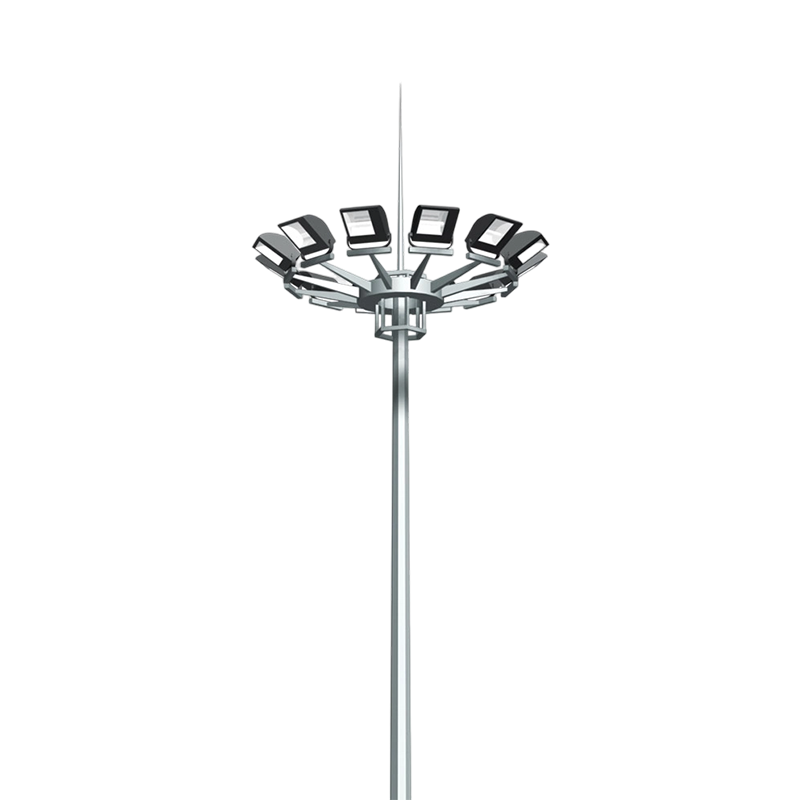
A key advantage of the Industrial High Mast Floodlight is its modular luminaire frame. The frame can support the installation of multiple high-power LED floodlights, allowing the lighting arrangement to be configured according to the size and shape of the target area. Instead of relying on one fixed light source with limited distribution, the system can combine several fixtures to create a coordinated illumination pattern.
This configuration is especially useful in open environments where light must cover large distances. A port yard may require illumination of container stacks, loading lanes, service roads, and crane operating areas. An airport-related facility may need lighting for apron zones, access roads, maintenance areas, or peripheral workspaces. A logistics park may require uniform lighting across vehicle circulation routes, storage yards, loading bays, and security boundaries.
By adjusting the number, orientation, beam angle, and installation position of the LED floodlights, lighting designers can distribute light more effectively across the site. This reduces the possibility of excessive brightness in one area and insufficient illumination in another. It also helps limit dark zones, shadows, and visual obstructions that may create safety risks.
The modular design offers practical flexibility during project expansion. When an industrial site grows, additional luminaires or modified lighting arrangements may be incorporated into the overall planning, subject to structural and electrical calculations. This provides a more adaptable solution than a fixed lighting structure designed for only one operating configuration.
Industrial High Mast Floodlight
Advanced LED Optical Performance
The luminaire uses LED light sources with a stated luminous efficiency of up to 140 lumens per watt. High luminous efficacy means that the system can produce substantial light output while using less electrical power than many traditional high-intensity discharge floodlights. Reduced power consumption can lower operating expenses, especially in facilities where lighting remains active for long periods each night.
Optical performance is equally important. Industrial sites do not simply need maximum brightness; they need light directed toward useful work areas. Advanced optical lenses help control the distribution of light and project it toward designated zones. This can improve uniformity, reduce wasted upward or lateral light, and support more accurate lighting calculations during project design.
The available color temperature range of 3000K to 6000K allows the lighting appearance to be selected according to the operational environment. Warmer color temperatures can provide a softer visual atmosphere and may be suitable for certain urban or pedestrian-oriented locations. Neutral and cooler color temperatures can support sharper visual contrast for industrial work areas, transport yards, roads, and security applications.
With a color rendering index of Ra 70, the product provides practical color recognition for general industrial and outdoor applications. Clear visibility of vehicles, equipment, signs, markings, personnel, and cargo is important for site management and safety procedures. The final color temperature and lighting layout should be selected according to the requirements of the project, local regulations, and the visual needs of users.
Optical customization can also be considered. Different locations may require narrow, medium, or broad beam distributions. A narrow distribution may be appropriate for long-distance targeting, while a broad distribution can support open work areas. Professional lighting design helps determine the appropriate combination and ensures that the floodlights contribute to a balanced overall illumination plan.
Structural Strength and Wind-Resistance Considerations
High-mounted lighting equipment is exposed to wind loads that increase with elevation and projected surface area. The pole, head frame, fixture brackets, foundation, anchor bolts, and connection points must therefore be considered as one structural system. A lighting product that performs well electrically but lacks appropriate structural engineering may create unnecessary operational risks.
The Industrial High Mast Floodlight is supported by a steel pole structure that can be designed using different grades and dimensions according to project requirements. The company provides mechanical calculation support for wind and foundation conditions, helping customers evaluate the structural requirements before production and installation.
Wind-resistance planning may include assessment of local basic wind speed, exposure category, pole height, luminaire quantity, fixture dimensions, projected area, topography, and mounting arrangement. These considerations are particularly important in coastal regions, open ports, airports, exposed logistics yards, and areas subject to typhoons or severe storms.
The pole structure can be manufactured with precision forming and welding processes. Accurate bending helps maintain the intended geometry and improves the consistency of each pole section. Reliable welding is essential for load-bearing connections, flange assemblies, brackets, access doors, and other structural components. The use of experienced and certified welders supports consistent workmanship across large production batches.
A suitable foundation is also essential. The foundation design depends on soil conditions, pole dimensions, wind loads, anchor bolt arrangement, and local construction standards. The product supplier can assist with mechanical and foundation calculations, while final civil engineering approval should be completed by qualified professionals in accordance with local regulations.
Corrosion Protection for Coastal and Industrial Locations
Corrosion is a major concern for lighting installed near the sea, chemical facilities, roadways, warehouses, and heavy industrial sites. Salt-laden air, rainwater, condensation, airborne pollutants, and contact with corrosive substances can gradually weaken exposed metal components and damage electrical equipment.
The use of hot-dip galvanized steel for the pole and structural parts provides a strong foundation for long-term outdoor service. The zinc coating acts as a barrier between steel and the environment. In addition, zinc offers galvanic protection, helping protect exposed areas if the surface is locally damaged.
The lighting housing is made from aluminum alloy, a material valued for its low weight, corrosion resistance, and thermal conductivity. Aluminum alloy is suitable for outdoor luminaires because it can help protect internal electrical components while supporting effective heat transfer away from the LED modules and drivers.
The stated IP65 protection rating indicates that the luminaire is designed to resist dust ingress and water jets from various directions. This protection level supports outdoor installation in locations exposed to rain, dust, and routine washing. Correct installation, cable gland selection, sealing inspection, and periodic maintenance remain important to preserve the intended protection level throughout the product’s service life.
For highly aggressive coastal or chemical environments, the complete protection system should be selected according to the site’s corrosion category. Customers may request additional coating specifications, stainless steel accessories, special fasteners, or enhanced surface treatment where necessary.
Motorized Lowering System for Safer Maintenance
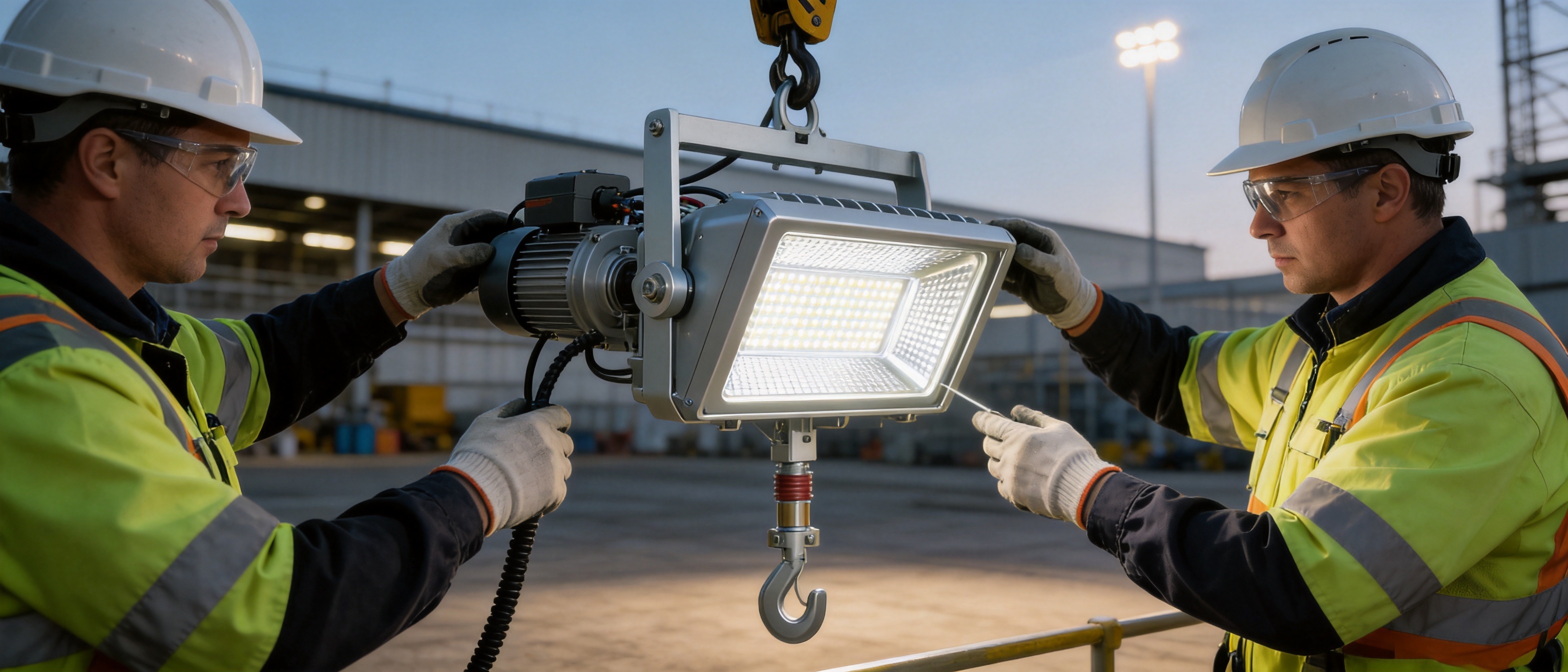
One of the most important differences between this product and many conventional elevated floodlight systems is its electric hoist control mechanism. The system allows the lighting head or luminaire assembly to be lowered to ground level for inspection, cleaning, repair, and fixture replacement.
Traditional high-mounted floodlights often require personnel to use aerial work platforms, climbing equipment, or specialized lifting machinery. Such procedures can be expensive, time-consuming, and difficult to arrange in busy ports, airports, road corridors, and industrial sites. They may also require temporary work zones, traffic restrictions, electrical isolation, and additional safety supervision.
A ground-level lowering system significantly reduces the need for dangerous work at height. Maintenance staff can access the lighting equipment from a safer working position, making routine inspection more practical. This can improve maintenance frequency and help identify loose connections, damaged seals, corrosion, cable aging, or LED failures before they develop into larger problems.
The system can also reduce downtime. When a luminaire is difficult to reach, operators may postpone repairs or wait for special access equipment. A lowering mechanism simplifies the process and can help maintenance teams complete work more efficiently. Faster maintenance is especially beneficial in facilities where lighting is directly connected to traffic movement, loading activity, security, or night-shift productivity.
Although the lowering system improves accessibility, it should be operated according to the supplied instructions and site safety procedures. Electrical isolation, inspection of the hoist, secure positioning of the lowered assembly, and protection against unauthorized operation should be included in the maintenance plan.
Thermal Management and Stable Long-Term Operation
LEDs are efficient light sources, but they still generate heat. If heat is not transferred away effectively, LED performance, driver reliability, and service life may be affected. This is particularly important in high-power floodlights operating for extended periods in warm climates.
The product uses heat dissipation modules within the luminaire assembly. The aluminum-alloy housing supports thermal transfer and helps maintain stable operating conditions. Proper thermal design can reduce the rate of light depreciation and support consistent output over prolonged operating periods.
The operating temperature range is specified as -35°C to 65°C. This broad range allows the product to serve in many climates, from cold winter regions to hot industrial and desert environments. Actual performance can be influenced by solar radiation, mounting position, airflow, ambient humidity, power quality, and enclosure cleanliness, so project-specific evaluation remains advisable.
Stable operation also depends on the quality of electrical connections and the suitability of the power supply. The product supports an input voltage range of AC85-265V, making it adaptable to different electrical networks within the specified limits. Surge protection, grounding, cable selection, and distribution cabinet design should be considered as part of the complete installation.
Control and Dimming Compatibility
The Industrial High Mast Floodlight supports DC 0-10V and DALI dimming options. These control methods enable the lighting system to operate more efficiently when full output is not required. For example, illumination levels may be reduced during low-traffic periods, while full output can be restored when vehicles, workers, cargo handling equipment, or security patrols are active.
Dimming can support energy-saving strategies and contribute to longer operating life by reducing unnecessary full-power operation. It can also assist with integration into intelligent lighting management systems, depending on the project’s control architecture and selected drivers.
For large facilities, control zoning may be used to manage different operational areas independently. Loading zones, access roads, parking areas, storage yards, and perimeter sections may have different schedules and lighting requirements. A properly designed control system can respond more effectively to these differences than a simple on-and-off arrangement.
Control compatibility should be confirmed before ordering because dimming performance depends on the driver, wiring method, control equipment, software, and commissioning procedure. Project teams should define whether the system requires scheduled control, photocell operation, motion detection, centralized monitoring, or integration with a broader smart-city or industrial management platform.
Manufacturing Strength and Production Capability
The performance of a high mast lighting system depends not only on its design but also on how accurately and consistently it is manufactured. Dimensional errors, inconsistent welding, poor surface preparation, or inadequate quality inspection can affect installation, structural reliability, and service life.
Yangzhou Jinyuan Lamps Co., Ltd. has operated in the road illumination industry since 2002. As a professional production, design, and engineering company, it manufactures street light poles, LED street lights, solar street lights, light fixtures, and related outdoor lighting products. Its experience across these product categories supports an integrated understanding of lighting, pole structures, electrical components, and project delivery.
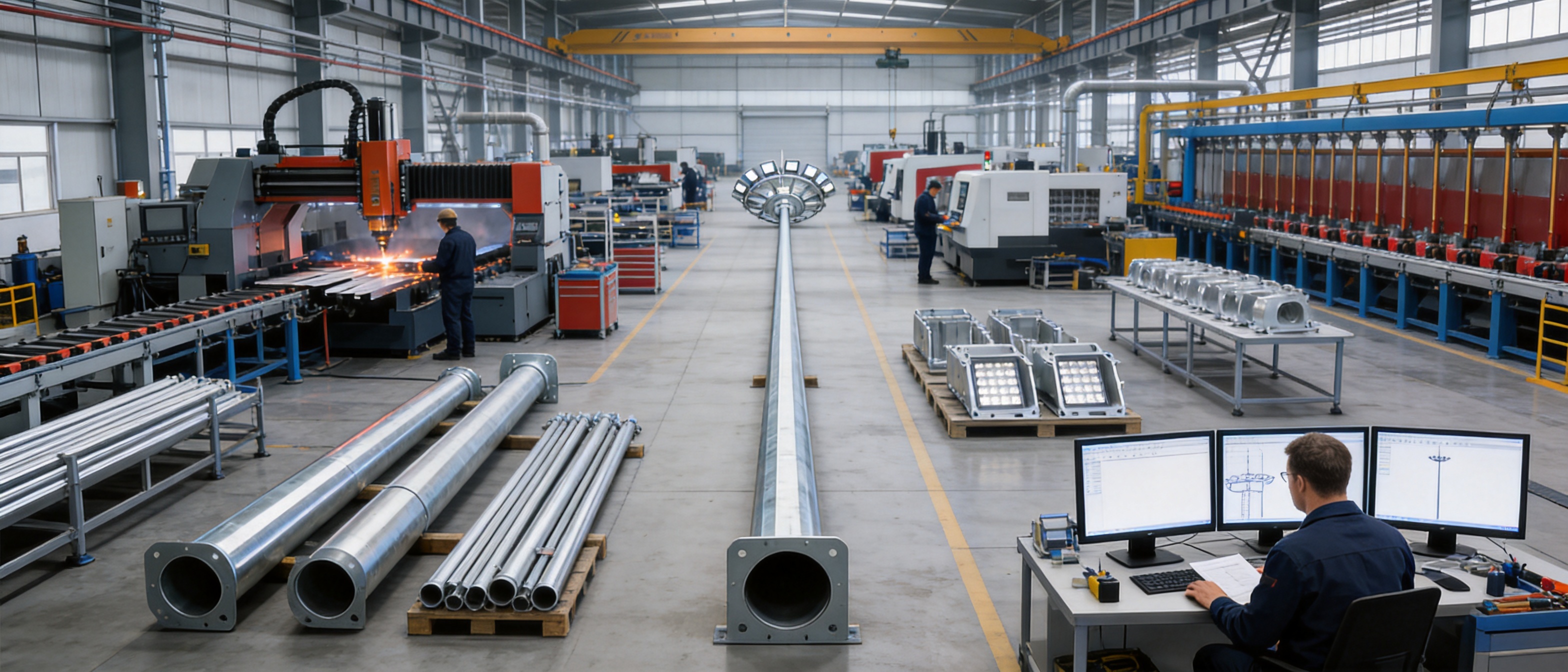
The company operates a production site covering more than 70,000 square meters and has more than 300 professional technicians. Its manufacturing capabilities are supported by equipment including CNC bending machines, automatic welding and cutting machines, electrostatic powder painting equipment, and a 1250-ton die casting machine.
These capabilities are valuable for high mast floodlight production. Pole manufacturing requires accurate cutting, forming, welding, flange preparation, and surface treatment. Luminaire production requires consistent housing dimensions, heat dissipation design, driver installation, sealing, and electrical testing. Having multiple related processes within an organized manufacturing system can improve coordination and production efficiency.
The company also maintains extensive material options, including Q235B, Q345B, S275JR, S355JR, Q460, A36, A572, GR56, GR50, and other grades. Material selection can be aligned with local standards, structural requirements, project specifications, and customer procurement policies.
Precision CNC Bending
Precision CNC bending helps produce pole sections with consistent geometry and controlled dimensions. Consistency is important because multiple pole sections must align during assembly, transportation, and installation. Accurate forming can also reduce the need for post-production correction and help maintain the intended structural design.
Reliable bending quality supports smoother installation and reduces the possibility of misalignment at flanges, access openings, brackets, and connecting points. It also contributes to a cleaner finished appearance, which is important for visible infrastructure in airports, urban transportation hubs, and commercial logistics developments.
High-Accuracy Cutting
The production process is described as offering cutting accuracy down to 0.01 millimeters. High-precision cutting helps create accurate dimensions, clean edges, and better-fitting components. This is beneficial for pole sections, plates, brackets, access doors, flanges, and other parts that must be assembled consistently.
Clean and accurate cuts can reduce unnecessary grinding and rework. They also help improve the quality of welding preparation and connection surfaces. For large orders, process consistency is especially important because every pole and fixture must meet the same design requirements.
Experienced Welding Team
Welding is a critical manufacturing process for pole structures and supporting assemblies. The company’s certified welders have many years of experience in structural and lighting-related production. Skilled welding helps ensure appropriate penetration, joint consistency, visual quality, and dimensional stability.
Welding quality may influence the load-bearing performance of pole sections, flanges, brackets, luminaire frames, and service components. A controlled welding process can also reduce deformation and minimize the amount of correction required after fabrication.
Automated Production Lines
Automated cutting, welding, coating, and related production lines can increase manufacturing efficiency while improving process repeatability. Automation helps reduce variation between products and supports faster production cycles for large-scale projects.
It can also contribute to cost control by reducing unnecessary material waste, improving labor efficiency, and supporting more predictable production scheduling. Environmental benefits may be achieved through better material utilization, controlled coating processes, and reduced rework.
Quality Control from Raw Material to Finished Product
Quality assurance for a high mast floodlight should cover the entire product lifecycle, beginning with raw material selection and continuing through design, fabrication, coating, electrical assembly, inspection, packaging, and delivery.
Material certificates and incoming inspection can help confirm that steel grades, aluminum alloy components, fasteners, cables, and electrical parts conform to the approved specification. During production, dimensional checks are useful for verifying pole length, section geometry, flange position, access door location, bracket alignment, and other critical features.
Welding inspections can be performed according to applicable project standards. Surface treatment inspection may include checking coating coverage, appearance, adhesion, thickness, and galvanizing quality. For luminaires, electrical tests, insulation checks, driver verification, light output evaluation, sealing inspection, and functional testing support reliable final performance.
Quality systems based on ISO9001, ISO14001, and OHSAS18001 provide a framework for production management, environmental responsibility, and occupational health and safety. These certifications and management practices are especially relevant for infrastructure customers who need traceable procurement, documented processes, and consistent supplier performance.
International project experience also supports the company’s ability to work with overseas customers. The company reports exports to more than 200 countries, giving it exposure to different technical specifications, packaging requirements, documentation practices, climate conditions, and installation expectations.
Customized Engineering for Different Projects
Large-area lighting projects rarely have identical requirements. Pole height, wind speed, foundation conditions, light levels, beam distribution, color temperature, control method, corrosion category, transport limitations, and local regulations can vary considerably.
The product can therefore be developed as part of a customized engineering service rather than treated as a one-size-fits-all fixture. Customers may request different pole materials, structural dimensions, luminaire quantities, mounting arrangements, surface finishes, electrical configurations, and control options.
CAD design allows the project team to review the proposed structure and component arrangement before production. Three-dimensional product simulation can help examine the relationship between the pole, lighting head, brackets, hoist system, and floodlights. Three-dimensional scene simulation can further demonstrate how the completed lighting system may appear within an airport, port, road, yard, or industrial site.
Specification and color customization can help align the product with project standards and architectural requirements. Although high mast structures are primarily functional, their appearance may still be important in public transportation facilities, commercial developments, industrial parks, and urban infrastructure projects.
Mechanical calculations for wind and foundation design provide additional technical support. These calculations help project owners and engineering contractors understand the structural requirements before construction begins. Final design approval should be coordinated with the responsible structural engineer and comply with applicable local codes.
Installation and Commissioning Support
Successful installation requires more than delivering the pole and floodlights to the construction site. The foundation must be correctly positioned, anchor bolts must match the pole base, cable routes must be prepared, lifting equipment must be suitable, and all electrical connections must be tested before operation.
The supplier provides overseas onsite installation guidance, helping customers and contractors understand assembly procedures, hoist operation, electrical connection requirements, and commissioning considerations. This support can reduce installation errors and improve the transition from construction to operation.
During installation, the contractor should verify the foundation dimensions, anchor bolt alignment, concrete strength, drainage arrangements, cable entries, grounding, and access clearances. Pole sections should be handled carefully to avoid damage to galvanized surfaces, flanges, cables, and mechanical components.
After the pole is erected, the lighting head should be installed and aligned according to the approved lighting plan. Each floodlight should be aimed at its designated area. Electrical testing should include insulation resistance, grounding continuity, input voltage verification, dimming control checks, and functional operation of the complete assembly.
The electric lowering mechanism should also be tested under controlled conditions. The operator should verify smooth movement, limit protection, cable management, locking arrangements, and safe stopping. Maintenance personnel should receive clear instructions before using the system independently.
Advantages over Conventional Floodlight Installations
| Evaluation Area | Industrial High Mast Floodlight | Conventional Elevated Floodlight Arrangement |
|---|---|---|
| Lighting configuration | Modular frame supporting multiple LED floodlights with adjustable positioning | Often based on fixed brackets or individually installed fixtures |
| Maintenance access | Electric hoist can lower the lighting assembly toward ground level | May require cranes, aerial platforms, or climbing equipment |
| Energy performance | LED source with luminous efficiency up to 140 lumens per watt | May use older, less efficient light sources or poorly optimized fixtures |
| Environmental protection | Aluminum-alloy housing and IP65-rated luminaire design | Protection depends heavily on fixture type, installation quality, and aging |
| Structural adaptation | Multiple steel grades and project-specific wind and foundation calculations | Often supplied as a standard configuration with limited engineering adaptation |
| Control compatibility | Supports DC 0-10V and DALI dimming options | May provide only basic switching or limited control integration |
| Project support | CAD, 3D simulation, customization, mechanical calculation, and installation guidance | Support may be limited to product delivery and basic documentation |
The comparison demonstrates that the value of the product is not limited to its LED light source. Its advantage comes from the complete system: structural engineering, modular illumination, maintenance accessibility, corrosion protection, thermal management, control compatibility, manufacturing precision, and project support.
Conventional floodlight arrangements may appear less complex at the initial procurement stage, but their long-term cost can increase if maintenance requires specialized access equipment or if light distribution is inefficient. A system designed with serviceability in mind can provide a better balance between purchase cost, operating cost, safety, and reliability.
Energy Efficiency and Operating Cost Reduction
Lighting can represent a significant portion of operating expenditure at ports, airports, logistics parks, and industrial yards. These facilities may require illumination throughout long nighttime periods, and some sites operate continuously. Replacing inefficient light sources with high-efficacy LED floodlights can reduce electricity consumption while maintaining or improving visibility.
The stated efficiency of 140 lumens per watt provides a strong basis for energy-conscious design. Actual system energy use depends on the selected wattage, number of floodlights, lighting schedule, control settings, ambient conditions, and required illumination level. Proper optical planning is essential because light that reaches the working surface contributes more value than light scattered outside the intended area.
Dimming support creates additional opportunities for savings. A site may use higher output during peak activity and lower output during periods of limited traffic or reduced personnel presence. This operating strategy can reduce energy use without requiring the entire lighting system to be switched off.
LED systems can also reduce replacement frequency compared with traditional lamps. Lower replacement demand means fewer spare parts, fewer maintenance visits, less use of lifting equipment, and reduced disruption to operations. When combined with a motorized lowering system, these benefits can contribute to a lower total cost of ownership.
Applications in Ports and Coastal Facilities
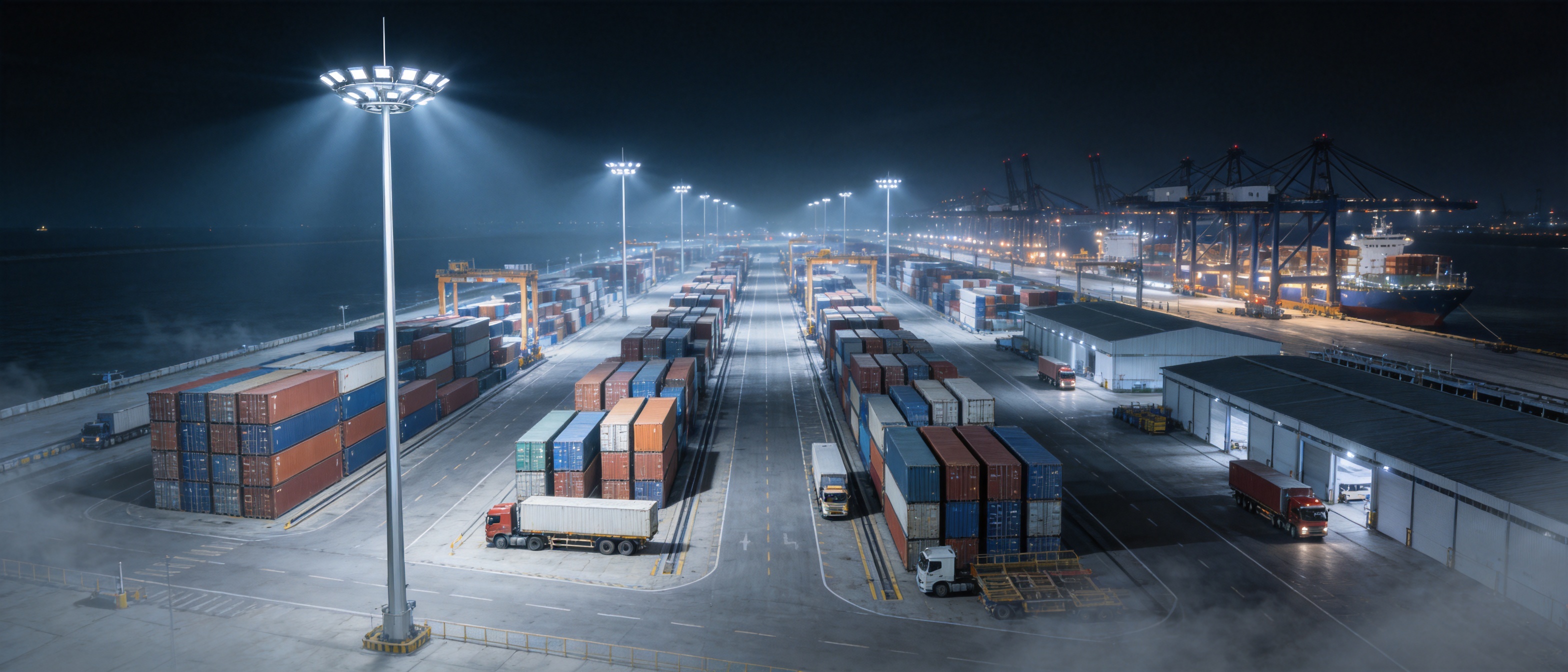
Ports require clear visibility for cargo handling, truck movement, container identification, security monitoring, and equipment operation. Lighting must function reliably in humid, windy, and salt-laden environments. The galvanized steel structure and corrosion-conscious design of this product make it suitable for many port-related applications.
In a container yard, modular floodlights can be aimed toward storage lanes, handling zones, and vehicle routes. In a bulk material terminal, wide-area illumination can support loading, unloading, conveyor access, and inspection areas. At a marine logistics facility, lighting can improve visibility around warehouses, gates, parking areas, and service roads.
Port lighting design must consider glare, reflections from water and metal surfaces, crane operations, vessel traffic, and the visibility requirements of drivers and workers. Professional optical planning and careful aiming are therefore important. The product’s modular frame allows the lighting arrangement to be adjusted to the site’s operational pattern.
Applications in Airports and Transportation Hubs
Airports and transportation hubs require carefully controlled lighting because many activities occur simultaneously. Service vehicles, maintenance teams, passengers, cargo operators, and security personnel may share adjacent areas. Lighting must provide visibility without creating excessive glare or interfering with navigation and operational procedures.
The system can be considered for airport access roads, maintenance zones, cargo facilities, parking areas, service yards, and other large outdoor spaces where high uniformity is required. Final use near aircraft movement areas must be reviewed against airport authority requirements, aviation safety rules, glare limits, and applicable lighting standards.
Transportation hubs also benefit from reliable maintenance access. If a floodlight requires attention, the ability to lower the lighting head can reduce the need for specialized access equipment and help minimize disruption to vehicles and staff.
Applications in Logistics Parks and Warehouses
Modern logistics parks operate with continuous vehicle movement, loading activity, storage operations, and security monitoring. Poorly illuminated yards can increase the possibility of vehicle accidents, loading mistakes, delays, and unauthorized activity.
High-mounted LED floodlights can cover broad areas while reducing the number of separate poles required. This may create a more organized site layout and reduce obstacles in vehicle circulation areas. Multiple fixtures installed on one lighting head can be aimed toward loading docks, parking zones, turning areas, and storage lanes.
The lighting system can also be integrated with operational schedules. Dimming controls may support different lighting levels for peak delivery periods, overnight security, emergency response, or maintenance operations. The ability to provide strong illumination when necessary and reduced output when activity is low can improve overall energy management.
Applications in Construction and Industrial Sites
Open-air construction sites often change as work progresses. Temporary roads, material storage zones, lifting areas, and work platforms may shift during different stages of development. A flexible high mast lighting system can provide broad illumination while supporting changing site requirements.
Industrial facilities such as steel plants, manufacturing yards, mining support areas, and large warehouses may need reliable lighting for night shifts, equipment inspection, loading, and security. The product’s wide operating temperature range and IP65 protection support use in many demanding outdoor environments.
Construction and industrial operations should always consider the relationship between lighting and moving machinery. Floodlights should be aimed to reduce glare for crane operators, drivers, and equipment users. Lighting levels should be verified through site measurements and adjusted after commissioning if necessary.
Maintenance Recommendations
Although the product is designed for long-term service, scheduled maintenance remains important. A maintenance program helps preserve lighting performance, structural integrity, electrical safety, and corrosion protection.
Routine visual inspections should check the pole surface, galvanized coating, flange connections, access doors, fasteners, brackets, cables, and luminaire housing. Special attention should be given to coastal installations, where salt deposits can accumulate on external surfaces and accelerate corrosion if not removed.
The LED lens and housing should be cleaned when dust, oil, salt, or industrial residue reduces light output. Cleaning procedures should use suitable materials that do not scratch the optical surface or damage seals. High-pressure cleaning should be controlled so that water is not forced into cable entries, vents, or joints.
The electric hoist should be inspected according to the manufacturer’s maintenance schedule. Operators should verify that the mechanism moves smoothly and that limit switches, cables, pulleys, locks, and control components remain in good condition. Abnormal noise, vibration, uneven movement, or delayed stopping should be investigated before continued operation.
Electrical inspections should include checking terminal tightness, cable insulation, grounding continuity, driver condition, surge protection, dimming signals, and input voltage. Maintenance staff should follow lockout and electrical isolation procedures before opening the luminaire or control cabinet.
The pole and foundation should be assessed periodically for settlement, cracking, water accumulation, loose anchor bolts, or other conditions that could affect stability. Inspection intervals should be adjusted according to local weather, corrosion exposure, traffic importance, and site risk level.
Project Planning and Selection Guidance
Before selecting the final configuration, the project team should define the area to be illuminated, required illumination levels, uniformity targets, operating schedule, mounting height, wind conditions, corrosion environment, electrical supply, and maintenance strategy.
The number and power of floodlights should be determined through professional lighting calculations rather than estimated only from site size. A lighting simulation can identify dark areas, excessive brightness, glare, shadowing, and potential spill light. It can also help establish the appropriate beam angles and aiming directions.
Pole height should be selected according to the coverage area, mounting position, surrounding obstructions, wind load, glare considerations, and maintenance requirements. The product information includes pole heights from 6 to 10 meters for the listed configuration, while larger projects may require separately engineered dimensions and structural arrangements.
Electrical engineers should confirm compatibility between the AC85-265V input range, local power network, driver, dimming system, protection devices, and control cabinet. If the project uses DALI or 0-10V control, the wiring topology and commissioning procedure should be defined in advance.
For coastal and severe-weather locations, the customer should provide relevant environmental information early in the design process. This may include wind speed, salt exposure, humidity, temperature range, soil conditions, and local corrosion requirements. Early engineering coordination helps prevent changes after production has begun.
Service and Technical Collaboration
A successful lighting project often requires continuous communication between the owner, lighting designer, civil engineer, electrical contractor, installation team, and manufacturer. The supplier’s role can extend from product consultation to project completion.
Technical collaboration may include product selection, lighting configuration, CAD drawings, 3D product simulation, 3D scene simulation, color and specification customization, wind and foundation calculations, production coordination, inspection documentation, packaging, shipping support, and overseas installation guidance.
This project-oriented approach is especially useful for customers purchasing complete lighting systems rather than individual fixtures. It helps ensure that the pole, floodlight, hoist, electrical system, foundation, and control method are considered together.
Yangzhou Jinyuan Lamps Co., Ltd. combines manufacturing capacity with engineering experience in the road illumination industry. Its broad product range, international export experience, large production site, professional technical team, and documented quality systems allow it to support both standard orders and customized infrastructure projects.
Warranty and Long-Term Value
The stated warranty period is five years. A five-year warranty can provide customers with greater confidence when purchasing lighting equipment for large projects, especially where replacement costs, installation access, and operational interruptions are significant.
Warranty conditions should be reviewed before purchase and should clearly identify coverage for LED modules, drivers, housings, hoist components, structural parts, and surface treatment. Installation, operating voltage, surge events, unauthorized modification, improper maintenance, and environmental conditions may affect warranty applicability.
Long-term value should be evaluated through total cost of ownership rather than purchase price alone. Important factors include energy consumption, maintenance access, replacement frequency, spare parts availability, corrosion resistance, structural service life, control capability, installation cost, and downtime risk.
The Industrial High Mast Floodlight addresses several of these cost factors simultaneously. Its LED efficacy can reduce energy use, its modular design supports adaptable illumination, its galvanized structure improves outdoor durability, its IP65 luminaire housing protects against dust and water, and its electric hoist reduces the complexity of maintenance work.
Frequently Asked Questions
What is the Industrial High Mast Floodlight used for?
It is designed for large outdoor areas that require broad and reliable illumination. Typical applications include ports, airports, logistics parks, construction sites, industrial yards, warehouses, transportation hubs, access roads, loading areas, and storage facilities.
Can multiple floodlights be installed on one lighting head?
Yes. The luminaire frame uses a modular design that supports multiple high-power floodlights. The number and arrangement should be determined according to lighting calculations, structural capacity, wind conditions, and the required coverage area.
How does the electric hoist improve maintenance?
The electric hoist allows the lighting head to be lowered toward ground level. Maintenance personnel can then inspect, clean, adjust, or replace fixtures without relying on routine aerial work. This can improve safety, shorten maintenance time, and reduce the need for cranes or elevated platforms.
Is the product suitable for coastal areas?
It is designed with a hot-dip galvanized steel structure, aluminum-alloy luminaire housing, and IP65-rated protection. These features support outdoor use in coastal environments. For highly corrosive locations, the final coating system, fasteners, accessories, and maintenance program should be selected according to site conditions.
What input voltage does the floodlight support?
The listed input voltage range is AC85-265V. The actual electrical configuration should be confirmed against the project’s power network, driver selection, protection equipment, and local electrical standards.
What dimming systems are supported?
The product supports DC 0-10V and DALI dimming options. Compatibility should be confirmed with the selected LED driver and the site’s lighting control system before production.
What is the operating temperature range?
The stated operating temperature range is -35°C to 65°C. Performance may also depend on solar radiation, airflow, humidity, installation position, and enclosure cleanliness.
What is the luminaire protection rating?
The listed protection rating is IP65. This indicates protection against dust ingress and water jets from different directions when the product is correctly installed and maintained.
What color temperatures are available?
The listed color temperature range is 3000K to 6000K. The most suitable selection depends on visual requirements, glare control, site activity, local standards, and the surrounding environment.
What materials can be used for the pole?
The listed pole materials include Q235, Q355, SS400, GR65, and other project-specified steel grades. Additional material options may be available depending on structural calculations and customer requirements.
What pole heights are available?
The listed configuration supports pole heights from 6 to 10 meters. Other heights or structural arrangements may be considered through project-specific engineering and wind-load calculations.
Does the manufacturer provide design support?
Yes. Available services include CAD design, three-dimensional product simulation, three-dimensional scene simulation, specification and color customization, mechanical calculations for wind and foundations, and overseas onsite installation guidance.
What quality certifications support the manufacturing process?
The company’s products and management systems are associated with ISO9001, ISO14001, and OHSAS18001 standards. Customers should request the relevant current certificates and project documentation during procurement.
What is the warranty period?
The listed warranty period is five years. Specific terms, exclusions, installation conditions, and component coverage should be confirmed in the commercial and technical documentation.
Conclusion
The Industrial High Mast Floodlight is a comprehensive outdoor lighting solution for sites where safety, coverage, durability, energy performance, and maintenance efficiency are essential. Its modular floodlight frame supports broad and uniform illumination, while advanced optical lenses help direct light toward designated work areas.
The combination of a hot-dip galvanized steel structure, aluminum-alloy luminaire housing, IP65 protection, high-efficiency LED technology, broad operating temperature range, and flexible control options makes the product suitable for many demanding industrial and infrastructure environments.
Its electric hoist mechanism is a particularly valuable feature because it improves access to elevated lighting equipment and reduces the risks and costs associated with working at height. This service-oriented design can help operators maintain reliable illumination with less disruption to daily activities.
Behind the product is an established manufacturing and engineering organization with extensive experience in road illumination, a large production site, professional technicians, advanced forming and welding equipment, automated production lines, extensive material choices, international export experience, and project customization capabilities.
For ports, airports, logistics parks, construction sites, industrial warehouses, transportation hubs, and other large outdoor facilities, the Industrial High Mast Floodlight offers a practical balance of structural reliability, optical performance, energy efficiency, operational safety, and long-term service value.
References
1. Manufacturer-provided Industrial High Mast Floodlight product specifications and technical description.
2. Manufacturer-provided information on LED efficiency, input voltage, operating temperature, IP rating, color temperature, dimming, materials, pole height, and warranty.
3. Manufacturer-provided production equipment and manufacturing capability information.
4. Manufacturer-provided company profile and road illumination industry experience.
5. General principles of outdoor area lighting design, luminaire photometry, glare control, and lighting uniformity.
6. General engineering practices for steel lighting poles, wind-load assessment, foundation design, galvanization, and corrosion protection.
7. General maintenance practices for LED luminaires, electrical enclosures, motorized lowering systems, and outdoor lighting structures.