

JINYUAN
JINYUAN
JINYUAN
JINYUAN
JINYUAN
JINYUAN
JINYUAN
JINYUAN
JINYUAN
JINYUAN
JINYUAN
JINYUAN
JINYUAN
JINYUAN
JINYUAN
JINYUAN
Content
- 1 Introduction
- 2 What Is an Integrated Framework Traffic Signal Light?
- 3 Key Product Specifications
- 4 Integrated Structural Design
- 5 High-Performance LED Signal Modules
- 6 Protection for Outdoor Operation
- 7 Advantages Compared with Conventional Traffic Signal Supports
- 8 Manufacturing Materials and Production Capability
- 9 Surface Treatment and Corrosion Control
- 10 Intelligent Traffic Management Compatibility
- 11 Applications
- 12 Design and Customization Services
- 13 Quality Assurance
- 14 Company Manufacturing Strength
- 15 Installation and Maintenance Recommendations
- 16 Selection Guide for Project Buyers
- 17 Why Choose an Integrated Framework Solution?
- 18 Frequently Asked Questions
- 18.1 What is the main benefit of an integrated framework traffic signal light?
- 18.2 What signal lamp sizes are available?
- 18.3 How long is the LED light source expected to operate?
- 18.4 Can the pole and arm dimensions be customized?
- 18.5 Is the framework suitable for high-wind areas?
- 18.6 What steel materials can be used?
- 18.7 How is the steel structure protected against corrosion?
- 18.8 Can the product operate in very cold or hot climates?
- 18.9 What does IP54 protection mean for the signal light?
- 18.10 Can the system be used with intelligent traffic control?
- 18.11 Does the manufacturer provide design support?
- 18.12 What should be confirmed before placing an order?
- 19 Conclusion
- 20 References
- 21 Product: Integrated Framework Traffic Signal Light
Introduction
Traffic signal equipment is one of the most important components of a modern road transportation system. It communicates right-of-way instructions, organizes vehicle and pedestrian movements, reduces conflict at intersections, and supports safer, more efficient travel. As traffic volumes increase and road networks become more complex, traffic authorities require signal systems that combine high visibility, structural strength, stable electrical performance, convenient installation, and long-term resistance to outdoor conditions.
The integrated framework traffic signal light is designed to meet these requirements through a unified structural concept. Instead of treating the signal heads, support structure, wiring arrangement, and mounting components as completely separate elements, the system integrates them into an orderly framework. This approach creates a clean appearance while improving mechanical stability, installation coordination, and overall system reliability.
The product is suitable for urban intersections, arterial roads, highways, industrial parks, newly developed districts, commercial areas, and other locations where traffic signals must remain clearly visible in changing weather and lighting conditions. Its rectangular support structure, high-strength steel construction, LED signal modules, protective treatment, and configurable design make it adaptable to a wide range of road engineering projects.
Manufactured by Yangzhou Jinyuan Lamps Co., Ltd., the integrated framework traffic signal light benefits from extensive experience in road lighting equipment, pole manufacturing, structural fabrication, lighting engineering, and overseas project support. The company’s production capabilities include CNC bending, precision cutting, automated welding, hot-dip galvanizing, powder coating, mechanical calculation, CAD design, three-dimensional simulation, and installation guidance.
This article examines the product’s construction, operating performance, application value, manufacturing process, customization options, and advantages compared with conventional traffic signal support solutions.
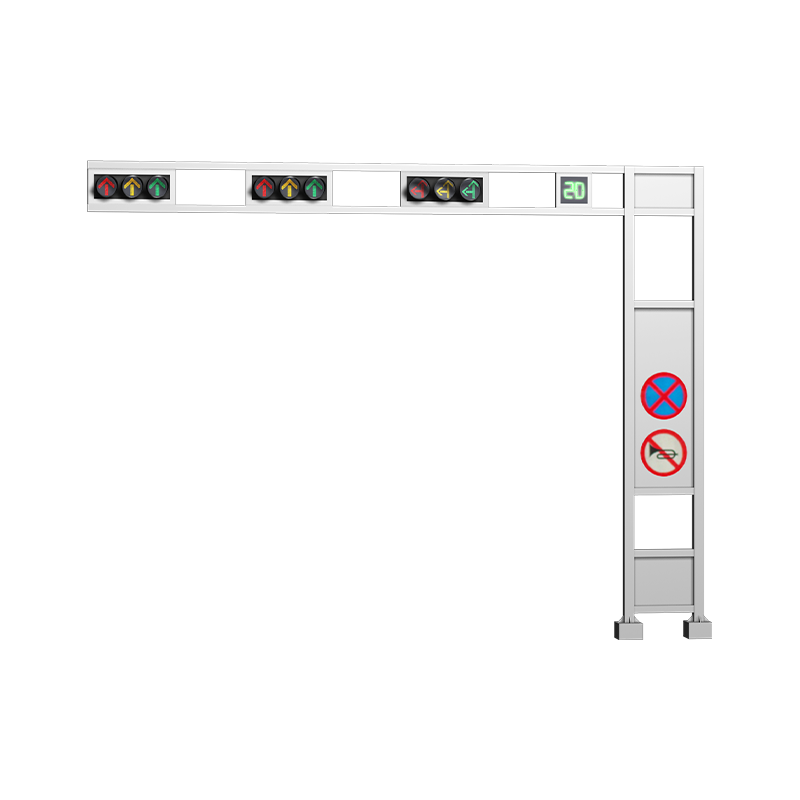
Integrated Framework Traffic Signal Light
What Is an Integrated Framework Traffic Signal Light?
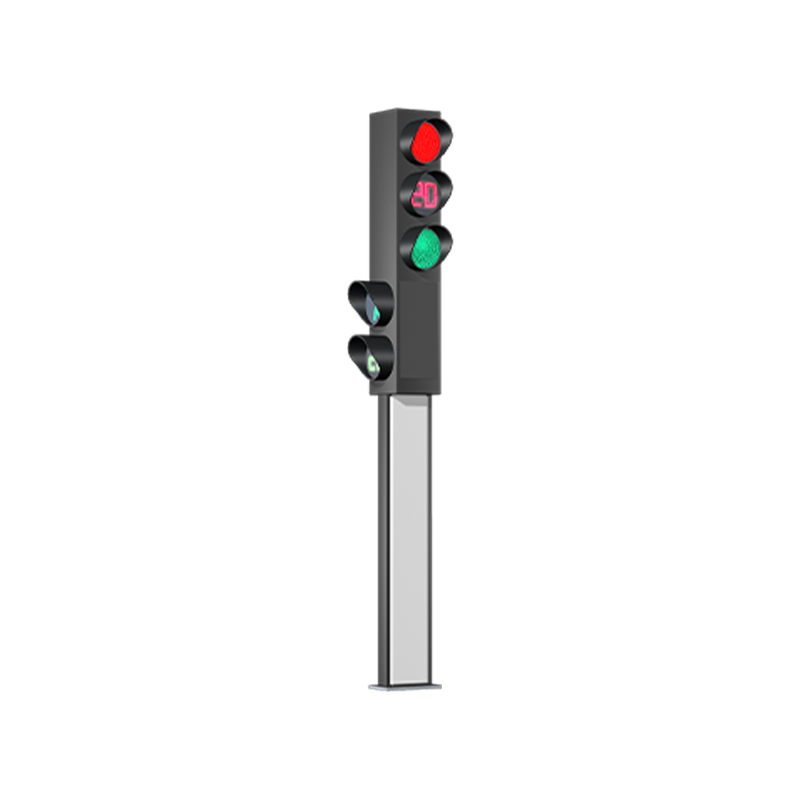
An integrated framework traffic signal light is a traffic control installation in which the signal heads and their supporting structure are developed as a coordinated system. The primary support normally consists of a vertical pole and a horizontal cantilever arm. Traffic signal lamps are positioned along the arm or at other specified points so that drivers can identify the signal indication from an appropriate approach distance.
The design combines a rectangular main pole with a rectangular cross arm. This creates a visually balanced structure with a strong load-bearing profile. Compared with simple circular or lightly constructed supports, the rectangular framework can provide a practical combination of rigidity, appearance, and space for internal routing or mounting accessories.
The integrated concept also simplifies project planning. The pole dimensions, arm length, lamp diameter, foundation requirements, color treatment, and signal configuration can be considered together rather than selected independently. This helps engineering teams coordinate the traffic signal with road width, lane arrangement, sight distance, overhead clearance, and local environmental conditions.
The product can be configured with signal lamp diameters of 400 millimeters or 500 millimeters. These options allow the system to be matched to different intersection scales and viewing distances. Larger signal heads may be appropriate for wide roads, multilane approaches, or locations where enhanced visual recognition is required.
Although the system is designed as an integrated framework, it remains suitable for project-specific customization. Arm lengths can be selected within a broad range, pole colors can be customized, and the arrangement of signal heads and accessories can be adjusted according to the traffic control plan.
Key Product Specifications
The following specifications summarize the standard structural and electrical characteristics of the integrated framework traffic signal light. Final project specifications should be confirmed according to local standards, traffic engineering requirements, site conditions, and the selected configuration.
| Item | Standard or Available Specification |
|---|---|
| Main pole structure | Rectangular material structure with a clean and elegant appearance |
| Pole height | Approximately 7,000–7,500 millimeters |
| Arm length | Approximately 6,000–14,000 millimeters |
| Main pole tube | 150 × 250 millimeters square tube, 5–10 millimeter wall thickness |
| Cross arm tube | 100 × 200 millimeters square tube, 4–8 millimeter wall thickness |
| Surface treatment | Hot-dip galvanizing, with optional plastic spraying and customized colors |
| Signal lamp diameter | 400 millimeters or 500 millimeters |
| Red wavelength | 620–625 nanometers |
| Green wavelength | 504–508 nanometers |
| Yellow wavelength | 590–595 nanometers |
| Operating power supply | 187–253 volts, 50 hertz |
| Rated power | Less than 20 watts per lamp |
| LED source life | More than 50,000 hours under suitable operating conditions |
| Ambient temperature | Approximately -40°C to +80°C |
| Protection class | IP54 |
The specifications demonstrate that the product is intended for demanding outdoor use. The selected pole and arm dimensions provide a strong basis for medium- and large-scale intersection applications, while the low-power LED modules help reduce energy consumption during continuous operation.
Integrated Structural Design
Unified Pole and Arm Configuration
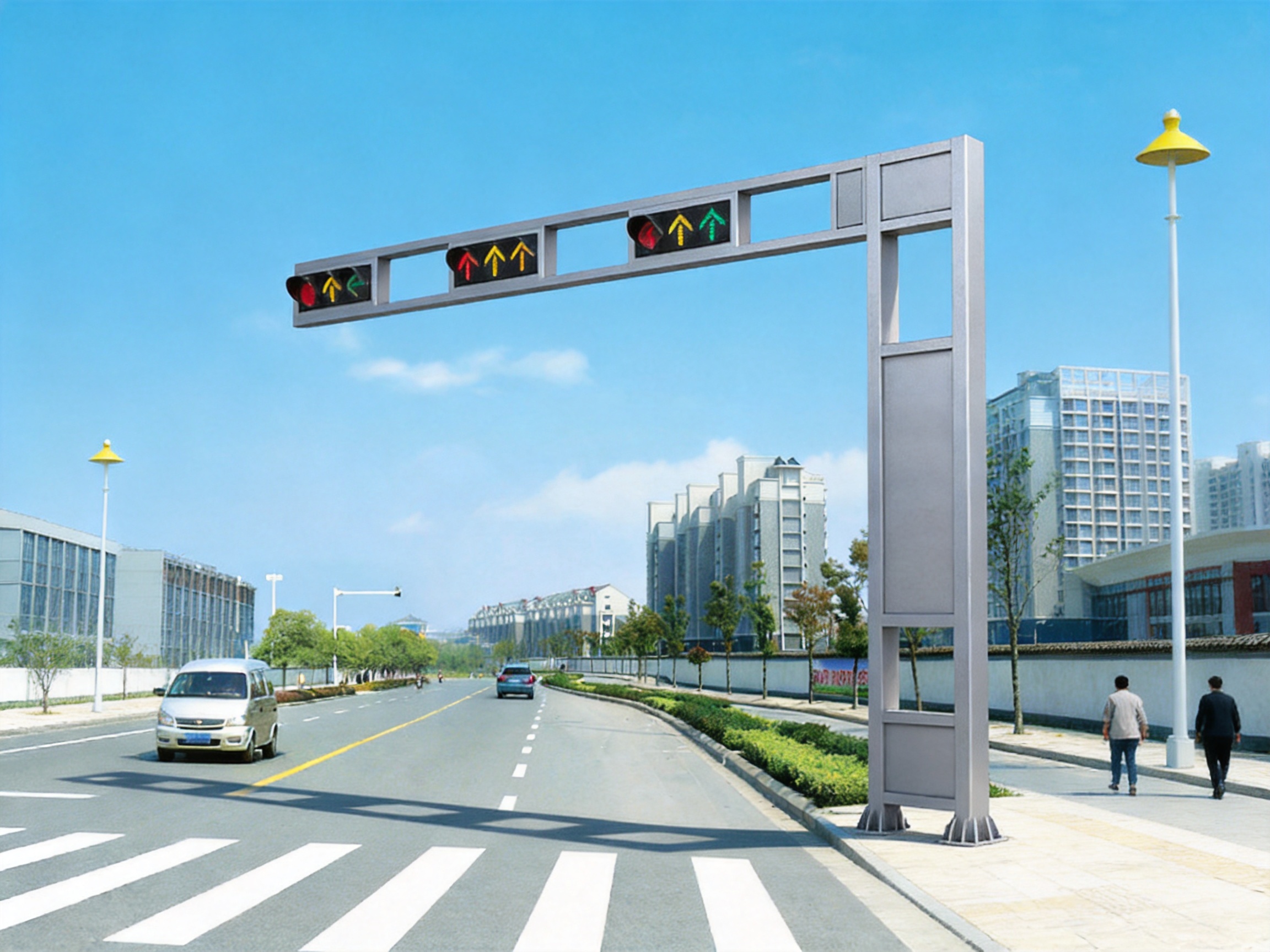
The main advantage of the integrated framework is the coordinated relationship between the vertical pole and horizontal arm. The rectangular pole provides support from the foundation upward, while the cross arm extends over the traffic lanes. Because the two components are engineered as part of one structural solution, their dimensions, connection points, and load paths can be assessed together.
This is especially valuable for cantilever traffic signal applications. A cantilever arm must resist the weight of the signal heads, wind pressure, vibration, and occasional environmental loading. Poorly coordinated components can lead to excessive movement, difficult installation, or premature stress at connection points. A properly designed integrated framework helps distribute these forces more effectively.
Clean Appearance for Urban Roads
The rectangular framework has a simple, modern appearance that suits urban streets, business districts, transportation hubs, and newly constructed communities. Its orderly geometry can contribute to a consistent streetscape when multiple intersections use the same design language.
A clean structural appearance is not only an aesthetic benefit. Unnecessary protrusions, exposed components, and irregular support arrangements can complicate maintenance and collect dirt or moisture. A well-organized framework gives maintenance personnel clearer access to the main components and makes visual inspection easier.
Improved Wind Resistance
Traffic signal supports are exposed to wind loads throughout their service life. The cantilever arm may experience considerable pressure because it extends horizontally over the roadway and carries signal heads, brackets, cables, and other accessories. The integrated framework is designed to improve stability under these conditions through suitable tube dimensions, structural connections, and foundation calculations.
Wind resistance is affected by more than the material thickness alone. Important factors include the total projected area, arm length, pole height, connection method, foundation design, local wind speed, soil characteristics, and the arrangement of mounted equipment. For this reason, project-specific mechanical calculations are recommended before production and installation.
The manufacturer provides mechanical calculation support for wind and foundation requirements. This service helps engineering teams determine whether the standard configuration is suitable or whether adjustments are needed for a particular site.
High-Performance LED Signal Modules
Low Energy Consumption
Each signal lamp has a rated power of less than 20 watts. Compared with traditional incandescent traffic signal sources, LED technology can significantly reduce electricity consumption while maintaining clear signal output. Lower power demand also reduces heat generation and may decrease the load placed on control cabinets and related electrical infrastructure.
For traffic signals operating continuously throughout the year, even a modest reduction in power per lamp can generate meaningful savings over the life of the installation. Energy efficiency becomes particularly valuable when a project includes many intersections or when signals are combined with other road lighting and intelligent transportation equipment.
High Brightness and Uniform Indication
Traffic signals must remain recognizable in direct sunlight, overcast weather, rain, fog, and nighttime conditions. The LED modules are designed to provide bright and uniform color output so that road users can distinguish red, yellow, and green indications without unnecessary confusion.
The specified chromaticity ranges support consistent signal recognition. Red is specified at approximately 620–625 nanometers, green at 504–508 nanometers, and yellow at 590–595 nanometers. Consistent color performance is important because traffic participants rely on rapid visual interpretation, often while approaching at speed.
Long Operating Life
The LED light source has a service life of more than 50,000 hours under suitable operating conditions. A long-life source reduces the frequency of lamp replacement and helps lower maintenance costs, especially at high-mounted positions where access may require traffic control equipment or temporary lane closures.
Long service life also supports better system availability. A traffic signal that remains operational for extended periods with fewer component changes can reduce interruptions to intersection management and decrease the workload for maintenance teams.
Clear Day and Night Visibility
The signal modules are intended to provide clear indications during both daytime and nighttime operation. Their brightness and optical arrangement support recognition from a suitable approach distance, while the signal head configuration can be selected according to the road layout and viewing requirements.
Visibility should always be evaluated as part of the complete intersection design. Signal placement, mounting height, approach geometry, surrounding trees, advertising structures, street lighting, weather, and the presence of nearby buildings can all influence the final result. The integrated framework provides a stable platform for positioning the signal heads correctly within that design.
Protection for Outdoor Operation
Weather-Resistant Construction
Traffic signals are exposed to sunlight, precipitation, temperature variation, dust, wind, and pollution. The product is specified for an ambient temperature range of approximately -40°C to +80°C, supporting use in a broad range of climates.
The IP54 protection class indicates protection against limited dust ingress and water splashing from different directions. This level is suitable for many general outdoor traffic signal applications when the equipment is correctly installed and maintained. Project planners should confirm whether local environmental conditions require a different protection level or additional sealing measures.
Corrosion Protection
The pole body is hot-dip galvanized to provide protection against rust and atmospheric corrosion. The stated service expectation for the galvanized structure can reach approximately 20 years under suitable environmental and maintenance conditions. Actual durability depends on humidity, salinity, industrial pollutants, surface damage, drainage, installation quality, and local climate.
Hot-dip galvanizing forms a metallurgically bonded zinc coating over the steel surface. This coating protects the underlying steel by creating a physical barrier and by providing sacrificial protection when small areas are exposed. It is widely used for outdoor poles, guardrails, transmission structures, road equipment, and other steel products that must withstand long-term exposure.
Optional Surface Spraying
In addition to galvanizing, the framework can be finished with plastic spraying or powder coating in a selected color. This option supports project identity, visual coordination, and additional surface protection. Common applications include municipal color schemes, transportation authority standards, industrial park branding, and streetscape design requirements.
Color customization should be specified before production so that the coating system, surface preparation, film thickness, and inspection requirements can be planned correctly. Proper preparation is essential to ensure adhesion and long-term appearance.
Advantages Compared with Conventional Traffic Signal Supports
More Complete Structural Coordination
Conventional solutions may combine a standard pole, a separately selected arm, third-party brackets, and signal heads from different sources. While this approach can be economical for simple projects, it may create coordination challenges. Different components may have incompatible dimensions, unclear load assumptions, inconsistent finishes, or separate delivery schedules.
The integrated framework approach brings the major structural components into one coordinated product solution. This can reduce design conflicts and make it easier for the project team to confirm overall dimensions, mounting positions, surface treatment, and installation requirements before shipment.
Better Adaptation to Large Intersections
The available arm length of approximately 6,000–14,000 millimeters allows the product to serve a wide range of road widths. Longer arms can support signal positioning over multiple lanes, while shorter configurations may suit smaller urban intersections.
Compared with lightweight supports designed only for narrow roads, the integrated framework offers a stronger platform for broader traffic approaches. Its suitability must still be verified through structural and foundation calculations, particularly in areas with high wind speed, soft soil, seismic activity, or special road clearance requirements.
Reduced Maintenance Burden
LED signal modules, corrosion-resistant steel treatment, and a coordinated support structure can reduce the frequency of maintenance interventions. Fewer lamp replacements mean fewer elevated work operations, fewer traffic disruptions, and lower long-term labor requirements.
The orderly layout also supports easier inspection. Maintenance personnel can check the pole surface, arm connections, signal housings, cable entries, and mounting hardware using a consistent inspection procedure. If replacement is necessary, standardized signal sizes and organized wiring can simplify the work.
Lower Energy Demand
The low power consumption of LED signal modules provides an advantage over older light sources. Reduced energy demand may lower operating costs and help authorities meet energy-efficiency targets. In larger traffic networks, energy savings can accumulate across hundreds or thousands of signal heads.
Professional Engineering Support
A major advantage of purchasing a complete framework from an experienced road equipment manufacturer is access to engineering assistance. Support may include CAD drawings, three-dimensional product simulation, three-dimensional scene simulation, specification confirmation, color customization, wind calculation, foundation calculation, and overseas installation guidance.
This support is particularly useful for contractors, distributors, municipal authorities, and international project developers who need to coordinate product selection with civil works, electrical plans, traffic control drawings, and installation schedules.
Manufacturing Materials and Production Capability
Material Selection
The manufacturer can work with a broad range of structural steel grades, including Q235B, Q345B, S275JR, S355JR, Q460, A36, A572, GR56, and GR50, subject to project requirements and availability. These material options allow the structural design to be matched to local standards, strength requirements, fabrication conditions, and procurement specifications.
Material selection affects yield strength, tensile strength, weldability, forming performance, weight, cost, and corrosion treatment compatibility. The appropriate grade should be selected according to the approved engineering design rather than based only on nominal thickness.
Material Inventory and Production Continuity
Maintaining an extensive stock of materials can help reduce delays between order confirmation and fabrication. Consistent material availability is valuable for projects with strict delivery schedules, phased intersection construction, or large quantities of identical poles and arms.
Inventory management also supports production planning. When the correct steel grades and dimensions are available, the manufacturer can organize cutting, bending, welding, and surface treatment more efficiently. This contributes to more predictable lead times and more consistent product quality.
Precision CNC Bending
CNC bending equipment is used to produce repeatable shapes and angles. Accurate bending is important because structural components must align correctly during assembly and installation. Inconsistent bending can create stress concentrations, fitting problems, visible deformation, or additional adjustment work at the construction site.
Precise and consistent bending improves structural integrity and reduces the need for post-production correction. It also supports repeatability when a project requires many poles and arms with identical dimensions.
High-Accuracy Cutting
The manufacturing process provides cutting accuracy of approximately 0.01 millimeters for applicable operations. Accurate cutting helps produce exact dimensions, clean edges, and improved component fit. It also reduces material waste and limits the amount of grinding or corrective fabrication required after cutting.
Clean and accurate edges are important for welding quality. Poorly prepared edges can create excessive gaps, uneven penetration, or unnecessary weld buildup. Precision cutting supports more stable welding conditions and more consistent finished structures.
Certified Welding Personnel
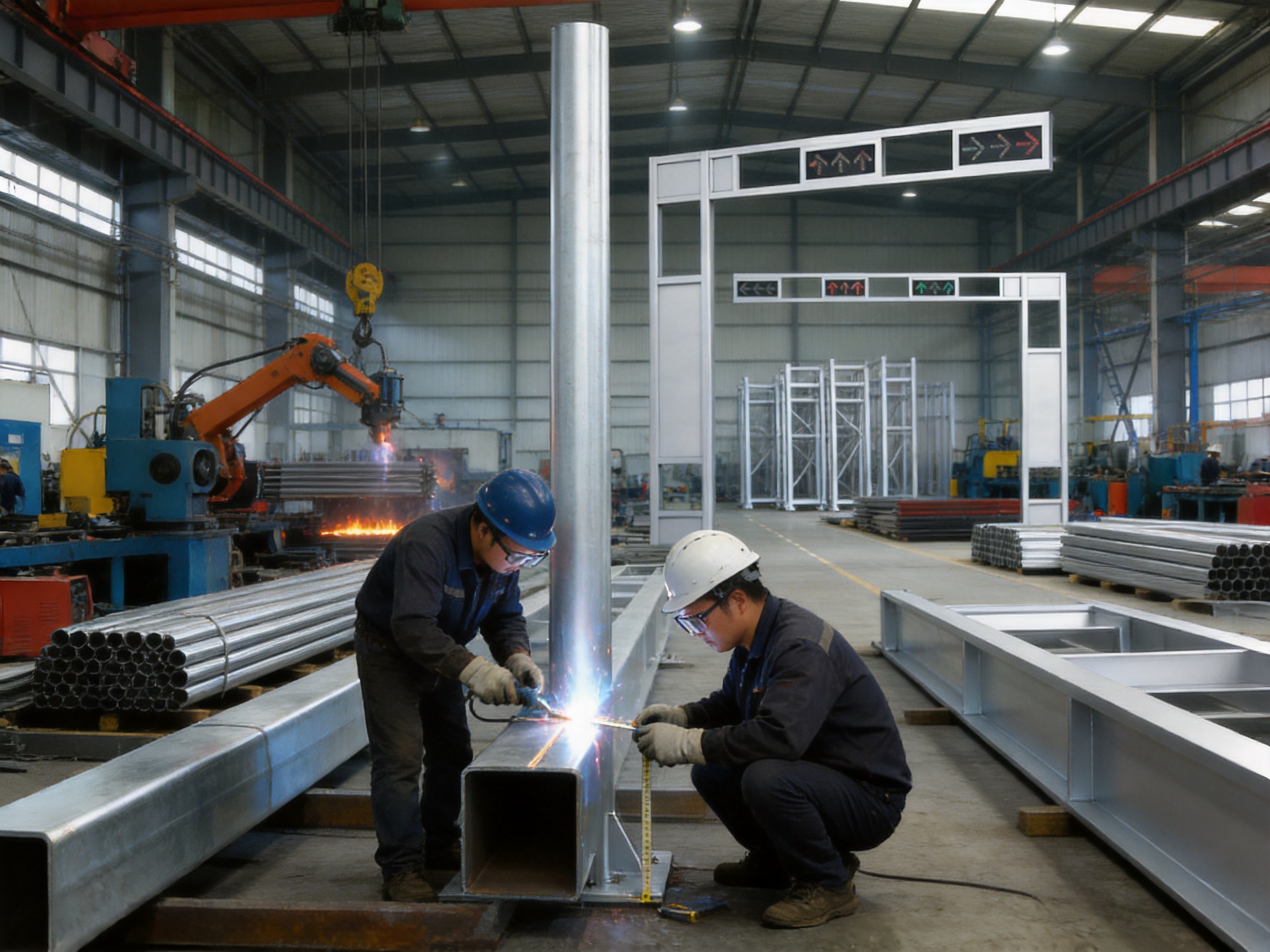
Welding is a critical stage in the production of traffic signal poles and arms. The manufacturer’s certified welders have many years of practical experience in structural fabrication. Their work focuses on producing reliable joints, maintaining appropriate welding sequences, controlling distortion, and completing projects within the required schedule.
Quality welding improves the load-bearing performance and service reliability of the framework. It is especially important at areas subject to bending moments, such as the connection between the vertical pole and the cantilever arm. Appropriate inspection and documentation can be arranged according to the project’s quality requirements.
Automated Production Lines
Automated lines help improve consistency, production efficiency, and process control. Automation can reduce variation between individual products, shorten production cycles, and support high-volume orders. It may also reduce unnecessary material handling and improve workplace safety.
Automation does not replace engineering judgment or skilled inspection. Instead, it provides a repeatable manufacturing base that is supported by experienced technicians, quality personnel, and final product checks.
Surface Treatment and Corrosion Control
After fabrication, the steel structure requires proper surface treatment to protect it from corrosion. Hot-dip galvanizing is a widely used process for outdoor traffic signal poles because it provides broad coverage, including many edges, corners, and less accessible surfaces.
Before galvanizing, the steel is prepared through cleaning and treatment stages that remove oil, scale, rust, and other contaminants. The prepared structure is immersed in molten zinc, allowing the zinc to bond with the steel surface. The resulting coating helps protect the steel during outdoor exposure.
Where a colored finish is required, an additional spraying or powder coating process may be applied. The galvanized surface and coating system must be compatible, and the surface should be properly prepared to promote adhesion. Color selection can be based on municipal standards, project specifications, or the surrounding architectural environment.
Inspection may include visual examination, coating thickness measurement, checking for exposed steel, reviewing drainage and vent openings, and confirming that mounting surfaces remain suitable for assembly. Quality control at this stage supports long-term appearance and corrosion resistance.
Intelligent Traffic Management Compatibility
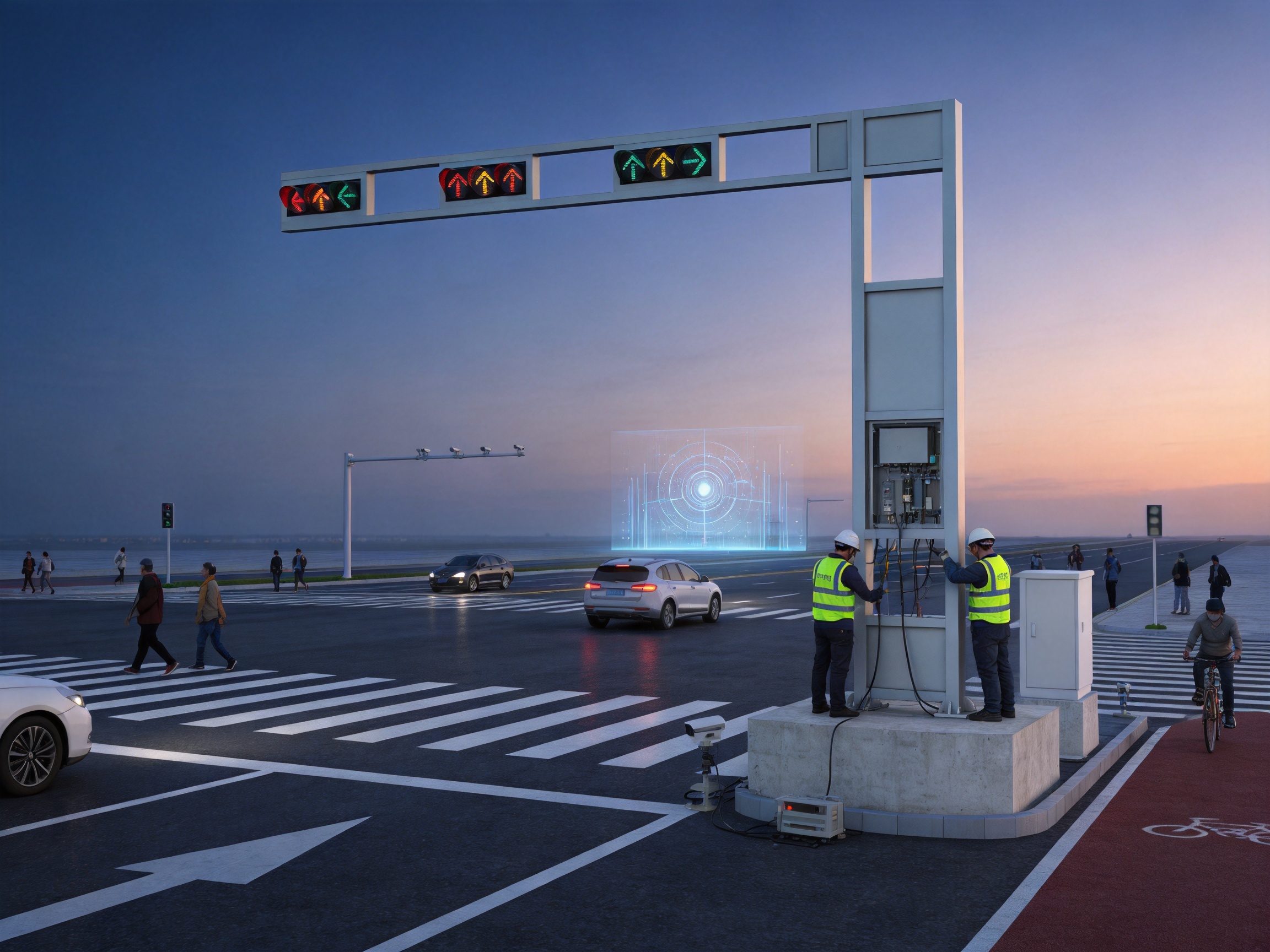
The integrated framework traffic signal light is not limited to passive illumination. It can serve as part of an intelligent traffic management system when connected to suitable controllers, detection equipment, communication networks, and centralized management platforms.
An intelligent control system can adjust signal duration according to traffic flow data. Depending on the project configuration, information may be obtained from vehicle detectors, cameras, radar systems, connected road equipment, or a central traffic management platform. Dynamic timing can help reduce unnecessary waiting, improve intersection throughput, and respond more effectively to changing demand.
Signal timing must be developed and approved by qualified traffic engineers. Automatic adjustment should operate within safe limits and remain consistent with pedestrian phases, emergency vehicle priorities, coordination plans, and local traffic regulations.
The product’s interference-resistant design supports stable operation in environments containing electrical equipment, communication systems, and other sources of electromagnetic activity. Proper grounding, surge protection, cabinet design, cable routing, and controller compatibility remain important elements of the complete installation.
Applications
Urban Intersections
In urban areas, intersections may include multiple lanes, turning movements, pedestrian crossings, bicycle facilities, bus stops, and nearby buildings. The integrated framework can provide a clearly positioned overhead signal structure while maintaining an orderly streetscape.
Highways and Arterial Roads
High-speed roads require signals that can be recognized from an appropriate distance. The available 400- and 500-millimeter signal sizes, combined with a stable cantilever structure, can support visibility at larger approaches. The final selection should consider approach speed, stopping sight distance, lane count, and local traffic standards.
Industrial Parks
Industrial parks often experience heavy vehicle movements, including trucks and specialized transport. A robust traffic signal framework can help organize internal intersections, access roads, loading areas, and connections to public highways.
Commercial and Mixed-Use Developments
Shopping centers, office districts, residential developments, and mixed-use projects require traffic control systems that are functional but also visually compatible with the built environment. Customized colors and a clean rectangular framework can help integrate the signal structure into the project’s overall design.
Transportation Hubs
Airports, railway stations, ports, and bus terminals depend on clear traffic organization. Signal frameworks can be used at vehicle entrances, internal circulation roads, parking access points, and connections between different transportation modes.
Design and Customization Services
CAD Design
CAD design helps project teams review dimensions, mounting locations, access points, foundation interfaces, and component relationships before fabrication. Drawings can be developed to match the approved traffic plan and civil engineering requirements.
Three-Dimensional Product Simulation
A three-dimensional product simulation provides a more complete view of the structure than a two-dimensional drawing alone. It can help verify the appearance of the pole, arm, signal heads, brackets, and access arrangements before production.
Three-Dimensional Scene Simulation
Scene simulation places the product within a representative road environment. This can help assess visual proportions, overhead clearance, signal alignment, nearby structures, and the relationship between the traffic signal and surrounding street equipment.
Specification and Color Customization
Projects may require variations in arm length, pole height, signal diameter, surface color, mounting accessories, and electrical configuration. Customization allows the product to meet project-specific requirements while maintaining a controlled manufacturing process.
Wind and Foundation Calculation
Structural calculations are essential for safe installation. Wind pressure, pole geometry, signal area, arm length, soil bearing capacity, foundation dimensions, anchor bolt arrangement, and local design codes should be considered together. The manufacturer can provide mechanical calculation support for the wind and foundation interface.
Overseas Installation Guidance
For international projects, installation guidance can help local contractors understand component identification, assembly sequence, anchor bolt positioning, signal mounting, cable routing, grounding, and final inspection. Proper guidance can reduce installation errors and support consistent project quality across different regions.
Quality Assurance
Quality assurance begins with the selection and inspection of raw materials. Steel grade, thickness, dimensions, and surface condition should be verified before cutting and forming. Production records can help maintain traceability throughout the manufacturing process.
During fabrication, inspectors can review cutting accuracy, bending dimensions, weld appearance, structural alignment, and component completeness. Special attention should be given to cantilever connections and other areas subject to significant loads.
After surface treatment, the finished structure should be checked for coating continuity, appearance, dimensions, mounting holes, access openings, and compatibility with the approved drawings. Signal modules should be tested for brightness, color, power consumption, switching operation, and basic electrical safety.
Quality documentation can be arranged according to project requirements. Depending on the contract, documentation may include material certificates, production inspection records, welding qualifications, coating records, dimensional inspection reports, electrical test results, and packing lists.
Company Manufacturing Strength
Yangzhou Jinyuan Lamps Co., Ltd. is affiliated with Jinshang Electric Group and has operated in the road illumination industry since 2002. The company specializes in street light poles, LED street lights, solar street lights, lighting fixtures, traffic-related equipment, and associated engineering products.
The company operates on a site area of more than 70,000 square meters and has more than 300 professional technicians. Its products are exported to more than 200 countries, giving the organization experience with different climates, project standards, packaging requirements, installation conditions, and international communication needs.
The company’s quality management systems and product operations are associated with international standards including ISO9001, ISO14001, and OHSAS18001. These standards reflect attention to quality management, environmental management, and occupational health and safety processes.
Its equipment includes bending machines, powder electrostatic painting equipment, automatic welding and cutting machines, and a 1,250-ton die-casting machine. This combination supports the production of structural poles, lighting components, brackets, housings, and related road equipment.
The company’s broad product experience is valuable for projects that combine traffic signals with street lighting, high mast lighting, solar lighting, LED floodlights, communication towers, photovoltaic power generation systems, or other municipal infrastructure. A supplier with knowledge across several road equipment categories can help coordinate multiple product requirements within a larger development.
Installation and Maintenance Recommendations
Foundation Preparation
The foundation should be designed according to the approved structural calculations and local construction standards. Anchor bolts must be positioned accurately, and the foundation should achieve the required strength before the pole is erected. Incorrect bolt spacing or insufficient concrete strength may affect alignment and structural safety.
Pole Erection
Appropriate lifting equipment should be used to raise the pole and arm safely. The lifting plan should consider the total weight, center of gravity, arm projection, nearby power lines, traffic lanes, and wind conditions. Temporary traffic control may be necessary during installation.
Signal Alignment
Signal heads should be aligned with the intended traffic approaches and secured using suitable hardware. The final position should be checked from the driver’s viewpoint to confirm that the signal is not obscured by poles, trees, signs, buildings, or other equipment.
Electrical Connection
Electrical work should be completed by qualified personnel. Cable routing should protect conductors from abrasion, water entry, excessive bending, and mechanical damage. Grounding and surge protection should follow the project’s electrical design and applicable local standards.
Routine Inspection
Routine inspection should include signal brightness, color output, switching response, housing condition, cable entries, mounting hardware, pole corrosion, coating damage, foundation condition, and arm alignment. Dust and other deposits should be removed when they affect visibility or heat dissipation.
Any damaged coating should be repaired according to the approved corrosion protection procedure. Loose bolts, abnormal vibration, water ingress, or unusual electrical behavior should be addressed promptly rather than waiting for a complete failure.
Selection Guide for Project Buyers
Before ordering an integrated framework traffic signal light, buyers should prepare the basic road and site information. Important data includes the number of lanes, approach width, required signal positions, road classification, design wind speed, soil conditions, local electrical standard, ambient temperature, signal diameter, color requirements, and installation schedule.
Buyers should also confirm whether the project requires pedestrian signals, countdown displays, camera brackets, variable message equipment, emergency vehicle priority devices, communication cabinets, or other accessories. These additions can affect structural loading, cable routing, power supply, and the final arm configuration.
For overseas projects, the purchaser should clarify voltage and frequency requirements, plug and terminal arrangements, packaging standards, export documents, customs information, spare parts, and installation responsibilities. Early communication helps prevent delays and ensures that the final product matches the site conditions.
A complete technical review should be conducted before production. Approved drawings, material specifications, surface treatment requirements, signal configurations, inspection criteria, and delivery terms should be confirmed in writing.
Why Choose an Integrated Framework Solution?
The integrated framework traffic signal light offers a balanced solution for projects that require structural strength, visual clarity, energy efficiency, and long-term outdoor reliability. Its rectangular pole and arm design supports a clean appearance, while the engineered framework provides a stable platform for overhead signal placement.
LED technology reduces power consumption and supports long operating life. Hot-dip galvanizing provides protection for the steel structure, and optional spraying allows color customization. The broad range of arm lengths and signal sizes enables the product to serve both medium and large intersections.
Compared with fragmented procurement, an integrated product can simplify design coordination, manufacturing control, shipping organization, installation planning, and after-sales communication. The availability of CAD design, three-dimensional simulation, wind and foundation calculations, and overseas installation guidance adds value beyond the physical pole and lamp.
Most importantly, the system is supported by a manufacturer with experience in road lighting products, structural fabrication, intelligent lighting applications, and international engineering supply. This combination helps contractors, distributors, municipalities, and infrastructure developers obtain a traffic signal solution that is practical, durable, and adaptable.
Frequently Asked Questions
What is the main benefit of an integrated framework traffic signal light?
The main benefit is the coordinated design of the pole, cantilever arm, mounting components, and signal modules. This can improve structural stability, simplify installation planning, create a cleaner appearance, and reduce coordination problems between separately sourced components.
What signal lamp sizes are available?
The standard signal lamp diameters are approximately 400 millimeters and 500 millimeters. The appropriate size depends on road width, approach speed, viewing distance, local regulations, and the traffic engineering design.
How long is the LED light source expected to operate?
The LED light source has a stated service life of more than 50,000 hours under suitable operating conditions. Actual performance depends on temperature, power quality, thermal management, operating hours, environmental exposure, and maintenance.
Can the pole and arm dimensions be customized?
Yes. Pole height, arm length, tube dimensions, signal arrangement, mounting accessories, and surface color can be discussed according to project requirements. Custom designs should be reviewed through engineering drawings and structural calculations before production.
Is the framework suitable for high-wind areas?
The framework is designed to provide strong wind resistance, but suitability must be confirmed through project-specific calculations. Local wind speed, pole height, arm length, signal area, foundation design, soil conditions, and applicable standards all affect the final configuration.
What steel materials can be used?
Available material options include Q235B, Q345B, S275JR, S355JR, Q460, A36, A572, GR56, and GR50, subject to project specifications, local standards, and material availability.
How is the steel structure protected against corrosion?
The standard protection method is hot-dip galvanizing. Optional plastic spraying or powder coating can be added for color customization and additional surface protection. Long-term performance depends on the environment, coating quality, installation, and maintenance.
Can the product operate in very cold or hot climates?
The stated ambient operating range is approximately -40°C to +80°C. The complete project design should also consider solar radiation, humidity, snow, ice, dust, coastal salt, electrical equipment ratings, and local climatic conditions.
What does IP54 protection mean for the signal light?
IP54 indicates protection against limited dust ingress and water splashing from various directions. It is suitable for many outdoor applications, but project designers should confirm whether additional protection is required for severe dust, driving rain, flooding, coastal exposure, or other special conditions.
Can the system be used with intelligent traffic control?
Yes. The LED signal system can be integrated into an intelligent traffic management arrangement when compatible controllers, detectors, communication equipment, and software are provided. Signal timing and automatic adjustments must be designed and approved by qualified traffic engineers.
Does the manufacturer provide design support?
Design support can include CAD drawings, three-dimensional product simulations, three-dimensional scene simulations, specification and color customization, wind and foundation calculations, and overseas onsite installation guidance.
What should be confirmed before placing an order?
Buyers should confirm the pole height, arm length, signal diameter, signal arrangement, operating voltage and frequency, steel grade, surface treatment, color, foundation requirements, local standards, accessories, inspection requirements, packaging, delivery schedule, and installation responsibilities.
Conclusion
The integrated framework traffic signal light is a comprehensive solution for modern intersection control. Its unified rectangular structure, extended cantilever capability, efficient LED modules, corrosion-resistant finish, broad operating temperature range, and customizable configuration allow it to serve a wide variety of road and infrastructure projects.
Its advantages are strengthened by professional manufacturing processes. Material inventory, CNC bending, precision cutting, experienced welding, automated production, hot-dip galvanizing, powder coating, and quality inspection all contribute to a reliable finished product. Engineering services such as CAD design, three-dimensional simulation, structural calculation, and installation guidance further support successful project delivery.
For municipalities, contractors, distributors, and infrastructure developers seeking a dependable traffic signal structure, the integrated framework design provides a practical balance between appearance, durability, energy efficiency, maintainability, and project adaptability. When properly designed, installed, and maintained, it can support clear traffic communication and stable intersection operation for many years.
References
1. Product technical information for the Integrated Framework Traffic Signal Light, including structural dimensions, LED specifications, operating conditions, and protection class.
2. ISO 9001, Quality Management Systems—Requirements.
3. ISO 14001, Environmental Management Systems—Requirements with Guidance for Use.
4. OHSAS 18001, Occupational Health and Safety Management Systems—Requirements.
5. General engineering principles for hot-dip galvanizing of fabricated steel structures.
6. General traffic signal design and installation practices for urban roads, arterial roads, and highway intersections.
7. General principles of LED traffic signal operation, energy efficiency, chromaticity, and long-life outdoor lighting.
8. Structural design considerations for cantilever poles, wind loading, foundation design, and outdoor traffic equipment.