


JINYUAN
JINYUAN
JINYUAN
JINYUAN
JINYUAN
JINYUAN
JINYUAN
JINYUAN
JINYUAN
JINYUAN
JINYUAN
JINYUAN
JINYUAN
JINYUAN
JINYUAN
JINYUAN
Content
- 1 What Is an Integrated Framework Traffic Signal Light?
- 2 Design Advantages Over Conventional Traffic Signal Structures
- 3 Advanced LED Signal Technology
- 4 Intelligent Traffic Control Capability
- 5 Durability for Outdoor and Harsh Environments
- 6 Material Selection and Structural Reliability
- 7 Precision Manufacturing Process
- 8 Quality Assurance and Production Control
- 9 Technical Specifications
- 10 Engineering and Customization Services
- 11 Installation Considerations
- 12 Maintenance and Lifecycle Performance
- 13 Energy Efficiency and Environmental Benefits
- 14 Applications in Different Transportation Environments
- 15 Why Manufacturing Capability Matters to Buyers
- 16 Comparison with Basic Traffic Signal Solutions
- 17 Procurement Guidance for Project Owners
- 18 Safety and Compliance Considerations
- 19 Project Service from Consultation to Completion
- 20 Frequently Asked Questions
- 20.1 What is the main benefit of an integrated framework traffic signal light?
- 20.2 What pole and arm dimensions are available?
- 20.3 What materials can be used for the framework?
- 20.4 How are the pole and arm protected from corrosion?
- 20.5 What signal lamp sizes are available?
- 20.6 How much power does each signal lamp consume?
- 20.7 How long does the LED light source last?
- 20.8 Can the traffic signal timing respond to traffic flow?
- 20.9 Is the signal suitable for extreme temperatures?
- 20.10 What does the IP54 protection class mean?
- 20.11 Can the framework color be customized?
- 20.12 Does the manufacturer provide design support?
- 20.13 What industries and products does the manufacturer serve?
- 20.14 What should be confirmed before placing an order?
- 21 Conclusion
- 22 References
- 23 Product: Integrated Framework Traffic Signal Light
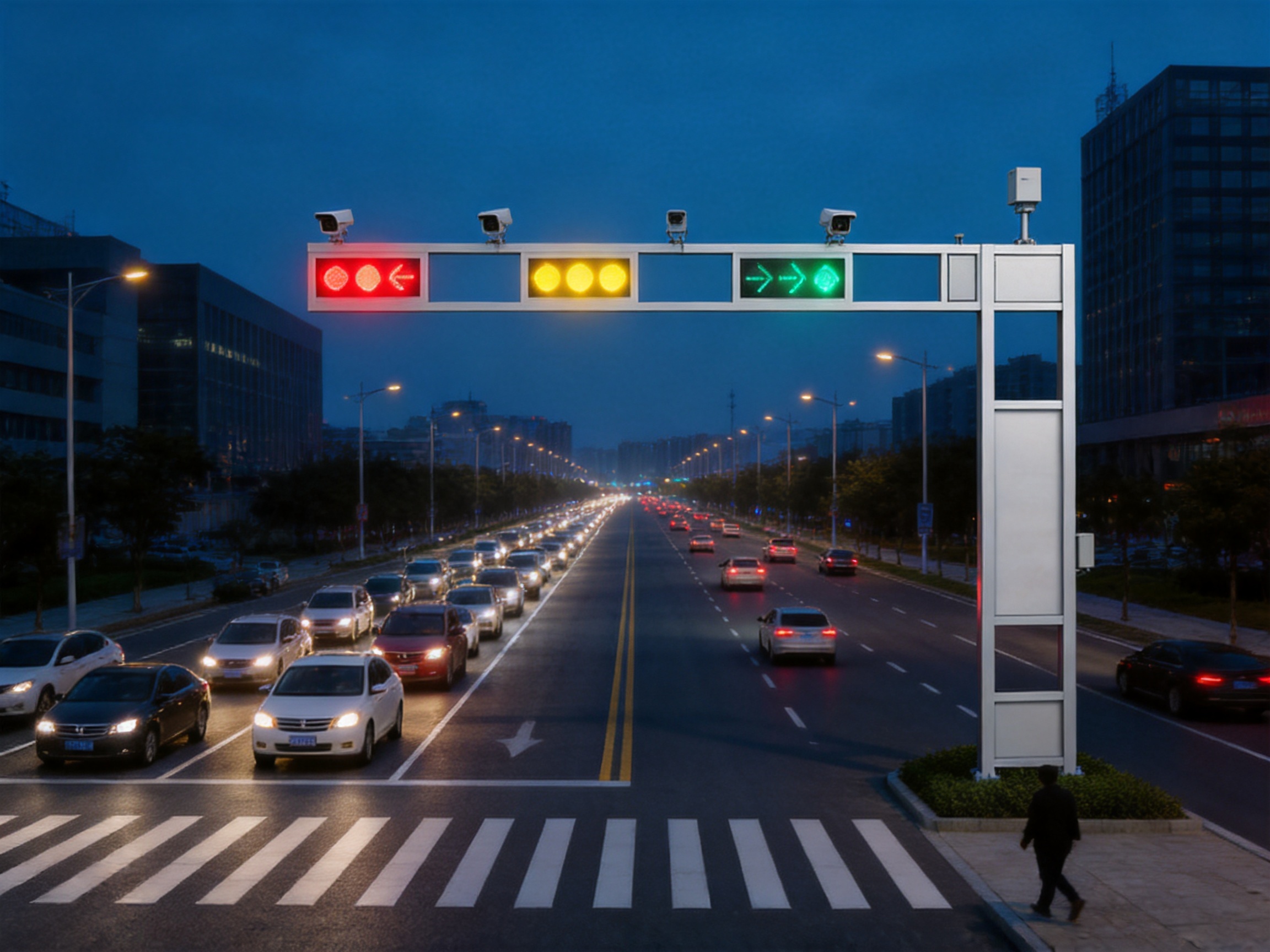
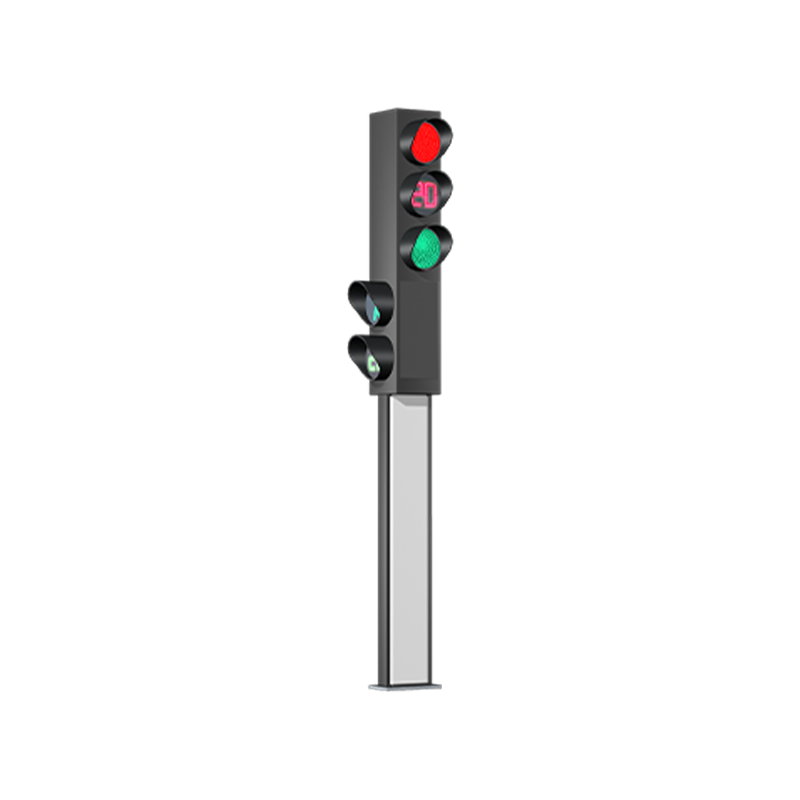
Modern road networks require traffic signal equipment that can deliver clear instructions, withstand demanding outdoor conditions, and integrate smoothly with increasingly intelligent traffic management systems. The integrated framework traffic signal light is designed to meet these requirements through a unified structural concept, advanced LED technology, durable materials, and flexible engineering support. By combining the signal lights, framework, and supporting structural components into one coordinated system, this solution provides a clean appearance, reliable mechanical performance, and efficient installation for urban intersections, highways, arterial roads, industrial parks, and other transportation environments.
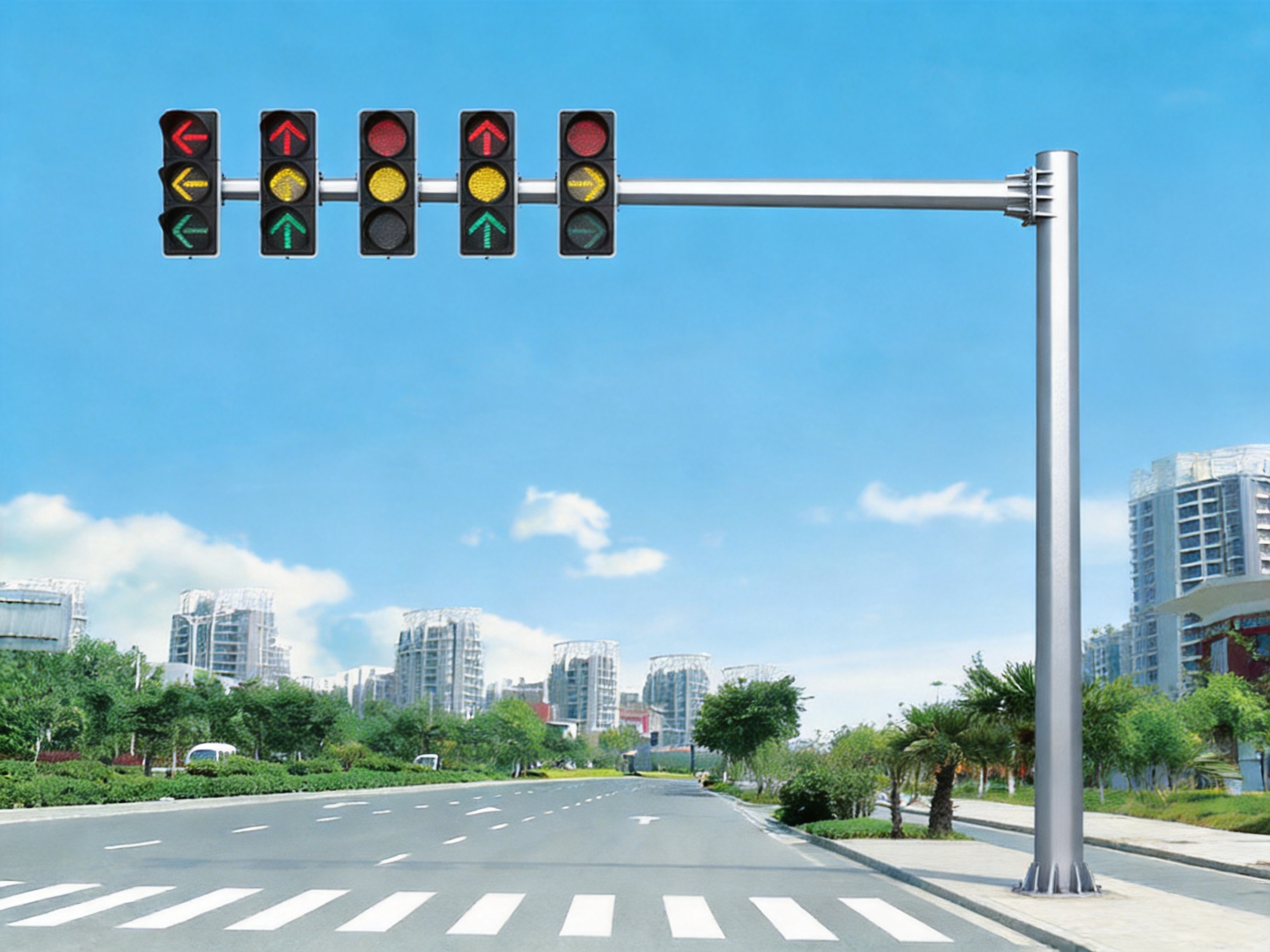
Unlike conventional traffic signal arrangements that may depend on multiple separate brackets, poles, and mounting accessories, the integrated framework design creates a more organized installation. Its rectangular structural form supports an elegant appearance while improving the overall stability of the signal assembly. The framework is engineered to resist wind and environmental stress, and its dimensions can be adapted to different intersection layouts. With pole heights of approximately 7,000 to 7,500 millimeters and arm lengths ranging from 6,000 to 14,000 millimeters, the product can serve a variety of road widths and traffic control requirements.
The signal light uses high-efficiency LED sources with low power consumption, high brightness, and a service life exceeding 50,000 hours. Red, green, and yellow signal colors are produced within defined chromaticity ranges to ensure that road users can identify instructions accurately during both daytime and nighttime operation. The intelligent control system can be incorporated into traffic management applications where signal timing is adjusted according to traffic flow, intersection conditions, or programmed control strategies.
Yangzhou Jinyuan Lamps Co., Ltd. manufactures this product as part of a broader portfolio that includes street light poles, LED street lighting, solar street lights, high mast lighting, mid-mast lighting, LED floodlights, communication towers, photovoltaic power generation systems, and traffic facilities. Established in 2002, the company combines product design, manufacturing, engineering, and project service capabilities to support both domestic and overseas infrastructure projects.
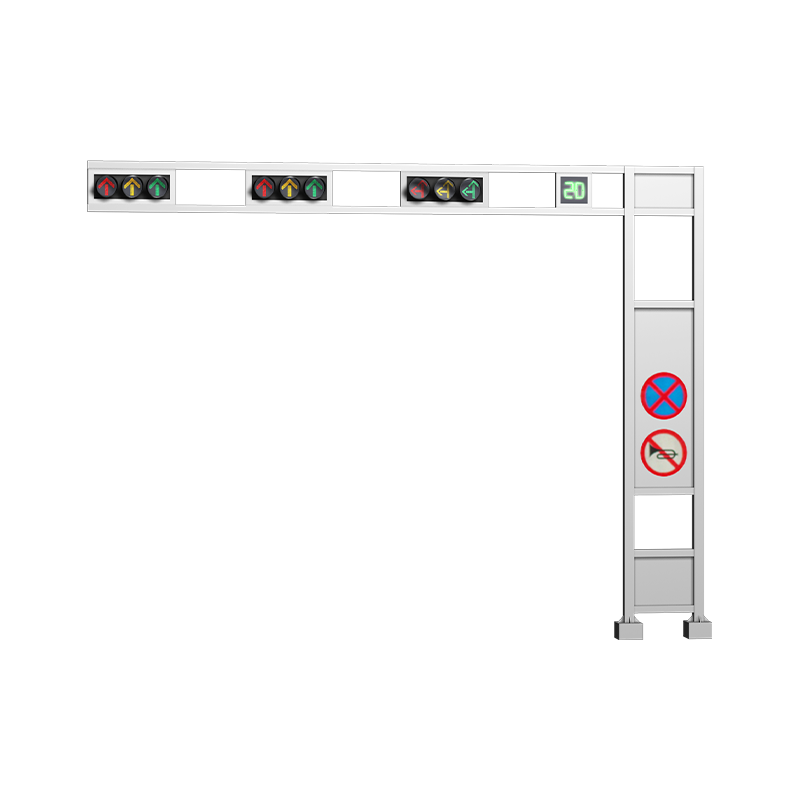
Integrated Framework Traffic Signal Light
What Is an Integrated Framework Traffic Signal Light?
An integrated framework traffic signal light is a traffic control structure in which the signal-supporting framework and related mounting elements are designed as a coordinated unit. The system normally includes a main vertical pole, a horizontal or cantilever arm, signal lamp mounting positions, cable routing provisions, foundation connections, surface protection, and traffic signal fixtures. This coordinated design reduces the visual and mechanical complexity often associated with separately assembled signal components.
The main pole uses a rectangular material structure that provides a distinctive appearance and a broad, stable profile. The standard main pole tube is specified as a 150 × 250 millimeter square tube with a wall thickness of approximately 5 to 10 millimeters. The cross arm uses a 100 × 200 millimeter square tube with a wall thickness of approximately 4 to 8 millimeters. These dimensions may be adjusted according to span length, loading conditions, local standards, and project-specific engineering calculations.
The product is suitable for signal lamps with a diameter of either 400 millimeters or 500 millimeters. This allows the equipment to be selected according to the visual distance required at an intersection and the traffic authority’s preferred signal format. The framework can accommodate different arrangements of signal heads and supplementary equipment, subject to the final design and installation requirements.
The integrated structure is especially useful where a clear and orderly intersection appearance is important. At large urban junctions, a well-designed signal framework can help reduce visual clutter and create a consistent streetscape. On highways and wide arterial roads, the long cross arm allows signal heads to be positioned where drivers can see them clearly from multiple approach lanes.
Design Advantages Over Conventional Traffic Signal Structures
Unified Structural Appearance
One of the primary advantages of the integrated framework design is its unified appearance. Traditional installations may use different pole profiles, separate brackets, exposed connection points, and multiple accessory supports. These elements can create a complicated visual effect, particularly at large intersections with several signal heads. The rectangular framework creates a more consistent geometry and can be finished in a standard galvanized surface or with optional painted colors.
A clean appearance is not only a matter of aesthetics. An organized structure makes the signal arrangement easier to understand during inspection, maintenance, and future modification. It also supports the visual identity of modern transportation corridors, civic districts, industrial parks, and commercial developments where infrastructure appearance is part of the overall planning concept.
Improved Wind Resistance
Traffic signal structures are exposed to wind, rain, temperature changes, dust, and vibration throughout their service life. A long cantilever arm creates a significant loading condition, particularly in open areas, coastal zones, elevated roads, and regions subject to seasonal storms. The integrated framework is engineered to provide improved resistance to wind loading through appropriate tube dimensions, wall thickness, welded connections, base design, and foundation coordination.
The precise structural design of the main pole and cross arm helps distribute mechanical loads through the framework. Rather than relying only on small independent brackets, the system provides a continuous support arrangement. This can reduce unnecessary movement of the signal heads and help maintain a stable visual signal position during normal weather conditions.
Wind resistance must always be confirmed according to local design codes, site exposure, foundation conditions, signal configuration, and actual span requirements. For this reason, project-specific mechanical calculations and foundation assessments are important parts of the engineering process. The manufacturer provides mechanical calculation support for wind and foundation requirements so that the final structure can be adapted to the installation environment.
Efficient Use of Space
The integrated framework is suitable for intersections where ground space is limited or where traffic signal equipment must span several lanes. A cantilever-style arm can position signal heads above the roadway without requiring additional support poles in the median or along the roadside. This can help preserve pedestrian pathways, improve sight lines, and reduce interference with road users.
The available arm length of approximately 6,000 to 14,000 millimeters provides flexibility for different road geometries. The actual length should be selected according to lane width, signal head arrangement, clearance requirements, wind loading, and local traffic engineering regulations.
Adaptability to Different Projects
Every intersection has different requirements. A small urban junction may need a short arm and a limited number of signal heads, while a wide highway interchange may require a longer span, multiple signal positions, additional signs, and specialized mounting accessories. The product can be configured with different dimensions, colors, surface finishes, signal diameters, and control arrangements.
Customization can begin during the design phase. CAD design, three-dimensional product simulation, three-dimensional scene simulation, specification selection, and color customization help project owners and engineers evaluate the proposed structure before production. These tools reduce uncertainty and allow conflicts with road geometry, overhead utilities, clearance zones, or nearby structures to be identified early.
Advanced LED Signal Technology
The signal lamps use LED light sources designed to provide high brightness while consuming less energy than many traditional lighting technologies. Each lamp has a rated power of less than 20 watts under the stated product configuration. Lower power demand can reduce operating costs, decrease the load on traffic signal cabinets, and support energy-conscious transportation infrastructure.
LED sources also provide rapid response. When a signal changes state, the light reaches its intended brightness quickly, helping drivers and pedestrians receive clear visual information. The optical system is designed to produce a bright and uniform signal display rather than a weak or uneven image. This is particularly important during daytime operation, when sunlight and atmospheric glare can reduce the apparent contrast of signal lights.
The specified chromaticity ranges are red at approximately 620–625 nanometers, green at approximately 504–508 nanometers, and yellow at approximately 590–595 nanometers. Consistent color performance helps distinguish the three traffic instructions and supports accurate recognition by road users. The final color and optical performance should be evaluated according to the applicable regional traffic signal standard and installation conditions.
With a stated light-source service life of more than 50,000 hours, the LED system can reduce the frequency of lamp replacement compared with shorter-life alternatives. Fewer replacements can lower maintenance labor, reduce the need for traffic lane closures, and improve the availability of the intersection. Long-life performance is especially beneficial at busy roads, elevated structures, highways, and locations where maintenance access is difficult.
The LED system also supports more predictable maintenance planning. Instead of frequent lamp replacement based on short operating cycles, transportation authorities can organize inspections around scheduled electrical checks, optical cleaning, connection testing, and structural maintenance. This helps create a more systematic asset management program.
Intelligent Traffic Control Capability
The integrated framework traffic signal light is intended to work with intelligent traffic management concepts. Its control system can be configured to adjust signal duration according to real-time traffic flow, programmed timing plans, or other traffic control strategies. Intelligent timing can help reduce unnecessary waiting, improve intersection capacity, and support safer movement through changing traffic conditions.
At a basic level, traffic signals operate through predetermined cycles. However, fixed timing may not always reflect actual traffic demand. A road that is quiet during one period may become heavily congested during another. Intelligent control can use data from vehicle detectors, cameras, radar units, pedestrian buttons, connected traffic equipment, or a central traffic management platform to modify the sequence and duration of signal phases.
Adaptive control does not eliminate the need for careful traffic engineering. Signal timing must still respect pedestrian crossing requirements, minimum and maximum phase times, emergency vehicle priorities, school-zone conditions, public transport requirements, and local regulations. The value of the intelligent system lies in its ability to apply approved control logic more responsively and consistently.
The signal framework can therefore serve as part of a wider smart transportation system. It may be installed alongside traffic monitoring equipment, communication devices, road sensors, variable message systems, surveillance equipment, and centralized control networks. The physical structure offers a practical platform for future upgrades, provided that the additional equipment is included in the structural and electrical design.
Durability for Outdoor and Harsh Environments
Outdoor traffic equipment must operate continuously despite exposure to changing weather. The product is designed for an ambient temperature range of approximately -40°C to +80°C, allowing it to serve projects in both cold and hot climates. The wide temperature range supports use in continental regions, desert environments, high-temperature urban areas, and locations with severe winter conditions.
The stated protection class is IP54. This means the signal housing is designed to resist the entry of harmful dust and protect against water splashing from different directions under the applicable test conditions. IP54 protection is suitable for many general outdoor traffic installations, although project engineers should review local environmental exposure and determine whether a higher protection level is needed for exceptionally wet, dusty, coastal, or industrial locations.
High interference resistance contributes to stable operation in environments containing electrical equipment, communication systems, power cables, and other sources of electromagnetic disturbance. Reliable interference performance helps reduce the possibility of unexpected signal behavior caused by surrounding electrical conditions. Proper grounding, surge protection, cable selection, cabinet design, and installation practices remain important for complete system reliability.
The framework body is hot-dip galvanized to provide strong corrosion protection. The stated surface performance indicates rust-free operation for up to 20 years under appropriate conditions. Actual service life depends on climate, salt exposure, industrial pollution, mechanical damage, installation quality, and maintenance. Optional plastic spraying can provide additional surface protection and allows the structure to be matched to a city’s infrastructure color scheme or project identity.
Material Selection and Structural Reliability
Material selection is a major factor in the performance of a traffic signal framework. The manufacturer can work with structural steel options such as Q235B, Q345B, S275JR, S355JR, Q460, A36, A572, GR56, and GR50, depending on engineering requirements and applicable standards. The selected material affects yield strength, weldability, structural weight, fabrication method, cost, and long-term performance.
Maintaining an extensive stock of suitable materials supports a more stable production schedule. When the required steel grades and dimensions are available, the manufacturer can reduce waiting time between order confirmation, cutting, forming, welding, and finishing. Material availability is particularly valuable for large infrastructure projects with fixed installation schedules or phased delivery requirements.
Material certificates, incoming inspection, dimensional verification, and traceability procedures help ensure that the selected steel meets the project requirements. For international projects, the relevant material grade should be confirmed against the customer’s technical specification, national standard, or structural design code before production begins.
The rectangular tube configuration provides a practical balance between structural strength, appearance, fabrication efficiency, and cable or accessory integration. The main pole and cross arm can be engineered with different wall thicknesses according to the span and loading conditions. This avoids using the same configuration for every site and helps achieve a more appropriate balance between performance and cost.
Precision Manufacturing Process
CNC Bending
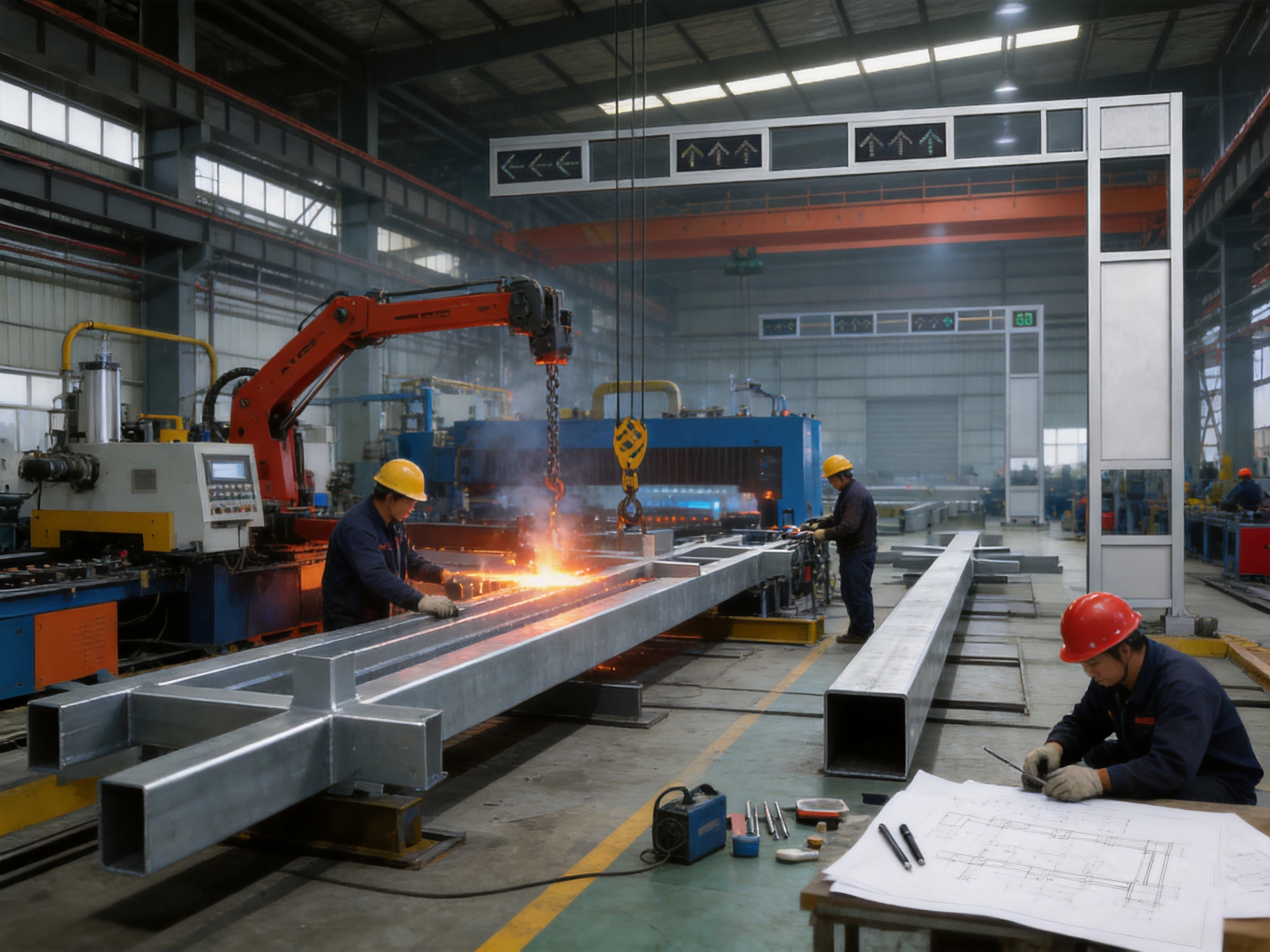
Accurate bending is essential when producing long structural members for traffic signal installations. Inconsistent bending can lead to alignment problems, uneven stress distribution, difficult assembly, and additional adjustment work at the installation site. The manufacturer uses precise and consistent CNC bending to improve dimensional control and structural integrity.
CNC equipment allows bending parameters to be programmed and repeated for similar components. This improves consistency between production batches and reduces dependence on manual estimation. Controlled bending also helps minimize post-production correction, which can save time and protect the surface finish.
High-Accuracy Cutting
The production process provides cutting accuracy of approximately 0.01 millimeters for applicable operations. High-accuracy cutting supports exact dimensions, clean edges, and reliable fitting between structural parts. Consistent cutting is important for base plates, connection components, arm sections, access openings, and other fabricated elements.
Clean edges also improve welding preparation and reduce the amount of grinding or correction required after cutting. Better dimensional control helps the finished structure align with engineering drawings and makes installation more efficient for contractors.
Experienced Welding
Welding quality has a direct influence on the strength and safety of a traffic signal framework. The manufacturer employs certified welders with many years of experience in structural fabrication. Their role includes preparing joints, selecting appropriate welding procedures, controlling heat input, maintaining alignment, and inspecting finished welds.
Experienced welders are especially important for large components, long arms, thick plates, and complex connection points. A well-executed weld can provide strong load transfer and reduce the risk of defects that may develop under vibration or repeated wind loading. Welding inspection may include visual examination, dimensional checks, and additional non-destructive testing where required by the project specification.
Automated Welding and Cutting
Automated production lines are used to improve repeatability, increase production efficiency, and support stricter quality control. Automation can reduce variation between components and help maintain consistent fabrication parameters. It can also lower production costs by reducing unnecessary handling and shortening manufacturing cycles.
For large orders, automated processing is useful because it allows the manufacturer to produce multiple structures with consistent dimensions. At the same time, skilled technicians remain essential for production setup, quality verification, special configurations, and project-specific requirements.
Hot-Dip Galvanizing and Surface Protection
After fabrication, steel traffic structures require effective corrosion protection. Hot-dip galvanizing coats the steel with a metallurgically bonded zinc layer that helps protect the underlying material from moisture and atmospheric corrosion. The galvanizing process is suitable for outdoor structures because it provides coverage over external surfaces and many difficult-to-reach areas.
Before galvanizing, the steel must be properly prepared through cleaning, degreasing, pickling, and fluxing or equivalent processing steps. Proper preparation helps the zinc coating bond consistently. Drainage and venting provisions are also important for hollow structural sections, as they support safe processing and complete coating coverage.
Optional plastic spraying can be applied when a specific color or additional surface finish is required. Powder coating or another approved coating system can improve appearance and provide an additional protective layer. The selected finish should be evaluated for ultraviolet exposure, impact resistance, maintenance requirements, and compatibility with the galvanized substrate.
Die Casting and Supporting Manufacturing Capability
The company operates advanced manufacturing equipment, including a 1,250-ton die casting machine. Although the main traffic signal framework is primarily a fabricated steel structure, die-casting capability supports the wider product portfolio and can be used for selected lighting or equipment components. This broader manufacturing base helps the company coordinate multiple product categories and provide integrated solutions for road illumination and transportation projects.
Quality Assurance and Production Control
Quality assurance begins before fabrication. Technical drawings, material specifications, signal configuration, surface treatment, electrical requirements, and packing instructions should be reviewed before production release. This review helps identify design conflicts and ensures that the manufacturing team understands the intended application.
During production, inspection points may include raw material verification, cutting dimensions, bending accuracy, component alignment, weld quality, flange flatness, bolt-hole positioning, galvanizing condition, coating thickness, electrical assembly, and final appearance. Each stage contributes to the reliability of the completed traffic signal system.
Dimensional inspection is especially important for large framework structures. A small deviation in a component can become more significant when several sections are assembled over a long span. Checking dimensions throughout production helps prevent problems during transportation and on-site erection.
Electrical inspection should verify rated voltage, power consumption, signal color, light distribution, switching response, insulation condition, grounding provisions, and control compatibility. The stated operating power supply is approximately 187 to 253 volts at 50 hertz. Project requirements should be confirmed before manufacture because voltage, frequency, connectors, control cabinets, and local electrical standards may vary by country.
The company’s management and production systems are supported by certifications and standards including ISO9001, ISO14001, and OHSAS18001. ISO9001 relates to quality management, ISO14001 relates to environmental management, and OHSAS18001 represents an occupational health and safety management framework. These systems provide a foundation for process control, environmental responsibility, and workplace safety.
Technical Specifications
| Item | Specification |
|---|---|
| Main pole structure | Rectangular material structure with an elegant appearance |
| Pole height | Approximately 7,000–7,500 millimeters |
| Arm length | Approximately 6,000–14,000 millimeters |
| Main pole tube | 150 × 250 millimeter square tube; wall thickness approximately 5–10 millimeters |
| Cross arm tube | 100 × 200 millimeter square tube; wall thickness approximately 4–8 millimeters |
| Pole surface | Hot-dip galvanized; optional plastic spraying and customized colors |
| Signal lamp diameter | 400 millimeters or 500 millimeters |
| Red chromaticity | Approximately 620–625 nanometers |
| Green chromaticity | Approximately 504–508 nanometers |
| Yellow chromaticity | Approximately 590–595 nanometers |
| Operating power supply | Approximately 187–253 volts, 50 hertz |
| Rated power | Less than 20 watts per lamp |
| LED light-source service life | More than 50,000 hours |
| Ambient temperature | Approximately -40°C to +80°C |
| Protection class | IP54 |
The specifications shown above provide a general reference for product planning. Final dimensions, material grades, electrical interfaces, foundation details, signal arrangements, and coating systems should be confirmed through the project’s approved drawings and technical documentation.
Engineering and Customization Services
A successful traffic signal project requires more than the supply of a pole and lamp. The structure must be coordinated with lane geometry, traffic flow, foundation design, electrical infrastructure, pedestrian facilities, road clearance, transportation regulations, and local construction practices. Engineering support helps connect these requirements into a practical and installable solution.
CAD Design
CAD design provides accurate two-dimensional drawings for review, approval, production, and installation. These drawings can show overall dimensions, arm lengths, signal positions, base plates, bolt patterns, access openings, cable paths, and connection details. CAD documentation is useful for communication between the manufacturer, consultant, contractor, and road authority.
Three-Dimensional Product Simulation
Three-dimensional product simulation allows engineers and project owners to review the shape and proportions of the framework before fabrication. This can help confirm whether the pole, arm, signal heads, and accessories have the intended relationship. It is particularly useful for customized structures or projects with unusual spans and multiple equipment types.
Three-Dimensional Scene Simulation
Scene simulation places the proposed traffic signal structure within a representation of the road environment. This helps assess visibility, clearance, streetscape appearance, and potential conflicts with buildings, trees, signs, utility lines, or other road furniture. Early visualization can reduce revisions after the construction work has begun.
Mechanical and Foundation Calculations
The framework transfers wind and equipment loads to the foundation through the pole and base connection. Mechanical calculations can evaluate the effect of arm length, signal head quantity, wind speed, exposure category, material properties, and connection design. Foundation calculations can support the selection of anchor bolts, base plates, concrete dimensions, and soil-related assumptions.
The final engineering responsibility must remain aligned with local codes and the qualified project designer. The manufacturer’s calculation support is valuable for coordination, but site conditions should be verified by the responsible engineering team before construction.
Color and Specification Customization
Hot-dip galvanized steel provides a practical standard finish, while optional plastic spraying allows the framework to be supplied in customized colors. Color selection can support municipal design guidelines, transportation authority standards, commercial development branding, or visual zoning within a large site.
Other customizable elements may include pole dimensions, arm length, signal diameter, mounting arrangement, access doors, cable openings, flange configuration, foundation interface, control equipment support, and packaging method. Customization should be finalized before production so that structural calculations, procurement, fabrication, and finishing remain coordinated.
Overseas On-Site Installation Guidance
For international projects, installation guidance can help local contractors understand the assembly sequence, foundation interface, lifting requirements, bolt tightening, cable routing, signal head mounting, grounding, and commissioning procedures. On-site guidance is particularly helpful when the structure is large, the arm is long, or the project uses a configuration unfamiliar to the installation team.
Installation Considerations
Installation begins with a review of approved drawings and site conditions. The contractor should confirm the position of underground utilities, drainage systems, foundations, sidewalks, curbs, traffic lanes, and overhead obstacles. The foundation must be completed and cured according to the structural design before the pole is erected.
Anchor bolts should be correctly positioned and protected during foundation construction. The bolt pattern must match the base plate, and the exposed threads should remain clean and undamaged. Incorrect anchor alignment can delay erection and may require costly corrective work.
Because the framework may be long and heavy, lifting equipment should be selected according to the pole weight, arm length, site access, and safety plan. Temporary supports may be needed during assembly. Workers should follow approved lifting procedures and maintain a safe exclusion zone around the structure.
After the main pole is installed, the cross arm and signal heads can be positioned according to the approved traffic plan. Electrical cables should be routed to avoid sharp edges, water accumulation, excessive tension, and interference with moving or removable components. Cable entries should be sealed in a manner consistent with the required environmental protection level.
Grounding and surge protection are important for structures exposed to lightning and electrical transients. The grounding system should comply with local electrical standards and be coordinated with the traffic signal cabinet, power supply, and communication equipment. The signal heads should be tested individually and as a complete control sequence before the intersection is opened to traffic.
Maintenance and Lifecycle Performance
Routine maintenance helps preserve the safety and service life of the traffic signal system. Inspection schedules should be established according to traffic volume, weather exposure, local regulations, and the importance of the intersection. A typical maintenance program may include visual inspection, cleaning, electrical testing, structural checks, and control-system verification.
Signal lenses and external surfaces should be kept clean so that brightness and color recognition remain clear. Dust, pollution, salt deposits, insects, and road spray can reduce optical performance even when the LED source itself remains functional. Cleaning methods should be compatible with the lens material and protective coating.
The framework should be inspected for corrosion, coating damage, unauthorized drilling, deformation, loose bolts, cracks, water accumulation, and damage caused by vehicles or maintenance equipment. Areas where the galvanized surface has been mechanically damaged should be repaired using an approved corrosion-protection method.
Electrical maintenance may include checking terminal connections, insulation, grounding continuity, surge devices, fuses, control modules, communication interfaces, and cabinet ventilation. Any abnormal flickering, delayed switching, reduced brightness, or inconsistent color should be investigated promptly because traffic signals are safety-critical equipment.
The long service life of the LED light source can reduce replacement frequency, but it does not eliminate the need for system inspection. Drivers and pedestrians depend on the complete signal assembly, including the housing, lens, controller, wiring, mounting hardware, and structure. Lifecycle reliability is achieved through the combination of durable components and disciplined maintenance.
Energy Efficiency and Environmental Benefits
Energy efficiency is increasingly important in transportation infrastructure. With a rated power of less than 20 watts per signal lamp, the LED system can reduce electricity use compared with higher-consumption signal technologies. When multiplied across many signal heads and intersections, the savings can become significant over the operating life of a road network.
Lower energy consumption can also reduce the thermal load within signal housings and control cabinets. Efficient LED operation supports more manageable equipment temperatures, although proper ventilation, thermal design, and climate considerations remain necessary. Reduced power demand may also help authorities evaluate renewable energy or backup power options for selected traffic facilities.
The company’s environmental management approach, supported by ISO14001-related practices, contributes to more responsible production. Automated manufacturing can reduce material waste, improve cutting efficiency, and shorten production cycles. Proper surface treatment and long service life can also reduce the environmental impact associated with repeated replacement and disposal.
For projects that combine traffic control with solar or photovoltaic systems, the low power demand of LED signals may be beneficial during backup operation. Such integration requires a complete electrical design covering battery storage, charging, autonomy, emergency operation, and regulatory compliance. The traffic signal should never be connected to a renewable energy system without confirming that power quality and continuity meet the requirements of the traffic authority.
Applications in Different Transportation Environments
Urban Intersections
In urban areas, traffic signal structures must balance visibility, safety, limited space, and visual appearance. The integrated framework provides a coordinated solution for busy crossroads, central business districts, residential areas, and municipal development zones. Its optional color finish can support local streetscape planning, while its cantilever arm can span multiple lanes without adding unnecessary roadside supports.
Highways and Arterial Roads
Highways and major arterial roads require signal equipment that remains visible at greater distances and performs reliably under strong wind and changing weather. The availability of 400-millimeter and 500-millimeter signal lamps allows designers to select an appropriate visual scale. Longer arms can position signal heads over wide roadways, provided that the design satisfies structural and clearance requirements.
Industrial Parks and Logistics Zones
Industrial parks often contain large vehicle movements, heavy trucks, wide access roads, and specialized traffic patterns. The framework can be customized for entrance gates, internal intersections, loading areas, and logistics corridors. High interference resistance is useful in environments containing motors, industrial equipment, communication systems, and other electrical installations.
Commercial and Mixed-Use Developments
Commercial projects frequently require traffic infrastructure that is both functional and visually coordinated with architectural planning. The integrated rectangular framework offers a more refined appearance than a collection of unrelated brackets. Customized colors and three-dimensional scene simulations can help developers and designers review the visual relationship between the signal structure and surrounding buildings.
Smart City Demonstration Projects
Smart city projects may combine traffic signals with cameras, vehicle detection, communication modules, environmental sensors, and centralized management systems. The integrated framework can provide a stable structural platform for such equipment when the additional loads and cable requirements are included in the design from the beginning.
Why Manufacturing Capability Matters to Buyers
Traffic signal structures are often purchased for projects with strict schedules, technical specifications, and coordination requirements. A supplier’s ability to manage design, materials, fabrication, finishing, quality control, packing, and technical service can influence the success of the entire project.
A manufacturer with extensive production experience can provide more than a standard catalog item. It can help select materials, confirm dimensions, adapt the structure to a specific road layout, prepare drawings, evaluate foundation requirements, and coordinate delivery. This reduces the number of separate parties involved in the procurement process.
Yangzhou Jinyuan Lamps Co., Ltd. has operated in the road illumination industry since 2002. Its facilities cover more than 70,000 square meters and include more than 300 professional technicians. The company exports products to more than 200 countries and regions, giving it experience with different project expectations, packaging requirements, documentation practices, and international cooperation procedures.
The product range includes traffic facilities as well as high mast lighting, solar lighting, smart street lighting, photovoltaic power generation systems, LED floodlights, LED street lighting, communication towers, and mid-mast lighting. This broad range allows the company to support projects that require several types of outdoor infrastructure from one manufacturing source.
Advanced equipment such as CNC bending machines, electrostatic powder painting equipment, automatic welding and cutting machines, and a large die casting machine supports production efficiency and product consistency. The combination of automated equipment and experienced technicians provides a practical balance between repeatability and customization.
Comparison with Basic Traffic Signal Solutions
| Evaluation Area | Basic Separate-Component Solution | Integrated Framework Traffic Signal Light |
|---|---|---|
| Visual appearance | May contain multiple brackets and inconsistent components | Unified rectangular framework with coordinated proportions |
| Structural coordination | Several components may be designed independently | Main pole, arm, and signal mounting positions are developed as one system |
| Wind-load planning | May require additional coordination between suppliers | Framework and foundation requirements can be reviewed together |
| Signal visibility | Depends heavily on individual bracket placement | Arm length and signal positions can be planned for the complete intersection |
| Lighting source | May use older or less efficient technologies | High-brightness LED source with rated power below 20 watts per lamp |
| Service life | Varies according to lamp and housing quality | LED light-source service life exceeds 50,000 hours under stated conditions |
| Surface protection | May have limited or inconsistent corrosion protection | Hot-dip galvanizing with optional plastic spraying |
| Customization | Often limited to standard dimensions | Dimensions, colors, arm lengths, and configurations can be customized |
| Engineering support | May be limited to product supply | Includes CAD, 3D simulation, mechanical calculation, and installation guidance support |
The comparison does not mean that every basic traffic signal installation is unsuitable. Different projects have different budgets, standards, and structural requirements. However, the integrated framework approach offers clear advantages where appearance, long-span visibility, coordinated engineering, durability, and future intelligent control are important priorities.
Procurement Guidance for Project Owners
Before ordering an integrated framework traffic signal light, project owners should prepare a clear technical brief. The brief should identify road width, number of lanes, signal head quantity, signal diameter, pole height, arm length, wind conditions, foundation type, power supply, control method, environmental exposure, surface finish, and applicable standards.
The site location should be reviewed carefully. Coastal areas may require additional corrosion considerations, while dusty industrial or desert locations may require special attention to housing protection and maintenance. Extremely cold or hot climates should be checked against the specified operating temperature range.
Buyers should also confirm whether the product will be installed as a complete traffic signal system or as a structural framework supplied to another signal-equipment provider. If a third-party controller, detector, camera, or communication module is involved, interfaces should be documented before production.
Packaging and transportation should be considered for long arms and large poles. Components may require protective wrapping, reinforced supports, moisture protection, marked lifting points, and clear identification. For overseas projects, shipping dimensions and container loading plans should be reviewed early to avoid unexpected logistics costs.
Documentation may include general arrangement drawings, material information, surface-treatment records, inspection reports, electrical data, installation instructions, packing lists, and maintenance recommendations. Clear documentation helps contractors install the structure correctly and supports future maintenance teams.
Safety and Compliance Considerations
Traffic signal equipment directly influences road safety, so the complete installation must comply with applicable traffic control, electrical, structural, and construction requirements. The product specifications should be reviewed by the responsible local authority or qualified design consultant before approval.
Signal visibility, mounting height, lateral clearance, overhead clearance, pedestrian accessibility, color performance, timing logic, emergency operation, and failure response should all be addressed in the project design. The physical framework is only one element of a safe traffic signal installation.
Electrical systems should include suitable protection against overcurrent, short circuits, surges, moisture, and accidental contact. Grounding and bonding should be completed according to local regulations. Installation work should be performed by qualified personnel using approved equipment and traffic management procedures.
Structural safety includes the verification of pole strength, cross-arm stability, anchor bolts, foundation capacity, welds, flanges, and connections. Wind calculations should reflect the actual site and the total projected area of all mounted equipment. Any future additions should be reviewed structurally rather than attached without approval.
Project Service from Consultation to Completion
A strong supplier relationship begins during consultation. The project team can discuss roadway dimensions, signal requirements, environmental conditions, schedule, budget, standards, and customization needs. Early communication allows the manufacturer to recommend a suitable structure and identify information still needed for design.
During the design stage, CAD drawings and three-dimensional simulations can be submitted for customer review. Revisions can be incorporated before material cutting and fabrication. This approach is more efficient than changing a structure after galvanizing or shipment.
During production, customers may require progress updates, inspection records, sample approval, or third-party inspection. A controlled production process allows these requirements to be integrated into the manufacturing plan.
Before shipment, the structure can be checked against approved drawings and packing instructions. Components should be labeled clearly so that the installation team can identify the main pole, cross arm, signal mounting hardware, bolts, accessories, and electrical parts.
After delivery, overseas on-site installation guidance can help local teams complete erection and commissioning. Continued technical communication is useful when a project includes customized dimensions, unusual foundations, complex signal sequences, or integration with smart traffic equipment.
Frequently Asked Questions
What is the main benefit of an integrated framework traffic signal light?
The main benefit is the combination of a coordinated structural framework, clear signal visibility, efficient LED lighting, and flexible engineering support in one traffic control solution. The unified design can improve appearance, reduce component complexity, and support stable operation at large intersections.
What pole and arm dimensions are available?
The standard information indicates a pole height of approximately 7,000 to 7,500 millimeters and an arm length of approximately 6,000 to 14,000 millimeters. Final dimensions should be confirmed according to road width, signal arrangement, wind loading, clearance requirements, and local design standards.
What materials can be used for the framework?
Material options include Q235B, Q345B, S275JR, S355JR, Q460, A36, A572, GR56, and GR50, among others. The correct grade depends on the project’s structural design, regional standard, strength requirements, weldability needs, and procurement conditions.
How are the pole and arm protected from corrosion?
The pole body is hot-dip galvanized for outdoor corrosion protection. Optional plastic spraying or powder coating can be added for customized colors and additional surface protection. Actual service life depends on climate, exposure, coating quality, installation, and maintenance.
What signal lamp sizes are available?
The product is designed for signal lamp surfaces with diameters of approximately 400 millimeters or 500 millimeters. The appropriate size should be selected according to viewing distance, road speed, intersection geometry, and applicable traffic signal regulations.
How much power does each signal lamp consume?
The stated rated power is less than 20 watts per lamp. Actual consumption can vary according to the final LED module, electrical configuration, controller, and project specification.
How long does the LED light source last?
The stated service life of the LED light source is more than 50,000 hours. This figure depends on operating temperature, power quality, surge protection, thermal management, environmental exposure, and appropriate maintenance.
Can the traffic signal timing respond to traffic flow?
The intelligent control system can be configured to adjust signal duration based on real-time traffic flow or approved control strategies. The final adaptive function depends on the traffic controller, detection equipment, communication network, software, and local authority requirements.
Is the signal suitable for extreme temperatures?
The stated ambient operating range is approximately -40°C to +80°C. Project engineers should still review the complete electrical and structural system for local conditions, including solar radiation, humidity, snow, ice, wind, dust, and salt exposure.
What does the IP54 protection class mean?
IP54 indicates protection against harmful dust entry and water splashing from different directions under the relevant test conditions. The project team should determine whether this protection level is adequate for the specific site and whether additional sealing or a higher rating is required.
Can the framework color be customized?
Yes. In addition to the standard hot-dip galvanized surface, optional plastic spraying can provide customized colors. Color selection should be confirmed before production and should be compatible with the specified coating and environmental conditions.
Does the manufacturer provide design support?
Available support includes CAD design, three-dimensional product simulation, three-dimensional scene simulation, specification and color customization, mechanical calculation for wind and foundation conditions, and overseas on-site installation guidance.
What industries and products does the manufacturer serve?
The manufacturer serves the road illumination and outdoor infrastructure industries. Its product range includes street light poles, LED street lights, solar street lights, high mast lighting, mid-mast lighting, LED floodlights, communication towers, photovoltaic power generation systems, smart street lighting, and traffic facilities.
What should be confirmed before placing an order?
Buyers should confirm the road layout, pole height, arm length, signal head quantity and diameter, material grade, surface finish, electrical supply, control method, wind conditions, foundation interface, local standards, packaging requirements, delivery schedule, and installation responsibilities.
Conclusion
The integrated framework traffic signal light provides a practical and modern solution for road intersections that require high visibility, structural stability, energy efficiency, and coordinated appearance. Its rectangular framework improves design consistency, while the available pole heights and long arm lengths support different roadway configurations. Hot-dip galvanizing, optional color spraying, wide-temperature operation, IP54 protection, and interference resistance make the product suitable for demanding outdoor environments.
The LED signal source delivers bright and uniform red, green, and yellow indications with low power consumption and a service life exceeding 50,000 hours. When combined with an intelligent control system, the signal can support more responsive traffic management and improved intersection efficiency.
The product’s advantages are strengthened by the manufacturer’s production capabilities. Material availability, CNC bending, high-accuracy cutting, experienced welding, automated manufacturing, galvanizing, powder coating, quality management, CAD engineering, three-dimensional simulation, mechanical calculations, and installation guidance provide buyers with a complete project-support process.
For cities, highways, industrial parks, commercial developments, and smart transportation projects, the integrated framework traffic signal light offers more than a visual traffic indicator. It is a coordinated structural and electrical platform designed to support reliable road communication over a long operating period. With proper engineering, installation, inspection, and maintenance, it can contribute to safer intersections, more efficient traffic movement, lower operating costs, and a more organized transportation environment.
References
1. International Electrotechnical Commission, “Degrees of Protection Provided by Enclosures,” IEC 60529.
2. International Organization for Standardization, “Quality Management Systems,” ISO 9001.
3. International Organization for Standardization, “Environmental Management Systems,” ISO 14001.
4. International Organization for Standardization, “Occupational Health and Safety Management Systems,” ISO 45001.
5. American Association of State Highway and Transportation Officials, “Specifications for Structural Supports for Highway Signs, Luminaires, and Traffic Signals.”
6. Institute of Transportation Engineers, “Traffic Signal Installation and Operational Guidance.”
7. International Commission on Illumination, “Road Traffic Signal Color and Visibility Principles.”
8. Manufacturer technical information for integrated framework traffic signal structures, LED signal modules, material options, surface treatments, and engineering services.