


JINYUAN
JINYUAN
JINYUAN
JINYUAN
JINYUAN
JINYUAN
JINYUAN
JINYUAN
JINYUAN
JINYUAN
JINYUAN
JINYUAN
JINYUAN
JINYUAN
JINYUAN
JINYUAN
Content
- 1 1. The Role of Mid-Mast Lighting in Modern Municipal Infrastructure
- 2 2. Minimalist Design with a Clear Engineering Purpose
- 3 3. LED Performance and Optical Efficiency
- 4 4. Durable Materials for Outdoor Conditions
- 5 5. Product Specifications at a Glance
- 6 6. Advantages Over Conventional Multi-Pole Arrangements
- 7 7. Manufacturing Strength and Quality Control
- 8 8. Engineering Services from Concept to Installation
- 9 9. Applications for Different Project Environments
- 10 10. Installation and Maintenance Considerations
- 11 11. Energy Efficiency and Total Cost of Ownership
- 12 12. Why the Manufacturing Partner Matters
- 13 13. Project Selection Checklist
- 14 14. Frequently Asked Questions
- 14.1 What is the main purpose of the Four-arm Minimalist Combined Municipal Lamp?
- 14.2 What pole heights are available?
- 14.3 What type of light source does the product use?
- 14.4 What is the stated luminous efficiency?
- 14.5 Can the lamp be connected to a smart lighting system?
- 14.6 Is the lamp suitable for cold and hot climates?
- 14.7 What level of outdoor protection does the luminaire have?
- 14.8 What materials are used for the luminaire and pole?
- 14.9 Can the color temperature be customized?
- 14.10 Does the manufacturer provide structural calculations?
- 14.11 Does the manufacturer support overseas projects?
- 14.12 What warranty period is provided?
- 14.13 Can the pole and lamp be customized?
- 15 15. Conclusion
- 16 References
- 17 Product: Four-arm Minimalist Combined Municipal Lamp
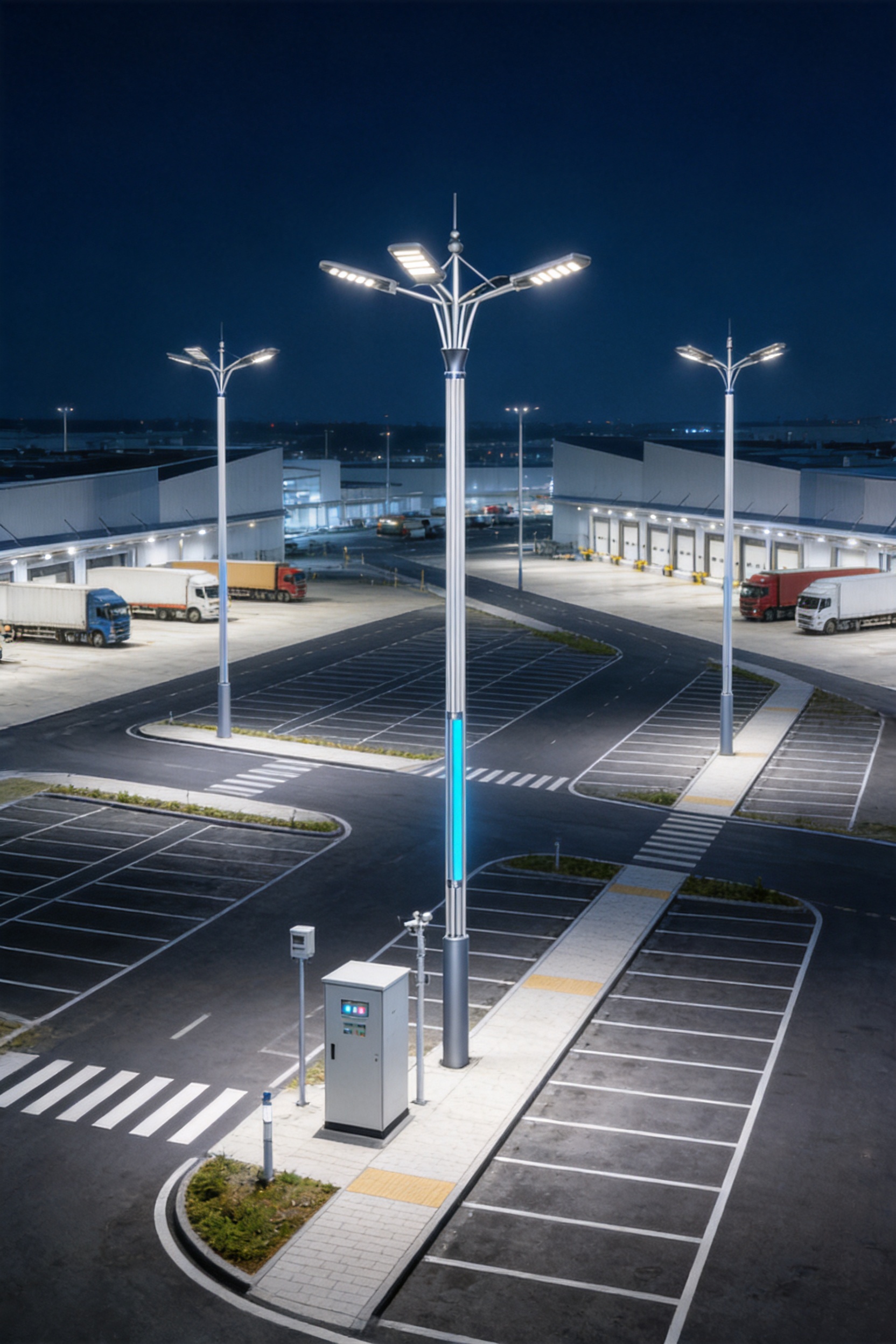
Modern municipal lighting projects increasingly require more than basic illumination. Roads, intersections, industrial parks, public squares, and large parking facilities must be safe, visually organized, energy-conscious, and simple to maintain. A lighting system must provide broad and uniform coverage while also fitting the architectural character of the surrounding environment. It must withstand wind, rain, temperature changes, corrosion, vibration, and continuous operation. At the same time, project owners expect efficient installation, predictable performance, long service life, and competitive total cost.
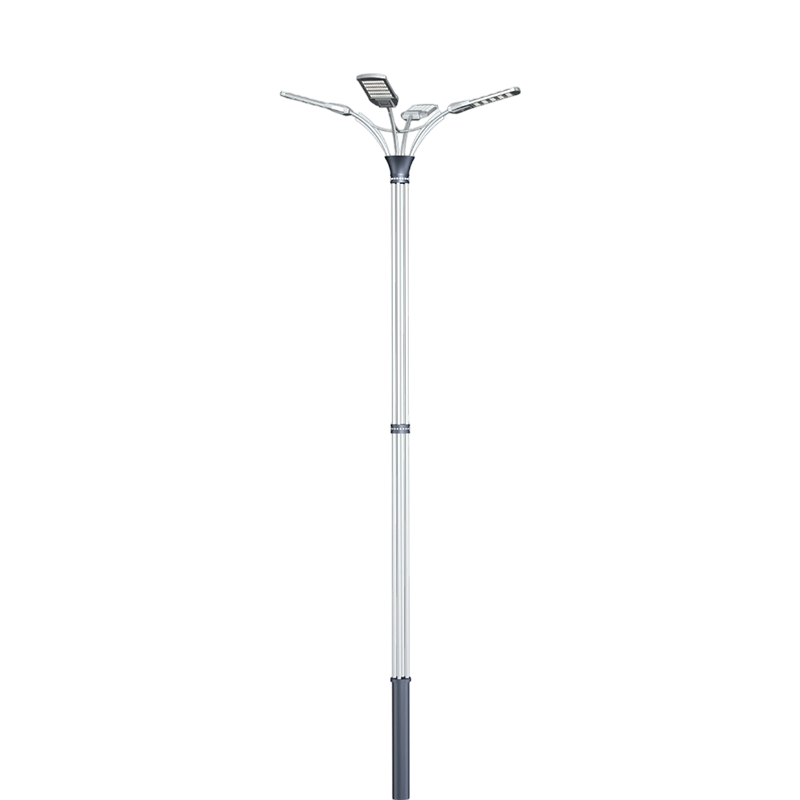
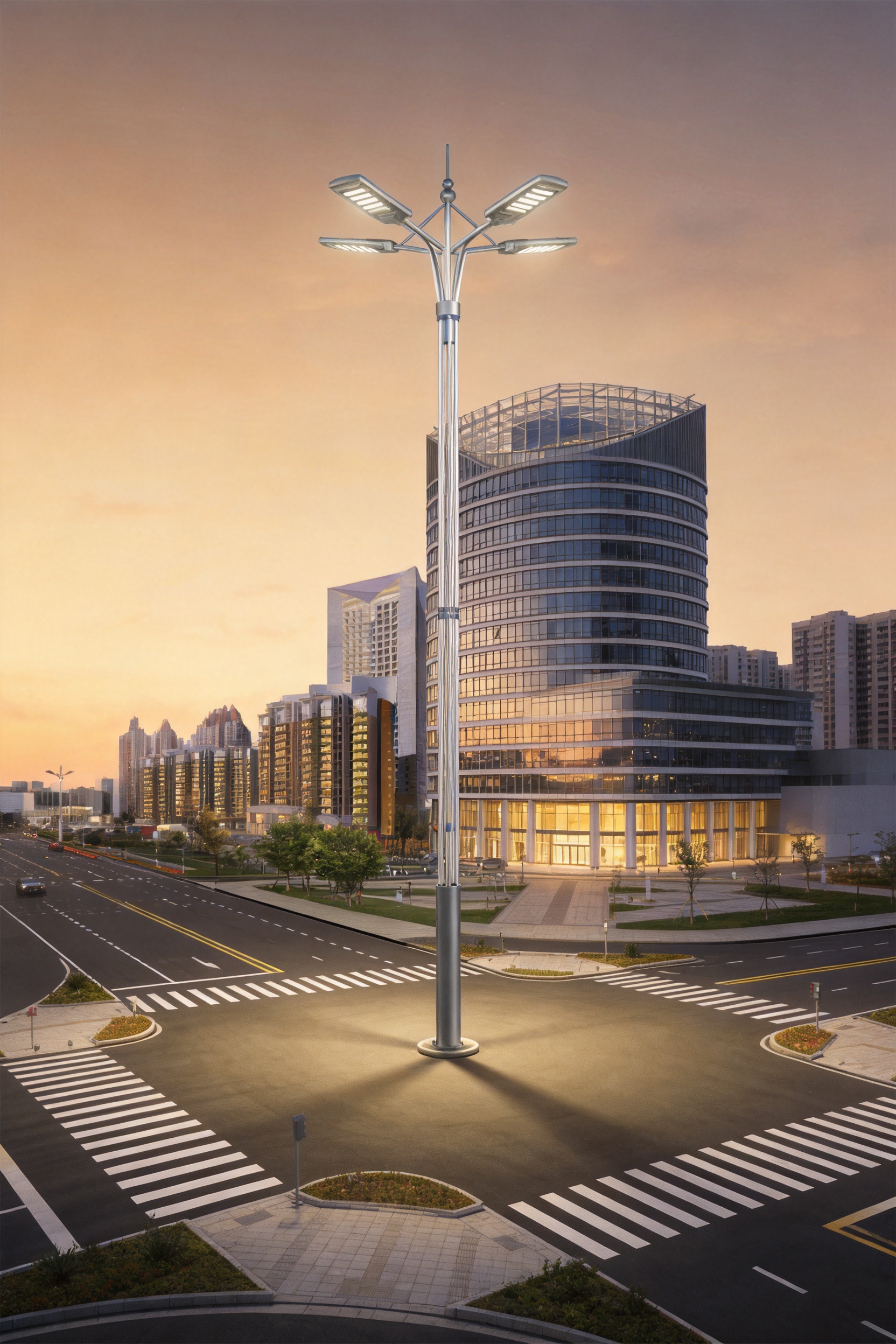
The Four-arm Minimalist Combined Municipal Lamp is designed to meet these requirements through a balanced combination of structural efficiency, high-performance LED technology, adaptable engineering, and disciplined manufacturing. Its symmetrical four-arm arrangement allows one pole to support multiple luminaires, making it especially suitable for wide intersections, expansive plazas, industrial park axes, transportation areas, and large parking facilities. Instead of filling an open space with numerous individual poles, the system creates a more coordinated lighting layout with fewer visual obstructions and a cleaner overall appearance.
The product belongs to the mid-mast lighting category and is available with pole heights from 6 meters to 10 meters. It uses an aluminum-alloy luminaire housing, LED light sources, IP65 protection, a stated luminous efficiency of 140 lm/W, and a broad input-voltage range of AC85-265V. Its operating temperature range of -35°C to 65°C supports deployment across demanding climates. Dimming compatibility with DC 0-10V and DALI systems further increases its suitability for smart municipal lighting and energy-management projects.
Behind the product is Yangzhou Jinyuan Lamps Co., Ltd., a large-scale road illumination manufacturer and engineering company with experience in the design, production, and supply of lighting poles, LED street lights, solar street lights, luminaires, and related infrastructure. The company combines engineering services with industrial production, providing support from consultation and CAD design through mechanical calculation, customization, manufacturing, and overseas installation guidance.
1. The Role of Mid-Mast Lighting in Modern Municipal Infrastructure
Municipal lighting must respond to the geometry and use of a site. A narrow residential road, for example, may be adequately served by poles positioned along both sides of the carriageway. A broad intersection or open transportation plaza creates a different challenge. Multiple conventional poles may be necessary to eliminate dark areas, but this approach can increase foundation work, cable routing, maintenance points, and visual clutter.
Mid-mast lighting provides a practical alternative for large and open spaces. By placing luminaires at a suitable height and extending them through carefully designed arms, a single support structure can illuminate several directions. The four-arm configuration of this lamp is particularly useful where four-way coverage is required. The symmetrical arrangement allows the lighting system to align naturally with intersecting roadways, central plazas, or cross-shaped traffic layouts.
The objective is not simply to produce more light. A successful municipal lighting system must distribute light where it is needed, reduce unnecessary glare and overspill, preserve traffic visibility, and create consistent visual guidance. The four-arm configuration supports this objective by positioning the luminaires around a central pole, helping establish a continuous and orderly lighting rhythm across the site.
Compared with an arrangement based entirely on separate poles, a combined lamp may reduce the number of foundations and improve the efficiency of electrical infrastructure. Fewer poles can also create wider clear zones for vehicles, pedestrians, landscaping, drainage, and future site development. The final result depends on professional photometric design and site conditions, but the product provides a strong structural basis for reducing pole density in appropriate applications.
2. Minimalist Design with a Clear Engineering Purpose
The appearance of a municipal lamp influences the character of an entire public area. Excessive decoration can make a product difficult to integrate into modern industrial or civic environments, while overly basic construction may appear unfinished or fail to communicate quality. This four-arm lamp takes a minimalist approach, emphasizing clean industrial lines, symmetry, proportion, and functional clarity.
Its visual simplicity is supported by a practical engineering concept. The four arms are arranged symmetrically around the pole, creating a balanced silhouette when viewed from different directions. This is valuable in intersections and open plazas where the pole may be observed from multiple approaches. Instead of presenting a complicated or ornamental structure, the lamp maintains a modern and orderly appearance that can complement contemporary roads, factories, logistics parks, public facilities, and commercial developments.
The minimalist form also supports easier project coordination. A visually neutral design can be combined with many architectural styles, road markings, landscape plans, and urban furniture systems. It does not compete unnecessarily with surrounding structures. For large-scale developments, this consistency can be more valuable than a highly decorative individual fixture.
Design simplicity may also assist maintenance. A structure with fewer decorative elements and clearly defined mechanical components is generally easier to inspect, clean, and service. The principal performance elements remain accessible as functional parts rather than being concealed within complicated decorative assemblies.
Symmetrical Four-Arm Configuration
The most distinctive feature is the four-arm arrangement. Each arm supports a lighting direction, allowing the pole to serve several areas from one central location. This makes the product suitable for four-way intersections, central traffic islands, large entrances, expansive parking lots, and open industrial areas.
Symmetry can simplify visual planning because the pole naturally establishes a central reference point. It also helps project designers coordinate lighting direction with road geometry. Depending on the photometric layout, the arms and luminaires can be positioned to support road lanes, pedestrian circulation, loading areas, or plaza activity zones.
The exact lighting outcome will depend on mounting height, luminaire optics, road width, pole position, installation spacing, and local lighting standards. Nevertheless, the four-arm concept offers an efficient platform for broad-area illumination while maintaining a clean and coherent appearance.
3. LED Performance and Optical Efficiency
The lamp uses LED light sources and is specified with a luminous efficiency of 140 lm/W. This level of efficiency can help project owners obtain strong illumination with controlled power consumption, provided that the selected wattage and optical distribution are correctly matched to the site. High efficacy is particularly valuable in municipal applications because lighting may operate for many hours every night across thousands of installation points.
LED technology provides several advantages over older conventional light sources. LEDs can deliver immediate start-up, support digital dimming, offer compact optical control, and reduce the need for frequent lamp replacement. Their directional nature also allows more of the generated light to be directed toward the roadway or activity area rather than dispersed inefficiently into the sky or surrounding properties.
The product uses a scientific secondary light distribution system to create uniform light projection. Uniformity is essential in road lighting. Bright spots directly beneath luminaires and dark gaps between poles can reduce visual comfort and make it more difficult for drivers and pedestrians to identify obstacles. A properly designed secondary optical system helps distribute light across the target area and supports smoother transitions between illuminated zones.
Uniformity is also important for visual continuity. In a wide intersection, users need to understand the road layout, lane boundaries, traffic islands, curbs, and pedestrian movements. Even lighting reduces abrupt changes in brightness and can contribute to a more comfortable nighttime environment.
Color Temperature and Color Rendering
The available color-temperature range is 3000K-6000K. This provides flexibility for different applications and local preferences. Warmer color temperatures may be appropriate for pedestrian environments, civic spaces, residential edges, and locations where a softer visual atmosphere is desired. Neutral or cooler color temperatures may be selected for roadways, industrial parks, logistics areas, and sites where strong visual contrast is prioritized.
The stated color-rendering index is Ra 70. This level is suitable for many general road and infrastructure applications where traffic visibility, spatial recognition, and energy efficiency are primary considerations. Project designers should select color temperature and optical characteristics according to applicable standards, surrounding land use, environmental requirements, and the desired nighttime appearance.
Smart Dimming Compatibility
The lamp supports DC 0-10V and DALI dimming. This compatibility gives system integrators additional options for connecting the product to intelligent lighting controls, centralized management platforms, timers, sensors, or energy-saving schedules.
Dimming can be used to reduce output during periods of low traffic or limited activity. For example, an industrial park road may require full output during shift changes but lower output during quiet overnight hours. A parking facility may use higher illumination when vehicles or pedestrians are detected and lower levels when the area is empty. These strategies can reduce energy use while retaining an appropriate level of safety and visibility.
Smart control also supports operational awareness. A connected lighting system may provide information about operating schedules, fault conditions, energy consumption, and maintenance requirements. The product’s dimming interfaces make it more adaptable to such systems than a basic non-dimmable luminaire.
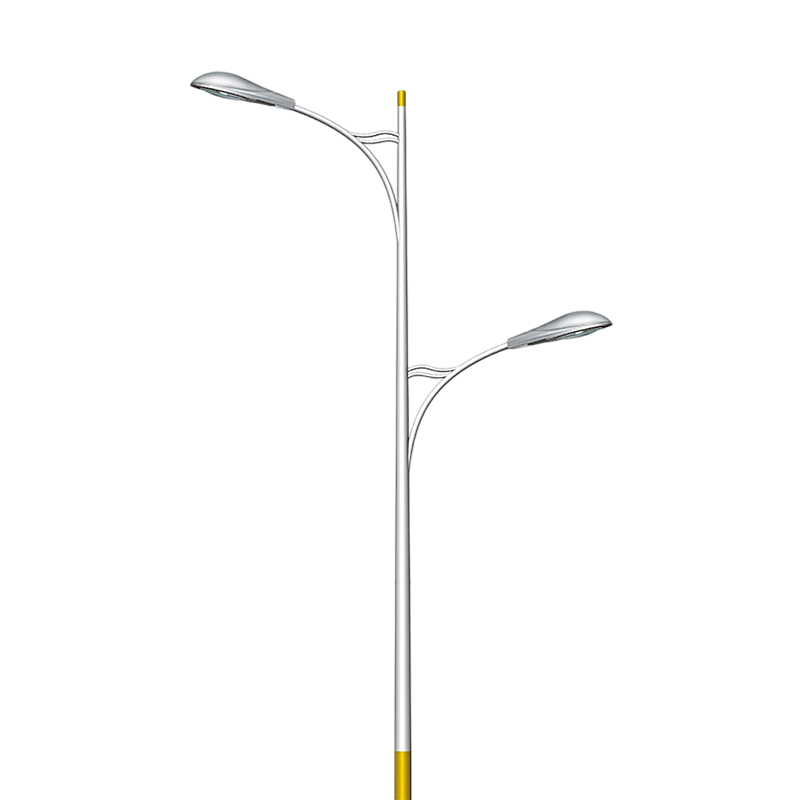
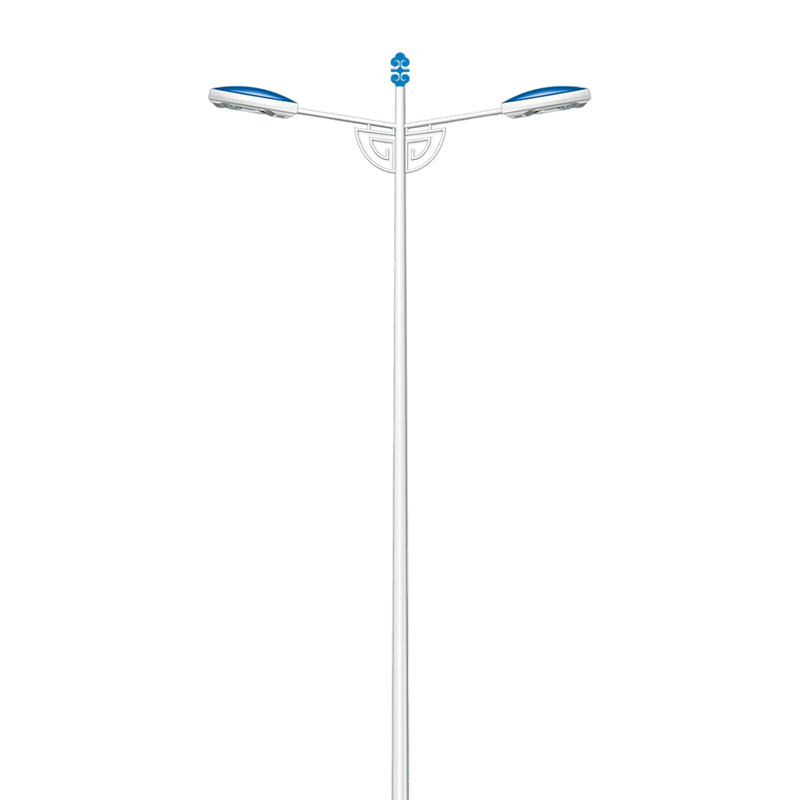
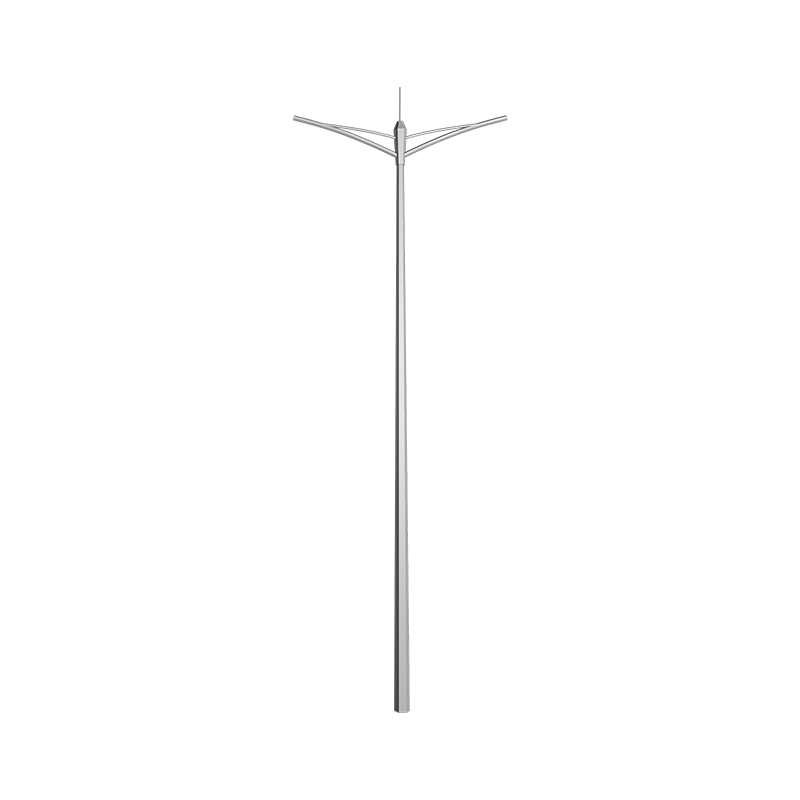
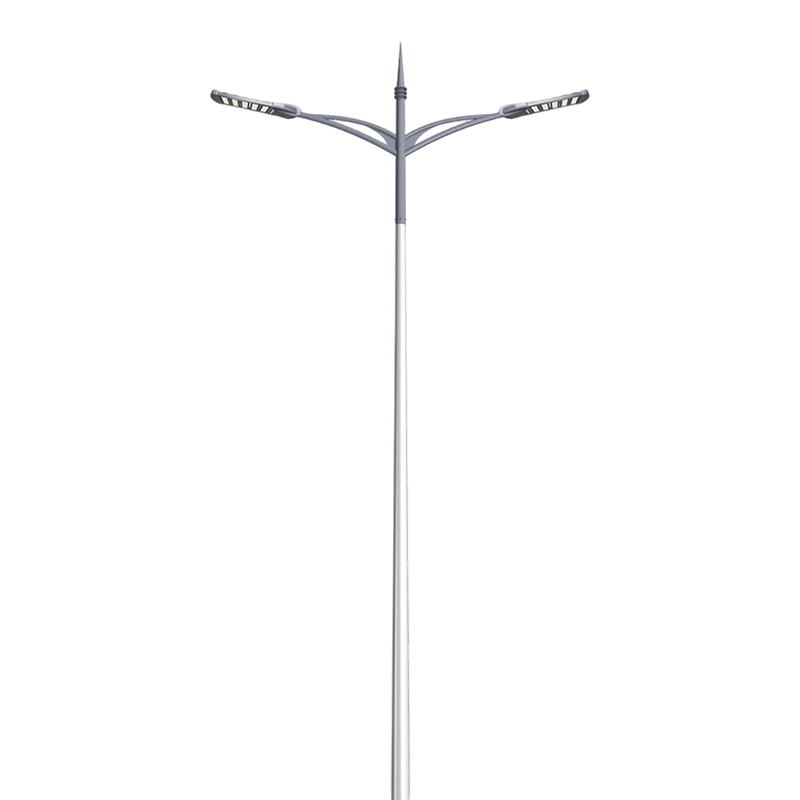
Four-arm Minimalist Combined Municipal Lamp
4. Durable Materials for Outdoor Conditions
Outdoor municipal lighting is exposed to a wide range of environmental stresses. Rainwater, humidity, airborne pollutants, road salt, ultraviolet radiation, dust, wind, and repeated thermal expansion can all affect a luminaire and its support structure. Material selection therefore has a direct relationship with service life and maintenance cost.
The luminaire housing is made from aluminum alloy, described as a lightweight high-pressure die-cast aluminum housing. Aluminum alloy provides a useful combination of low weight, corrosion resistance, structural rigidity, and thermal conductivity. The relatively low mass can reduce the load placed on the supporting arm and pole, while the material’s heat-transfer characteristics help remove heat from the LED modules.
Thermal management is especially important for LED lighting. Excessive heat can accelerate component aging, reduce light output, and affect long-term reliability. A properly designed die-cast housing can function as part of the heat-dissipation system, transferring heat away from internal components and releasing it to the surrounding air.
The product has an IP65 rating. This indicates protection against dust ingress and protection against water jets from different directions under applicable testing conditions. IP65 is a widely used protection level for outdoor lighting, but installation quality remains essential. Cable glands, connectors, covers, seals, and maintenance procedures must all be handled correctly to preserve the intended protection level throughout the product’s service life.
Hot-Dip Galvanized Steel Pole
The supporting pole uses large-diameter premium steel and is hot-dip galvanized. The available material options include Q235, Q355, SS400, GR65, and other grades, subject to project requirements. Hot-dip galvanizing creates a protective zinc coating over the steel surface. This coating helps protect the pole from atmospheric corrosion and can extend the maintenance interval in demanding outdoor environments.
For municipal projects, corrosion protection is not merely an aesthetic issue. Rust can reduce the thickness of steel, affect bolted connections, damage surface appearance, and create long-term structural concerns. A galvanized pole provides a strong foundation for outdoor durability, especially when the coating thickness, preparation process, drainage details, and installation practices are properly controlled.
The selection of steel grade can be coordinated with structural calculations, pole height, arm geometry, wind speed, luminaire weight, mounting arrangement, and foundation design. This flexibility allows the product to be adapted to different national standards and project conditions rather than forcing every application into one fixed material specification.
Stainless Steel Fasteners
Mechanical connections use rust-proof stainless steel fasteners. Fasteners are small components, but they are critical to the safety and maintainability of a lighting structure. If bolts, nuts, or washers corrode prematurely, future inspection and replacement may become difficult. Corroded connections can also affect the stability of arms and fixtures.
Stainless steel fasteners help reduce these risks and support more reliable assembly in wet, coastal, industrial, or polluted environments. They also make routine maintenance more manageable because access components are less likely to seize or deteriorate rapidly.
5. Product Specifications at a Glance
The following table summarizes the principal technical information provided for the Four-arm Minimalist Combined Municipal Lamp. Final project specifications should be confirmed during design because optical power, arm dimensions, foundation requirements, and control architecture may vary according to site conditions.
| Specification | Provided Information | Project Relevance |
|---|---|---|
| Product category | Mid-mast Light | Suitable for broad roads, intersections, parking facilities, and open municipal areas |
| Brand | Jinyuan | Manufacturer product identification |
| Application | Road | Designed for roadway and related outdoor infrastructure lighting |
| Light source | LED | Supports high efficiency, long operating life, and digital control |
| Input voltage | AC85-265V | Broad compatibility with common AC power conditions |
| Lamp luminous efficiency | 140 lm/W | Supports efficient conversion of electrical power into useful light |
| Operating temperature | -35°C to 65°C | Suitable for a wide range of hot and cold outdoor climates |
| Lamp housing material | Aluminum alloy | Combines lightweight construction with thermal management and corrosion resistance |
| Ingress protection | IP65 | Protects against dust and water jets under applicable testing conditions |
| Color temperature | 3000K-6000K | Allows adaptation to road, industrial, civic, and public-space requirements |
| Color rendering index | Ra 70 | Provides general-purpose color recognition for infrastructure applications |
| Dimming support | DC 0-10V / DALI | Enables connection to energy-management and smart-lighting systems |
| Warranty period | 5 years | Provides a defined support period for project planning |
| Pole material | Q235, Q355, SS400, GR65, and others | Allows structural adaptation to project standards and loading conditions |
| Pole height | 6m-10m | Supports different roadway widths, mounting needs, and lighting layouts |
6. Advantages Over Conventional Multi-Pole Arrangements
The product’s principal advantage over a conventional multi-pole approach is its ability to combine several lighting directions on one central structure. This can simplify the visual arrangement of a large site and may reduce the number of foundations, poles, cable routes, and maintenance locations required for equivalent coverage.
Fewer poles can produce a clearer streetscape. This is valuable at major intersections, where too many poles can obstruct sightlines or make traffic infrastructure appear disorganized. It is also useful in parking facilities and plazas, where users benefit from open circulation areas and clear pedestrian routes.
A combined structure can potentially reduce civil works. Each separate pole typically requires excavation, foundation construction, anchor-bolt placement, cable termination, and future inspection. A four-arm pole consolidates these requirements at one location. The extent of savings depends on the site plan, electrical layout, soil conditions, wind design, and required illuminance, but consolidation may improve project efficiency.
Another advantage is visual consistency. Four luminaires mounted around one center point are naturally coordinated in height and orientation. By contrast, several independent poles may show small differences in alignment, elevation, or fixture orientation after installation or maintenance. The combined design helps preserve a uniform appearance when correctly installed.
The product can also be advantageous where land use is constrained. In a busy intersection or industrial entrance, available space for foundations may be limited by underground utilities, drainage systems, traffic islands, or property boundaries. A central combined pole may provide a more practical solution than placing multiple poles around the perimeter.
Comparison with Decorative Multi-Arm Lamps
Decorative multi-arm lamps can be appropriate for historic districts, themed developments, parks, or architectural streetscapes. However, decorative structures often include additional shapes, ornaments, or nonessential components that can increase manufacturing complexity and maintenance requirements. The minimalist lamp focuses on the lighting function and structural clarity.
For industrial parks, logistics centers, warehouses, and modern municipal roads, a clean engineering appearance may be more suitable than a decorative style. The product is designed to deliver a professional infrastructure aesthetic while maintaining the practical advantages of a multi-arm system.
Comparison with Single-Arm Streetlights
Single-arm streetlights remain effective for ordinary roads and linear corridors. However, they may require a higher number of poles to serve a wide intersection or open area. The four-arm design is intended for situations where illumination is needed in several directions from a central position.
It should not be assumed that one configuration is suitable for every road. The correct choice depends on photometric calculations, road classification, traffic volume, mounting restrictions, and local regulations. The strength of the four-arm lamp is its specialization in broad, multi-directional spaces.
7. Manufacturing Strength and Quality Control
Product performance depends not only on the design concept but also on how consistently each component is manufactured. Pole straightness, arm alignment, welding quality, cutting accuracy, coating integrity, dimensional control, and assembly precision all influence installation and service life.
The manufacturer operates a large production, design, and engineering facility covering more than 70,000 square meters. The company has more than 300 professional technicians and exports products to more than 200 countries. Its stated quality-management framework includes ISO9001, ISO14001, and OHSAS18001-related standards and systems. These capabilities support production on both domestic and international projects.
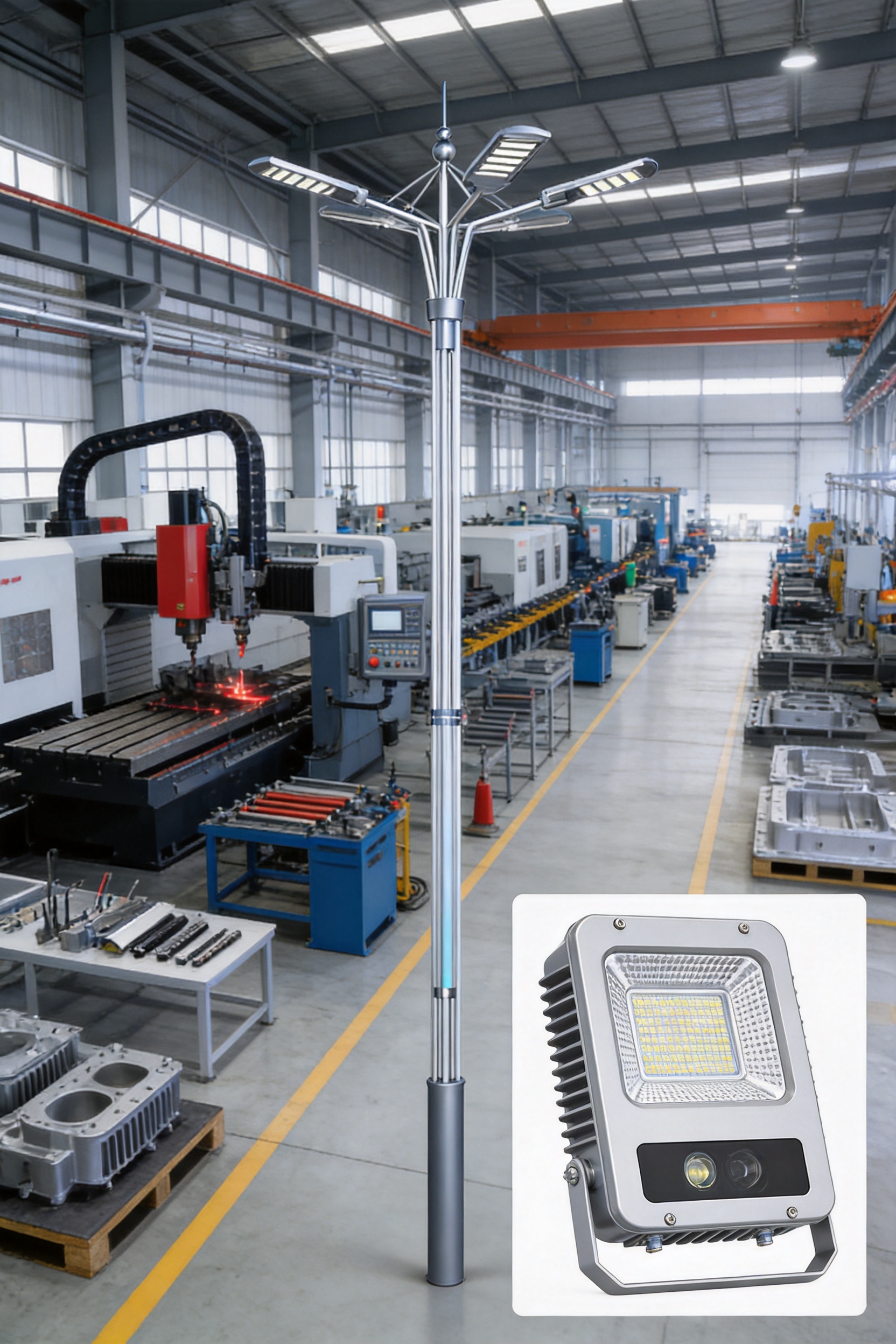
The manufacturing process includes advanced equipment such as bending machines, powder electrostatic painting equipment, automatic welding and cutting machines, and a 1250-ton die-casting machine. The combination of equipment and technical personnel allows the company to manage multiple stages of production rather than relying entirely on external suppliers.
Material Availability
The company maintains extensive material stock and offers steel options including Q235B, Q345B, S275JR, S355JR, Q460, A36, A572, GR56, GR50, and other grades. Material availability can shorten production lead times and reduce the risk of project delays caused by sourcing shortages.
Material selection is still subject to engineering confirmation. Different grades have different mechanical properties, welding requirements, coating behavior, and suitability for particular loading conditions. The availability of several options allows the project team to select an appropriate grade rather than using one universal material for every environment.
CNC Bending
Precise CNC bending contributes to repeatable pole and arm geometry. Accurate bending helps maintain consistent angles, reduces distortion, and improves the fit between structural components. It can also reduce the amount of post-production correction required before welding or assembly.
Consistency is important for four-arm structures because all arms should maintain a balanced relationship with the central pole. Small geometric deviations can become visually obvious when four components are intended to appear symmetrical. CNC-controlled production supports more reliable dimensional performance across multiple units.
High-Accuracy Cutting
The manufacturing information identifies cutting accuracy of 0.01 mm. High-accuracy cutting can produce exact dimensions and clean edges, helping components fit correctly during fabrication. Clean cuts may also reduce the need for excessive grinding or rework.
Cutting precision is particularly valuable when parts must align with pre-drilled holes, connection plates, arm brackets, access openings, and welded assemblies. Better dimensional control can improve production efficiency and support a more consistent final product.
Automated Welding and Certified Welders
Welding quality influences the strength and appearance of poles, arms, brackets, and other fabricated components. Automated welding lines can deliver repeatable production and stable process control, while experienced certified welders are valuable for complex joints, structural details, and quality verification.
The company reports a team of certified welders with many years of experience. This combination of automation and skilled labor enables the manufacturer to balance production speed with workmanship. Consistent welding can reduce defects, minimize rework, and help ensure that large project orders are completed on schedule.
Surface Treatment and Corrosion Resistance
The manufacturing process includes powder electrostatic painting equipment and production methods intended to enhance anti-corrosion performance. Surface preparation, coating adhesion, curing temperature, coating thickness, and handling are all important factors in the final result.
For steel poles, hot-dip galvanizing provides the primary long-term corrosion barrier. Additional surface treatments or colors may be selected according to the visual and environmental needs of the project. The manufacturer’s production capabilities support customization of specifications and finishes while preserving industrial process control.
Die Casting for Luminaire Housings
A 1250-ton die-casting machine supports production of aluminum luminaire housings. Die casting is suitable for creating complex, repeatable shapes with integrated ribs, mounting features, and thermal-management surfaces. Consistent housing geometry helps ensure proper assembly of LED modules, drivers, covers, seals, and optical components.
High-pressure die casting can also support efficient large-volume production. When tooling and process parameters are properly managed, the method produces components with a consistent appearance and repeatable dimensions, supporting both quality and cost control.
8. Engineering Services from Concept to Installation
A municipal lighting product is most successful when supported by accurate project engineering. A pole and luminaire must be selected according to road geometry, wind load, foundation conditions, electrical supply, maintenance access, lighting standards, and environmental requirements. The manufacturer provides services intended to support customers through these stages.
CAD Design
CAD design allows the project team to review pole geometry, arm arrangement, dimensions, mounting positions, access points, and connection details before production begins. This can identify conflicts with road layouts, traffic signs, utility corridors, drainage, or landscape features at an early stage.
CAD documentation also improves communication between the manufacturer, consultant, contractor, and project owner. Clear drawings can reduce ambiguity and provide a reference for fabrication, installation, inspection, and future maintenance.
Three-Dimensional Product Simulation
Three-dimensional product simulation helps stakeholders evaluate the lamp from different viewing angles. This is useful for confirming proportion, arm symmetry, luminaire orientation, pole height, and compatibility with surrounding structures.
For public projects, visual review can be as important as technical review. A lamp may meet structural requirements but still appear too large, too small, or poorly positioned within an urban setting. Three-dimensional modeling helps the project team assess these factors before committing to production tooling or mass manufacture.
Three-Dimensional Scene Simulation
Scene simulation places the lighting structure within a representation of the proposed road, intersection, plaza, parking facility, or industrial park. This enables evaluation of visibility, clearances, visual continuity, and the relationship between the pole and surrounding buildings or landscaping.
Scene modeling can also support presentations to municipal departments, developers, investors, and community stakeholders. It gives nontechnical decision-makers a clearer understanding of how the completed lighting system may appear in the real environment.
Specification and Color Customization
Projects may require different pole heights, steel grades, surface colors, arm dimensions, LED specifications, color temperatures, control interfaces, or installation accessories. Specification and color customization helps the product adapt to project identity and technical conditions.
Customization should be managed carefully so that appearance changes do not compromise structural performance, heat dissipation, ingress protection, or maintenance access. Professional engineering review ensures that aesthetic and functional requirements remain compatible.
Mechanical Calculation for Wind and Foundation
Wind loading is a critical consideration for mid-mast lighting. The pole, arms, luminaires, fasteners, anchor bolts, and foundation must work as one structural system. Wind pressure depends on local wind speed, exposure category, terrain, pole height, luminaire surface area, arm geometry, and installation location.
The manufacturer provides mechanical calculation services for wind and foundation requirements. These calculations can help determine appropriate steel grades, wall thicknesses, base-plate dimensions, anchor-bolt arrangements, foundation sizes, and reinforcement details. Final structural design must be reviewed according to local codes and project-specific geotechnical information.
Overseas Onsite Installation Guidance
International projects may involve local contractors who are unfamiliar with the specific pole design, assembly sequence, cable routing, torque requirements, or lifting procedures. Overseas onsite installation guidance can help reduce mistakes and support consistent implementation.
Installation guidance may include component identification, assembly instructions, foundation checks, alignment procedures, electrical connection considerations, and final inspection. Proper installation is essential for preserving the product’s designed performance and ensuring safe operation.
9. Applications for Different Project Environments
Wide Municipal Intersections
Large intersections often require lighting in several directions and may contain traffic islands, turn lanes, pedestrian crossings, and open corner areas. The four-arm lamp can be positioned at a strategic central location to support multiple approaches while reducing the need for numerous individual poles.
The selected height, arm reach, optical distribution, and installation position should be determined through a professional lighting design. The goal is to provide sufficient horizontal illumination and uniformity without creating excessive glare or interfering with traffic signals and signs.
Industrial Park Axes
Industrial parks commonly include wide roads, long straight corridors, heavy vehicles, loading areas, factory entrances, and large setbacks. A clean, robust, and standardized lighting system is appropriate for these environments. The lamp’s industrial appearance and durable steel construction can integrate well with modern factories and logistics infrastructure.
The broad operating-temperature range is useful for industrial sites exposed to seasonal weather changes. Dimming support may also allow energy use to be coordinated with production schedules, shift changes, and traffic levels.
Large Parking Facilities
Parking facilities need clear visibility for vehicles and pedestrians, especially at entrances, intersections within the site, pedestrian routes, and remote parking rows. A four-arm pole can serve multiple parking directions from a central position, helping reduce obstacles and preserve open circulation.
When combined with occupancy sensors or a central management platform, dimming can support a responsive lighting strategy. Higher output may be used during periods of active parking movement, while lower output can be selected during quiet periods, subject to safety requirements.
Open Plazas and Civic Areas
Open plazas require a balance between functional illumination and visual appearance. The minimalist form allows the lamp to provide broad coverage without introducing excessive decorative detail. Color-temperature selection can be coordinated with the atmosphere of the space, surrounding architecture, landscaping, and pedestrian use.
In civic environments, designers should also consider glare control, mounting height, visual comfort, accessibility, and the protection of nearby residential areas. A complete photometric and environmental assessment remains necessary before installation.
Transportation and Logistics Areas
Distribution centers, freight yards, bus facilities, and transportation entrances often require reliable lighting across broad paved surfaces. The four-arm layout can support road intersections and maneuvering areas where vehicles approach from multiple directions.
The robust pole materials, IP65 luminaire protection, high-efficiency LEDs, and wide input-voltage range make the product suitable for demanding infrastructure applications. Maintenance access and safe working procedures should be included in the overall site design.
10. Installation and Maintenance Considerations
Although the product is designed for reliable outdoor use, correct installation is essential. The foundation must be constructed according to approved calculations and site soil conditions. Anchor bolts should be accurately positioned, properly embedded, and protected during concrete work. The pole should be lifted using approved equipment and checked for vertical alignment before final tightening.
Arm orientation must be verified against the lighting plan. Even a well-designed four-arm system can produce uneven coverage if the arms are rotated incorrectly or if luminaires are mounted at inconsistent angles. Installation teams should check horizontal alignment, bolt torque, cable routing, grounding, and the condition of seals and access covers.
Electrical connections should comply with local regulations and be protected against moisture, mechanical damage, and accidental contact. The AC85-265V input range provides broad compatibility, but the actual supply voltage, protection devices, earthing system, surge protection, and control interface must be confirmed for each project.
Routine maintenance should include visual inspection of the pole, arms, fasteners, luminaire housing, cable entries, surface coating, and foundation area. Operators should look for corrosion, loose connections, water ingress, impact damage, unusual vibration, or changes in light output. A scheduled inspection program can identify small issues before they become major repairs.
The LED system reduces the need for frequent lamp replacement, but LED lighting is not maintenance-free. Drivers, control components, seals, connectors, and surge-protection devices may require inspection or replacement over the life of the installation. Keeping records of installation dates, operating hours, faults, and maintenance activities can support better asset management.
11. Energy Efficiency and Total Cost of Ownership
Purchase price is only one part of a municipal lighting investment. Total cost of ownership includes energy consumption, installation, civil works, maintenance labor, spare parts, traffic management during repairs, and eventual replacement. A product that combines efficient LEDs, consolidated structural design, durable materials, and smart dimming can contribute to lower long-term operating costs.
The stated 140 lm/W efficacy supports efficient operation, although actual system performance will depend on LED power, driver efficiency, optical losses, ambient temperature, dimming schedules, and maintenance conditions. A photometric design should compare the required illumination level with the selected input power rather than relying on efficacy alone.
The four-arm arrangement may reduce the number of poles and foundations in suitable layouts. This can lower civil construction costs and reduce the number of electrical connection points. It can also simplify future inspection because several lighting directions are associated with a central asset.
Energy savings can be increased through DC 0-10V or DALI dimming. A project may establish different lighting levels for evening, late-night, early-morning, and high-traffic periods. These schedules should be developed with safety, traffic patterns, local regulations, and public expectations in mind.
The five-year warranty period provides a defined planning horizon for project owners and contractors. Warranty conditions should be reviewed carefully, including installation requirements, electrical protection, operating conditions, maintenance obligations, and documentation procedures.
12. Why the Manufacturing Partner Matters
A combined municipal lamp is not simply a standard luminaire mounted on a pole. It is an integrated system involving optical design, aluminum casting, steel fabrication, structural calculation, welding, galvanizing, fasteners, electrical components, packaging, and installation coordination. Working with a manufacturer that manages these areas can improve consistency and accountability.
Yangzhou Jinyuan Lamps Co., Ltd. has operated in the road illumination industry since 2002 and is affiliated with Jinshang Electric Group. Its product range includes street light poles, LED street lights, solar street lights, light fixtures, and related lighting products. This broader experience is relevant because municipal projects often combine several product categories rather than requiring one isolated lamp.
The company’s production scale, technical staff, manufacturing equipment, international export experience, and engineering services provide a foundation for large projects. Its reported certifications and management systems indicate an emphasis on quality control, environmental management, and occupational safety.
For buyers, the ability to coordinate design, manufacturing, customization, and installation support through one experienced supplier can reduce communication gaps. It may also simplify documentation, quality inspections, packaging arrangements, and after-sales service.
13. Project Selection Checklist
Before ordering the Four-arm Minimalist Combined Municipal Lamp, project teams should confirm the road classification, required illumination level, pole locations, mounting height, arm projection, luminaire wattage, optical distribution, color temperature, control method, and electrical supply.
Structural designers should verify local wind speed, terrain exposure, soil bearing capacity, foundation limitations, seismic conditions where applicable, and the weight and projected area of the selected luminaires. The design should also consider transportation restrictions, lifting equipment, installation access, and future maintenance vehicles.
Electrical engineers should confirm voltage, frequency, surge protection, grounding, circuit protection, cable size, dimming protocol, control cabinet requirements, and communication compatibility. If the project uses a smart city platform, the DALI or 0-10V interface should be evaluated alongside the selected control architecture.
Urban designers should review the pole’s appearance, finish color, visual scale, relationship to buildings, sightline impacts, and compatibility with signs, traffic signals, landscaping, and pedestrian facilities. A three-dimensional scene simulation can support this review.
Procurement teams should confirm material grades, galvanizing requirements, coating specifications, fastener type, packaging, inspection standards, warranty terms, delivery schedule, spare parts, and documentation. Early confirmation of these factors helps avoid changes after production has begun.
14. Frequently Asked Questions
What is the main purpose of the Four-arm Minimalist Combined Municipal Lamp?
Its main purpose is to provide multi-directional lighting for wide intersections, industrial park roads, large parking facilities, open plazas, and other broad municipal spaces. Four luminaires are supported around one central pole to improve coverage and reduce the need for multiple separate poles where the site layout allows.
What pole heights are available?
The stated pole-height range is 6 meters to 10 meters. The correct height should be selected according to road width, lighting requirements, wind conditions, surrounding structures, maintenance access, and the approved photometric and structural designs.
What type of light source does the product use?
The product uses LED light sources. LED technology supports high luminous efficiency, immediate operation, digital dimming, compact optical control, and reduced routine lamp replacement compared with many older lighting technologies.
What is the stated luminous efficiency?
The stated lamp luminous efficiency is 140 lm/W. Actual installed-system performance depends on the selected LED power, driver, optical system, operating temperature, dimming level, and maintenance conditions.
Can the lamp be connected to a smart lighting system?
Yes. The product supports DC 0-10V and DALI dimming. These interfaces can be used with suitable control equipment, timers, sensors, centralized management systems, and energy-saving schedules.
Is the lamp suitable for cold and hot climates?
The stated operating-temperature range is -35°C to 65°C. This broad range supports many outdoor environments, although project engineers should also consider humidity, salinity, pollution, wind, snow, solar exposure, and local environmental conditions.
What level of outdoor protection does the luminaire have?
The luminaire is specified with an IP65 rating. This indicates protection against dust ingress and water jets under applicable testing conditions. Installation, cable entry, seals, covers, and maintenance practices must preserve this protection level.
What materials are used for the luminaire and pole?
The luminaire housing uses aluminum alloy, while pole material options include Q235, Q355, SS400, GR65, and other grades. The pole is hot-dip galvanized, and the mechanical connections use rust-proof stainless steel fasteners.
Can the color temperature be customized?
The listed color-temperature range is 3000K-6000K. The appropriate selection depends on the project’s visual objectives, road classification, environmental requirements, surrounding land use, and local standards.
Does the manufacturer provide structural calculations?
Yes. The available engineering services include mechanical calculations for wind and foundation requirements. Final calculations should be based on local wind data, soil conditions, pole configuration, luminaire loading, and applicable structural codes.
Does the manufacturer support overseas projects?
Yes. The company provides overseas onsite installation guidance and has experience exporting lighting products to international markets. Project-specific logistics, local installation regulations, and site supervision requirements should be confirmed in advance.
What warranty period is provided?
The listed warranty period is five years. Buyers should review the complete warranty terms, including covered components, operating conditions, installation requirements, electrical protection, maintenance responsibilities, and claim procedures.
Can the pole and lamp be customized?
Specification and color customization are available. Customization may include pole material, height, finish, color, luminaire configuration, optical requirements, and control options, subject to engineering review and production confirmation.
15. Conclusion
The Four-arm Minimalist Combined Municipal Lamp is a practical lighting solution for large, open, and multi-directional municipal environments. Its central four-arm structure can provide broad coverage from one coordinated installation point, helping reduce visual clutter and potentially lowering the number of poles, foundations, and maintenance locations required for suitable sites.
Its design combines clean industrial aesthetics with functional engineering. LED technology, a stated efficiency of 140 lm/W, aluminum-alloy housing, IP65 protection, a wide operating-temperature range, selectable color temperature, and compatibility with DC 0-10V and DALI dimming make it adaptable to modern road and infrastructure projects.
The product’s long-term value is further supported by hot-dip galvanized steel poles, stainless steel fasteners, multiple material options, structural calculation services, CAD and three-dimensional design support, and overseas installation guidance. The manufacturer’s production capabilities, including CNC bending, high-accuracy cutting, automated welding, powder coating, die casting, and quality-control systems, provide a strong industrial foundation for consistent delivery.
For project owners, consultants, contractors, and municipal authorities, the most important step is to integrate the lamp into a complete lighting and structural design. When its height, optics, arm orientation, foundation, electrical system, control strategy, and maintenance plan are properly coordinated, the four-arm configuration can help create safer, cleaner, more efficient, and more visually coherent public spaces.
References
1. Product technical information supplied for the Four-arm Minimalist Combined Municipal Lamp, including electrical, optical, material, environmental, and structural specifications.
2. Manufacturer-provided information concerning production equipment, CNC bending, cutting accuracy, welding, die casting, powder coating, material availability, and quality-control procedures.
3. Manufacturer-provided engineering service information concerning CAD design, three-dimensional simulation, customization, wind and foundation calculation, and overseas installation guidance.
4. General principles of LED roadway lighting, optical distribution, energy-efficient operation, and smart dimming control.
5. General engineering principles for hot-dip galvanized steel structures, outdoor luminaire ingress protection, wind loading, foundation design, and maintenance planning.