


JINYUAN
JINYUAN
JINYUAN
JINYUAN
JINYUAN
JINYUAN
JINYUAN
JINYUAN
JINYUAN
JINYUAN
JINYUAN
JINYUAN
JINYUAN
JINYUAN
JINYUAN
JINYUAN
Content
- 1 1. A New Approach to Landscape and Lawn Lighting
- 2 2. Product Design for Modern Outdoor Environments
- 3 3. Solar Energy and Integrated Electrical Performance
- 4 4. Materials, Durability, and Environmental Resistance
- 5 5. Manufacturing Capabilities Behind the Product
- 6 6. Quality Management and Certifications
- 7 7. Technical Specifications
- 8 8. Advantages over Conventional and Single-Purpose Alternatives
- 9 9. Applications Across Different Project Types
- 10 10. Engineering and Customization Support
- 11 11. Recommended Installation and Commissioning Practices
- 12 12. Maintenance and Service-Life Considerations
- 13 13. Sustainability and Total Project Value
- 14 14. Why Manufacturing Strength Matters to Buyers
- 15 15. Selection Guide for Buyers and Project Designers
- 16 16. Frequently Asked Questions
- 16.1 Q1: What is the Multifunctional Solar Landscape Lawn Light designed for?
- 16.2 Q2: Does the product require underground wiring?
- 16.3 Q3: How does the light turn on and off?
- 16.4 Q4: How long can it operate at night?
- 16.5 Q5: What type of light source is used?
- 16.6 Q6: What color temperatures are available?
- 16.7 Q7: What materials are used for the lamp structure?
- 16.8 Q8: Can the product be customized?
- 16.9 Q9: Is the product suitable for cold and hot climates?
- 16.10 Q10: How is product quality checked?
- 16.11 Q11: What certifications and management standards are associated with the manufacturer?
- 16.12 Q12: What maintenance does a solar lawn light require?
- 16.13 Q13: Can it replace all roadway lighting?
- 16.14 Q14: What company manufactures the product?
- 16.15 Q15: What is the warranty period?
- 17 17. Conclusion
- 18 References
- 19 Product: Multifunctional Solar Landscape Lawn Light
Outdoor lighting has evolved from a basic utility into an important part of landscape architecture, public-space planning, hospitality design, and residential development. Modern lighting systems are expected to provide dependable visibility, contribute to visual identity, reduce installation complexity, and operate efficiently with minimal maintenance. The Multifunctional Solar Landscape Lawn Light is designed to meet these requirements through the combination of solar energy generation, integrated LED illumination, intelligent controls, weather-resistant construction, and adaptable optical styling.
Developed for garden paths, villa walkways, hotel landscapes, municipal projects, and other outdoor environments, this solar lawn light series offers a practical alternative to conventional wired landscape fixtures. Its integrated solar architecture eliminates the need for underground electrical cabling, while its light-control and time-control functions allow automatic operation according to environmental conditions and programmed schedules. The result is a lighting solution that supports both aesthetic presentation and dependable outdoor performance.
The product is manufactured by Yangzhou Jinyuan Lamps Co., Ltd., a professional lighting and road-illumination enterprise with experience in product design, fabrication, engineering support, and international project service. The company combines large-scale production capabilities with design customization, testing procedures, and supply-chain control. These strengths help the product compete effectively in projects where quality consistency, installation speed, long service life, and visual refinement are essential.
1. A New Approach to Landscape and Lawn Lighting
Traditional landscape lighting systems generally depend on underground wiring, centralized power distribution, separate control equipment, and extensive civil works. Although wired systems can be suitable for certain permanent installations, they may require trenching, cable protection, drainage planning, electrical connection, and post-installation repair access. These requirements can increase project duration and cost, particularly in finished gardens, established parks, historic areas, or locations where excavation is difficult.
The Multifunctional Solar Landscape Lawn Light addresses these challenges with an integrated photovoltaic and lighting design. The solar panel, battery system, LED light source, control components, and fixture structure are combined into a coordinated unit. During the daytime, the photovoltaic system converts available sunlight into electrical energy and stores that energy in the internal battery. At night, the stored power operates the LED module without requiring a connection to the public electricity network.
This configuration offers a high degree of deployment flexibility. Fixtures can be installed along pathways, around planting areas, beside building entrances, near recreational zones, or in locations where conventional power infrastructure is unavailable. Because there is no requirement for underground electrical wiring, the installation process can be simplified and the risk of landscape disturbance can be reduced.
The product is not limited to a single visual style. The series supports multiple diffuser and light-distribution concepts, including frosted light-transmitting columns, layered light dispersers, and conical focusing modules. These alternatives allow project designers to select a suitable appearance and illumination effect according to the surrounding architecture, pathway geometry, landscape vegetation, and desired atmosphere.
2. Product Design for Modern Outdoor Environments
A lawn light must perform several functions simultaneously. It must illuminate walking routes, define boundaries, support wayfinding, complement nearby architecture, resist weather exposure, and remain visually attractive during the daytime. The Multifunctional Solar Landscape Lawn Light is designed around this combination of performance and appearance.
2.1 Multiple Diffuser and Optical Concepts
The optical design of the series is one of its most significant advantages. A frosted light-transmitting column produces a soft and evenly distributed glow. This type of diffuser is suitable for residential gardens, hotel courtyards, entrance paths, and quiet public spaces where visual comfort is more important than concentrated beam intensity.
Layered light dispersers create a more dimensional appearance. The layers can produce a decorative rhythm and help distribute light around the fixture while reducing the visual harshness that may occur with exposed LED points. This makes the product useful in landscape projects where the luminaire itself is intended to contribute to the overall design composition.
Conical focusing modules provide a more directed lighting effect. They can be used where the designer wants to emphasize a pathway, a planting line, a change in elevation, or a specific architectural feature. By offering several optical approaches within one product family, the series is more adaptable than a single-style lawn light designed for only one visual application.
2.2 Integration with Landscape Architecture
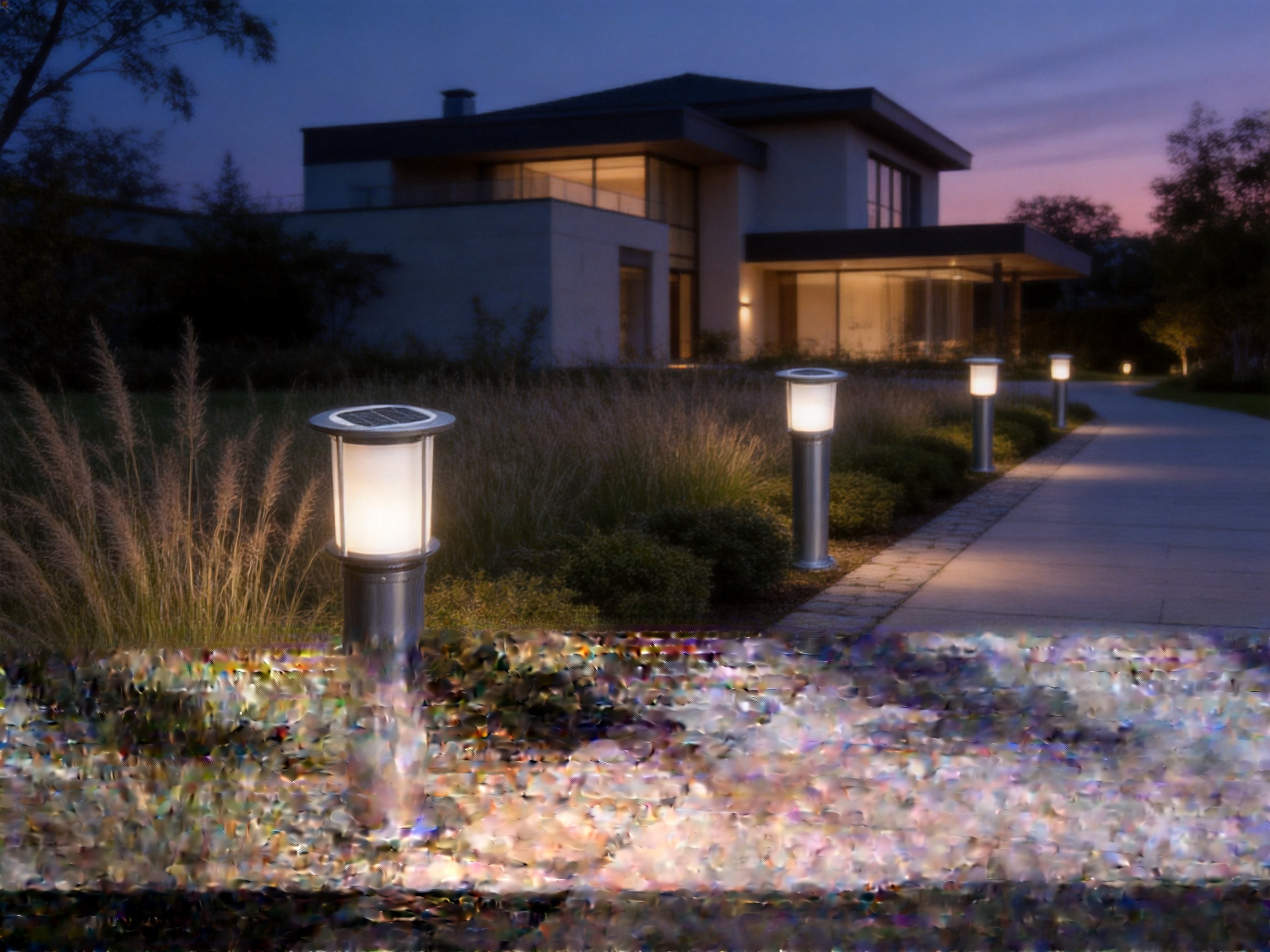
The fixture is intended to support the landscape rather than dominate it. Its proportions, diffuser options, and refined industrial appearance allow it to be incorporated into boutique hotel gardens, luxury residential developments, landscaped public roads, municipal pathways, and commercial outdoor spaces.
In a private garden, the light can create a clear route between the entrance, terrace, driveway, and recreational areas. In a hotel landscape, it can support guest movement while reinforcing a premium atmosphere. In a municipal project, repeated installation along a walkway can provide orderly visual guidance and improve the perceived safety of the environment.
The ability to combine pathway lighting and ambient accent lighting is another practical benefit. Fixtures with more diffused optical output can establish a calm background glow, while focused versions can highlight circulation areas or selected landscape features. This allows one product family to address multiple zones within a larger project.
2.3 Above-Ground Base Mounting
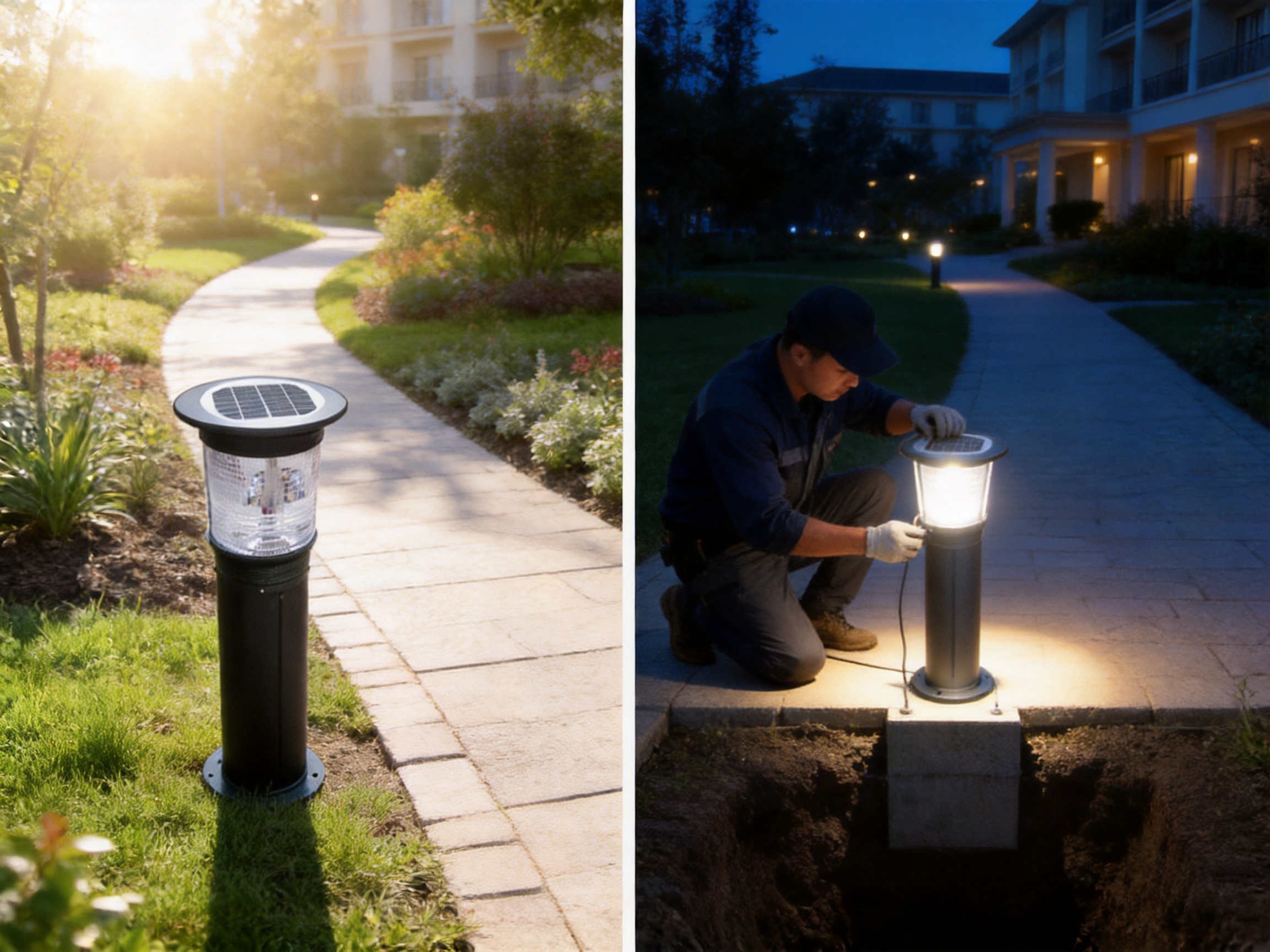
The series uses a simplified above-ground base-mounting method. This installation concept can reduce the need for extensive excavation and helps contractors complete projects more efficiently. It is especially useful where the landscape has already been completed, where underground utilities must be avoided, or where project schedules require rapid deployment.
Above-ground mounting also simplifies inspection and replacement. Maintenance personnel can access the fixture base without opening underground junction boxes or tracing buried cables. For large projects containing many independent lighting points, this can improve service efficiency and reduce the disruption associated with maintenance work.
Before installation, the foundation, mounting surface, spacing, solar exposure, and local wind conditions should be assessed. The product can be supported by project-specific design assistance, including mechanical calculations for wind and foundation conditions. This engineering support helps ensure that the selected installation method is appropriate for the site.
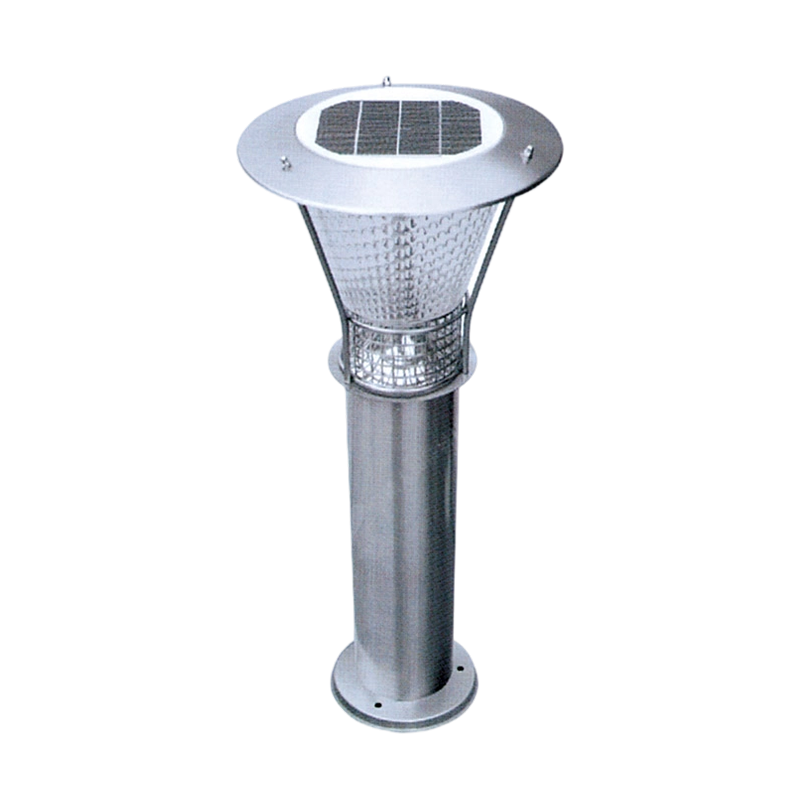
Multifunctional Solar Landscape Lawn Light
3. Solar Energy and Integrated Electrical Performance
The product uses an integrated solar photovoltaic system to harvest energy from natural daylight. Solar power allows the fixture to operate independently from the conventional grid and avoids the energy consumption associated with continuously powered wired lighting. For projects with multiple scattered lighting points, this independent configuration can offer substantial practical advantages.
3.1 Daytime Charging and Nighttime Operation
During the day, the photovoltaic panel charges the internal energy-storage system. When ambient light levels decrease, the control system activates the LED light source. At dawn or when sufficient natural light returns, the fixture stops illumination and resumes charging.
The stated continuous lighting time is approximately 5 to 12 hours, depending on factors such as solar radiation, season, local weather, panel orientation, battery condition, lighting configuration, and operating settings. This range provides flexibility for different project requirements, but designers should always evaluate local sunlight conditions before finalizing the quantity and operating schedule of fixtures.
The integrated structure reduces the number of separate components that must be installed and coordinated on site. A conventional lighting point may require a pole or housing, cable, junction box, underground conduit, external controller, and electrical connection. The solar lawn light combines the essential functions into one self-contained fixture, helping simplify logistics and reduce installation dependencies.
3.2 Intelligent Light and Time Control
The fixture uses both light control and time control. Light-control technology enables the product to respond to changes in natural ambient brightness. Time-control functionality can support a programmed operating period, helping balance illumination needs and available stored energy.
This dual-control approach is more adaptable than a simple manual switch. The fixture can be configured to operate automatically without requiring daily intervention. According to the supplied operating guidance, the transport mode should be disabled after installation so that the unit can enter normal automatic operation. Once activated, it can turn on at dusk and charge during the day.
Automatic operation reduces the likelihood of lights being left on unnecessarily. It also minimizes routine maintenance visits, which is particularly valuable for remote garden zones, large public areas, hotels, and commercial properties with numerous independent fixtures.
3.3 Energy Efficiency of LED Illumination
The light source is LED, with a stated lamp luminous efficiency of 140 lm/W. High luminous efficiency means that more visible light can be produced from a given amount of electrical energy than with less efficient light sources. In a solar product, this is especially important because the available energy depends on the daily charging conditions and the capacity of the internal battery.
Efficient LED performance supports longer operating periods and can help the system make better use of stored solar energy. It may also allow the designer to achieve the required pathway brightness with a compact fixture and an appropriately sized photovoltaic and battery system.
LED technology also offers advantages in switching performance, service life, vibration resistance, and design flexibility. LEDs reach operating output quickly, which is suitable for automatic dusk activation. They can be arranged with different optical components to create soft, layered, or focused illumination effects.
3.4 Photovoltaic Material Quality
The production information identifies the use of Grade-A silicon wafers in the solar panels. High-quality silicon materials support stable energy conversion and are intended to provide strong resistance to outdoor aging and environmental impact. Panel quality is important because the photovoltaic module is the energy source for the entire lighting system.
Automated production processes are used for solar-cell encapsulation and panel inspection. Consistent encapsulation helps protect internal photovoltaic components against moisture penetration, temperature variation, and long-term outdoor exposure. The stated manufacturing approach places emphasis on sealing quality and weather resistance, both of which influence the reliability of solar charging.
Although solar performance varies by location, a well-designed panel and properly maintained surface can provide dependable energy generation over an extended operating period. Installers should ensure that the panel is not shaded by trees, buildings, signs, or other fixtures during the most productive daylight hours.
4. Materials, Durability, and Environmental Resistance
Outdoor lighting products are exposed to sunlight, rainfall, humidity, wind, dust, temperature changes, and, in some locations, corrosive atmospheric conditions. A lawn light that performs well indoors or in mild weather may not deliver the same service life in a demanding outdoor environment. The Multifunctional Solar Landscape Lawn Light is therefore constructed with weather-resistant materials and protective finishing processes.
4.1 Aluminum Alloy Lamp Structure
The stated lamp material is aluminum alloy. Aluminum alloy provides a useful combination of structural strength, manageable weight, corrosion resistance, and manufacturing flexibility. Its relatively low weight can make handling and installation easier than heavier metal alternatives, while its strength supports the stability of the fixture housing and mounting components.
Aluminum alloy is also suitable for precise forming and finishing. It can be used to create clean housing lines, integrated supports, and carefully shaped components that contribute to both visual quality and functional performance. In a landscape project, the appearance of every repeated fixture influences the overall impression of the site, making material consistency important.
4.2 Anti-Oxidation and Anti-Corrosion Finishing
The lamp structures receive precision anti-oxidation and anti-corrosion treatments. These treatments are intended to help preserve the surface and underlying structure when the product is exposed to high temperatures, humidity, rainfall, and acid rain.
Protective finishing is especially relevant in coastal areas, industrial zones, regions with high humidity, and cities where air pollution may accelerate surface degradation. A durable finish helps reduce discoloration, corrosion marks, and premature deterioration, supporting a more consistent appearance over the service life of the project.
The quality of a protective finish depends on surface preparation, coating uniformity, curing conditions, inspection standards, and handling after production. For this reason, the company’s in-house manufacturing and quality-control procedures are important complements to the selected material.
4.3 Operating Temperature Range
The specified operating temperature range is -35°C to 65°C. This broad range is suitable for many outdoor environments, from cold winter regions to hot summer conditions. Thermal performance is important for the solar panel, battery, LED module, controller, seals, coating, and structural materials.
Project planners should still consider local climate conditions, installation orientation, ventilation, snow accumulation, and exposure to direct solar heat. Correct site planning helps the fixture operate within its intended conditions and supports long-term system stability.
4.4 Protection through Factory Testing
Each unit is reported to undergo three critical factory tests: light-source aging and durability testing, structural waterproofing testing, and comprehensive performance verification. These tests address different aspects of product reliability.
Light-source aging tests help identify potential LED or electrical performance problems before shipment. Waterproofing checks examine the ability of the structure and sealing interfaces to resist water penetration. Comprehensive performance verification reviews the overall operation of the fixture, including charging, control response, illumination, and related functions.
Testing at the factory is more efficient than relying only on site troubleshooting. It allows potential issues to be detected under controlled conditions and supports more consistent quality across production batches.
5. Manufacturing Capabilities Behind the Product
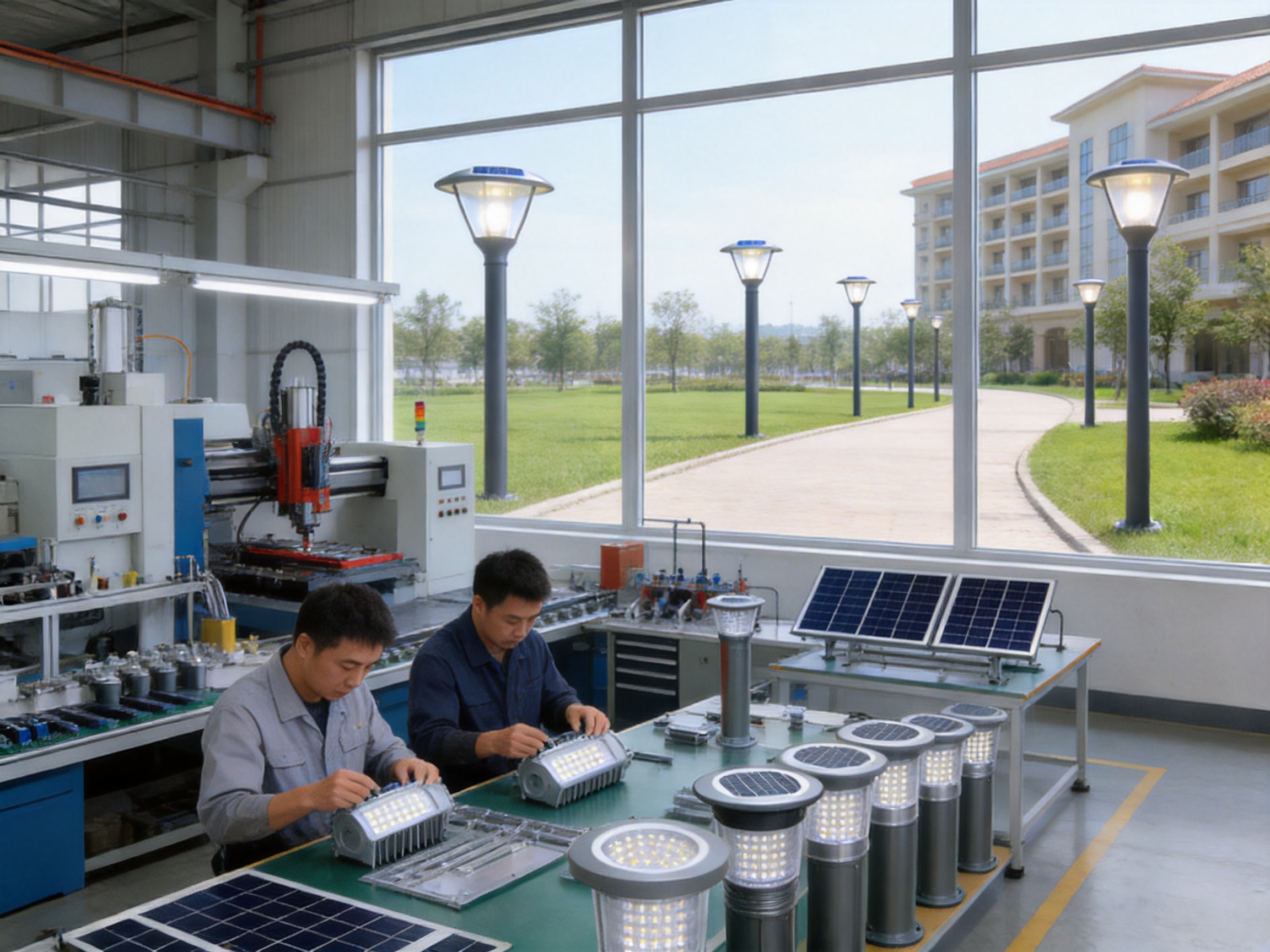
The performance of a solar landscape light depends not only on its design but also on how consistently that design is manufactured. Dimensional variation, weak welds, incomplete coatings, inconsistent encapsulation, or poor assembly can reduce product reliability. Yangzhou Jinyuan Lamps Co., Ltd. uses a combination of material management, CNC processing, automated production, machine-based inspection, and final testing to control these risks.
5.1 Large-Scale Production Infrastructure
The company operates on a site covering more than 70,000 square meters and employs more than 300 professional technicians. This scale provides a foundation for coordinated production, technical supervision, product development, and project support.
Large-scale infrastructure can also improve production planning. Raw materials, components, fabrication equipment, assembly lines, testing stations, packaging areas, and engineering personnel can be organized within an integrated manufacturing system. This supports more efficient movement from design approval to mass production.
The company has experience serving domestic and overseas customers and exports products to more than 200 countries. International project experience exposes the manufacturer to a wide range of climate conditions, installation practices, technical expectations, and procurement requirements. This background is valuable when supplying products for different markets and applications.
5.2 Material Selection for Structural Components
The company’s production information lists several material options for different structural products, including Q235B, Q345B, S275JR, S355JR, Q460, A36, A572, GR56, and GR50. Although the solar lawn light uses aluminum alloy for the lamp material, the broader material capability demonstrates experience with multiple grades of metal used in lighting poles, supports, and related infrastructure.
Material selection influences strength, forming behavior, weldability, corrosion performance, weight, and cost. Maintaining access to suitable materials helps the manufacturer adapt products to project requirements while reducing the possibility of supply delays. Extensive material stock can also support faster production scheduling for customized or large-volume orders.
5.3 CNC Bending and Dimensional Consistency
Precision CNC bending is used to produce consistent shapes and improve structural integrity. Computer-controlled bending helps reduce variation between components and limits the need for post-production correction. This is important for parts that must align accurately during assembly or connect with mounting structures.
Consistent bending also supports a cleaner finished appearance. In architectural and landscape lighting, repeated fixtures are often installed in close visual proximity. Small differences in alignment or geometry can become noticeable across a large project, so controlled forming processes contribute to a more uniform result.
5.4 Automated Welding and Cutting
The manufacturing facility includes automatic welding and cutting equipment. Automated processes can improve repeatability and help produce stable joints when correctly programmed and monitored. Welding quality affects the strength of supports, brackets, housings, and other structural parts.
Automatic cutting improves dimensional control and can reduce material waste. When combined with technical drawings and inspection procedures, it supports a consistent production standard across different orders. The company’s equipment portfolio also includes a 1250-ton die-casting machine, demonstrating capacity for manufacturing precision metal components at scale.
5.5 Powder Electrostatic Painting
Powder electrostatic painting equipment is used for surface finishing. Electrostatic application helps distribute coating material across metal surfaces before curing. A correctly applied powder coating can provide a durable protective layer and a consistent appearance.
For landscape products, coating quality has both practical and aesthetic importance. The finish must resist outdoor exposure while maintaining the visual character selected by the project designer. Consistent color and surface texture are particularly important when many fixtures are installed throughout a garden, resort, public square, or municipal route.
5.6 Automated Solar-Panel Production
The solar panel production process includes automated solar-cell encapsulation and machine-based inspections. Encapsulation protects the photovoltaic cells and electrical connections from the environment. Automated control helps improve consistency during bonding, sealing, and panel assembly.
Weather resistance is central to the performance of an integrated solar light. If moisture enters the panel or internal electrical area, charging efficiency and service life may be reduced. Standardized encapsulation and inspection processes help limit these risks and provide a stronger production basis than uncontrolled manual assembly.
5.7 End-to-End Supply-Chain Oversight
In-house manufacturing with supply-chain oversight gives the company greater visibility from components to finished products. This can make it easier to coordinate material selection, production schedules, quality inspections, assembly standards, packaging, and delivery requirements.
Supply-chain control is also useful for managing customized projects. A customer may require a specific color, optical style, operating configuration, voltage option, or installation arrangement. Coordinating these elements internally can reduce communication gaps and help ensure that the final product matches the approved specification.
6. Quality Management and Certifications
The company identifies ISO, CE, and CQC certifications among its quality credentials, while its broader corporate information references ISO9001, ISO14001, and OHSAS18001. These standards and certifications indicate attention to quality management, environmental management, occupational health and safety, and product conformity.
Certification alone does not replace product testing or responsible installation, but it provides an additional framework for documented processes and organizational control. A quality-management system can help establish procedures for purchasing, production, inspection, corrective action, traceability, and customer service.
Environmental management is particularly relevant to solar lighting because the product is intended to reduce dependence on grid electricity and avoid underground wiring. Responsible manufacturing should also consider material use, production efficiency, coating processes, packaging, and end-of-life handling.
Occupational health and safety management supports safer factory operations and helps create a controlled environment for employees working with metal processing, welding, painting, assembly, and testing equipment.
The company’s stated dual-layer quality control includes factory inspection and production-stage verification. Every unit is subjected to critical tests before shipment, helping reduce the likelihood of post-sales problems and improving customer confidence in large-scale orders.
7. Technical Specifications
The following specifications summarize the available product information. Final values may vary according to the selected configuration, project requirements, optical design, battery capacity, solar-panel arrangement, and approved technical drawing.
| Specification | Available Information |
|---|---|
| Product type | Multifunctional solar landscape lawn light |
| Brand | Jinyuan |
| Application | Road lighting, garden paths, landscape areas, municipal and private outdoor spaces |
| Light source | LED |
| Voltage options | 3.2V / 12V / 24V |
| Lamp material | Aluminum alloy |
| Operating temperature | -35°C to 65°C |
| Continuous lighting time | Approximately 5–12 hours |
| Lamp luminous efficiency | 140 lm/W |
| Color temperature | 3000K–6000K |
| Color rendering index | Ra 70 |
| Control method | Light control and time control |
| Warranty period | 3 years |
7.1 Voltage and Configuration Options
The available voltage options of 3.2V, 12V, and 24V provide flexibility for different internal system designs and project requirements. The selected voltage is typically related to the battery configuration, controller design, LED assembly, and electrical architecture of the fixture.
Customers should confirm the required voltage during the technical approval stage. Compatibility between the solar panel, storage battery, controller, LED module, and any optional monitoring equipment is essential for stable operation.
7.2 Color Temperature Selection
The available color-temperature range is 3000K to 6000K. A 3000K light generally produces a warm appearance that can complement wood, stone, planting, hospitality spaces, and traditional architectural materials. It is often selected where a welcoming and relaxing atmosphere is desired.
Neutral or cooler temperatures within the available range can provide a clearer and more contemporary visual effect. These options may be suitable for modern municipal pathways, commercial developments, public circulation areas, and projects where higher visual contrast is preferred.
Color temperature should be selected in relation to the surrounding environment rather than independently. Excessively cool lighting may appear harsh in a warm garden setting, while very warm lighting may not provide the desired visual clarity for certain public routes.
7.3 Color Rendering
The stated color rendering index is Ra 70. This level is appropriate for many general outdoor pathway and landscape applications. It allows common colors and surface materials to be presented with reasonable visual differentiation while keeping the system focused on efficient outdoor illumination.
For projects requiring highly accurate color judgment, such as art display areas, premium retail landscapes, or specialized architectural presentation, the lighting designer should evaluate the color-rendering requirement during specification.
8. Advantages over Conventional and Single-Purpose Alternatives
The product’s competitive advantages arise from the combination of integrated solar power, adaptable design, efficient LED technology, simplified installation, durable materials, and structured manufacturing control. It is not merely a decorative fixture; it is a complete lighting point designed for practical outdoor deployment.
8.1 No Underground Electrical Cabling
The most immediate advantage over conventional wired lawn lights is the absence of underground electrical cabling. This can reduce excavation, conduit installation, cable routing, waterproof junction work, and coordination with existing utilities.
Reduced civil work can be particularly valuable in projects with strict environmental requirements. Mature landscapes, paved courtyards, resort gardens, and completed residential developments may be damaged by trenching. A self-contained solar fixture helps preserve existing surfaces and planting arrangements.
8.2 Faster Project Deployment
The integrated design allows fixtures to be delivered and installed with fewer separate components. Once the mounting bases and site conditions are prepared, the lighting units can be positioned and commissioned without waiting for a new power network to be completed.
Faster installation can help contractors meet tight project schedules. It can also reduce labor exposure in difficult locations and simplify the management of projects containing many independent lighting points.
8.3 Lower Routine Intervention
Automatic light sensing and time control reduce the need for manual switching. The fixture can operate according to the day-night cycle and its programmed settings. This reduces the need for daily operation and can lower the frequency of site visits.
Lower intervention is helpful for public gardens, large hotels, remote pathways, and private properties where lighting personnel are not present every evening. Maintenance teams can focus on periodic inspection, cleaning, battery evaluation, and structural checks rather than routine switching.
8.4 More Design Choices than Basic Bollards
Many basic solar lawn lights offer only one housing style and one diffusion method. The Multifunctional Solar Landscape Lawn Light series provides several diffuser concepts, making it easier to create a coordinated lighting language across different zones.
A project can use soft diffused fixtures near seating areas, layered decorative fixtures along an entrance route, and focused fixtures beside circulation paths. The shared product family helps maintain design coherence while supporting functional variation.
8.5 Efficient Use of Stored Energy
The combination of LED illumination and a high stated luminous efficiency of 140 lm/W allows the fixture to produce useful illumination while managing the limitations of solar-generated energy. Efficient light output is important during periods of reduced sunlight, when the battery must support nighttime operation with a smaller energy reserve.
8.6 Manufacturing Consistency
Precision CNC bending, automated cutting and welding, machine-based inspection, solar-cell encapsulation, and final testing provide a stronger basis for repeatable quality than unstructured small-batch production. For a project with dozens or hundreds of fixtures, consistency between units is essential.
Uniform appearance, stable mounting dimensions, controlled coating, reliable sealing, and verified illumination help reduce installation adjustments and post-installation complaints. This is a significant advantage for contractors, developers, property managers, and distributors.
9. Applications Across Different Project Types
9.1 Boutique Hotels and Resorts
Hotels use outdoor lighting to guide guests, define entrances, support evening activities, and create a distinctive atmosphere. Solar landscape lawn lights can be installed along garden paths, around water features, beside outdoor dining areas, and near reception approaches.
The choice of diffuser design allows the lighting to match the property’s architectural character. Warm color temperatures and frosted columns can support a calm, premium environment, while layered or focused designs can emphasize key arrival points and circulation routes.
9.2 Luxury Villas and Residential Communities
Private residences and villa developments often require lighting that is functional without appearing industrial. The product’s landscape-oriented form and multiple optical options allow it to fit into gardens, driveways, perimeter paths, terraces, and entrance zones.
Solar operation can also be beneficial when homeowners or property managers want to avoid extensive cable installation. Independent fixtures can be added to existing gardens with limited disturbance, provided that the selected positions receive adequate sunlight.
9.3 Municipal Pathways and Public Landscapes
Municipal lighting projects may involve long pathways, parks, greenbelts, public squares, and roadside landscape zones. Solar lawn lights can help provide route definition in areas where extending grid power would be expensive or disruptive.
For public projects, durability and consistent production are especially important. Fixtures may be exposed to frequent weather changes, cleaning operations, accidental contact, and prolonged daily use. The aluminum-alloy structure, protective treatment, automatic control, and factory testing are aligned with these requirements.
9.4 Commercial Developments
Shopping centers, office campuses, mixed-use developments, and business parks can use solar landscape lights to illuminate walkways and improve the presentation of outdoor spaces. Because the product operates independently, it can be installed in landscape areas that are separated from the main building electrical system.
The design flexibility also helps developers create a consistent visual identity. Color temperature, diffuser style, coating color, and spacing can be coordinated with the building façade and overall site plan.
9.5 Roadsides and Supporting Road Illumination
The listed application includes road lighting. In this context, the product is best suited to low-height landscape margins, pedestrian routes, entrance lanes, green strips, and supporting illumination rather than replacing high-mast or full-height roadway luminaires where elevated traffic illumination is required.
Used correctly, the fixtures can reinforce road edges, guide pedestrians, highlight turning points, and improve the visual continuity of landscaped road corridors. A qualified lighting design should determine spacing, mounting height, glare control, and illumination levels for each road-related application.
10. Engineering and Customization Support
Outdoor lighting projects often require more than a standard product catalogue. Designers may need CAD drawings, 3D simulations, customized dimensions, specific colors, mechanical calculations, installation guidance, and technical documentation. The company provides a range of project services intended to support customers from consultation through completion.
10.1 CAD Design
CAD design can help customers review fixture dimensions, mounting details, component relationships, and installation interfaces before production. Accurate drawings are useful for tender documents, engineering approvals, construction coordination, and maintenance planning.
10.2 Three-Dimensional Product Simulation
Three-dimensional product simulation allows the customer to examine the fixture’s form from multiple angles. This can be valuable when comparing diffuser options, housing proportions, mounting arrangements, and material finishes.
10.3 Three-Dimensional Scene Simulation
Scene simulation places the product into a representative landscape or architectural environment. It can help designers evaluate how the light relates to pathways, plants, façades, paving, furniture, and other site elements. This visual review may identify spacing or appearance issues before the project reaches the construction stage.
10.4 Specification and Color Customization
Projects may require a particular finish, color, optical effect, voltage, operating schedule, or structural arrangement. Specification and color customization enables the lighting system to align more closely with a project’s design language and technical conditions.
Customization should be confirmed through an approved technical specification. Important items include solar-panel capacity, battery type and capacity, LED power, color temperature, control logic, mounting method, coating, dimensions, and warranty conditions.
10.5 Mechanical Calculations
Wind and foundation calculations support the safe installation of outdoor fixtures. Even a compact lawn light must be evaluated in relation to local wind speed, soil conditions, mounting surface, foundation geometry, and potential external impact.
Engineering calculations are especially valuable for large projects, exposed sites, coastal areas, open parks, and installations subject to local building or public-works requirements.
10.6 Overseas On-Site Installation Guidance
International customers may receive overseas on-site installation guidance. This service can help contractors understand assembly, positioning, transport-mode deactivation, solar orientation, control settings, and basic commissioning procedures.
Professional installation guidance is useful because solar lighting performance depends strongly on site conditions. Even a high-quality fixture may underperform if the panel is shaded, the mounting surface is unstable, the controller is not activated, or the light distribution is not coordinated with the pathway layout.
11. Recommended Installation and Commissioning Practices
Before installation, inspect the products for transport damage, verify the approved model and accessories, and compare the delivered units with the project schedule. Confirm that mounting hardware, foundations, brackets, and any required tools are available.
Select locations with strong access to daylight. Avoid placing the solar panel beneath dense tree canopies, beside tall walls, under roof overhangs, or near structures that cast long shadows. Seasonal shading should also be considered because the sun’s position changes throughout the year.
Install the fixture on a stable and level base. The mounting surface should be able to resist wind, vibration, accidental contact, and repeated maintenance activity. For projects with special soil or wind conditions, use the applicable foundation and mechanical calculations.
Maintain consistent spacing along pathways unless the lighting design calls for emphasis at entrances, steps, intersections, or landscape features. Correct spacing improves visual rhythm and can reduce dark gaps between illuminated zones.
After installation, confirm that the solar panel and light head are correctly oriented. Check the housing, seals, fasteners, and mounting points. Remove any protective packaging that may block the panel or diffuser.
Disable transport mode according to the manufacturer’s instructions. Test the light-control and time-control functions by following the approved commissioning procedure. Where immediate nighttime testing is not possible, verify the controller settings and allow sufficient charging time before evaluating the complete operating cycle.
Record the installation date, product configuration, location, and commissioning results. This information can support future inspection, warranty service, and battery replacement planning.
12. Maintenance and Service-Life Considerations
Solar lighting is designed to reduce maintenance, but no outdoor product is entirely maintenance-free. Periodic inspection helps preserve performance and identify issues before they become serious.
Keep the photovoltaic panel clean and free from leaves, dust, bird residue, and other deposits. A contaminated panel may receive less sunlight and generate less charging energy. Cleaning frequency should reflect the local environment, rainfall, nearby vegetation, and dust levels.
Inspect the diffuser for cracks, discoloration, or excessive dirt. A damaged diffuser may affect light distribution and allow moisture to enter the optical or electrical compartment. Replace damaged components with approved parts.
Check the housing, coating, fasteners, and base for signs of corrosion, loosening, impact, or deformation. Coastal and industrial environments may require more frequent inspection because airborne contaminants can accelerate surface deterioration.
Monitor nighttime operating duration. A significant reduction in operating time may indicate inadequate charging, panel shading, battery aging, controller problems, or LED-system faults. Troubleshooting should begin with simple environmental checks before replacing components.
The product is supplied with a stated three-year warranty period. Warranty claims should be supported by the purchase record, product identification, installation information, and a description of the observed issue. Unauthorized modifications may affect warranty evaluation, so repairs should follow the manufacturer’s instructions.
13. Sustainability and Total Project Value
The environmental value of a solar lawn light extends beyond the absence of grid electricity. The product can reduce the need for underground cable, conduit, trenching, and associated landscape restoration. This may reduce material consumption and site disturbance during installation.
Solar operation also supports energy independence at the individual fixture level. Instead of drawing electricity from a centralized network every night, the fixture uses locally harvested solar energy stored within its own system. This is particularly useful in areas where grid extension is expensive, unreliable, or unavailable.
LED efficiency contributes to efficient use of the stored energy. Durable materials and protective finishing can extend the useful service period, reducing the frequency of replacement and the resources required for repeated installation.
Total project value should be evaluated across the product life cycle rather than by purchase price alone. Installation labor, trenching, cable materials, electrical accessories, restoration work, operating electricity, maintenance visits, and replacement costs all influence the final investment. An integrated solar solution may provide stronger value when these factors are considered together.
Project owners should also assess battery replacement requirements, local solar conditions, cleaning needs, and expected operating schedules. A complete life-cycle comparison provides a more reliable basis for selecting solar or wired lighting.
14. Why Manufacturing Strength Matters to Buyers
Lighting distributors, engineering contractors, municipal buyers, landscape architects, and property developers often need a supplier capable of more than one-time product delivery. They need stable quality, dependable communication, design assistance, consistent production, documentation, and after-sales support.
A manufacturer with its own production equipment can respond more directly to technical questions and customization requests. CNC bending, automated welding, powder coating, die casting, photovoltaic encapsulation, and assembly inspection are all part of a broader capability that supports product development and manufacturing control.
The company’s experience in street light poles, LED street lights, solar street lights, light fixtures, and related products also provides a broader understanding of outdoor illumination. This background helps connect the solar lawn light with larger road-lighting, landscape-lighting, and infrastructure projects.
International export experience is another benefit for overseas buyers. Products supplied to different countries may require attention to packaging, documentation, voltage standards, climate, local installation practices, and project communication. A manufacturer accustomed to international orders is better positioned to coordinate these requirements.
Quality control is particularly important for repeat orders. If a developer expands a project or a distributor places several orders over time, consistent dimensions, colors, optical effects, and electrical specifications are essential. Standardized processes and documented inspections help support this continuity.
15. Selection Guide for Buyers and Project Designers
When evaluating the Multifunctional Solar Landscape Lawn Light, buyers should first define the lighting purpose. Is the fixture intended mainly to mark a path, improve pedestrian visibility, create decorative ambience, highlight landscape features, or support a road-edge lighting plan? The answer will influence diffuser type, color temperature, spacing, and mounting arrangement.
Next, evaluate the solar resource. Review annual sunlight, seasonal cloud cover, shading, panel orientation, and the desired nighttime operating period. A site with limited daylight may require a different system configuration from a site with strong year-round solar exposure.
Determine the required light appearance. Warm 3000K light may be suitable for hospitality and residential landscapes, while cooler settings may support modern public or commercial environments. Select the diffuser according to the required distribution: soft, layered, or focused.
Confirm the mechanical conditions. Identify the base type, foundation dimensions, wind exposure, soil conditions, risk of impact, and maintenance access. For large or exposed sites, request mechanical calculations and installation drawings.
Clarify the electrical configuration. Confirm the voltage option, LED output, battery capacity, solar-panel rating, control method, charging behavior, and expected lighting time. These specifications should be recorded in the final quotation and technical approval documents.
Finally, review quality documentation, test procedures, warranty conditions, packaging, delivery schedule, customization limits, and after-sales support. A complete evaluation reduces the risk of technical mismatch and helps ensure that the selected fixture performs properly after installation.
16. Frequently Asked Questions
Q1: What is the Multifunctional Solar Landscape Lawn Light designed for?
It is designed for outdoor landscape and pathway lighting, including gardens, villa walkways, hotel grounds, municipal landscapes, commercial developments, road-edge areas, and other pedestrian-oriented spaces. Its optical options allow it to provide either soft ambient illumination, layered decorative light, or more focused pathway lighting.
Q2: Does the product require underground wiring?
No. The fixture integrates the solar panel, energy-storage system, LED light source, and control components. It is designed to operate independently from underground electrical cabling, which can simplify installation and reduce site excavation.
Q3: How does the light turn on and off?
The product uses light control and time control. The light sensor responds to natural ambient brightness, while the time-control function supports programmed operating schedules. After installation, transport mode must be disabled according to the operating instructions so the automatic cycle can begin.
Q4: How long can it operate at night?
The stated continuous lighting time is approximately 5 to 12 hours. Actual performance depends on sunlight availability, season, shading, battery condition, configuration, operating schedule, and local weather.
Q5: What type of light source is used?
The light source is LED, with a stated luminous efficiency of 140 lm/W. LED technology supports efficient energy use, rapid switching, long operating life, and flexible optical design.
Q6: What color temperatures are available?
The available color-temperature range is 3000K to 6000K. Warm light is generally suitable for comfortable residential and hospitality landscapes, while neutral or cooler light can support contemporary public, commercial, and municipal applications.
Q7: What materials are used for the lamp structure?
The stated lamp material is aluminum alloy. The structure is also treated with anti-oxidation and anti-corrosion processes to support outdoor durability in conditions involving humidity, high temperatures, rainfall, and acid rain.
Q8: Can the product be customized?
Project support includes specification and color customization, CAD design, three-dimensional product and scene simulation, and engineering assistance. Final customization options should be confirmed with the manufacturer because they may depend on order quantity, technical requirements, and the approved design.
Q9: Is the product suitable for cold and hot climates?
The stated operating temperature range is -35°C to 65°C. This range covers many cold and hot outdoor environments. Site-specific factors such as snow, shading, heat accumulation, coastal exposure, and installation conditions should still be reviewed before ordering.
Q10: How is product quality checked?
The manufacturer reports three critical factory tests: light-source aging and durability testing, structural waterproofing testing, and comprehensive performance verification. Production also includes machine-based inspections, photovoltaic-panel encapsulation controls, and quality checks throughout manufacturing.
Q11: What certifications and management standards are associated with the manufacturer?
The supplied company information references ISO, CE, and CQC credentials, as well as ISO9001, ISO14001, and OHSAS18001. Buyers should request current certificates and confirm their applicability to the specific product and order.
Q12: What maintenance does a solar lawn light require?
Routine maintenance normally includes cleaning the photovoltaic panel, checking the diffuser, inspecting the housing and coating, tightening mounting hardware where necessary, and monitoring nighttime operating duration. The inspection frequency should reflect the local environment.
Q13: Can it replace all roadway lighting?
It is primarily a landscape and low-height pathway fixture. It can support road-edge, pedestrian, entrance, and landscape illumination, but it should not automatically be treated as a replacement for high-mast, mid-mast, or full-height roadway lighting. A professional lighting design should determine whether its output and mounting height meet the requirements of a particular road.
Q14: What company manufactures the product?
The product is manufactured by Yangzhou Jinyuan Lamps Co., Ltd., located in Gaoyou City, Jiangsu Province, China. The company specializes in outdoor lighting, street-lighting products, solar lighting, light poles, engineering support, and related manufacturing services.
Q15: What is the warranty period?
The listed warranty period is three years. Warranty coverage should be reviewed together with the final quotation, product specification, installation requirements, operating conditions, and exclusions.
17. Conclusion
The Multifunctional Solar Landscape Lawn Light is a versatile outdoor lighting solution for projects that require efficient illumination, simplified installation, attractive design, and dependable environmental resistance. Its integrated solar architecture removes the need for underground electrical cabling, while LED technology and intelligent light-and-time control support efficient automatic operation.
The series stands out through its range of diffuser concepts. Frosted columns, layered light dispersers, and conical focusing modules give designers the flexibility to create different lighting effects without moving to unrelated product families. This supports visual consistency across gardens, hotel grounds, villa pathways, commercial developments, and municipal landscape projects.
Its aluminum-alloy structure, anti-corrosion treatment, broad operating-temperature range, and factory waterproofing and performance tests provide a strong foundation for outdoor use. The stated 140 lm/W luminous efficiency, 3000K–6000K color-temperature range, 5–12-hour operating time, and three-year warranty further support its suitability for a wide range of applications.
The product is also backed by manufacturing capabilities that include CNC bending, automated cutting and welding, powder electrostatic painting, die casting, solar-cell encapsulation, machine-based inspection, and end-to-end quality control. Combined with CAD design, three-dimensional simulation, customization, mechanical calculations, and overseas installation guidance, these capabilities make the solution suitable for both standard orders and larger engineered projects.
For buyers comparing solar landscape lighting options, the most important evaluation should include not only appearance and price but also installation requirements, solar performance, battery configuration, material protection, production consistency, quality documentation, and long-term service support. When these factors are considered together, the Multifunctional Solar Landscape Lawn Light offers a balanced solution for modern, attractive, and energy-conscious outdoor environments.
References
1. Product technical information for the Multifunctional Solar Landscape Lawn Light series, including voltage, operating temperature, luminous efficiency, color temperature, control method, operating time, and warranty data.
2. Manufacturer-provided information regarding solar photovoltaic integration, Grade-A silicon wafers, automatic charging, nighttime lighting, solar-cell encapsulation, and weather-resistance processes.
3. Manufacturer-provided production information concerning CNC bending, automated welding and cutting, powder electrostatic painting, die-casting equipment, machine-based inspection, and factory testing.
4. Manufacturer-provided company profile for Yangzhou Jinyuan Lamps Co., Ltd., including production site, technical personnel, international export experience, product categories, and management certifications.
5. General outdoor lighting design principles concerning pathway illumination, landscape integration, color temperature selection, solar-panel positioning, maintenance planning, and site-specific engineering evaluation.