


JINYUAN
JINYUAN
JINYUAN
JINYUAN
JINYUAN
JINYUAN
JINYUAN
JINYUAN
JINYUAN
JINYUAN
JINYUAN
JINYUAN
JINYUAN
JINYUAN
JINYUAN
JINYUAN
Content
- 1 Introduction
- 2 Product Overview
- 3 Key Product Advantages
- 4 Technical Specifications
- 5 Signal Color Performance
- 6 Structural Design and Mechanical Reliability
- 7 Advanced Manufacturing Capabilities
- 8 Quality Control and Production Efficiency
- 9 Design and Engineering Services
- 10 Advantages Over Conventional Alternatives
- 11 Application Areas
- 12 Company Manufacturing Strength
- 13 Installation and Maintenance Recommendations
- 14 Frequently Asked Questions
- 14.1 What is the main purpose of this signaling lamp?
- 14.2 What lamp sizes are available?
- 14.3 What type of light source is used?
- 14.4 Can the system be customized?
- 14.5 What is the available cantilever arm length?
- 14.6 How is the steel pole protected against corrosion?
- 14.7 What is the operating temperature range?
- 14.8 What is the protection class?
- 14.9 Does the product comply with a traffic signal standard?
- 14.10 Can engineering support be provided?
- 14.11 What materials can be used for production?
- 14.12 Why is an integrated design useful?
- 15 Conclusion
- 16 References
- 17 Product: All-in-One Monoblock Cantilevered Signaling Lamp
Introduction
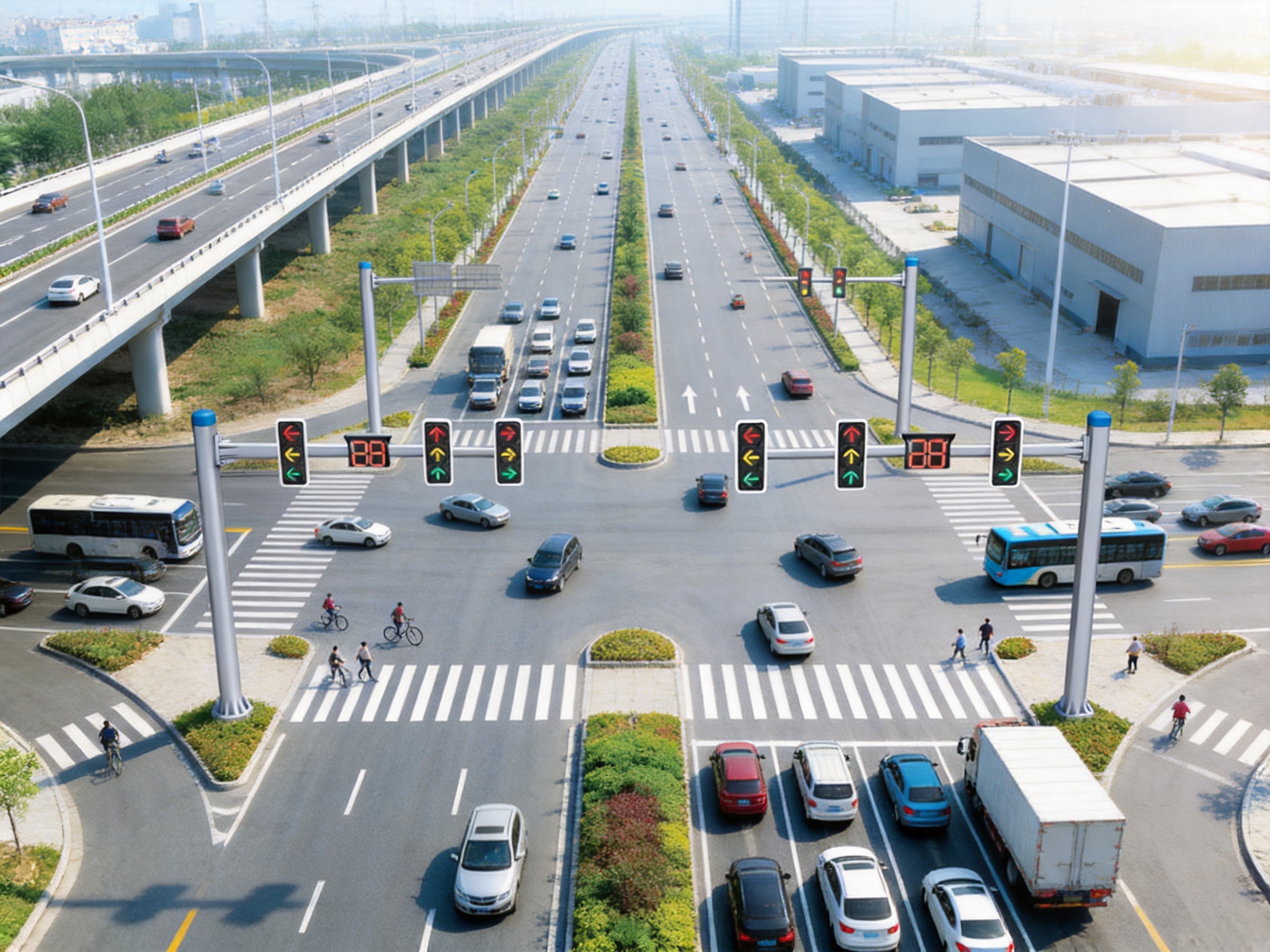
Modern roads depend on traffic signal systems that remain visible, stable, and dependable in demanding outdoor environments. At busy urban intersections, highway interchanges, industrial parks, and municipal transportation networks, a signaling lamp is more than a simple light source. It is a critical safety device that communicates movement instructions clearly to drivers, cyclists, and pedestrians while supporting the organized flow of traffic.
The All-in-One Monoblock Cantilevered Signaling Lamp is designed for high-intensity traffic management applications where dependable visibility, structural strength, and long-term outdoor performance are essential. Its integrated construction combines the signaling lamp, mounting arrangement, and supporting cantilever structure into a coordinated system. This approach helps simplify project planning, improve visual consistency, and provide a durable solution for intersections that require overhead or cantilevered signal placement.
Using original imported ultra-high-brightness LEDs, the signaling lamp provides strong optical visibility in direct sunlight and other challenging conditions. Its one-piece housing is manufactured from die-cast aluminum or impact-resistant engineering plastic, offering resistance to weather exposure, ultraviolet radiation, vibration, and routine environmental stress. The design is available with 300-millimeter or 400-millimeter round and square light-emitting surfaces, allowing transportation authorities and project designers to select an appropriate configuration for different road layouts.
The product is supported by advanced metalworking, welding, cutting, surface treatment, design, and quality-control capabilities. These manufacturing strengths are particularly important for large-scale traffic infrastructure projects, where consistent dimensions, reliable structural performance, and timely delivery can directly affect construction schedules and public safety.
Product Overview
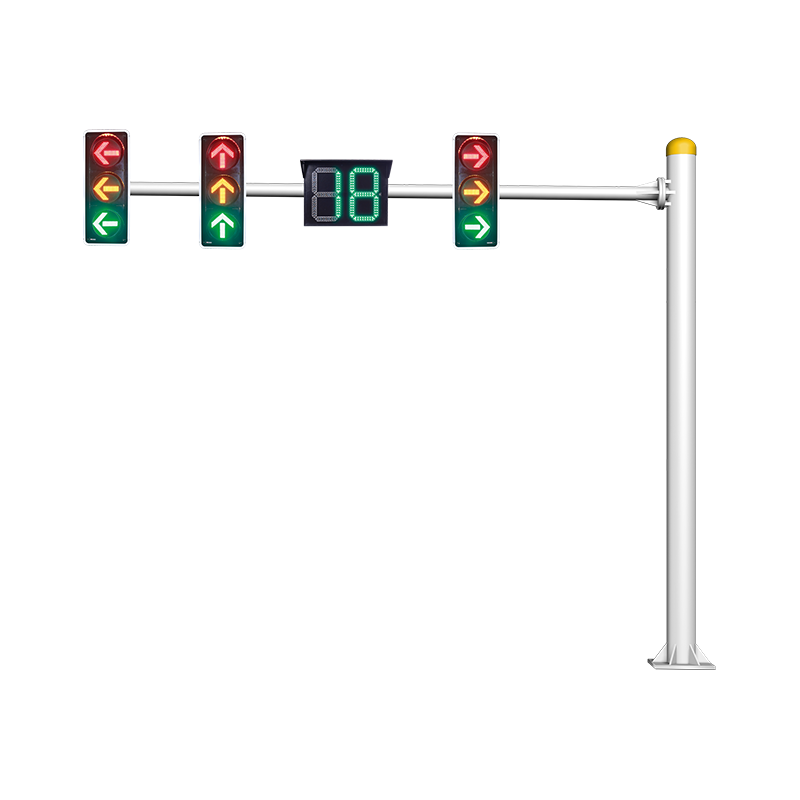
The All-in-One Monoblock Cantilevered Signaling Lamp is a high-visibility LED traffic signal system intended for fixed installation at road intersections and other controlled traffic points. The product uses an integrated monoblock concept to create a coordinated signaling assembly with a clean appearance and strong mechanical support.
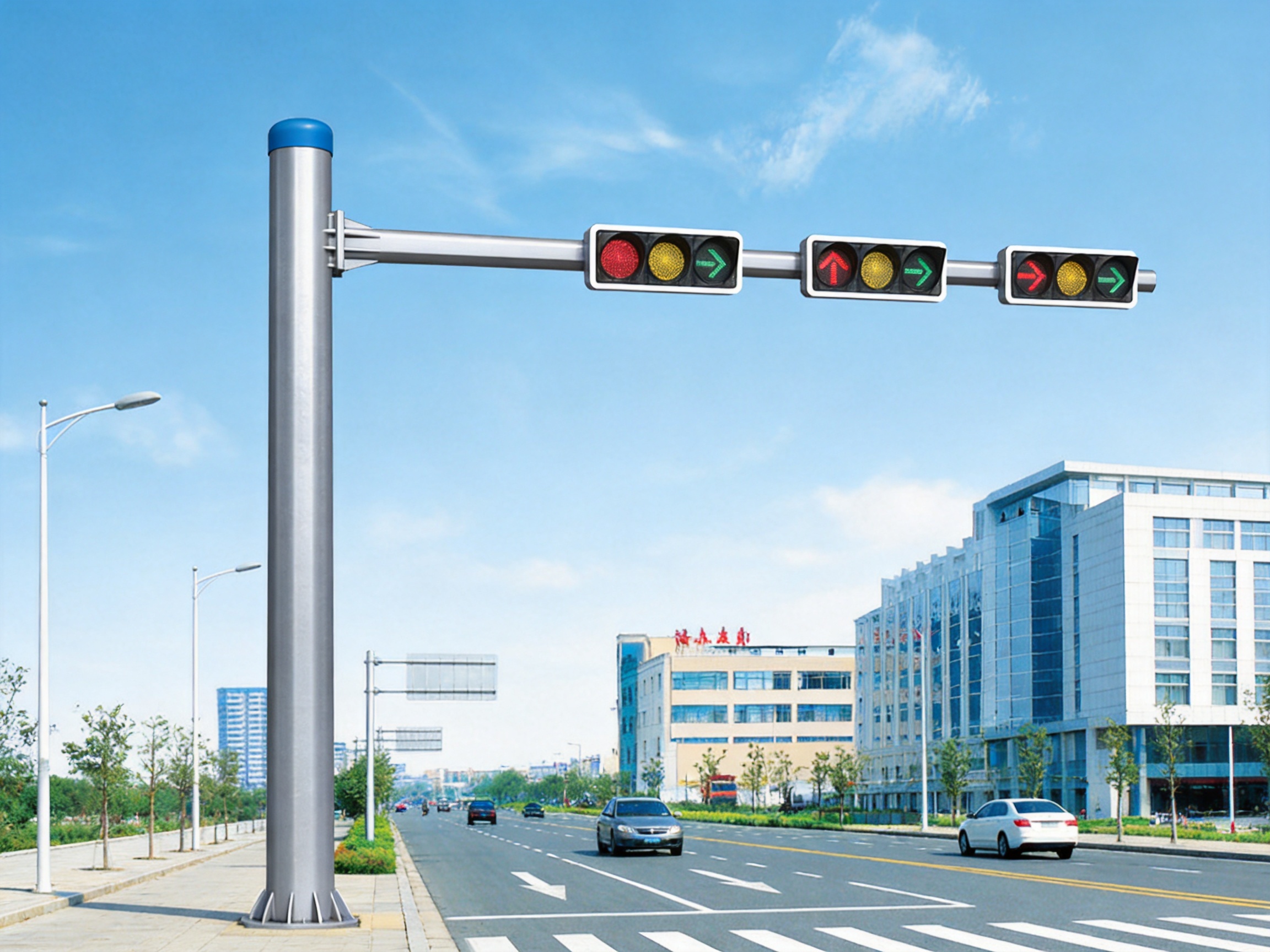
Its cantilevered mounting structure allows the signal to extend over a traffic lane or approach, improving the viewing angle for drivers who may be positioned some distance from the roadside. Depending on the project configuration, the system can support flexible horizontal or vertical cantilever mounting. This flexibility is useful for intersections with different lane widths, road geometries, and equipment positioning requirements.
The signaling lamp is available in multiple face configurations. Round and square light-emitting surfaces are offered in diameters or corresponding dimensions of 300 millimeters and 400 millimeters. These options allow the system to be matched to visibility requirements, road classification, mounting height, and local traffic engineering practices.
All core technical parameters are designed to comply with the GB14887-2011 national standard. Compliance with a recognized traffic signal standard helps provide a consistent technical foundation for government projects, municipal infrastructure programs, commercial developments, and industrial transportation systems.
Key Product Advantages
High Visibility in Direct Sunlight
Traffic signals must remain clearly visible during bright daylight, including conditions involving direct sunlight, reflective vehicle surfaces, glare, and changing viewing angles. The All-in-One Monoblock Cantilevered Signaling Lamp uses original imported ultra-high-brightness LEDs to provide strong luminous performance and clear signal recognition.
Compared with basic low-output signal lamps, high-brightness LED technology can provide a more distinct indication of red, green, and yellow commands. This is especially valuable at wide intersections, multilane approaches, elevated roadways, and locations where the signal is mounted at a considerable distance from the driver.
LED light sources also provide a concentrated and stable optical output. When combined with an appropriate signal lens and housing design, this helps reduce uncertainty about the active traffic instruction. Clear color recognition is essential because drivers must distinguish between stop, proceed, and transition commands quickly and accurately.
Long Operating Life
The rated service life of the light source is greater than 50,000 hours. This long operating life can reduce the frequency of lamp replacement and support lower maintenance requirements throughout the service period. Fewer replacement operations also reduce traffic disruption, labor costs, equipment requirements, and risks associated with working near moving vehicles.
Long-life LED operation is particularly beneficial for municipal and highway authorities responsible for large networks of intersections. Instead of managing frequent replacement cycles across multiple locations, maintenance teams can focus on inspection, electrical testing, cleaning, and scheduled system servicing.
The actual service life of any LED system depends on operating temperature, power quality, installation conditions, ventilation, and maintenance practices. Nevertheless, the use of a high-quality LED source provides a strong foundation for reliable, long-term traffic signal operation.
Integrated Monoblock Construction
The monoblock construction creates a unified product appearance and reduces the need to coordinate multiple independent assemblies during installation. An integrated design can help minimize alignment issues and support a more orderly installation process, especially when several signal heads are installed along a single cantilevered arm.
A coordinated housing and support structure also helps improve visual uniformity across an intersection. This is important for urban projects where infrastructure appearance must complement the surrounding streetscape. The clean cylindrical form of the main pole provides a modern and attractive appearance while maintaining the structural function required for outdoor traffic equipment.
Flexible Cantilever Mounting
The system supports horizontal or vertical cantilever mounting arrangements. This flexibility makes it suitable for different intersection designs and road conditions. A horizontal arm can extend the signal over a lane or approach, while a vertical arrangement may be selected where the installation layout, pole configuration, or available space requires it.
The cantilever arm length can be configured from 5,000 millimeters to 14,000 millimeters. This broad range supports projects with different road widths and visibility requirements. The appropriate arm length should be selected through engineering review, taking into account lane arrangement, wind loading, foundation conditions, clearance requirements, and the required signal viewing position.
Weather and UV Resistance
Traffic signaling equipment is continuously exposed to rain, sunlight, dust, wind, temperature changes, and road vibration. The lamp housing is made from one-piece die-cast aluminum or impact-resistant engineering plastic injection molding. These materials are selected to provide weather resistance and long-term resistance to ultraviolet exposure.
Die-cast aluminum offers a strong and rigid housing option with good dimensional stability. Engineering plastic can provide impact resistance, reduced weight, and design flexibility. The selected housing material can be matched to the project’s technical requirements, environmental conditions, and installation preferences.
The stated operating ambient temperature range is -40 degrees Celsius to +80 degrees Celsius. This broad range supports use in both cold and hot climates, although local project engineering should consider solar loading, enclosure ventilation, electrical conditions, and installation-specific temperature factors.
Protection Against Outdoor Conditions
The product has an IP54 protection class. This rating indicates protection against limited dust ingress and water splashing from various directions. IP54 equipment is suitable for many outdoor traffic signal applications when properly installed and maintained.
Correct installation remains important. Cable entries, covers, fasteners, drainage arrangements, and electrical connections should be assembled according to the project installation requirements. Regular inspection can help identify damage, loose components, contamination, or moisture-related issues before they affect signal performance.
All-in-One Monoblock Cantilevered Signaling Lamp
Technical Specifications
The following table summarizes the principal specifications provided for the All-in-One Monoblock Cantilevered Signaling Lamp and its supporting structure.
| Item | Specification |
|---|---|
| Main pole structure | Cylindrical design with an elegant and attractive appearance |
| Pole height | 6,800 millimeters |
| Arm length | 5,000 to 14,000 millimeters |
| Main pole wall thickness | 5 to 10 millimeters |
| Cross arm wall thickness | 4 to 8 millimeters |
| Pole surface treatment | Hot-dip galvanized; optional plastic spraying in selected colors |
| Lamp surface size | 300 millimeters or 400 millimeters |
| Available signal colors | Red, green, and yellow |
| Chromaticity | Red: 620–625; green: 504–508; yellow: 590–595 |
| Operating power supply | 187 to 253 volts, 50 hertz |
| Rated power | Less than 20 watts per lamp |
| Light source service life | More than 50,000 hours |
| Ambient temperature | -40 to +80 degrees Celsius |
| Protection class | IP54 |
| Applicable standard basis | Core technical parameters designed in accordance with GB14887-2011 |
Signal Color Performance
Traffic signal recognition depends on clear and consistent color output. The product supports red, green, and yellow signal colors with stated chromaticity ranges. The red signal is specified at 620–625, the green signal at 504–508, and the yellow signal at 590–595.
Maintaining distinct color boundaries helps drivers recognize the active command rapidly. In a properly designed traffic signal system, color performance works together with luminous intensity, lens design, viewing angle, signal sequencing, and the position of the signal head.
Red is used to communicate stopping or prohibited movement. Green indicates permitted movement subject to road conditions and applicable traffic rules. Yellow warns of an approaching signal transition and requires drivers to respond appropriately. Consistent output across all signal heads at an intersection can help reduce confusion and improve overall traffic discipline.
Structural Design and Mechanical Reliability
Robust Pole Configuration
The main pole has a specified height of 6,800 millimeters and uses a cylindrical structure. The cylindrical form provides a balanced appearance and can support efficient load distribution when appropriately engineered. It is suitable for applications where an attractive public-facing appearance is required without compromising the practical needs of traffic infrastructure.
Main pole wall thickness is available from 5 to 10 millimeters, while cross-arm wall thickness ranges from 4 to 8 millimeters. These ranges allow the structure to be adapted to project requirements, including arm length, equipment weight, wind conditions, foundation design, and local engineering criteria.
Wind and Foundation Considerations
Cantilevered traffic signal structures are exposed to wind loads that act on the pole, arm, signal heads, electrical equipment, and any additional mounted components. As the arm length increases, the structural and foundation requirements may also increase. Proper mechanical calculation is therefore essential before fabrication and installation.
The supplier provides mechanical calculation support for wind and foundation conditions. This service can assist project teams in reviewing pole dimensions, foundation requirements, anchor arrangements, loading assumptions, and installation conditions. The final design should be confirmed by qualified engineering personnel according to local regulations and actual site data.
Foundation conditions may vary significantly between urban pavement, reclaimed land, industrial zones, highway shoulders, and areas with weak or variable soil. A dependable cantilevered system must be designed with the foundation, anchor bolts, pole base, arm connection, and signal equipment considered as one structural assembly.
Hot-Dip Galvanized Protection
The pole surface is treated by hot-dip galvanizing. This process provides a protective zinc coating that helps shield steel from atmospheric corrosion. The stated product information indicates rust-free performance for 20 years under appropriate conditions, while actual durability depends on the environment, coating thickness, exposure level, mechanical damage, maintenance, and local atmospheric conditions.
Hot-dip galvanizing is widely used for outdoor lighting poles, traffic structures, utility supports, and other infrastructure because it provides durable protection over large and complex steel surfaces. Unlike a thin surface coating that may only cover the exterior, galvanizing creates a metallurgically bonded zinc layer that can provide robust protection when properly applied.
For projects requiring a specific visual finish, the pole surface can also be plastic sprayed in optional colors. Color customization can help coordinate the traffic signal structure with municipal identity, road design standards, architectural surroundings, or project-specific visual requirements.
Advanced Manufacturing Capabilities
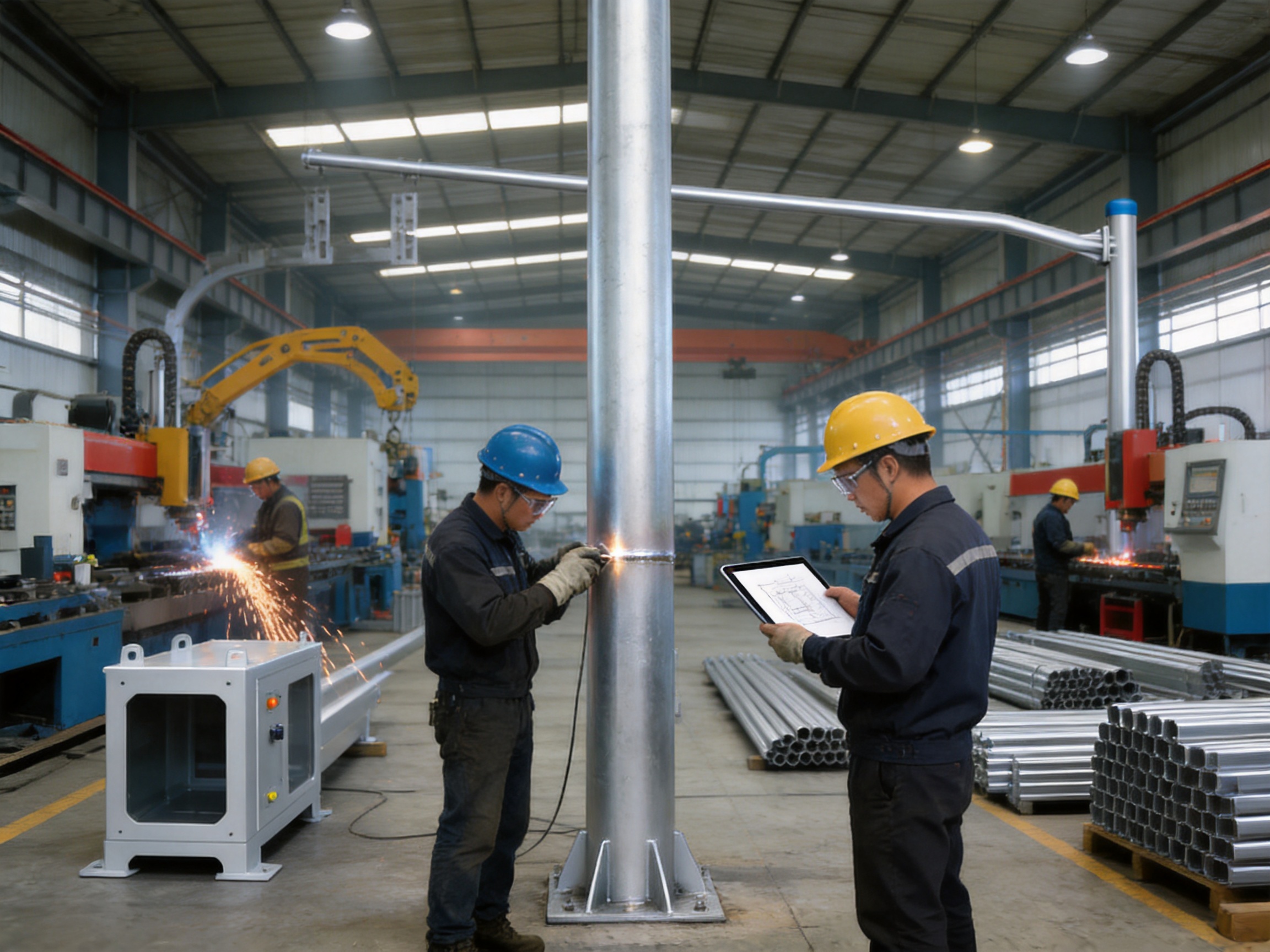
The company behind the product operates as a professional production, design, and engineering enterprise within the road illumination industry. Its manufacturing capabilities include material preparation, CNC bending, precision cutting, automated welding, surface treatment, powder electrostatic painting, and die casting.
These capabilities provide several advantages over suppliers that rely heavily on fragmented external processing. Greater control over key production steps can improve consistency, shorten communication cycles, reduce coordination problems, and make it easier to respond to customized project requirements.
Material Selection and Stock Availability
Material options include Q235B, Q345B, S275JR, S355JR, Q460, A36, A572, GR56, GR50, and other grades according to project needs. The availability of multiple material options allows the engineering and procurement teams to select a suitable balance of strength, weldability, availability, and cost.
Extensive material stock can also help reduce delays. Traffic infrastructure projects often operate under fixed construction schedules, and a delay in steel or component availability can affect pole fabrication, galvanizing, transport, installation, and road opening dates. Maintaining material inventory supports faster production planning and improves supply continuity.
Material selection should always be confirmed against the project specification, applicable national standards, structural calculations, welding procedure requirements, and environmental conditions. A suitable grade must be compatible with the intended fabrication and surface treatment processes.
CNC Bending
Precise and consistent CNC bending is used to form structural components accurately. Controlled bending helps maintain repeatable geometry across production batches and reduces the need for post-production correction. Accurate forming is important because deviations in pole or arm geometry can affect appearance, assembly, alignment, loading, and installation.
CNC equipment also supports efficient production of customized components. When project requirements include different arm lengths, dimensions, angles, or connection details, programmable bending can provide more consistent results than manual forming methods.
Enhanced structural integrity is another benefit of controlled bending. Correct bending parameters can help reduce unintended deformation, uneven stress concentration, and dimensional variation. These benefits are especially valuable in long cantilever arms where alignment and load behavior are important.
High-Precision Cutting
The manufacturing process provides cutting accuracy of up to 0.01 millimeters. High-precision cutting creates accurate dimensions and clean edges, supporting proper fit-up during assembly and welding. Precise cutting also helps reduce material waste and minimizes the need for grinding or corrective work.
Clean and consistent edges are important for structural fabrication. They support better joint preparation, more predictable welding, improved component alignment, and a more uniform finished appearance. In projects involving many identical poles or signal arms, consistent cutting can contribute significantly to batch quality.
Automated Welding
Automated welding lines help improve process consistency and production efficiency. Automated welding can deliver repeatable weld paths, controlled production cycles, and more uniform results across suitable product components. This is particularly helpful for large orders where multiple poles, arms, brackets, and related structural parts must meet the same requirements.
The company also employs certified welders with extensive welding experience. Skilled personnel remain essential for complex joints, special configurations, inspection activities, repair work, and quality verification. The combination of automation and experienced welders helps balance production speed with the flexibility needed for customized infrastructure projects.
Reliable welding is critical to the mechanical performance of a cantilevered traffic signal structure. Weld quality can affect load transfer, vibration resistance, fatigue behavior, and long-term durability. Welding procedures should be selected according to material type, thickness, joint design, and applicable project standards.
Die Casting and Lamp Housing Production
The company operates a 1,250-ton die-casting machine. This equipment supports the production of strong and accurately formed aluminum components, including suitable lamp housing parts and other structural or lighting-related components.
Die casting can provide repeatable component dimensions, smooth external surfaces, efficient production of complex shapes, and good integration of mounting features. Consistent housing geometry is valuable for traffic signal lamps because the housing must accommodate optical components, electrical parts, covers, seals, mounting hardware, and heat management requirements.
The alternative use of impact-resistant engineering plastic injection molding provides additional design flexibility. Plastic housings can offer low weight, impact resistance, and corrosion resistance. Selecting die-cast aluminum or engineering plastic allows the product configuration to be matched to performance, weight, environmental, and project requirements.
Surface Treatment and Corrosion Protection
Surface treatment includes hot-dip galvanizing and powder electrostatic painting capabilities. Hot-dip galvanizing is primarily associated with long-term corrosion protection for steel poles and arms. Powder electrostatic painting can provide a durable decorative finish and support optional color customization.
Effective surface treatment begins with appropriate preparation. Cleaning, degreasing, scale removal, surface activation, coating control, and inspection all influence final performance. Consistent process management helps reduce defects such as incomplete coverage, adhesion problems, uneven color, pinholes, and premature corrosion.
For outdoor traffic structures, corrosion protection is not only a visual issue. Corrosion can reduce wall thickness, affect connection strength, damage fasteners, and compromise the long-term structural reliability of a pole or arm. A controlled surface treatment process therefore contributes directly to the service value of the complete signaling system.
Quality Control and Production Efficiency
The use of advanced equipment, automated lines, skilled personnel, and controlled production procedures supports a comprehensive quality approach. Quality control can begin with incoming material inspection and continue through cutting, bending, welding, assembly, surface treatment, electrical integration, and final inspection.
Production consistency is especially important for traffic signal projects because a single intersection may require several visually and mechanically matched assemblies. In larger municipal programs, hundreds or thousands of signal components may be required. Consistent quality across the complete order helps simplify installation and maintenance.
Automated production lines can also help reduce costs by improving throughput, limiting unnecessary rework, and using materials more efficiently. Lower production waste and controlled process cycles can support competitive pricing without relying solely on lower-grade materials or simplified construction.
Environmental sustainability is another benefit associated with efficient production. Reduced material waste, optimized energy use, longer product life, and fewer replacement operations can all contribute to a lower overall environmental burden. Long-life LED sources and durable galvanized structures support this objective by reducing the frequency of replacement and disposal.
Design and Engineering Services
CAD Design
CAD design services help translate project requirements into accurate drawings for review and production. CAD documentation can include pole dimensions, arm lengths, lamp positions, connection details, foundation interfaces, cable routing, and surface treatment specifications.
Accurate drawings reduce ambiguity between the project owner, consultant, manufacturer, contractor, and installation team. They also support approval procedures and provide a reference for quality inspection and future maintenance.
Three-Dimensional Product Simulation
Three-dimensional product simulation allows project stakeholders to review the physical form of the signaling lamp and supporting structure before fabrication. This can help identify clearance problems, conflicts between components, access limitations, and appearance concerns at an early stage.
Three-dimensional review is particularly valuable for custom cantilever systems. It can show how the arm extends over the road, how the signal heads are positioned, how the pole relates to the pavement edge, and whether the selected arrangement provides suitable driver visibility.
Three-Dimensional Scene Simulation
Scene simulation places the product in a virtual road or intersection environment. This service can help clients evaluate the appearance of the completed installation and review its relationship with buildings, landscaping, road markings, other lighting poles, signs, and transportation equipment.
For urban improvement projects, scene simulation can support communication between engineering teams and public authorities. It can also help identify whether the signal structure is visually appropriate for the surrounding streetscape before construction begins.
Specification and Color Customization
Traffic infrastructure projects may have different requirements for pole height, arm length, lamp face size, signal arrangement, surface finish, and color. Specification and color customization helps accommodate these requirements while maintaining a controlled manufacturing process.
Customization should be coordinated with structural calculations, local traffic standards, electrical conditions, road clearance rules, and maintenance procedures. A customized configuration is most effective when visual preferences and engineering requirements are reviewed together.
Installation Guidance
Overseas onsite installation guidance is available for projects that require additional technical support. Installation guidance can assist with pole erection, arm assembly, signal mounting, cable routing, electrical connection, alignment, and commissioning procedures.
Proper installation is essential to achieve the expected performance of the equipment. Even a well-manufactured signaling lamp can experience reduced reliability if the foundation is inadequate, fasteners are incorrectly tightened, cables are poorly protected, or the signal heads are not aligned with the intended viewing direction.
Advantages Over Conventional Alternatives
Compared with Low-Output Traditional Lamps
Traditional low-output signal lamps may provide less effective visibility under intense sunlight and may require more frequent maintenance. The high-brightness LED source used in this product is designed to produce a stronger and more recognizable signal indication.
LED technology can also offer longer operating life and lower rated power per lamp. The stated rated power is less than 20 watts per lamp, supporting energy-conscious operation when compared with many older lighting technologies. Actual energy savings will depend on signal timing, the number of lamps, control equipment, and local operating schedules.
Compared with Fragmented Multi-Component Systems
A fragmented system may require separate sourcing of signal heads, brackets, support arms, poles, and surface treatment. This can create more coordination points and increase the possibility of dimensional mismatch or installation delays.
The integrated monoblock concept provides a more coordinated solution. By combining compatible components through a unified design and manufacturing process, the system can simplify procurement, project communication, installation planning, and appearance control.
Compared with Light-Duty Structures
Light-duty structures may be unsuitable for long cantilever arms, high wind areas, or locations with substantial traffic vibration. The product’s available wall thickness ranges, structural material options, hot-dip galvanized treatment, and mechanical calculation support provide a stronger basis for demanding infrastructure applications.
Structural performance must always be verified for the specific site. However, the combination of engineering support and configurable dimensions allows the product to be adapted more effectively than a one-size-fits-all structure.
Compared with Suppliers with Limited Customization
Some suppliers offer only fixed dimensions, limited signal sizes, or restricted surface finishes. This can make it difficult to meet special road layouts or municipal design requirements. The All-in-One Monoblock Cantilevered Signaling Lamp supports different lamp sizes, arm lengths, mounting arrangements, materials, and colors.
Customization is supported by CAD design, three-dimensional simulation, engineering calculation, and production capabilities. This combination helps reduce the risk that customization will compromise manufacturing consistency or delivery efficiency.
Application Areas
Urban Intersections
Busy city intersections require signal equipment that remains visible among buildings, vehicles, signs, streetlights, and other urban elements. Cantilevered mounting can position the signal above the approach, improving visibility for vehicles in multiple lanes.
The clean cylindrical pole and optional color finishes also make the system appropriate for city improvement programs where infrastructure appearance is an important consideration.
Highway Interchanges
Highway interchanges often involve high vehicle speeds, wide approaches, complex lane arrangements, and long viewing distances. High-brightness LED signals and extended cantilever arms can support clearer driver recognition where roadside signal placement may not be sufficient.
Highway applications require careful evaluation of wind loads, foundation conditions, clearance, maintenance access, and electrical protection. The product’s structural and engineering support can contribute to a comprehensive installation plan.
Industrial Parks
Industrial parks may contain heavy vehicles, large transport routes, warehouse entrances, internal intersections, and mixed traffic. Reliable traffic signal equipment can support safer movement between production facilities, loading areas, employee parking, and public roads.
The product’s resistance to vibration, weather, and ultraviolet exposure is useful in industrial environments where equipment may be exposed to vehicle movement, dust, and extended outdoor operation.
Municipal Infrastructure Projects
Municipal authorities often require products that can be delivered consistently across multiple locations. The company’s large production site, professional workforce, material stock, and international export experience provide a foundation for supporting extensive infrastructure programs.
Standardized manufacturing combined with configuration flexibility allows different intersections within the same project to use compatible products while adapting dimensions to local road conditions.
Company Manufacturing Strength
Yangzhou Jinyuan Lamps Co., Ltd. is affiliated with Jinshang Electric Group and was established in 2002. The company specializes in road illumination products and related engineering services, including street light poles, LED street lights, solar street lights, light fixtures, and traffic-related equipment.
The company covers more than 70,000 square meters and employs more than 300 professional technicians. Its products are exported to more than 200 countries, demonstrating experience in serving international project requirements, shipping arrangements, technical communication, and customer support.
The company reports management and quality systems associated with ISO9001, ISO14001, and OHSAS18001. These standards relate respectively to quality management, environmental management, and occupational health and safety management. Such systems can help establish documented procedures, responsibility controls, process monitoring, corrective action, and continuous improvement.
Its equipment includes bending machines, powder electrostatic painting equipment, automatic welding and cutting machines, and a 1,250-ton die-casting machine. This equipment base supports the manufacture of structural poles, lighting components, signal housings, brackets, and related road infrastructure products.
Installation and Maintenance Recommendations
Pre-Installation Review
Before installation, project teams should confirm the foundation design, anchor bolt arrangement, pole location, road clearance, overhead clearance, arm direction, signal face orientation, electrical supply, and maintenance access. The selected configuration should correspond to approved drawings and local traffic engineering requirements.
The site should also be checked for underground utilities, drainage conditions, pavement limitations, nearby structures, and visibility obstructions. A properly planned installation reduces the risk of later relocation, foundation modification, or signal realignment.
Structural Assembly
The pole, cantilever arm, brackets, and signal heads should be assembled using the specified hardware and torque requirements. Connections should be checked for correct fit, alignment, and secure tightening. Any damaged galvanizing or surface coating caused during transportation or installation should be repaired using an appropriate approved method.
The arm should be positioned to provide the intended signal view while maintaining the required clearance from vehicles, pedestrians, signs, utilities, and surrounding structures. Signal heads should be aligned consistently so that the intended approach receives a clear indication.
Electrical Commissioning
The operating power supply is specified as 187 to 253 volts at 50 hertz. Before energizing the system, the electrical installation should be checked by qualified personnel. Testing may include insulation condition, grounding, polarity, cable continuity, controller compatibility, signal sequence, and emergency or fault behavior.
Electrical equipment should be protected from unauthorized access, moisture, mechanical damage, and voltage irregularities. Local electrical codes and traffic control requirements should be followed during commissioning.
Routine Maintenance
Routine maintenance may include visual inspection of signal faces, housing condition, pole connections, arm alignment, cable entries, fasteners, surface treatment, and foundation areas. Dirt, dust, road spray, or other contamination should be removed when it affects signal visibility.
Maintenance teams should also monitor changes in signal brightness, color consistency, intermittent operation, water ingress, abnormal vibration, corrosion, and physical impact. Early corrective action can help preserve safety and extend the useful service life of the system.
Frequently Asked Questions
What is the main purpose of this signaling lamp?
The product is designed to provide high-visibility red, green, and yellow traffic signals at intersections, highway interchanges, industrial parks, and other controlled traffic locations. Its cantilevered structure positions the signal where it can be clearly viewed by approaching road users.
What lamp sizes are available?
The product is available with 300-millimeter and 400-millimeter round or square light-emitting surfaces. The appropriate size depends on the road layout, viewing distance, mounting position, local standards, and project requirements.
What type of light source is used?
The signaling lamp uses original imported ultra-high-brightness LEDs. The light source has a stated service life of more than 50,000 hours and is designed to maintain strong visibility under direct sunlight.
Can the system be customized?
Yes. Configuration options include lamp size, round or square face design, arm length, mounting arrangement, material selection, pole dimensions, and surface color. Customization should be reviewed through engineering drawings and structural calculations.
What is the available cantilever arm length?
The stated arm length range is 5,000 to 14,000 millimeters. The correct length should be selected according to lane arrangement, signal visibility, wind conditions, clearance requirements, and foundation design.
How is the steel pole protected against corrosion?
The pole is treated by hot-dip galvanizing, which provides a durable zinc coating for outdoor corrosion protection. Optional plastic spraying in selected colors is also available for projects requiring a specific appearance.
What is the operating temperature range?
The stated ambient operating temperature range is -40 to +80 degrees Celsius. Site-specific engineering should still consider solar exposure, enclosure conditions, electrical factors, and local climate characteristics.
What is the protection class?
The signaling lamp has an IP54 protection class. Proper installation and maintenance of covers, cable entries, seals, and connections remain necessary to preserve outdoor protection.
Does the product comply with a traffic signal standard?
The core technical parameters are designed to comply with GB14887-2011. Project owners should confirm all applicable local requirements and approval procedures before procurement and installation.
Can engineering support be provided?
Yes. Available services include CAD design, three-dimensional product simulation, three-dimensional scene simulation, specification and color customization, mechanical calculation for wind and foundation conditions, and overseas onsite installation guidance.
What materials can be used for production?
Material options include Q235B, Q345B, S275JR, S355JR, Q460, A36, A572, GR56, GR50, and other grades subject to project requirements. The selected material should be confirmed through structural calculations and applicable standards.
Why is an integrated design useful?
An integrated design can simplify coordination among the signal head, support arm, pole, brackets, and installation requirements. It can also improve visual consistency, reduce alignment problems, and support more efficient project planning.
Conclusion
The All-in-One Monoblock Cantilevered Signaling Lamp is designed as a durable, high-visibility solution for modern traffic control infrastructure. Its ultra-high-brightness LED source supports clear signal recognition in direct sunlight, while the available 300-millimeter and 400-millimeter configurations provide flexibility for different road environments.
The product combines a coordinated monoblock signaling design with a cylindrical structural pole, configurable cantilever arm lengths, hot-dip galvanized corrosion protection, optional color finishes, and engineering services for wind and foundation conditions. Its broad operating temperature range, IP54 protection class, and light source service life exceeding 50,000 hours support dependable outdoor use when the system is correctly installed and maintained.
Its competitive strength also comes from the manufacturing foundation behind it. Material stock, CNC bending, high-precision cutting, automated welding, certified welders, die casting, powder coating, hot-dip galvanizing, CAD design, three-dimensional simulation, and installation guidance provide a complete project-oriented capability rather than a simple lighting component supply model.
For municipalities, government agencies, highway contractors, industrial park developers, and commercial infrastructure owners, the system offers a practical combination of visibility, structural adaptability, manufacturing consistency, customization, and technical support. By integrating advanced LED technology with robust production and engineering processes, it can contribute to safer intersections, more organized traffic movement, and long-term infrastructure value.
References
GB14887-2011, Road Traffic Signal Lights, national technical standard referenced in the product specifications.
International Electrotechnical Commission, IEC 60529, Degrees of Protection Provided by Enclosures, reference framework for IP protection classifications.
International Organization for Standardization, ISO 9001, Quality Management Systems, reference framework for quality management practices.
International Organization for Standardization, ISO 14001, Environmental Management Systems, reference framework for environmental management practices.
Occupational health and safety management system principles associated with OHSAS 18001, referenced in the company quality and management information.
Product technical information supplied for the All-in-One Monoblock Cantilevered Signaling Lamp, including structural, electrical, optical, environmental, and manufacturing specifications.