


JINYUAN
JINYUAN
JINYUAN
JINYUAN
JINYUAN
JINYUAN
JINYUAN
JINYUAN
JINYUAN
JINYUAN
JINYUAN
JINYUAN
JINYUAN
JINYUAN
JINYUAN
JINYUAN
Content
- 1 1. A New Design Language for Garden and Landscape Lighting
- 2 2. Uniform and Comfortable LED Illumination
- 3 3. Durable Aluminum Alloy Construction
- 4 4. Electrical Flexibility and Lighting Control
- 5 5. Applications Across Multiple Outdoor Environments
- 6 6. Installation and Bracket Compatibility
- 7 7. Manufacturing Strength and Production Capability
- 8 8. Advantages Compared with Conventional Outdoor Fixtures
- 9 9. Project Planning and Specification Guidance
- 10 10. Maintenance and Long-Term Operation
- 11 11. Customization and Professional Service
- 12 12. Why This Product Suits Modern Landscape Projects
- 13 13. Frequently Asked Questions
- 13.1 Q1: What is the main design feature of the C-Shape ring garden landscape light?
- 13.2 Q2: Where can this product be installed?
- 13.3 Q3: Is the product suitable for outdoor use?
- 13.4 Q4: What voltage does the luminaire support?
- 13.5 Q5: Does the product support dimming?
- 13.6 Q6: What color temperatures are available?
- 13.7 Q7: What is the lamp luminous efficacy?
- 13.8 Q8: What material is used for the lamp body?
- 13.9 Q9: How does the diffuser affect the light?
- 13.10 Q10: What is the warranty period?
- 13.11 Q11: Can the product be customized?
- 13.12 Q12: What manufacturing technologies support the product and related lighting systems?
- 13.13 Q13: Is the product appropriate for coastal or industrial environments?
- 13.14 Q14: How should the product be maintained?
- 14 14. Conclusion
- 15 References
- 16 Product: C-Shape ring garden landscape light

Outdoor lighting has evolved from a basic functional requirement into an important part of landscape design, architectural presentation, public-space planning, and nighttime safety. Modern users expect more than illumination alone. They want lighting products that provide reliable performance, comfortable visual quality, long service life, efficient installation, and an appearance that complements contemporary environments. The C-Shape ring garden landscape light responds to these expectations through a distinctive open-ring design, integrated LED technology, durable aluminum construction, and adaptable control options.
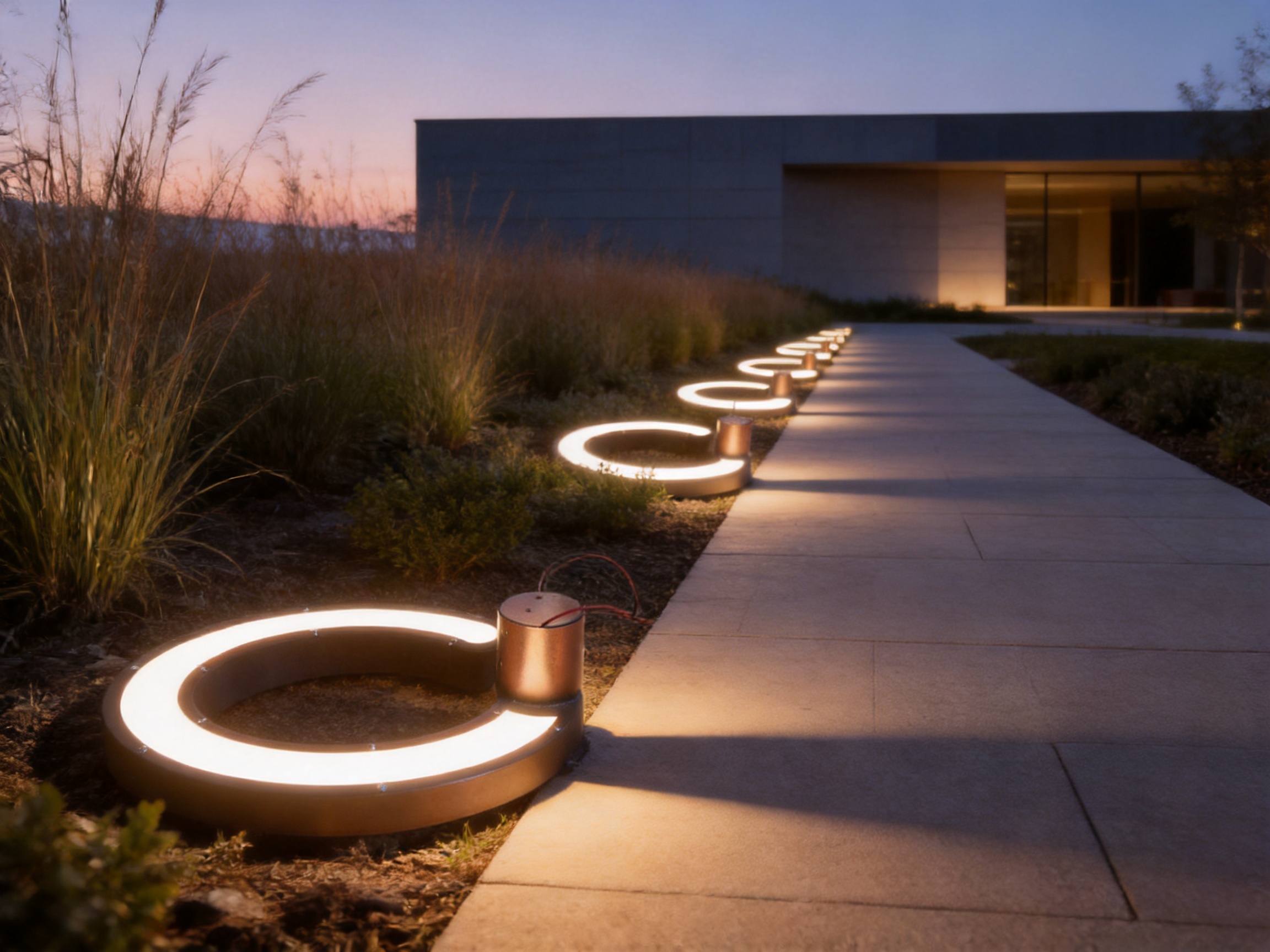
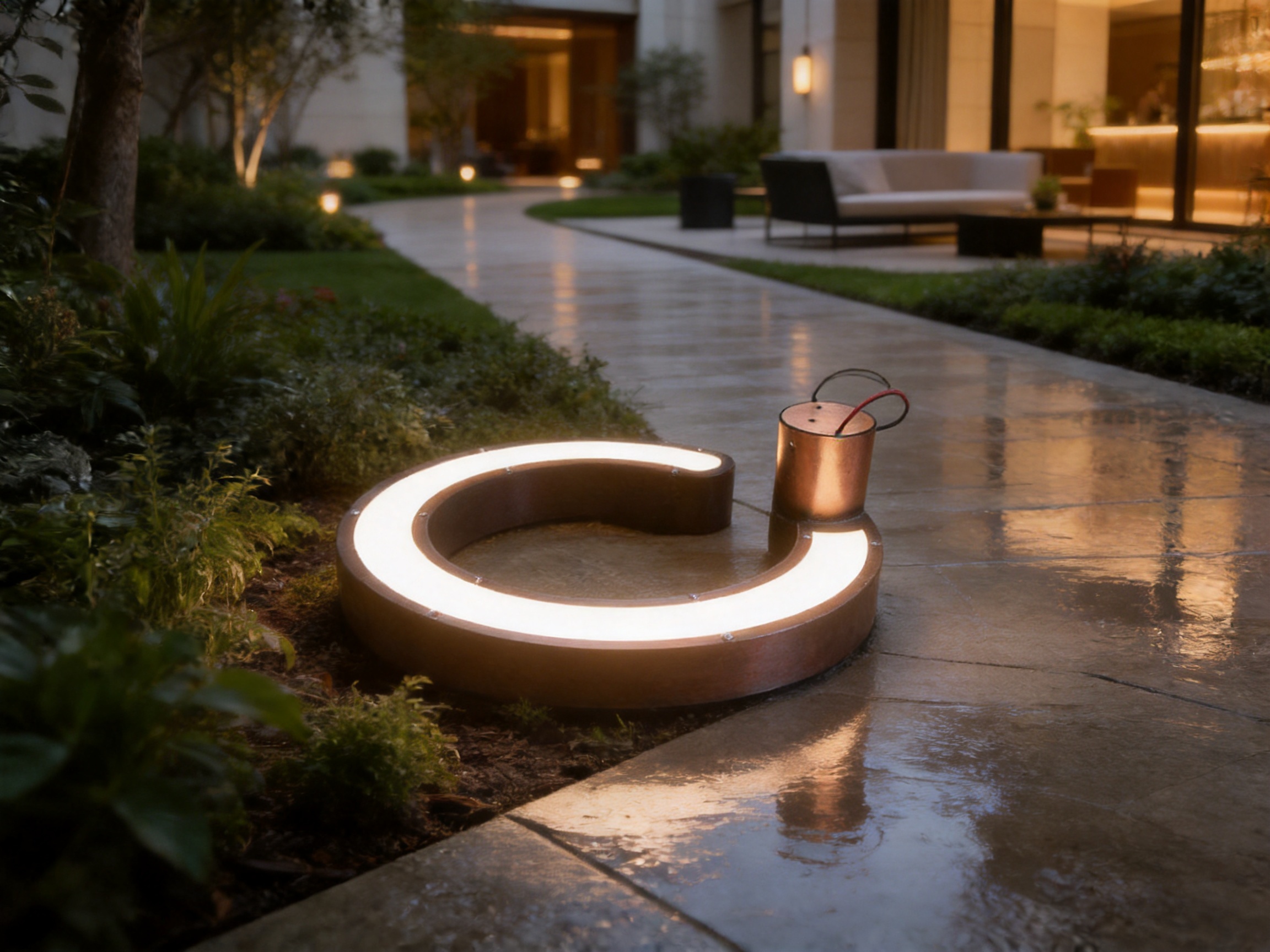
Unlike conventional garden luminaires that often rely on enclosed geometric bodies, this product uses a carefully designed C-shaped ring silhouette. The open form creates a sense of visual lightness and movement while allowing the luminaire to function as both a lighting fixture and a landscape feature. When illuminated at night, the ring can resemble a suspended halo, introducing a refined futuristic character to gardens, courtyards, walkways, hotel grounds, residential developments, commercial landscapes, and urban paths.
The product combines aesthetic appeal with practical engineering. Its integrated high-brightness LED module is paired with a thickened diffusing cover to produce uniform light with reduced glare and a comfortable visual effect. The aluminum alloy housing provides structural strength and corrosion resistance, while the IP65 rating supports outdoor use in demanding weather conditions. With an input voltage range of AC85-265V, operating temperatures from -35°C to 65°C, dimming support through DC 0-10V or DALI, and a five-year warranty period, the product is designed for long-term project reliability.
1. A New Design Language for Garden and Landscape Lighting
Traditional garden lighting often emphasizes familiar forms such as lanterns, cylinders, cones, or rectangular housings. These designs can be effective, but they may not always provide the visual distinction required by contemporary landscape projects. The C-Shape ring garden landscape light takes a different approach by using an open-ring structure based on minimalist geometric lines.
The incomplete circular form creates a stronger sense of rhythm than a fully enclosed shape. The opening in the ring introduces visual tension and makes the fixture appear lighter, less solid, and more dynamic. This design can be integrated into environments where the lighting fixture itself is expected to contribute to the overall appearance of the site rather than disappear into the background.
During daylight hours, the lamp presents a clean architectural profile. Its geometric structure can coordinate with modern buildings, paved walkways, planted borders, water features, outdoor seating areas, and sculptural landscape elements. At night, the illuminated ring becomes a prominent visual accent. The result is a product that supports both functional wayfinding and decorative placemaking.
The open-ring concept is particularly suitable for projects that seek a high-tech or artistic atmosphere. Contemporary residential communities, cultural facilities, boutique hotels, technology parks, landscaped commercial streets, and urban renewal projects can all benefit from a luminaire that offers a more distinctive identity than a standard post-top or bollard light.
At the same time, the product remains sufficiently restrained to avoid overwhelming the surrounding landscape. Its minimalist form does not depend on excessive ornamentation. Instead, the visual effect is created through proportion, line, light distribution, and the relationship between the open ring and the surrounding environment.
1.1 A Balance Between Art and Utility
Decorative outdoor lighting sometimes sacrifices practical performance for appearance. Conversely, highly functional fixtures may provide good illumination but contribute little to the visual quality of a project. The C-Shape design is intended to balance these two requirements.
The ring profile provides a recognizable design feature, while the integrated LED module delivers the primary illumination. The product can therefore serve as a visual landmark without losing its role as a pathway and area-lighting fixture. This balance makes it suitable for professional landscape schemes in which lighting must support safety, orientation, mood, and architectural expression at the same time.
The fixture’s open shape can also help designers create repeated visual patterns. Multiple units may be installed along a path, around a courtyard, or beside a landscaped boundary. When arranged at consistent intervals, the illuminated rings can create a continuous nighttime rhythm. When used selectively, they can highlight entrances, garden nodes, gathering points, or transitions between different zones.
2. Uniform and Comfortable LED Illumination
Visual comfort is one of the most important performance requirements for outdoor landscape lighting. A fixture that produces uneven brightness, intense hotspots, or visible flicker can reduce the quality of an environment even when the total light output is sufficient. The C-Shape ring garden landscape light addresses this concern through an integrated high-brightness LED module and a thickened light-diffusing cover.
The diffuser helps distribute light more evenly across the ring. Instead of exposing individual LED points directly to observers, the cover softens the emitted light and reduces harsh contrasts. This creates a continuous luminous appearance that supports the product’s halo-like visual effect.
Uniform illumination is valuable in pathway applications because it helps users identify the route ahead without being distracted by concentrated glare. It also supports a calmer nighttime atmosphere in gardens, courtyards, and public spaces. A soft, consistent glow can enhance the visibility of paving, planting, steps, edges, and entrances while maintaining a comfortable relationship with nearby buildings and residences.
The product is specified with a lamp luminous efficacy of 140 lm/W. This figure indicates a strong relationship between electrical input and delivered light output, helping project owners pursue energy-conscious lighting designs. Actual system performance will depend on the selected power configuration, operating schedule, installation height, spacing, ambient conditions, and lighting design requirements.
The available color temperature range is 3000K to 6000K. Warm white settings around 3000K can create a welcoming and intimate atmosphere for gardens, hospitality areas, residential courtyards, and cultural landscapes. Neutral or cooler settings can provide a cleaner, more contemporary appearance for commercial paths, public areas, and modern architectural surroundings. The range gives designers flexibility to coordinate the light with paving colors, façade materials, vegetation, and project identity.
The listed color rendering index is Ra 70. This level is suitable for many general outdoor illumination applications where reliable visibility and efficient operation are primary requirements. For projects involving specialized artwork, retail displays, or highly color-sensitive planting presentations, the lighting designer should confirm whether a different color-rendering specification is required.
2.1 Flicker-Free Visual Experience
The product description emphasizes gentle, flicker-free illumination. This is important for spaces where people may remain for extended periods or where lighting is viewed directly from multiple angles. A stable luminous appearance contributes to a more comfortable environment and helps prevent the distracting visual sensation associated with unstable or poorly controlled light sources.
Flicker performance can be affected by the driver, dimming method, power quality, and control system. For this reason, project specifications should confirm the complete luminaire and driver configuration rather than evaluating the LED module alone. When properly matched with the project’s electrical and control infrastructure, the product’s integrated LED design can support a consistent nighttime appearance.
3. Durable Aluminum Alloy Construction
Outdoor luminaires must withstand rain, humidity, temperature variation, dust, ultraviolet exposure, and routine maintenance activity. The C-Shape ring garden landscape light uses aluminum alloy as its principal lamp material. This material offers a favorable combination of low weight, structural strength, thermal performance, corrosion resistance, and manufacturability.
Aluminum alloy is especially useful for lighting housings because it can be shaped into precise profiles while remaining relatively light for installation and transportation. It also supports heat dissipation from the LED assembly. Effective thermal management is essential because excessive operating temperature can accelerate component aging and reduce long-term performance.
The product is finished with an industrial-grade paint treatment. The refined surface finish contributes to wear resistance and oxidation resistance while giving the luminaire a premium metallic appearance. In landscape applications, the visible finish must remain attractive under direct sunlight, rain, dust, and changing seasonal conditions. A well-controlled coating process helps maintain the product’s appearance and protects the underlying aluminum structure.
The IP65 rating indicates protection against dust ingress and water jets from any direction. This makes the luminaire appropriate for many outdoor environments, including garden paths, courtyards, public walkways, and landscaped road-adjacent areas. IP65 does not mean that the fixture is designed for permanent immersion, so installation should avoid locations where the luminaire may be submerged or exposed to uncontrolled standing water.
3.1 Performance Across a Wide Temperature Range
The specified operating temperature range of -35°C to 65°C allows the product to serve projects in a broad range of climatic conditions. This range can support installations exposed to cold winters, hot summers, and significant daily temperature changes. Such capability is useful for export projects and for large developments that require consistent product specifications across different geographical regions.
Temperature performance depends on several factors, including installation clearance, direct solar exposure, driver configuration, ventilation, and the local environment. Proper installation and adherence to the product’s technical instructions remain important. Nevertheless, the stated range demonstrates that the product has been developed with demanding outdoor operation in mind.
4. Electrical Flexibility and Lighting Control
The C-Shape ring garden landscape light supports an input voltage range of AC85-265V. This broad range can simplify integration into different electrical networks and reduce the need for separate product variants in projects with varying supply conditions. It is particularly useful for international procurement, where local electrical standards and voltage conditions may differ.
Electrical compatibility should always be confirmed by the project engineer before installation. The power supply, protective devices, cabling, grounding, and control equipment should be selected in accordance with local regulations and the project’s load calculations.
The fixture supports DC 0-10V and DALI dimming. These control methods provide designers and operators with greater flexibility than simple on-and-off switching. Dimming can be used to reduce nighttime energy consumption, adjust the visual atmosphere, respond to operating schedules, and coordinate lighting levels with surrounding facilities.
For example, a landscape path may operate at a higher output during evening arrival periods and transition to a lower level later at night. A hotel courtyard may use different lighting scenes for regular operation, special events, and maintenance. A commercial development may coordinate pathway lighting with building management or public-area control systems.
DALI control can support addressable lighting management and more detailed system coordination, subject to the selected control equipment and network design. DC 0-10V control can provide a familiar and widely used dimming interface for projects that already include compatible control infrastructure. The availability of both options increases the product’s adaptability across different project types.
5. Applications Across Multiple Outdoor Environments
The product is categorized as an LED garden light, while its listed application is road. This combination reflects the versatility of the fixture and the broader experience of its manufacturer in road illumination and outdoor lighting systems. The C-Shape ring light is most naturally suited to landscaped pedestrian and low-speed environments, but it may also be incorporated into larger road-adjacent or public-realm schemes when the lighting design confirms its suitability.
5.1 Gardens and Residential Landscapes
In private gardens and residential communities, the ring light can provide a clear visual route through planting areas, courtyards, and shared outdoor spaces. Its soft illumination can make paths feel safer and more welcoming without creating the harsh atmosphere sometimes associated with high-output security fixtures.
Repeated units can define a pedestrian axis, frame a seating area, or create a transition between a residential building and a landscape garden. The geometric form can also complement modern housing designs that use simple façades, linear paving, metal details, and minimalist planting schemes.
5.2 Hotels, Resorts, and Hospitality Sites
Hospitality properties often require outdoor lighting that is practical but also contributes to the guest experience. The C-Shape ring can be used near entrances, garden paths, poolside circulation areas, outdoor dining zones, and courtyards. Its distinctive appearance can help establish a recognizable nighttime character for the property.
The available color temperature range allows the project team to select a warmer appearance for relaxing spaces or a cleaner appearance for arrival routes and architectural areas. Dimming support can help the operator create different lighting scenes for evening operation, late-night circulation, and event use.
5.3 Commercial and Mixed-Use Developments
Commercial landscapes need to support movement, orientation, branding, and visual appeal. The open-ring luminaire can identify entrances and pedestrian zones while adding an artistic feature to plazas, retail streets, and mixed-use courtyards.
Because the fixture can be integrated with dimming systems, it may be coordinated with commercial operating hours. Lighting levels can be adjusted according to foot traffic, security requirements, and energy management policies. The product’s modern appearance can also support developments that aim to communicate innovation and contemporary design.
5.4 Urban Paths and Public Landscapes
Public projects require durable products that can withstand continuous outdoor exposure and routine use. The aluminum alloy structure, protective finish, IP65 rating, and broad operating temperature range provide a sound basis for such applications.
Potential locations include landscaped sidewalks, civic plazas, park entrances, pedestrian promenades, cultural districts, and urban renewal projects. Before application, the project designer should evaluate mounting height, spacing, light distribution, accessibility, vandal resistance, maintenance access, and compliance with local public-lighting standards.
6. Installation and Bracket Compatibility
The product includes a robust bracket interface designed to support efficient and stable installation. A reliable bracket connection is essential because landscape luminaires may be exposed to wind, vibration, accidental contact, and repeated maintenance activity. The interface should maintain alignment while transferring loads safely to the supporting pole or structure.
The product is described as adaptable to various landscape light poles. This can assist project teams that need to coordinate the luminaire with existing site infrastructure or with a customized pole design. However, compatibility should be checked using actual dimensions, mounting hole patterns, connection methods, cable entry requirements, and structural calculations.
Installation planning should consider the following factors:
First, the mounting structure must have adequate strength for the luminaire and local wind conditions. Second, the electrical connection should be protected from moisture and installed according to the required ingress-protection level. Third, the fixture should be positioned to provide the intended light distribution without creating glare for pedestrians, drivers, or nearby properties. Fourth, maintenance access should be preserved so that cleaning, inspection, and component replacement can be performed safely.
For larger projects, the manufacturer’s support services may include CAD design, three-dimensional product simulation, three-dimensional scene simulation, specification and color customization, mechanical calculations for wind and foundations, and overseas onsite installation guidance. These services can reduce coordination problems between the product, pole, foundation, landscape plan, and electrical design.
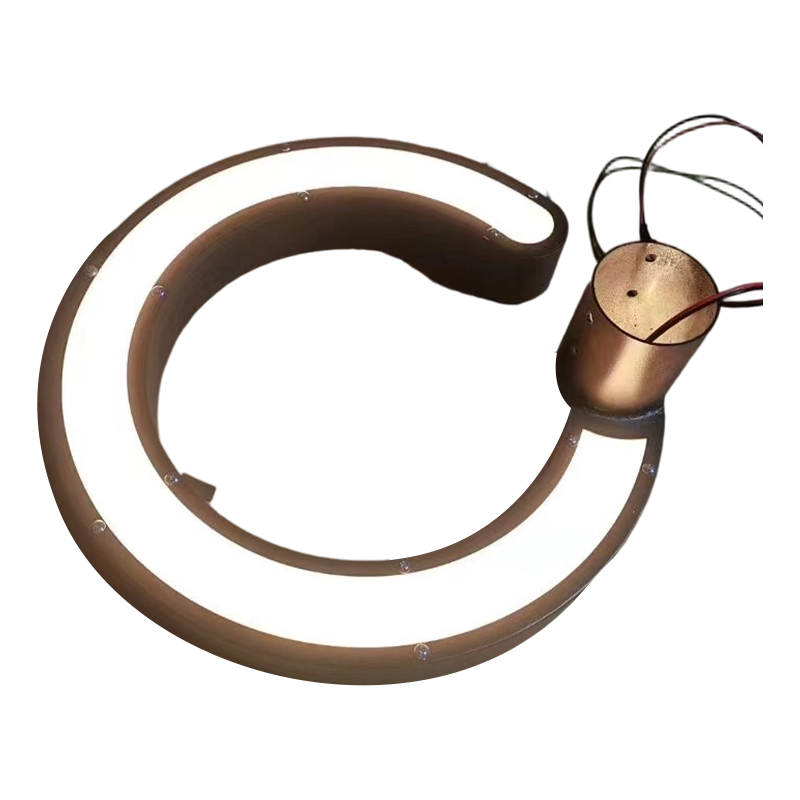
C-Shape ring garden landscape light
7. Manufacturing Strength and Production Capability
The performance of an outdoor luminaire depends not only on its visible design but also on the consistency of its manufacturing process. Dimensional accuracy, weld quality, surface preparation, coating control, material traceability, assembly procedures, and final inspection all influence the final result.
The manufacturer operates as a professional production, design, and engineering company serving the road illumination industry. Its product scope includes street light poles, LED street lights, solar street lights, light fixtures, and related outdoor lighting products. This broader product experience is valuable because it provides knowledge of complete lighting systems rather than isolated fixture production.
The company covers more than 70,000 square meters and employs more than 300 professional technicians. Its products are exported to more than 200 countries. This scale indicates experience in international project coordination, production scheduling, export documentation, packaging, and communication with customers in different markets.
Established in 2002, the company has developed long-term experience in outdoor lighting manufacturing. It also reports quality-management and environmental-management certifications including ISO9001 and ISO14001, as well as OHSAS18001. These standards and systems can support structured procedures for quality control, environmental responsibility, and occupational health and safety.
7.1 Material Selection and Inventory Planning
The manufacturing operation supports material options including Q235B, Q345B, S275JR, S355JR, Q460, A36, A572, GR56, and GR50, depending on the product and project requirements. These material grades are commonly associated with structural applications, and the appropriate selection should be based on design loads, local standards, fabrication requirements, and corrosion-protection specifications.
Maintaining an extensive material inventory can help reduce production delays. For project-based manufacturing, material availability is important because delays in steel or aluminum preparation can affect bending, welding, coating, assembly, and shipment schedules. A reliable inventory system can provide a more stable foundation for large-scale orders and customized production.
For the C-Shape ring landscape light, aluminum alloy is used for the lamp body. The manufacturer’s broader material capability is still relevant because the luminaire may be supplied alongside poles, brackets, foundations, or other structural components requiring different materials and fabrication methods.
7.2 CNC Bending and Dimensional Consistency
Precise CNC bending is used to improve consistency and structural integrity. In lighting and pole manufacturing, accurate bending helps ensure that components meet their intended geometry and fit correctly during assembly. Consistent angles and radii can reduce post-production adjustments and improve the appearance of repeated products.
For a ring-shaped landscape product, geometric consistency is especially important. Small differences in curvature, alignment, or joint positioning can affect the visual quality of the illuminated ring. Controlled bending and forming processes help maintain a uniform appearance across a production batch.
7.3 High-Accuracy Cutting
The production process is described as providing cutting accuracy down to 0.01 mm. Such precision supports exact dimensions and clean edges, although actual tolerance requirements may vary by material, component, machine, and process stage. Accurate cutting can improve fit, reduce the need for manual correction, and support more efficient assembly.
Clean edges are also important for finishing and safety. Properly prepared edges reduce the possibility of sharp projections, coating defects, or stress concentrations. In a product that combines visible aluminum parts, diffusing covers, brackets, and electrical components, controlled cutting contributes to both appearance and function.
7.4 Welding and Structural Reliability
The company employs certified welders with many years of experience. Skilled welding is essential for poles, brackets, frames, and other structural components that may be exposed to wind and outdoor loads. Consistent weld penetration, joint preparation, heat control, and inspection help ensure that fabricated parts meet the required structural expectations.
Although the C-Shape ring lamp body may rely primarily on formed and assembled components, its supporting bracket and associated pole systems can involve welded structures. The manufacturer’s welding capability is therefore relevant to complete landscape-lighting packages and customized support systems.
7.5 Automated Production Lines
Automated lines are used to improve production efficiency, quality control, and environmental performance. Automation can reduce variation between units, support repeatable processing times, and lower the risk of manual errors in suitable production stages.
Faster production cycles are particularly valuable for projects requiring multiple identical luminaires. Consistency in surface treatment, component preparation, and assembly helps ensure that units installed across a site have a coherent appearance and comparable performance.
Automation may also contribute to more efficient material use and lower production costs. Environmental benefits depend on the specific equipment, energy sources, process controls, waste-management procedures, and operational practices used at the facility, but modern automated production can provide a foundation for more responsible manufacturing.
7.6 Powder Electrostatic Painting and Corrosion Protection
The manufacturer uses powder electrostatic painting equipment. Powder coating can create a durable and visually consistent protective layer when the surface is properly prepared and the coating is correctly cured. It is widely used for outdoor lighting poles, housings, brackets, and other metal components.
Effective corrosion protection involves more than the coating itself. Surface cleaning, pretreatment, coating thickness, curing temperature, edge coverage, handling, and packaging all influence long-term performance. A controlled painting process helps improve resistance to oxidation, wear, and weather exposure.
For projects located in coastal, industrial, or high-humidity environments, the design team should confirm the complete corrosion-protection system and specify any additional treatment required by local conditions. The product’s aluminum alloy construction and industrial-grade finish provide a strong starting point, but environmental classification and maintenance planning remain important.
7.7 Die Casting Capability
The production facility includes a 1250-ton die-casting machine. Die casting can support the manufacture of complex aluminum components with repeatable dimensions and integrated structural features. Such capability is useful for producing brackets, housings, connectors, and other parts that require detailed geometry and consistent production.
When used appropriately, die casting can reduce the number of separate parts, improve assembly efficiency, and support a clean finished appearance. It can also help achieve complex forms that would be difficult or costly to produce through conventional machining alone.
8. Advantages Compared with Conventional Outdoor Fixtures
The C-Shape ring garden landscape light offers several advantages over conventional enclosed or purely utilitarian fixtures.
The first advantage is visual differentiation. Its open ring provides an identifiable design language that can help a project create a stronger nighttime identity. Conventional fixtures may illuminate effectively but often contribute little to the architectural or landscape concept. The C-Shape form functions as a visible design element even when the light is switched off.
The second advantage is a sense of lightness. The open profile reduces the visual mass of the fixture and can make a pole-mounted installation appear less bulky. This is beneficial in gardens and public spaces where designers want to maintain clear views of planting, architecture, and pedestrian movement.
The third advantage is luminous continuity. The integrated LED module and diffuser are intended to produce a smooth ring of light rather than a series of visually disconnected points. This supports a more refined appearance and reduces the harshness associated with exposed LED sources.
The fourth advantage is control flexibility. Support for DC 0-10V and DALI dimming provides more options for energy management and scene control than a fixed-output fixture. It allows the lighting system to respond to schedules, occupancy patterns, special events, and operational requirements.
The fifth advantage is environmental adaptability. The IP65 rating, aluminum alloy structure, industrial-grade finish, and operating temperature range support use in a wide variety of outdoor climates. These features help the product compete with standard fixtures that may have narrower application conditions.
The sixth advantage is manufacturing support. The company can provide engineering and customization services, including CAD design, three-dimensional simulation, color selection, structural calculation, and installation guidance. This is valuable for projects in which the luminaire must be coordinated with custom poles, landscape layouts, and architectural details.
9. Project Planning and Specification Guidance
Successful use of the C-Shape ring landscape light begins with a clear project brief. The lighting designer should define the purpose of the installation, the target areas, the desired visual atmosphere, the operating schedule, and the expected maintenance approach.
Photometric planning should evaluate mounting height, spacing, orientation, light distribution, illuminance targets, uniformity, glare, and spill light. A decorative appearance alone does not guarantee adequate pathway visibility. Conversely, excessive output may create glare or disturb adjacent properties. The final arrangement should balance safety and atmosphere.
Color temperature should be selected according to the surrounding materials and intended mood. Warm light may suit hospitality and residential areas, while neutral or cooler light may coordinate with modern public architecture. The 3000K-6000K range gives flexibility, but a single project should normally maintain a coherent color strategy.
Electrical planning should include voltage compatibility, circuit loading, surge protection, grounding, driver access, control wiring, and emergency procedures. If DALI or DC 0-10V dimming is required, the control topology should be coordinated with the project’s building-management or landscape-control system.
Structural planning should include wind loading, pole height, foundation design, bracket strength, cable routing, and access for maintenance. The manufacturer’s mechanical calculation and installation-guidance services may assist with these tasks, particularly for overseas or customized projects.
Procurement teams should also confirm packaging, delivery quantities, spare parts, documentation, inspection procedures, and warranty conditions. The product is listed with a five-year warranty period, but the precise warranty terms should be reviewed for coverage, exclusions, installation conditions, and maintenance responsibilities.
10. Maintenance and Long-Term Operation
LED luminaires generally require less routine maintenance than traditional lamps because they do not require frequent lamp replacement. However, long-term reliability still depends on cleaning, inspection, electrical protection, thermal conditions, and the integrity of seals and connections.
The diffuser should be checked periodically for dust, dirt, biological growth, or other deposits that may reduce light output or change the appearance of the ring. Cleaning procedures should follow the manufacturer’s recommendations to avoid scratching or damaging the surface.
The aluminum housing and coating should be inspected for mechanical damage, corrosion, peeling, or impact marks. Any damage should be addressed promptly, especially in coastal or industrial environments where corrosion can progress more quickly.
Electrical connections should be checked by qualified personnel. Loose terminals, moisture ingress, damaged cables, or control-system faults can affect performance and safety. The dimming system should also be reviewed if the lighting output becomes inconsistent or if individual units respond differently to commands.
Landscape maintenance activities should be coordinated with lighting maintenance. Trimming vegetation, irrigation, paving work, and chemical treatment can affect luminaires and their electrical connections. A coordinated maintenance plan helps protect the installation and preserve the intended lighting design.
11. Customization and Professional Service
Outdoor lighting projects often require more than an off-the-shelf product. Pole heights, colors, mounting arrangements, control systems, environmental conditions, and local standards can vary from one project to another. The manufacturer provides a range of services intended to support customization and project delivery.
11.1 CAD and Three-Dimensional Design
CAD design can help confirm dimensions, mounting details, cable entries, clearances, and installation interfaces. Three-dimensional product simulation can show how the luminaire relates to a pole or support structure before production begins.
Three-dimensional scene simulation extends this process by placing the product within a representative landscape or architectural environment. This can help project teams evaluate scale, spacing, color, visual prominence, and nighttime design intent.
11.2 Specification and Color Customization
Color and finish are important in landscape lighting because the luminaire is visible during the day as well as at night. Custom color selection can help coordinate the product with poles, street furniture, façades, paving, or landscape structures.
Specification customization may also address mounting details, control options, electrical configurations, and project-specific packaging. Any modification should be documented clearly so that design, production, inspection, and installation teams share the same technical reference.
11.3 Mechanical Calculation and Installation Guidance
Mechanical calculations for wind and foundation design can help verify the relationship between the luminaire, pole, anchor system, and ground conditions. This service is particularly important for installations in exposed locations or regions with strict structural requirements.
Overseas onsite installation guidance can support contractors who are unfamiliar with the product or who need assistance coordinating a large project. Professional guidance can reduce installation errors, improve commissioning, and help ensure that the completed system matches the approved design.
12. Why This Product Suits Modern Landscape Projects
Modern landscape projects increasingly seek products that combine functionality, identity, and environmental responsibility. The C-Shape ring garden landscape light addresses these priorities through a distinctive form, efficient LED technology, adaptable control, durable construction, and manufacturing support.
Its design can make an ordinary path feel more intentional. Its continuous luminous ring can provide visual continuity across a site. Its aluminum housing and protective finish can support long-term outdoor use. Its broad input-voltage range and dimming options can simplify integration into different project systems. Its manufacturing background can support both standard orders and customized engineering requirements.
The product is especially appropriate when the lighting fixture is expected to participate in the landscape concept. It can be used to create a repeated pattern, mark a destination, reinforce a pedestrian route, or introduce a contemporary visual accent. Rather than treating light as an invisible utility, the design treats the luminaire as part of the nighttime architecture.
At the same time, the product should be specified responsibly. Lighting levels, glare, energy consumption, environmental conditions, structural loading, control compatibility, and maintenance access must all be evaluated. When these factors are addressed during the design stage, the C-Shape ring light can deliver a strong combination of beauty, safety, and operating reliability.
13. Frequently Asked Questions
Q1: What is the main design feature of the C-Shape ring garden landscape light?
The main feature is its open-ring silhouette. Unlike a fully enclosed circular or conventional lamp body, the C-shaped structure creates a floating, lightweight, and dynamic visual effect. When illuminated, it can resemble a halo and become a distinctive landscape element.
Q2: Where can this product be installed?
It can be considered for gardens, courtyards, residential communities, hotel grounds, commercial landscapes, urban paths, pedestrian areas, public plazas, and other outdoor environments. The exact application should be confirmed through lighting, structural, electrical, and local-code evaluations.
Q3: Is the product suitable for outdoor use?
Yes. The product has an IP65 rating, an aluminum alloy lamp body, an industrial-grade painted finish, and a specified operating temperature range of -35°C to 65°C. It is designed for outdoor conditions, although permanent immersion and unsuitable drainage conditions should be avoided.
Q4: What voltage does the luminaire support?
The listed input voltage range is AC85-265V. Project engineers should still verify the exact electrical configuration, driver requirements, circuit protection, grounding, and local electrical standards before installation.
Q5: Does the product support dimming?
Yes. The product supports DC 0-10V and DALI dimming. These systems can help project operators adjust light levels, create different lighting scenes, reduce energy use during low-traffic periods, and integrate the fixture into wider lighting-control systems.
Q6: What color temperatures are available?
The listed color temperature range is 3000K to 6000K. Warm settings can create a welcoming atmosphere, while neutral or cooler settings may suit contemporary public or commercial environments. The selected color temperature should be coordinated with the overall project design.
Q7: What is the lamp luminous efficacy?
The listed lamp luminous efficacy is 140 lm/W. Actual energy consumption and light output depend on the selected configuration, operating conditions, control strategy, and project installation.
Q8: What material is used for the lamp body?
The lamp body is made from aluminum alloy. This material provides a useful combination of low weight, strength, corrosion resistance, and heat-dissipation capability for outdoor lighting applications.
Q9: How does the diffuser affect the light?
The thickened light-diffusing cover helps distribute the LED output more evenly and reduces the visibility of individual LED points. It supports a softer, more continuous luminous appearance and contributes to visual comfort.
Q10: What is the warranty period?
The listed warranty period is five years. Buyers should review the complete warranty terms, including installation requirements, operating conditions, exclusions, claims procedures, and responsibilities for maintenance.
Q11: Can the product be customized?
Project support includes CAD design, three-dimensional product simulation, three-dimensional scene simulation, specification and color customization, mechanical calculation for wind and foundations, and overseas onsite installation guidance. The availability and scope of customization should be confirmed for each order.
The manufacturing operation includes CNC bending, high-accuracy cutting, automated production lines, powder electrostatic painting equipment, automatic welding and cutting machines, and a 1250-ton die-casting machine. These capabilities support dimensional consistency, structural reliability, efficient production, and surface protection.
Q13: Is the product appropriate for coastal or industrial environments?
The aluminum alloy body, protective finish, and IP65 rating provide useful protection for outdoor use. However, coastal and industrial environments may require additional corrosion evaluation and maintenance planning. The project team should confirm the appropriate coating and material specification for the site.
Q14: How should the product be maintained?
Maintenance should include cleaning the diffuser and housing, inspecting the coating and bracket, checking cable connections and seals, verifying control-system operation, and reviewing the installation after severe weather or landscaping work. Maintenance should be performed by qualified personnel where electrical work is involved.
14. Conclusion
The C-Shape ring garden landscape light offers a compelling alternative to conventional outdoor luminaires by combining a strong visual identity with practical lighting performance. Its open-ring geometry introduces a minimalist and futuristic character, while its integrated LED module and diffuser provide comfortable, uniform illumination.
The product’s aluminum alloy construction, industrial-grade finish, IP65 protection, wide operating temperature range, AC85-265V input, 140 lm/W listed efficacy, 3000K-6000K color-temperature range, and DC 0-10V or DALI dimming support make it adaptable to a wide variety of outdoor projects. Its five-year warranty further supports long-term procurement planning.
Equally important is the manufacturing and engineering capability behind the product. Experience in road illumination, extensive production facilities, skilled technicians, CNC forming, accurate cutting, welding, automated production, powder coating, die casting, and project-support services provide a strong foundation for consistent delivery.
For landscape architects, lighting designers, developers, contractors, and public-space planners, the product can provide more than nighttime visibility. It can create a recognizable visual rhythm, reinforce pedestrian movement, enhance the character of a site, and contribute to a modern outdoor atmosphere. When selected and installed through a careful technical design process, it represents a balanced solution for projects that value appearance, durability, controllability, and manufacturing reliability.
References
1. Product technical information for the C-Shape ring garden landscape light, including electrical, optical, material, environmental, control, and warranty specifications.
2. Manufacturer-provided information regarding production equipment, material options, CNC bending, precision cutting, welding, automated lines, powder electrostatic painting, and die-casting capability.
3. Manufacturer-provided information regarding CAD design, three-dimensional product and scene simulation, color customization, mechanical calculation, and overseas installation guidance.
4. ISO 9001 quality management system principles and related quality-control practices.
5. ISO 14001 environmental management system principles and related manufacturing considerations.
6. Outdoor lighting design principles concerning visual comfort, uniformity, glare control, energy management, and maintenance planning.
7. General engineering principles for aluminum alloy outdoor luminaires, ingress protection, corrosion resistance, thermal management, and electrical integration.