


JINYUAN
JINYUAN
JINYUAN
JINYUAN
JINYUAN
JINYUAN
JINYUAN
JINYUAN
JINYUAN
JINYUAN
JINYUAN
JINYUAN
JINYUAN
JINYUAN
JINYUAN
JINYUAN
Content
- 1 Introduction
- 2 Designed for Demanding Road and Urban Applications
- 3 Core Product Specifications
- 4 Efficient LED Performance and Controlled Light Distribution
- 5 Robust Materials for Outdoor Reliability
- 6 Structural Design and Pole Options
- 7 Advantages Compared with Basic Street-Light Solutions
- 8 Modular and Tool-Free Maintenance
- 9 Advanced Manufacturing Capabilities
- 10 Engineering and Customization Services
- 11 Quality Assurance and Project Reliability
- 12 Energy Efficiency and Sustainability Considerations
- 13 Planning and Specification Guidance
- 14 Installation and Commissioning
- 15 Company Manufacturing and Supply Strengths
- 16 Q&A
- 16.1 What type of road is suitable for the double-arm LED street light?
- 16.2 What is the main advantage of using two arms?
- 16.3 What input voltage does the product support?
- 16.4 Can the lighting output be dimmed?
- 16.5 What is the expected environmental operating range?
- 16.6 What does IP65 protection mean for this luminaire?
- 16.7 What materials can be used for the pole?
- 16.8 What pole heights are available?
- 16.9 How does the modular design simplify maintenance?
- 16.10 Can the appearance be customized?
- 16.11 Does the manufacturer provide engineering assistance?
- 16.12 Is the product suitable for coastal or high-salinity environments?
- 16.13 What should be confirmed before placing an order?
- 17 Conclusion
- 18 References
- 19 Product: High-Performance Double-Arm LED Street Light
Introduction
Modern road infrastructure requires lighting systems that deliver more than basic illumination. Urban arterial roads, industrial park routes, commercial districts, transportation corridors, and large public developments all need dependable lighting that improves visibility, supports traffic safety, withstands demanding outdoor conditions, and remains economical throughout its service life. The High-Performance Double-Arm LED Street Light is designed to meet these requirements with an integrated combination of robust pole construction, efficient LED technology, controlled light distribution, flexible design, and simplified maintenance.
As a double-arm lighting solution, this system can illuminate two directions, two carriageways, broad road sections, intersections, central medians, or large public spaces from a single structural installation. This arrangement can reduce the number of poles required in certain layouts while creating a visually balanced appearance. It is especially suitable for locations where wide and uniform illumination is needed without compromising the architectural character of the surrounding environment.
The system combines high-strength metalwork with high-efficiency LED modules and precision-engineered optical lenses. Its aluminum alloy lamp housing provides effective protection for the lighting components, while the pole can be manufactured from structural materials such as Q235, Q355, SS400, GR65, and other specified grades. A multi-layer anti-corrosion coating supports long-term operation in changing climates, including areas exposed to humidity, salt, temperature variation, and strong wind.
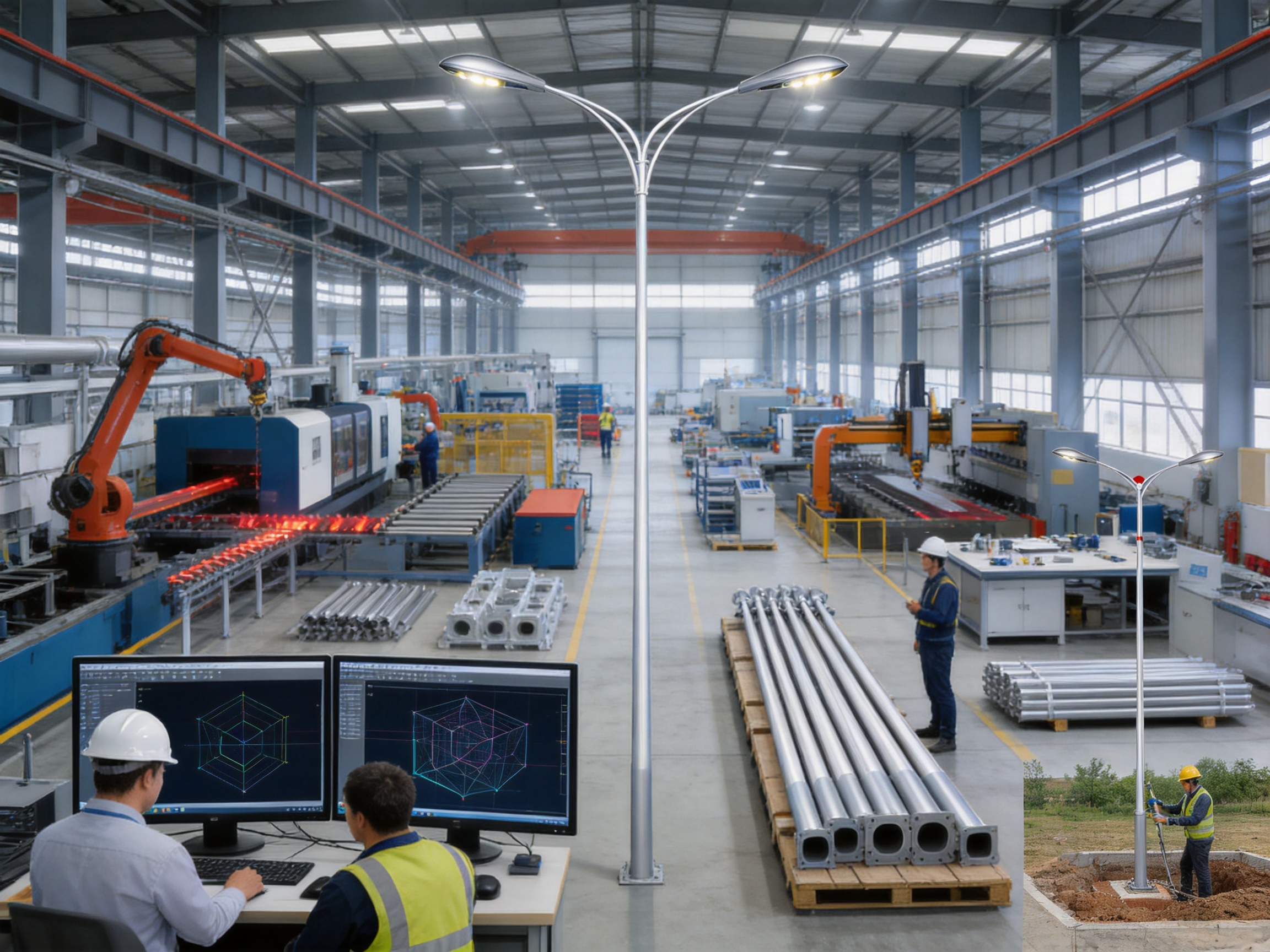
Beyond the hardware itself, the solution is supported by professional design, engineering, production, quality-control, and project-service capabilities. These capabilities include CAD design, three-dimensional product simulation, scene simulation, specification and color customization, mechanical calculations for wind and foundations, and overseas installation guidance. Together, these services help transform a lighting product into a complete infrastructure solution.
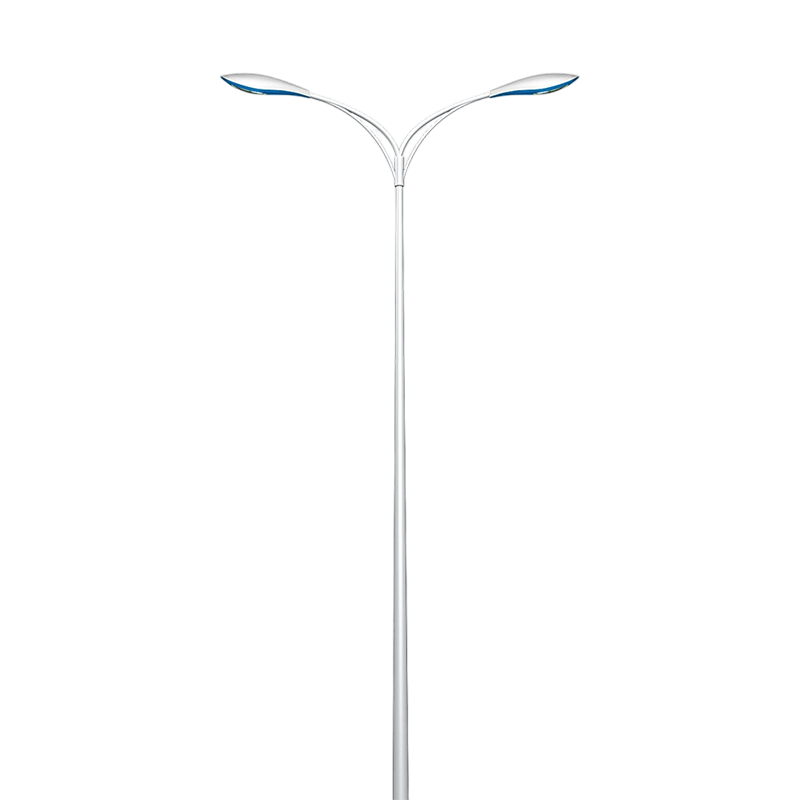
High-Performance Double-Arm LED Street Light
Designed for Demanding Road and Urban Applications
The High-Performance Double-Arm LED Street Light is engineered for applications where lighting quality, structural reliability, and visual presentation must work together. It can be used on urban arterial roads that carry high traffic volumes, industrial park roads that operate throughout the night, commercial landscapes that require attractive streetscapes, and broad public routes where uniform illumination is a key safety objective.
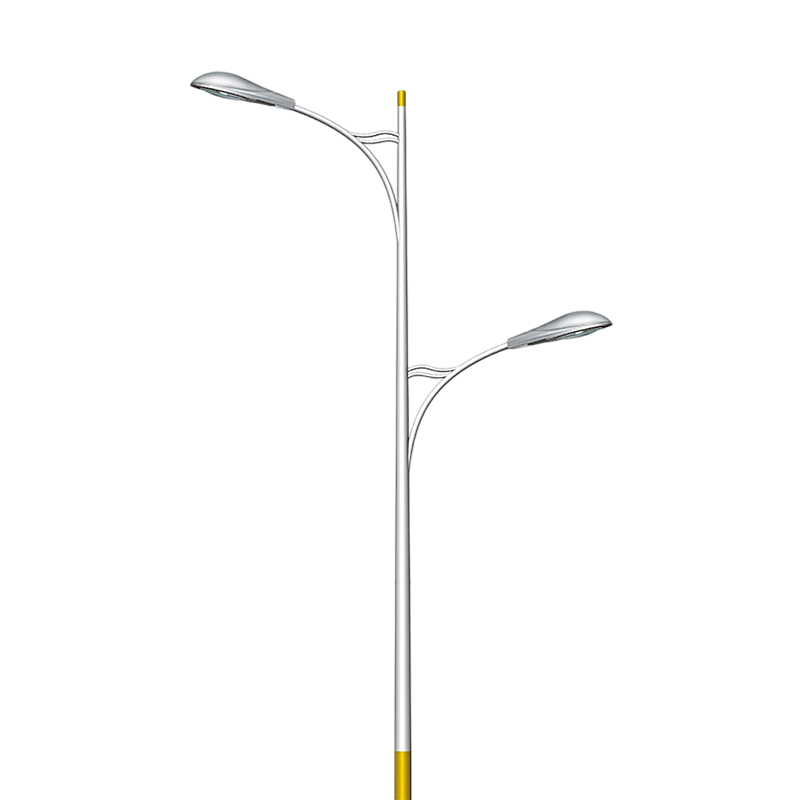
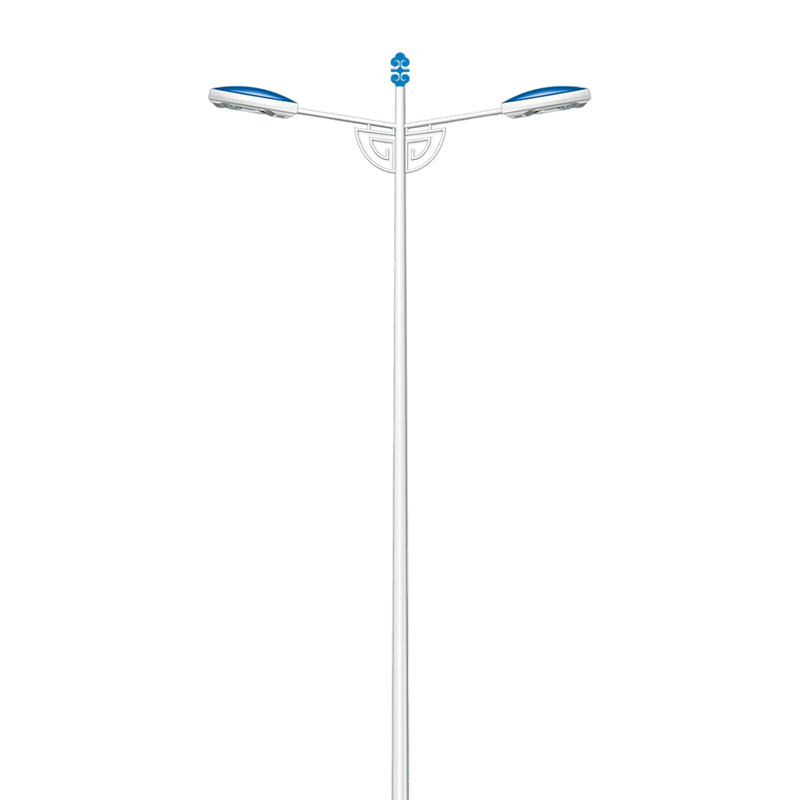
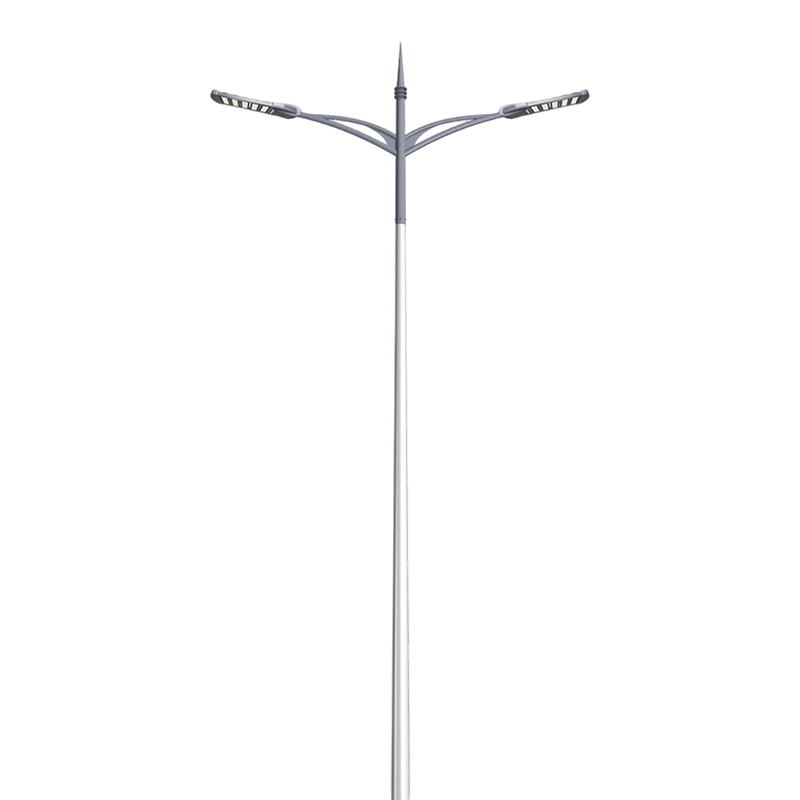
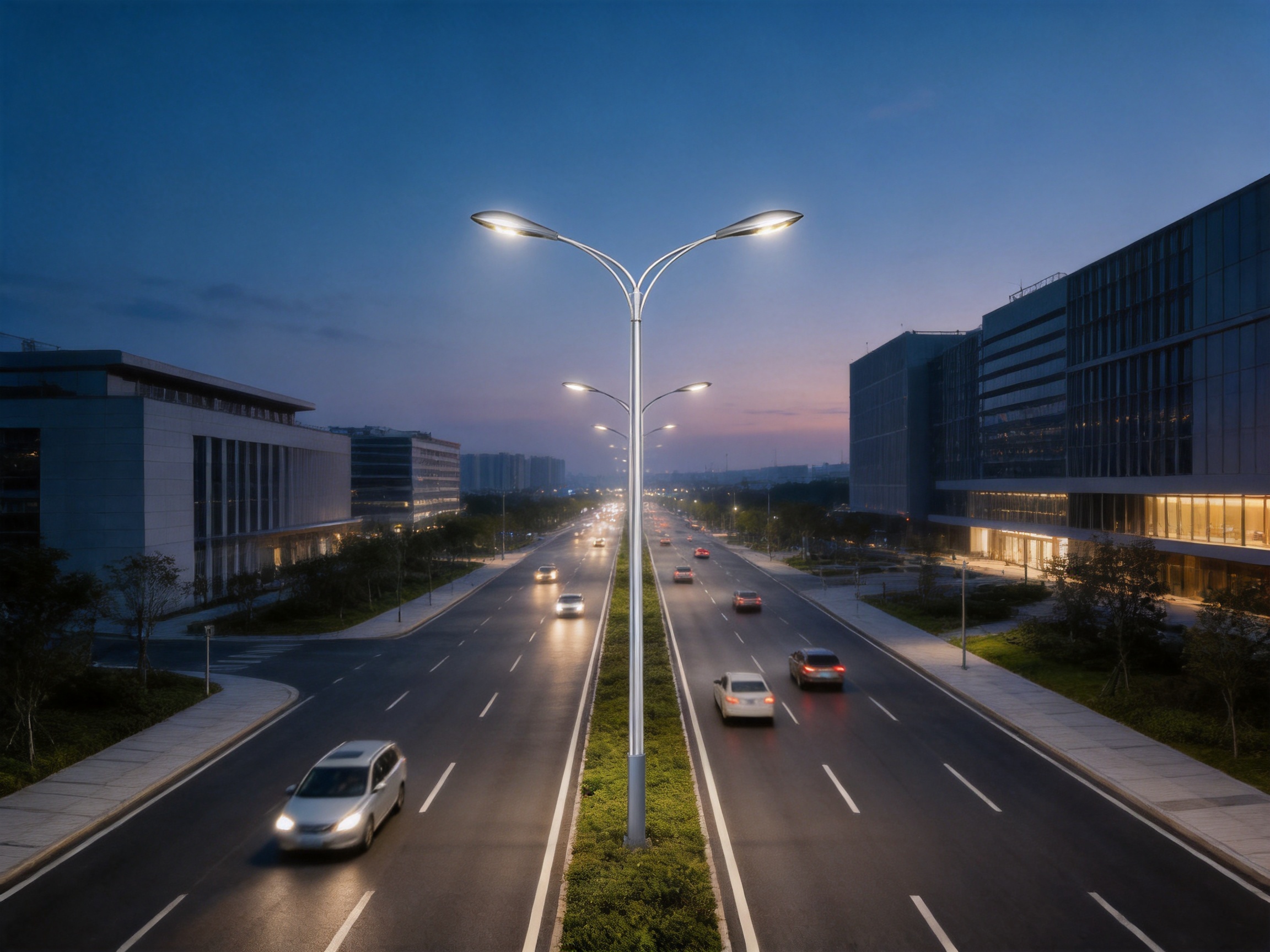
Traditional single-arm fixtures may be suitable for narrow roads or simple layouts, but wider corridors often require multiple poles, overlapping light distributions, or complex installation arrangements. A double-arm configuration provides an alternative by positioning two LED lighting units on a shared pole. Depending on the project design, the arms may serve opposite sides of a road, illuminate both sides of a central median, or provide coordinated coverage for a broad open area.
This arrangement can create a cleaner visual rhythm along the road. Fewer structural points may be required in some installation plans, which can support a more organized streetscape and reduce visual clutter. The final layout must always be confirmed through professional photometric analysis, road geometry review, wind-load calculation, and foundation design, but the double-arm structure offers valuable flexibility during the planning stage.
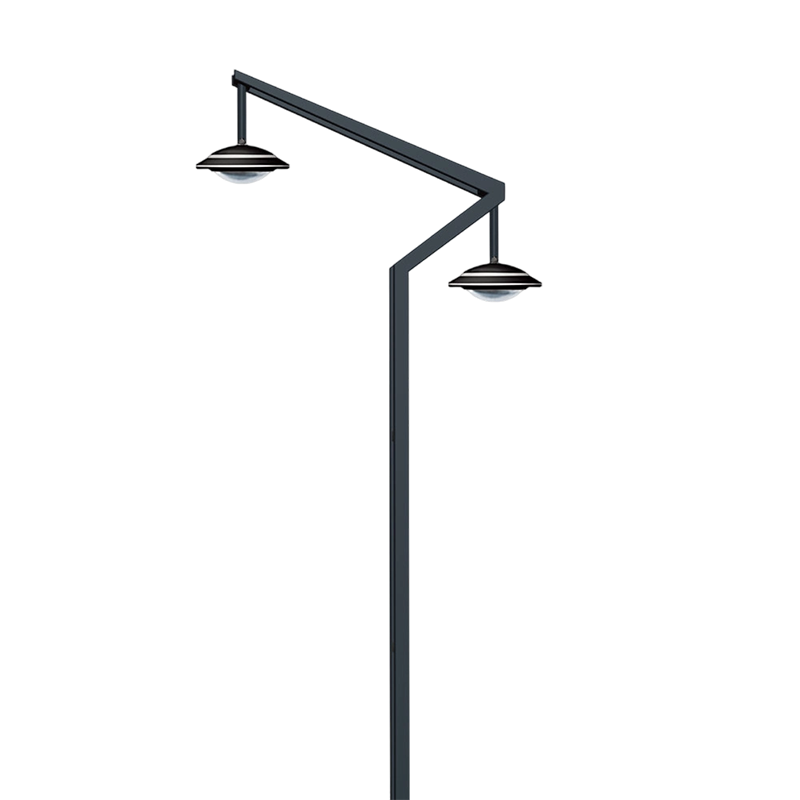
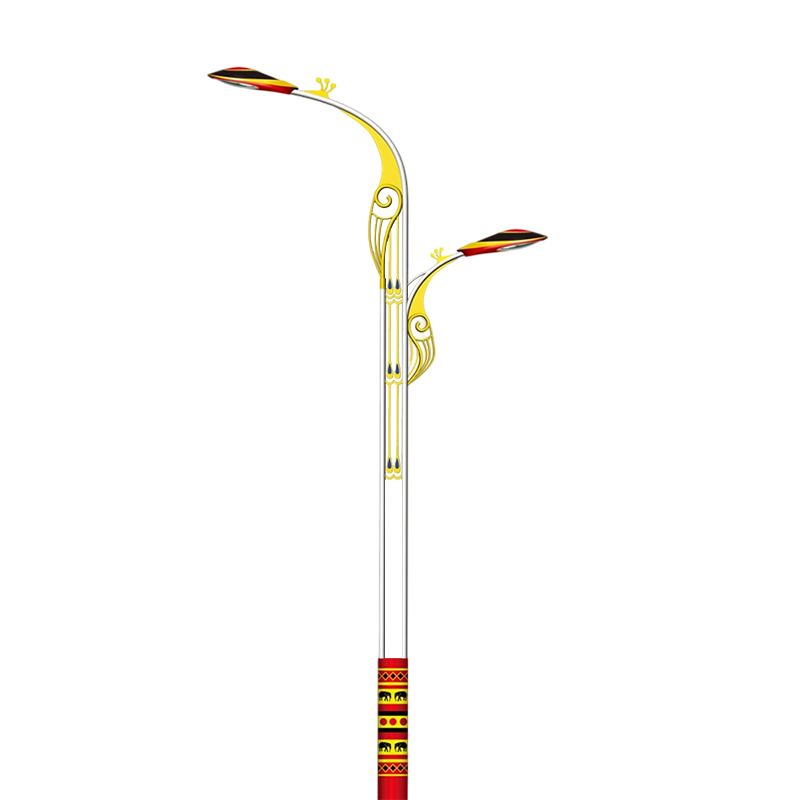
The system is also suitable for projects that place importance on appearance. The available design direction ranges from minimalist geometric forms to more streamlined and artistic structures. This allows project owners, consultants, contractors, and landscape designers to select a style that complements modern buildings, industrial facilities, landscaped boulevards, public squares, and commercial developments.
Urban Arterial Roads
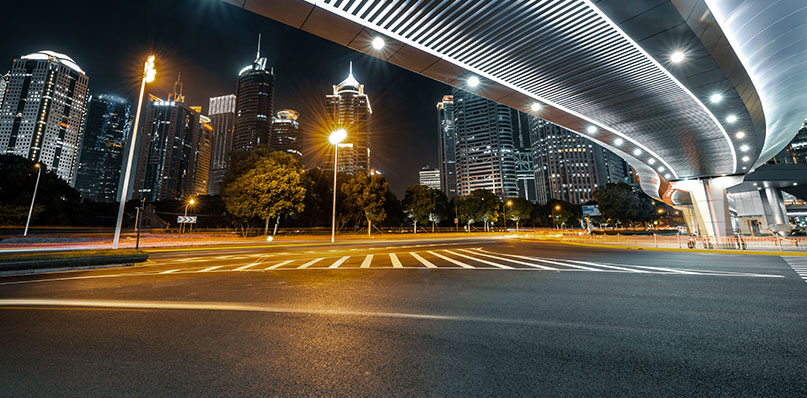
Urban arterial roads require consistent lighting across long distances and at intersections, turning areas, pedestrian zones, and merging sections. The wide distribution capability of the LED modules helps reduce uneven lighting when the system is correctly positioned and specified. Improved uniformity can make road markings, vehicles, cyclists, and roadside objects easier to recognize during nighttime operation.
The double-arm arrangement is particularly useful for divided roads and wide carriageways. A properly designed installation can direct light toward separate traffic flows, helping the project achieve broad coverage from a coordinated pole structure. This can also support a consistent visual identity across long urban routes.
Industrial Parks and Logistics Routes
Industrial parks often contain long internal roads, heavy vehicles, loading zones, storage yards, and access routes that must remain operational after sunset. These environments can expose lighting equipment to dust, vibration, weather fluctuations, and intensive maintenance demands. A durable pole, sealed luminaire housing, and modular service approach are important advantages in such conditions.
High mounting positions and double-arm coverage can help illuminate wide road sections while preserving clearance for trucks and industrial vehicles. Project engineers can select pole height, arm geometry, LED output, color temperature, and dimming strategy according to traffic patterns and operational requirements.
Commercial and Architectural Landscapes
Commercial districts and high-standard landscapes require lighting that supports safety while contributing to the appearance of the development. A visually unbalanced pole or oversized fixture can weaken an otherwise carefully planned environment. The product’s range of geometric and streamlined design options helps project teams coordinate the lighting system with adjacent buildings, streetscape furniture, planting schemes, and architectural materials.
Color temperature can be selected within the stated range of 3000K to 6000K. Warmer settings may be appropriate for hospitality areas, landscaped environments, or pedestrian-oriented commercial spaces, while cooler settings may be chosen for roads, industrial areas, and locations where a more neutral or crisp visual impression is preferred. The most suitable setting should be determined by the project’s lighting plan and local requirements.
Core Product Specifications
The system is built around a practical combination of electrical flexibility, efficient light output, environmental protection, structural material options, and control compatibility. The following table summarizes the principal specifications supplied for the product.
| Specification | Product Information | Project Benefit |
|---|---|---|
| Product type | Double-arm LED street light | Supports wide-area and two-direction road illumination |
| Application | Road and urban infrastructure | Suitable for arterial roads, industrial routes, and commercial landscapes |
| Input voltage | AC85-265V | Supports operation across a broad mains-voltage range |
| Light source | LED | Provides efficient, long-service lighting performance |
| Operating temperature | -35°C to 65°C | Designed for a wide range of outdoor climates |
| Lamp housing material | Aluminum alloy | Combines strength, low weight, and effective heat dissipation |
| Ingress protection | IP65 | Protects the luminaire against dust and water jets from outdoor directions |
| Luminous efficiency | 140 lm/W | Supports high light output with controlled energy consumption |
| Color temperature | 3000K-6000K | Allows adaptation to different road and landscape environments |
| Color rendering index | Ra 70 | Provides practical color recognition for road applications |
| Dimming support | DC 0-10V and DALI | Enables integration with suitable lighting-control systems |
| Warranty | 5 years | Supports long-term project confidence |
| Pole material options | Q235, Q355, SS400, GR65, and others | Allows structural selection according to project requirements |
| Pole height | 6m-10m | Fits a broad range of road and area-lighting layouts |
These specifications provide a starting point for project evaluation. Final product selection should consider road width, pole spacing, mounting height, arm projection, traffic classification, required average illuminance, uniformity, glare control, environmental exposure, local regulations, and maintenance access. Photometric calculations and structural verification are essential before production and installation.
Efficient LED Performance and Controlled Light Distribution
LED technology is central to the product’s performance. Compared with older conventional road-lighting technologies, modern LED modules can provide high luminous efficiency, directional control, faster switching, and easier compatibility with dimming systems. The stated luminous efficiency of up to 140 lm/W supports the development of energy-conscious road-lighting designs when the luminaire output is matched correctly to the application.
Efficiency should not be considered only as a number on a specification sheet. A successful road-lighting system must deliver useful light to the pavement, conflict areas, pedestrian routes, and relevant roadside zones while minimizing unnecessary upward or off-road light. The product’s precision-engineered lenses are intended to shape the light distribution so that illumination is spread more evenly across the target area.
Poorly controlled lighting can create bright spots directly beneath fixtures and dark gaps between poles. This uneven pattern can reduce visual comfort and make it more difficult for drivers to identify road users, obstacles, lane markings, and changes in the road surface. The combination of LED modules and optical lenses is designed to reduce these variations and support a more uniform visual environment.
Uniform lighting is particularly important on arterial roads and in high-speed traffic environments. Drivers do not look only at the area immediately below a luminaire; they continuously scan the road ahead. A balanced distribution can help reduce abrupt changes between very bright and very dark areas. It can also improve the consistency of the streetscape, especially when the pole spacing and mounting arrangement are optimized through professional lighting calculations.
Energy Management Through Dimming
The system supports DC 0-10V and DALI dimming. These interfaces can allow the lighting output to be adjusted according to time, traffic volume, weather conditions, or operating policy, provided that the project’s control equipment is compatible. For example, a road may operate at a higher lighting level during peak evening traffic and use a reduced level during low-traffic hours.
Scheduled dimming can lower energy consumption and reduce operating costs without requiring the entire lighting system to be switched off. In smart-city applications, the lighting system may be connected to a central management platform, local sensors, or a programmable control cabinet. The exact control architecture depends on the project design, but the product’s dimming compatibility provides a foundation for more flexible operation.
Dimming may also reduce thermal stress on the LED and driver during selected operating periods. When used with an appropriate control strategy, this can contribute to a more balanced lifecycle plan. Any dimming schedule should be verified against safety requirements, road classification, local regulations, and the needs of pedestrians and other road users.
Robust Materials for Outdoor Reliability
Outdoor lighting equipment must withstand rain, dust, sunlight, temperature variation, wind, and, in some regions, salt-laden air. The product uses an aluminum alloy lamp housing and can be paired with pole materials selected for the structural requirements of the project. Aluminum alloy is widely used in LED luminaires because it offers a useful combination of mechanical strength, manageable weight, corrosion resistance, and heat-transfer performance.
Heat management is important because LED performance and driver reliability can be influenced by operating temperature. The lamp housing can assist in transferring heat away from internal components when the luminaire is properly designed and installed. Maintaining an appropriate thermal environment supports stable operation and helps preserve light output over time.
The IP65 rating provides protection against dust ingress and water projected from multiple directions. This is appropriate for many outdoor road-lighting applications, although the rating does not remove the need for correct installation, cable sealing, drainage design, and routine inspection. The luminaire should be mounted according to the manufacturer’s instructions, with all covers, gaskets, connectors, and cable entries properly secured.
Protection Against Corrosion
The pole is finished with a multi-layer anti-corrosion coating. Surface protection is especially significant for road-lighting poles because they are exposed continuously to moisture and airborne contaminants. Coastal locations may introduce salt, while industrial locations may contain dust or chemical pollutants. A suitable coating system can help delay corrosion and preserve the appearance and structural condition of the pole.
Coating performance depends on the quality of surface preparation, material compatibility, application control, curing conditions, film thickness, and inspection. This is why manufacturing discipline is as important as the coating material itself. The production process includes automated and specialized equipment intended to improve consistency and support the long-term anti-corrosion performance of the finished product.
For projects in high-salinity or particularly aggressive environments, the coating specification should be reviewed with the engineering team. Additional requirements may apply, including special surface treatment, enhanced coating systems, inspection documentation, or increased maintenance frequency.
Performance in Challenging Temperatures
The stated operating temperature range is -35°C to 65°C. This broad range supports use in many cold, temperate, hot, and seasonally variable regions. Temperature performance is influenced by the LED driver, electrical components, housing design, installation conditions, and local climate. Project teams should verify the expected ambient conditions and select the appropriate configuration before ordering.
In cold climates, materials and seals must remain functional at low temperatures. In hot climates, adequate heat dissipation and correct fixture orientation become increasingly important. The product’s aluminum alloy housing, thermal design, and component selection are intended to support reliable operation across the specified range.
Structural Design and Pole Options
The double-arm pole is a structural element as well as a lighting support. It must carry the weight of the luminaires and arms while resisting wind, vibration, and environmental loads. The available pole material options include Q235, Q355, SS400, GR65, and other grades. These choices allow the design team to match the pole to the required mechanical performance, local standards, availability, and project budget.
Pole heights from 6m to 10m provide flexibility for different road widths and installation conditions. Lower poles may be suitable for local roads, pedestrian-oriented areas, or locations where a more intimate lighting scale is desired. Higher poles may be selected for wider roads, larger setbacks, or layouts requiring broader coverage. Mounting height must be coordinated with optical distribution, pole spacing, glare objectives, maintenance access, and wind-load calculations.
The arms can be designed as part of a coordinated structural assembly. Their length, angle, projection, and orientation affect both the appearance of the pole and the location of light on the road surface. The best configuration is not determined by appearance alone. It must also be evaluated for mechanical stress, luminaire aiming, access for maintenance, and consistency with the project’s photometric model.
Wind and Foundation Engineering
Wind conditions can vary significantly between inland, coastal, open, urban, and elevated locations. A pole that performs adequately in one region may require a different design in another. The service offering includes mechanical calculation for wind and foundation conditions, allowing the pole and base design to be reviewed in relation to local requirements.
Foundation design typically considers pole height, arm projection, luminaire size, wind area, soil conditions, anchor-bolt arrangement, concrete strength, and installation method. The final foundation must be prepared by qualified professionals in accordance with applicable local codes and site data. Professional calculations help reduce the risk of under-design, unnecessary material use, installation delays, and later structural concerns.
Advantages Compared with Basic Street-Light Solutions
The High-Performance Double-Arm LED Street Light offers several practical advantages over basic street-light products that are designed only for simple illumination. The first advantage is coverage flexibility. Two arms can serve opposite road directions or separate areas from one pole, making the system suitable for broader corridors and coordinated median layouts.
The second advantage is optical control. Low-cost fixtures may produce harsh hot spots, excessive glare, or insufficient light between poles when the optics are not properly matched to the road geometry. The use of precision-engineered lenses supports a more controlled distribution and helps create a more uniform lighting pattern.
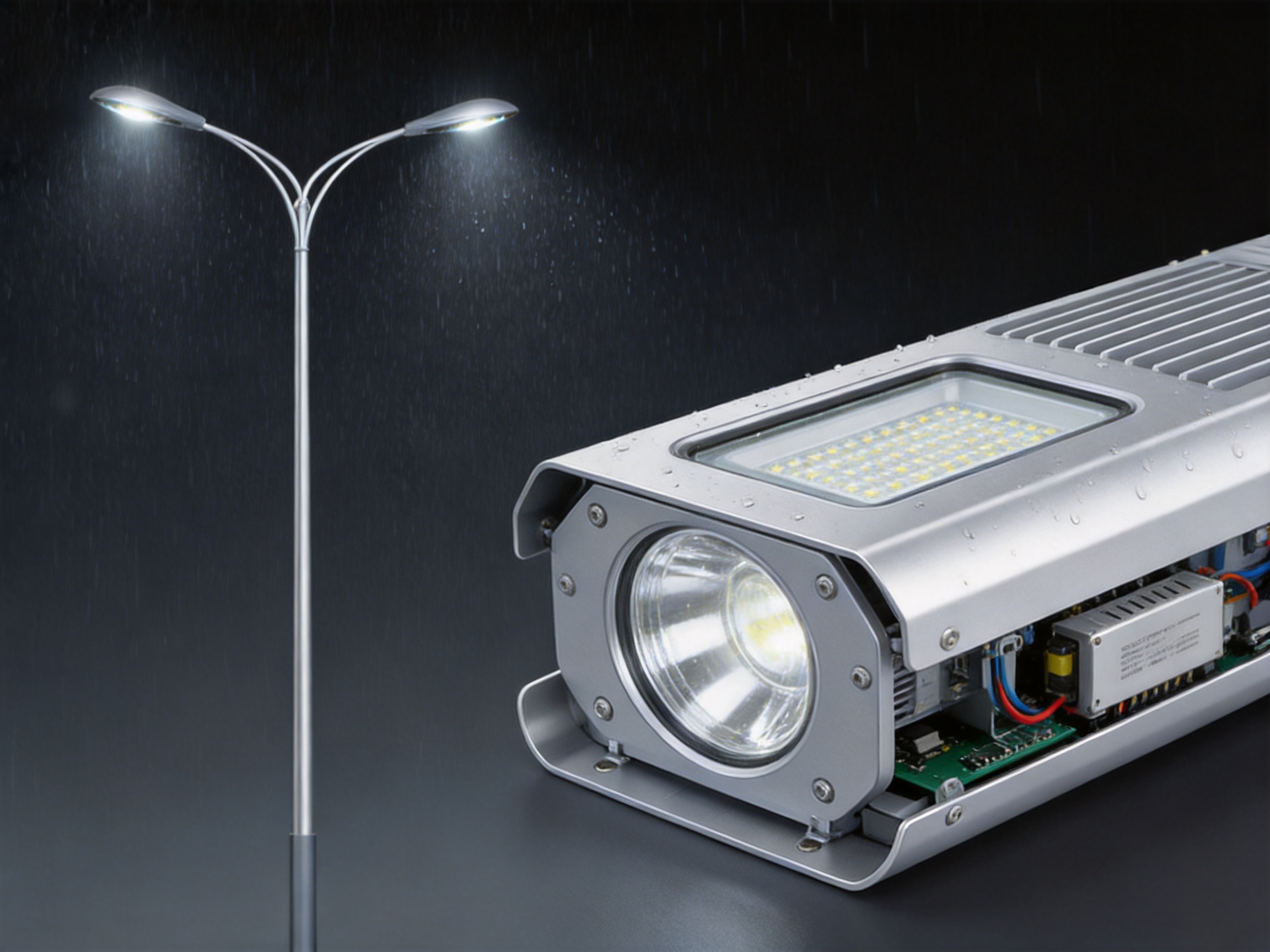
The third advantage is serviceability. Some conventional fixtures use a sealed, non-modular construction that requires complete replacement when a driver or light board fails. This can increase material waste, maintenance time, and inventory requirements. The product uses a modular, tool-free design intended to allow rapid replacement of LED driver units and light boards. This approach can simplify field service and reduce the time that a road section remains affected by a lighting fault.
The fourth advantage is environmental adaptability. The combination of aluminum alloy housing, IP65 protection, a broad operating temperature range, and multi-layer anti-corrosion treatment provides a stronger basis for demanding outdoor conditions than a basic fixture with limited environmental protection.
The fifth advantage is design adaptability. Rather than offering only one standard shape, the product can be developed in minimalist, contemporary, geometric, streamlined, or artistic directions. This is valuable for municipalities, developers, industrial parks, and commercial property owners that want infrastructure to support a coherent visual identity.
The sixth advantage is project support. Lighting performance depends on more than the luminaire itself. CAD layouts, three-dimensional simulations, foundation calculations, color selection, and installation guidance can help reduce design uncertainty. A supplier capable of supporting these stages may provide greater value than a supplier that only ships a standard product without engineering assistance.
Modular and Tool-Free Maintenance
Maintenance is a major part of the total cost of ownership for road lighting. Labor, traffic control, access equipment, replacement parts, and service interruptions can all add expenses over the life of a project. The modular tool-free design addresses this issue by making key components easier to access and replace.
LED driver units and light boards are serviceable modules rather than components that necessarily require replacement of the entire luminaire. When a fault is identified, trained maintenance personnel may be able to replace the affected module more quickly. This can reduce the duration of a road-lighting outage and help limit the number of complete fixtures held in spare inventory.
Modularity can also support lifecycle planning. A project owner may keep selected driver units, light boards, gaskets, and other approved components in stock. This can be more efficient than storing complete luminaires for every possible failure scenario. The appropriate spare-parts strategy depends on the project size, location, maintenance team, and expected operating conditions.
Tool-free access should not be interpreted as permission for unqualified personnel to work on energized equipment. Electrical isolation, safe access equipment, traffic management, and approved maintenance procedures remain essential. The benefit is that qualified technicians can perform authorized replacement work with fewer specialized tools and less disassembly.
Reducing Long-Term Maintenance Pressure
Road-lighting maintenance often takes place at night or during low-traffic periods. Every additional step in a repair procedure can increase labor time and road-management requirements. A modular design can shorten the repair sequence, helping maintenance teams return the system to service more efficiently.
Consistent component design may also simplify training. When the same replacement method is used across a project, technicians can develop a repeatable workflow. This is particularly useful for industrial parks, municipal networks, airports, logistics zones, and large commercial developments that contain many lighting points.
Preventive maintenance remains important even with modular construction. Inspections should check the pole, foundation, fasteners, electrical connections, coating condition, seals, lens cleanliness, and signs of corrosion or impact. Regular inspection helps identify small issues before they develop into larger failures.
Advanced Manufacturing Capabilities
The quality of a double-arm street-lighting system depends heavily on the manufacturing process. Structural alignment, cutting accuracy, bending consistency, weld quality, coating uniformity, and assembly control all influence the final product. The manufacturing capabilities associated with this solution are intended to provide repeatable production and dependable quality for both standard and large-scale projects.
Material Availability and Selection
The production system supports material options including Q235B, Q345B, S275JR, S355JR, Q460, A36, A572, GR56, GR50, and other specified grades. Maintaining an extensive material inventory can help reduce procurement delays and support faster production scheduling. It also enables the supplier to select materials according to structural design, local standards, customer requirements, and project conditions.
Material selection is not simply a purchasing decision. The grade affects forming behavior, welding requirements, structural strength, coating preparation, and final inspection. Proper documentation and traceability are important for projects where material certificates, engineering records, or quality dossiers are required.
Precision CNC Bending
Accurate bending contributes to the geometry, alignment, and structural integrity of the pole and arms. CNC bending equipment provides consistent control over bending angles and dimensions, helping reduce variation between units. Consistency is especially important when multiple poles must create a uniform visual line along a roadway.
Precise bending can also reduce post-production correction. Excessive manual adjustment may introduce surface marks, dimensional variation, or delays. By controlling the forming process more accurately, the manufacturer can improve repeatability and support smoother assembly and installation.
High-Accuracy Cutting
The production process provides cutting accuracy of up to 0.01mm for specified operations. Accurate cutting helps create clean edges and consistent dimensions. This can support better fit-up during welding, reduce unnecessary finishing work, and improve the appearance of completed components.
Clean and accurate cutting is also relevant to quality control. When components are produced to consistent dimensions, inspectors can compare them more reliably against drawings and production tolerances. This supports a more organized process for large orders with many identical or related components.
Automated Welding and Skilled Welders
Welding quality is critical for poles, arms, mounting structures, and other load-bearing parts. Automated welding lines can improve process consistency, while certified welders with extensive experience provide the judgment required for complex assemblies, special designs, and project-specific details.
A balanced manufacturing approach combines automation with professional human oversight. Automated systems can deliver repeatable production speed and controlled weld paths. Experienced welders can manage fit-up, inspect joint conditions, address unusual geometries, and ensure that the work follows approved procedures.
Welding inspections may include visual examination, dimensional checks, and additional testing where required by the project. The inspection level should correspond to the structural design, applicable standards, and customer documentation requirements.
Automated Cutting and Production Lines
Automated production lines can improve throughput and reduce variation across large orders. They can also support more efficient use of materials and better coordination between cutting, forming, welding, surface treatment, assembly, and inspection stages.
Automation may help reduce production costs while maintaining process stability. It can also support environmental objectives by improving material utilization, reducing rework, and creating more predictable production cycles. The benefit is most visible in projects that require hundreds or thousands of poles and luminaires with controlled dimensional consistency.
Powder Electrostatic Painting and Surface Treatment
Powder electrostatic painting equipment supports the application of protective and decorative coatings. The process can provide a more controlled finish when surface preparation, powder selection, application voltage, curing temperature, and film thickness are properly managed.
A durable coating system contributes to the pole’s resistance against weather and corrosion. It also helps maintain a consistent appearance across an installation. Color customization allows project owners to coordinate poles with local streetscape standards, architectural themes, corporate environments, or landscape designs.
Die-Casting Capability
A 1250-ton die-casting machine supports the production of aluminum components with controlled shapes and repeatable dimensions. Die casting can be useful for luminaire housings and related parts that require a combination of strength, heat-management features, mounting precision, and consistent appearance.
Accurate die-cast components can simplify assembly and support stable integration of LED modules, drivers, optical lenses, covers, and mounting hardware. Production control remains important because casting conditions, cooling, finishing, and inspection all influence the performance of the finished part.
Engineering and Customization Services
Infrastructure projects rarely have identical requirements. Road width, pole spacing, traffic speed, climate, soil, architectural context, energy policy, and control systems vary from one location to another. The product is therefore supported by engineering and customization services intended to adapt the system to the specific project.
CAD Design
CAD design can be used to prepare pole geometry, arm configuration, mounting details, base plates, anchor-bolt layouts, and related project drawings. Accurate drawings help contractors review installation conditions before fabrication. They also provide a useful reference for approval, procurement, construction, and future maintenance.
Three-Dimensional Product Simulation
Three-dimensional product simulation allows project teams to assess the shape and proportions of the pole before production. This can be useful when the lighting system forms a prominent part of a boulevard, entrance road, commercial district, or landscaped development.
Simulation can help identify conflicts between the pole, arm, luminaire, signage, trees, overhead lines, and nearby structures. It also supports communication between designers, owners, engineers, and contractors who may otherwise interpret two-dimensional drawings differently.
Three-Dimensional Scene Simulation
Scene simulation places the product within a representative environment. This helps project stakeholders review how the double-arm pole will appear in relation to buildings, roadways, medians, planting, sidewalks, and other street elements.
A scene review can reveal whether the selected design appears too large, too small, too decorative, or insufficiently prominent for the intended setting. It can also support decisions about pole color, arm shape, luminaire orientation, and spacing before manufacturing begins.
Specification and Color Customization
Customization may include pole height, arm configuration, material grade, coating color, LED output, color temperature, control method, and installation details. The available options should be finalized according to engineering calculations and project standards rather than selected only for appearance.
Color customization is particularly valuable for coordinated developments. A neutral finish may suit a modern industrial district, while a darker or warmer finish may be preferred for a landscaped commercial boulevard. Consistency between poles, brackets, cabinets, and other street furniture can strengthen the overall visual quality of the project.
Overseas Installation Guidance
International projects often involve local contractors, different construction practices, varying standards, and complex logistics. Overseas onsite installation guidance can help coordinate pole assembly, luminaire mounting, electrical connections, foundation preparation, and commissioning.
Installation guidance does not replace local licensing or qualified electrical and civil contractors. Instead, it provides technical coordination so that the supplied equipment is installed in accordance with the approved design and manufacturer requirements. This can be especially useful for large projects where installation teams need clarification on assembly sequences or adjustment procedures.
Quality Assurance and Project Reliability
Quality assurance begins with material selection and continues through forming, cutting, welding, surface treatment, electrical assembly, inspection, packaging, and shipment. A product intended for public roads must be made with a process that is repeatable enough to support consistent performance across the entire project.
Manufacturing equipment alone does not guarantee quality. It must be supported by documented procedures, trained personnel, calibrated equipment, production inspections, and final verification. Dimensional checks can confirm pole geometry and mounting points. Visual inspection can identify surface defects, coating problems, weld irregularities, or assembly issues. Electrical checks can verify connections and functional operation.
The company’s quality and environmental management capabilities are associated with international standards including ISO9001 and ISO14001, while occupational health and safety management is supported by OHSAS18001-related practices. These systems provide a framework for process control, environmental responsibility, workplace safety, and continual improvement.
For project buyers, appropriate documentation may include material certificates, inspection records, electrical test reports, coating information, packing lists, installation instructions, and warranty documents. The exact documentation package should be agreed during the quotation and order-confirmation stages.
Consistency in Large-Scale Orders
Large road-lighting projects require consistency from the first pole to the last. Variations in arm angle, coating color, luminaire appearance, or mounting position can become visible across a long boulevard. Controlled manufacturing processes and final inspection help reduce such variations.
Production capacity is also important. The manufacturing site covers more than 70,000 square meters and is supported by more than 300 professional technicians. This scale provides a foundation for handling standard products, customized designs, and large project orders while maintaining coordination between engineering, production, quality, and logistics teams.
Energy Efficiency and Sustainability Considerations
Road lighting operates for many hours each night, so energy efficiency has a direct effect on operating costs and environmental impact. The LED system’s stated efficiency of 140 lm/W can support lower energy consumption when compared with less efficient alternatives delivering an equivalent useful lighting level.
Energy performance depends on the complete design. Pole spacing, optical distribution, mounting height, drive current, dimming schedule, maintenance condition, and road classification all influence actual consumption. A high-efficiency luminaire installed with excessive output or poor spacing may not achieve the expected project benefit. Professional photometric design is therefore essential.
Dimming through DC 0-10V or DALI can further support energy management. A project may use time-based dimming, traffic-responsive control, or centralized scheduling. Reducing output during periods of low activity can lower energy consumption while maintaining a planned level of safety and visibility.
Modular maintenance can also contribute to sustainability by extending the useful service life of the luminaire housing and pole. Replacing a driver or light board instead of discarding an entire fixture can reduce material waste. Longer service intervals, efficient production, and proper recycling of replaced electronic components further support responsible lifecycle management.
Planning and Specification Guidance
Before ordering, project teams should define the road classification, lane arrangement, pavement width, median condition, sidewalk locations, pole spacing, mounting height, required light level, uniformity target, glare limitations, color temperature, control method, and local regulatory requirements.
The double-arm design should be reviewed in relation to the exact road layout. For a divided road, each arm may face a different carriageway. For an undivided road, the arms may illuminate opposite sides or serve different zones. For a commercial landscape, the design may be used to illuminate a central route, plaza edge, entrance area, or parking approach.
Photometric files and layout calculations should be prepared for the selected LED configuration. These calculations can help verify illumination levels, uniformity, spacing, mounting height, and light trespass. They can also identify whether a different lens distribution, output level, or arm projection is more suitable for the site.
Structural calculations should confirm the pole, arm, base plate, anchor bolts, and foundation. Wind speed, exposure category, terrain, luminaire projected area, and local code requirements should be considered. Soil data may be needed to finalize the foundation design.
Electrical planning should address input voltage, circuit protection, grounding, surge protection, cable routing, control cabinets, dimming compatibility, and maintenance isolation. The product supports AC85-265V input and selected dimming protocols, but the complete electrical system must be designed by qualified professionals.
Installation and Commissioning
Correct installation is essential for achieving the intended performance. Before installation, the contractor should inspect the delivered poles, luminaires, arms, fasteners, cables, control components, and protective finishes. Any visible transport damage should be documented and reviewed before assembly.
Foundation locations should be checked against approved drawings. Anchor bolts must be positioned accurately, and the concrete foundation must have achieved the required strength before the pole is erected. The pole should be lifted using suitable equipment and methods that prevent damage to the coating, arms, and luminaire mounting points.
After installation, the pole should be aligned and secured. The LED luminaires should be oriented according to the approved lighting design. Electrical connections must be completed by qualified personnel, with proper grounding, insulation, sealing, and protection against moisture ingress.
Commissioning should include visual inspection, electrical testing, control-system verification, dimming tests where applicable, and nighttime observation. Nighttime checks can confirm that the fixtures are correctly aimed and that there are no unexpected dark zones, glare issues, or conflicts with signs and nearby properties.
Company Manufacturing and Supply Strengths
Yangzhou Jinyuan Lamps Co., Ltd. is a professional manufacturer and engineering company serving the road-illumination industry. Established in 2002 and affiliated with Jinshang Electric Group, the company specializes in street-light poles, LED street lights, solar street lights, light fixtures, and related lighting products.
The company’s production and engineering capabilities support both standard and customized lighting projects. Its manufacturing site covers more than 70,000 square meters, with more than 300 professional technicians. Products are exported to more than 200 countries, giving the organization experience with international project coordination, export logistics, and varied customer requirements.
The company’s product range extends beyond double-arm LED street lights to include high-mast lighting, solar lighting, smart street lighting, traffic facilities, photovoltaic power-generation systems, LED floodlights, communication towers, and mid-mast lighting. This broader product capability can be useful for projects that require several types of outdoor infrastructure from one experienced source.
The manufacturing facility includes bending machines, powder electrostatic painting equipment, automatic welding and cutting machines, and a 1250-ton die-casting machine. These resources support an integrated production process, from structural fabrication and surface treatment to luminaire-component manufacturing.
For customers, an integrated supplier can simplify communication between product design, pole engineering, luminaire selection, coating, packaging, and after-sales support. It may also help maintain compatibility between the pole structure and lighting equipment, particularly when the project includes customized dimensions or special mounting arrangements.
Q&A
What type of road is suitable for the double-arm LED street light?
The system is suitable for urban arterial roads, industrial park routes, broad internal roads, commercial landscapes, divided carriageways, and other locations requiring wide or two-direction illumination. Final suitability depends on photometric calculations, pole spacing, mounting height, traffic requirements, and local standards.
What is the main advantage of using two arms?
Two arms allow one pole to support two lighting directions or two separate lighting zones. This can be useful for divided roads, central medians, wide corridors, and large open areas. It may also create a more balanced streetscape and reduce the need for separate structural supports in some layouts.
What input voltage does the product support?
The stated input-voltage range is AC85-265V. The project electrical design should still confirm local supply conditions, circuit protection, grounding, surge protection, and compatibility with the selected driver and control system.
Can the lighting output be dimmed?
Yes. The product supports DC 0-10V and DALI dimming. Compatibility with the central control system, sensors, cabinet, and commissioning procedure should be confirmed before final specification.
What is the expected environmental operating range?
The stated operating temperature range is -35°C to 65°C. Actual project selection should consider local climate, solar exposure, installation conditions, driver configuration, and any special environmental factors.
What does IP65 protection mean for this luminaire?
IP65 indicates protection against dust ingress and water jets from multiple directions. Correct installation remains essential. Cable entries, covers, gaskets, connectors, and fasteners must be installed and maintained properly to preserve the intended protection level.
What materials can be used for the pole?
Available pole material options include Q235, Q355, SS400, GR65, and other specified grades. The appropriate selection should be based on structural calculations, local standards, wind conditions, availability, and customer requirements.
What pole heights are available?
The stated pole-height range is 6m to 10m. The most appropriate height depends on road width, pole spacing, required light distribution, glare control, maintenance access, and structural calculations.
How does the modular design simplify maintenance?
The modular, tool-free design is intended to allow rapid replacement of LED driver units and light boards. Qualified technicians can replace selected components rather than necessarily replacing the entire luminaire, potentially reducing labor time, spare-parts requirements, and service interruptions.
Can the appearance be customized?
Yes. The design direction can range from minimalist geometric forms to streamlined or artistic structures. Project teams can also discuss specification and color customization, subject to engineering feasibility, production requirements, and order quantities.
Does the manufacturer provide engineering assistance?
Available services include CAD design, three-dimensional product simulation, three-dimensional scene simulation, specification and color customization, mechanical calculations for wind and foundations, and overseas onsite installation guidance.
Is the product suitable for coastal or high-salinity environments?
The system includes a multi-layer anti-corrosion coating and is designed for demanding outdoor conditions. For especially aggressive coastal environments, the coating specification, fasteners, electrical components, inspection plan, and maintenance schedule should be reviewed during project engineering.
What should be confirmed before placing an order?
Buyers should confirm road layout, pole height, arm geometry, material grade, LED output, optical distribution, color temperature, dimming method, input voltage, coating color, wind conditions, foundation requirements, installation responsibilities, documentation, spare parts, warranty terms, and delivery schedule.
Conclusion
The High-Performance Double-Arm LED Street Light is a comprehensive road-lighting solution for projects that require broad coverage, structural strength, efficient operation, attractive design, and manageable maintenance. Its double-arm configuration supports two-direction lighting and wide-area applications, while its high-efficiency LED modules and precision optical lenses are designed to create more uniform illumination with fewer bright and dark transitions.
The product combines an aluminum alloy lamp housing, IP65 protection, a wide operating-temperature range, multiple pole-material options, 6m-10m pole heights, 3000K-6000K color-temperature choices, Ra 70 color rendering, and support for DC 0-10V and DALI dimming. Its modular, tool-free service design can make driver and light-board replacement more efficient over the operating life of the system.
Its competitive value also comes from the manufacturing and engineering platform behind it. CNC bending, accurate cutting, automated welding and cutting, skilled certified welders, powder electrostatic painting, die-casting capability, extensive material availability, and quality-management systems help support consistent production. CAD design, simulation, customization, wind and foundation calculations, and installation guidance provide additional support for complex international projects.
For municipalities, developers, industrial parks, contractors, and infrastructure consultants, the most important step is to match the product configuration with the actual site. When the pole structure, optics, controls, electrical system, foundation, and maintenance plan are designed as one coordinated system, the double-arm LED street light can provide a durable, efficient, and visually coherent solution for modern road infrastructure.
References
1. Product technical information for the High-Performance Double-Arm LED Street Light, including electrical, optical, structural, environmental, and control specifications.
2. Manufacturer information regarding road-lighting products, engineering services, production equipment, quality systems, and international project support.
3. General principles of roadway lighting design, including illumination uniformity, glare control, pole spacing, mounting height, and photometric evaluation.
4. General guidance for LED luminaire thermal management, ingress protection, outdoor electrical installation, and lifecycle maintenance.
5. General engineering practices for steel lighting poles, wind-load assessment, anchor-bolt design, and reinforced-concrete foundations.
6. General principles of lighting-control systems using DC 0-10V and DALI dimming interfaces.
7. General quality-management and environmental-management practices applicable to outdoor lighting manufacturing and infrastructure projects.
Product: High-Performance Double-Arm LED Street Light