


JINYUAN
JINYUAN
JINYUAN
JINYUAN
JINYUAN
JINYUAN
JINYUAN
JINYUAN
JINYUAN
JINYUAN
JINYUAN
JINYUAN
JINYUAN
JINYUAN
JINYUAN
JINYUAN
Content
- 1 1. The Role of High-Mast Lighting in Industrial Environments
- 2 2. Product Architecture and Operating Principle
- 3 3. Structural and Environmental Advantages
- 4 4. Electric Lowering and Maintenance Safety
- 5 5. Intelligent Power Distribution and Control
- 6 6. Application Areas
- 7 7. Product Specifications
- 8 8. Advantages Compared with Conventional Alternatives
- 9 9. Advanced Manufacturing and Quality Control
- 10 10. Engineering and Project Support
- 11 11. Recommended Selection Process
- 12 12. Installation, Commissioning, and Long-Term Operation
- 13 13. Why Manufacturing Strength Matters to Buyers
- 14 14. Q&A
- 14.1 Q1: What is high-mast industrial projection lighting equipment used for?
- 14.2 Q2: How does it differ from ordinary street lighting?
- 14.3 Q3: What light source does the equipment use?
- 14.4 Q4: Can the lighting output be adjusted?
- 14.5 Q5: How is maintenance performed?
- 14.6 Q6: Is the product suitable for coastal or dusty environments?
- 14.7 Q7: What materials can be used for the lamp pole?
- 14.8 Q8: What temperature range is specified?
- 14.9 Q9: Can the equipment be customized?
- 14.10 Q10: What is the warranty period?
- 14.11 Q11: Is the listed 6–10 meter height suitable for every high-mast project?
- 14.12 Q12: Why are optical calculations important?
- 14.13 Q13: Does high luminous efficiency automatically guarantee lower energy costs?
- 14.14 Q14: What should buyers request before placing an order?
- 15 15. Conclusion
- 16 References
- 17 Product: High-Mast Industrial Projection Lighting Equipment

High-mast industrial projection lighting equipment is designed for locations where ordinary streetlights, floodlights, or low-mounted fixtures cannot provide sufficient coverage, uniformity, or operational reliability. Port terminals, logistics distribution centers, airport aprons, open-pit mines, industrial yards, stadium surroundings, transport depots, and other expansive outdoor facilities all require lighting systems capable of illuminating large working areas from elevated positions. In these environments, lighting is not merely a matter of nighttime convenience. It directly affects vehicle movement, cargo handling, worker safety, surveillance, equipment operation, and the continuity of industrial activities.
The High-Mast Industrial Projection Lighting Equipment described in this article is an infrastructure-oriented solution developed for high-intensity and long-distance illumination. It combines a strong steel support structure, modular projection arrays, high-efficiency LED optical systems, protective housing, electric lowering functionality, and intelligent power management. The result is a lighting platform that can provide broad coverage while simplifying maintenance and supporting long-term outdoor operation.
Compared with conventional high-mounted floodlights or scattered low-level fixtures, a well-engineered high-mast system can reduce the number of support points required, improve lighting consistency, minimize dark zones, and make maintenance more controlled. Its value lies not only in the brightness of individual luminaires, but also in the coordinated performance of the mast, lighting array, electrical system, optical design, protective treatment, and service process.
1. The Role of High-Mast Lighting in Industrial Environments
Large outdoor facilities present lighting challenges that are substantially different from those found on ordinary urban roads. A road-lighting project usually focuses on a linear corridor, while an industrial yard or airport apron may require illumination across a wide, irregularly shaped area. The lighting system must support multiple activities at the same time, including vehicle circulation, loading and unloading, machinery operation, personnel movement, inspections, security monitoring, and emergency response.
When lighting is installed too low, the project may require a large number of poles and fixtures to achieve acceptable coverage. This can increase foundation work, cable routing, maintenance points, and the risk of physical damage caused by vehicles or industrial equipment. Low-level fixtures may also produce more glare, uneven light distribution, and obstacles within the operating area.
High-mast projection lighting addresses these challenges by placing multiple luminaires at an elevated point and directing their beams toward the required zones. The elevated arrangement allows light to travel over a longer distance and cover a larger area. With an appropriate optical layout, the system can reduce overlapping shadows and improve the continuity of illumination between working zones.
At ports and logistics centers, high-mast lighting helps operators identify containers, trailers, loading areas, lanes, and equipment after sunset. At mines, it assists in illuminating haul roads, extraction areas, stockpiles, and maintenance zones. At airports and transport facilities, it contributes to apron visibility and safer movement of ground-support equipment. Around stadiums and large public venues, it can support service roads, parking areas, perimeter zones, and event-related operations.
2. Product Architecture and Operating Principle
The equipment consists of several integrated subsystems rather than a single lamp. The principal elements include the support pole or mast, the lighting array, optical modules, protective housing, electrical distribution equipment, control and monitoring components, and the mechanical lifting structure.
2.1 High-Strength Support Structure
The support structure is manufactured from high-strength carbon steel options such as Q235, Q355, SS400, GR65, and related grades selected according to project requirements. These materials provide a practical balance of structural strength, manufacturability, availability, and cost. The final selection can be based on the required height, wind load, luminaire weight, local environmental conditions, foundation design, and applicable engineering standards.
A high-mast support must carry more than its own weight. It must resist the combined effects of lighting-array weight, wind pressure, vibration, temperature variation, and long-term outdoor exposure. For this reason, the structural design should be considered together with the lighting arrangement. The number and orientation of projection units influence the mast’s loading behavior, while the mast geometry and mounting system influence the final aiming angles.
The matrix-style lighting arrangement provides a practical way to distribute multiple projection units around the upper assembly. Instead of relying on one concentrated beam, the system can use several precisely aimed luminaires to produce overlapping coverage. This arrangement supports more flexible project adaptation because the projection directions can be adjusted to match the shape and use of the illuminated area.
2.2 Modular Projection Array
The modular array allows the lighting package to be configured according to the application. A compact installation may require fewer projection units for a smaller yard, while a large port or industrial facility may require a larger array with different aiming directions. Modular construction can also simplify replacement because individual lighting units may be serviced without redesigning the entire support system.
Each projection unit contributes to a coordinated lighting pattern. The goal is not simply to produce the highest possible lumen output directly beneath the mast. A well-planned system distributes light toward operational areas, access roads, loading zones, equipment lanes, and peripheral workspaces. This helps reduce excessive brightness in one area while leaving other areas underlit.
Adjustable projection angles are especially important for long-distance lighting. The angle of each module can be selected to focus light on a specific zone while maintaining a balanced transition between adjacent areas. Such flexibility is a major advantage over fixed, non-adjustable lighting arrangements that may be difficult to adapt after installation.
2.3 LED Optical System
The equipment uses LED light sources with a stated luminous efficiency of up to 140 lm/W. High luminous efficiency means that more useful light can be produced for each unit of electrical power, helping reduce operating costs when compared with less efficient technologies. The actual energy savings in a project will depend on installed power, operating hours, dimming schedules, ambient conditions, and the required illumination level.
High-transmittance tempered glass covers help protect the optical components while allowing light to pass through efficiently. Precision light-distribution lenses shape the output and assist in directing the beam toward the target area. This combination supports focused, long-range projection and can reduce uncontrolled light dispersion.
The available color-temperature range of 3000K to 6000K allows the system to be matched to different project preferences. Warmer color temperatures may be suitable where a softer visual environment is preferred, while neutral or cooler white light may be selected for industrial work areas requiring strong visual contrast. The listed color-rendering index is Ra 70, which provides practical visibility for many outdoor industrial applications.
Optical design should always be evaluated together with the facility’s operational needs. A high-output beam is not automatically the best solution if it creates glare for drivers, affects nearby residences, or produces excessive contrast between bright and dark zones. The adjustable, multi-unit layout allows designers to balance reach, uniformity, glare control, and visual comfort.
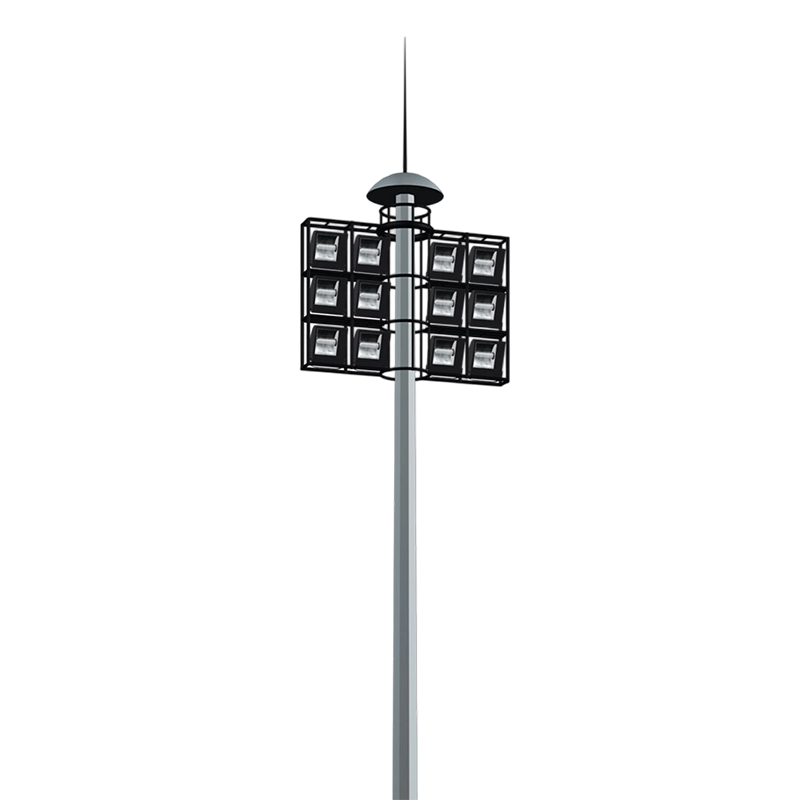
High-Mast Industrial Projection Lighting Equipment
3. Structural and Environmental Advantages
3.1 Stability in Outdoor Conditions
Industrial lighting installations are exposed to rain, dust, humidity, solar radiation, temperature changes, and wind. Port facilities may also experience salt-laden air, while mines can generate substantial airborne dust. Airport aprons and logistics yards may be exposed to vehicle exhaust, vibration, and frequent equipment movement. A high-mast system must therefore be designed as a complete outdoor infrastructure product rather than as an indoor luminaire placed outdoors.
The carbon-steel pole options provide a robust structural foundation. The matrix arrangement helps distribute wind loads through the upper lighting assembly, while appropriate pole geometry and foundation engineering contribute to overall stability. Mechanical calculations for wind and foundation conditions are available as part of the company’s project support capabilities, allowing the installation to be assessed according to the intended site.
The structural design should be finalized after reviewing local wind speed, terrain category, installation height, projection-area dimensions, soil conditions, and the total weight of the lighting array. This process is important because a suitable mast for a sheltered industrial park may not be suitable for an exposed coastal terminal or open mining area.
3.2 Protective Housing and IP65 Performance
The lighting housing uses aluminum alloy, a material valued for its relatively low weight, corrosion resistance, and ability to dissipate heat. Reducing luminaire weight can ease the loading requirements on the upper structure, while effective heat dissipation supports stable LED operation and can contribute to longer component life.
The stated IP65 rating indicates protection against dust ingress and water jets from multiple directions. This level of protection is appropriate for many outdoor industrial environments, although the complete project must still consider local conditions, maintenance practices, drainage, cable-entry protection, and the possible presence of corrosive chemicals or saline atmosphere.
The housing receives sandblasting and anti-corrosion coating treatment. Sandblasting prepares the metal surface by removing contaminants and improving coating adhesion. The subsequent protective coating forms a barrier against moisture and environmental exposure. This process can extend the anti-corrosion lifespan of the product and is particularly valuable in areas where repainting or replacing high-mounted equipment would be disruptive.
Anti-corrosion performance depends on more than the coating itself. Material selection, surface preparation, coating thickness, edge treatment, fastener quality, welding quality, transport protection, and installation procedures all influence long-term results. A professional manufacturer must therefore control the entire production chain rather than treating painting as an isolated final step.
4. Electric Lowering and Maintenance Safety
One of the most important advantages of this high-mast platform is its electric lifting and lowering structure. Traditional high-mounted lighting often requires workers to use elevated platforms, cranes, or temporary access equipment to reach the luminaires. Such work can involve traffic management, weather restrictions, extended downtime, and significant safety risks.
With a lowering system, the lighting array can be brought down to ground level for inspection, cleaning, component replacement, connection checks, and optical adjustment. Maintenance personnel can perform many tasks from a safer and more accessible working position. The system does not eliminate the need for proper safety procedures, but it can significantly reduce dependence on high-altitude operations.
Ground-level maintenance also improves service efficiency. A damaged driver, cable, LED module, lens, or protective component can be examined more easily when the array is lowered. Technicians can use standard tools and testing equipment without working at the top of a tall mast. This may shorten outage time and help maintenance teams identify developing problems before they become major failures.
The lowering mechanism must be correctly matched to the mast height, array weight, duty cycle, and local environmental conditions. Routine inspection of lifting components, electrical controls, cables, fasteners, and mechanical interfaces is recommended. Operators should also establish procedures for lowering the array during suitable weather and isolating the power supply before service work begins.
4.1 Maintenance Cost Benefits
Maintenance cost is often underestimated during the initial purchase of industrial lighting. A low-price fixture may become expensive if it requires specialized access equipment every time a driver or LED module needs attention. The electric lowering function provides a lifecycle advantage because it can reduce the frequency and complexity of elevated maintenance operations.
Lower service complexity may also improve the facility’s maintenance planning. Inspections can be scheduled in advance, spare parts can be prepared at ground level, and several units can be serviced during one planned maintenance period. This is particularly useful for facilities that operate continuously and cannot tolerate unexpected lighting outages.
5. Intelligent Power Distribution and Control
The equipment includes intelligent power distribution and monitoring functions that allow power output to be adjusted according to operational requirements. This supports a more flexible relationship between lighting performance and energy consumption.
For example, a logistics yard may require full output during peak loading activity but a lower level during periods of reduced movement. A port terminal may use different lighting schedules for cargo handling zones, internal roads, and security perimeters. A transport facility may apply one setting during normal operations and another during emergency response or special events.
The stated dimming options include DC 0-10V and DALI. These interfaces provide compatibility with many professional lighting-control architectures. Through appropriate control equipment, operators may establish dimming levels, schedules, group control, fault monitoring, and operational scenes. The actual control strategy should be designed according to the project’s electrical system, facility-management platform, and local regulations.
Dimming can lower energy consumption and reduce unnecessary light output. It may also extend the useful life of components by reducing thermal and electrical stress during periods when full output is not required. However, control settings should always protect safety-critical activities. Emergency routes, active loading areas, surveillance zones, and aircraft or vehicle movement areas may require defined minimum illumination levels.
Intelligent monitoring can provide an additional operational advantage by identifying abnormal conditions. Depending on the final system configuration, monitoring may assist with detecting power interruptions, driver issues, control faults, or unusual operating patterns. Early awareness allows maintenance personnel to respond before a localized fault affects a larger area.
6. Application Areas
6.1 Port Terminals
Port terminals combine large open spaces with heavy vehicle movements, container handling, cranes, storage areas, and continuous operational schedules. Lighting must support workers and equipment operators without creating uncontrolled glare or interfering with visual observation.
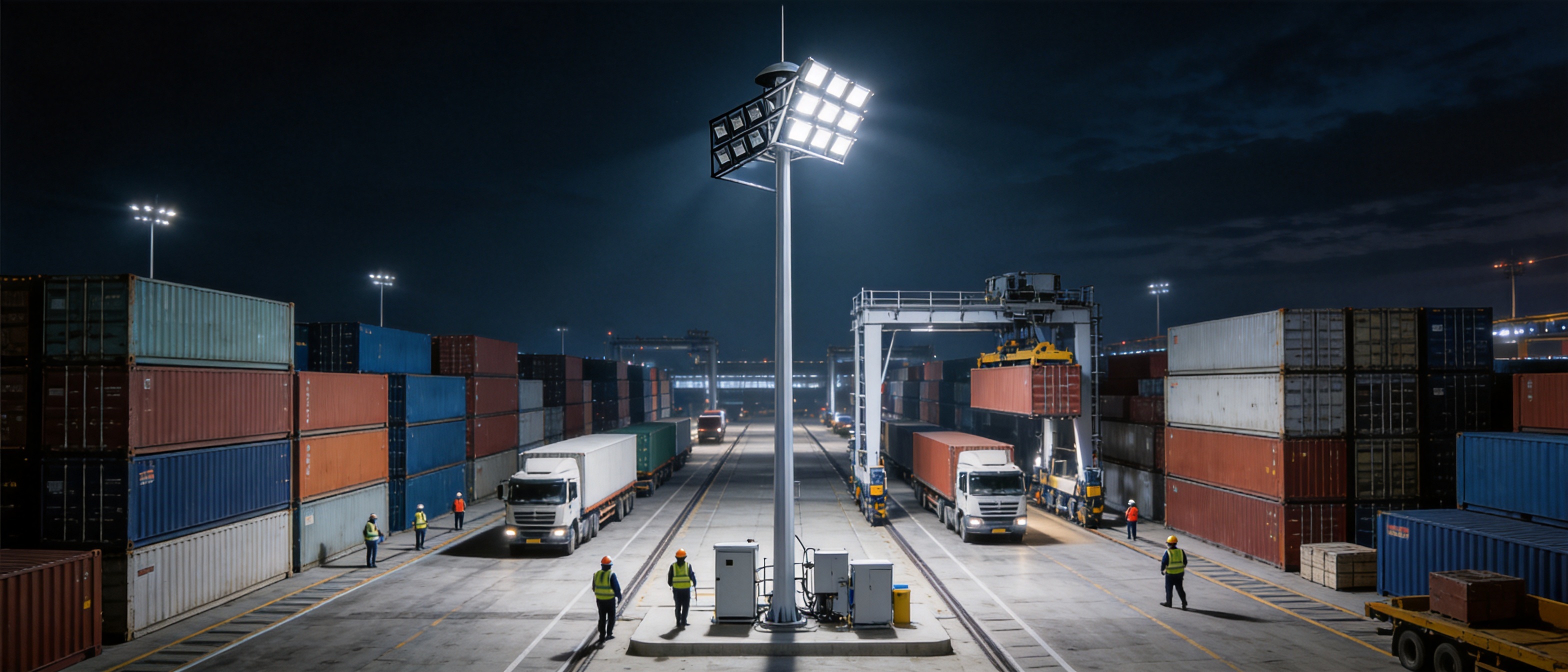
High-mast projection equipment can be positioned to illuminate container yards, internal circulation routes, loading zones, inspection areas, and open handling spaces. Its elevated position can help reduce the number of obstacles at ground level and provide broad coverage over container stacks or vehicle lanes. Adjustable optics allow individual modules to be directed toward specific work areas.
Because coastal sites can be corrosive, surface preparation and anti-corrosion coating are especially important. Project specifications should also consider stainless or suitably protected fasteners, cable-entry sealing, drainage, and an inspection program appropriate for salt exposure.
6.2 Logistics Distribution Centers
Modern distribution centers often operate around the clock. Trucks arrive and depart at different times, loading bays remain active during night shifts, and workers move between warehouses, parking areas, and dispatch zones. Poor lighting can slow operations and increase the possibility of vehicle or pedestrian incidents.
A high-mast system can cover truck yards, turning areas, trailer parking zones, loading approaches, and perimeter roads. The ability to reduce output during quiet periods may help the operator control energy use without compromising the safety of active zones. The electric lowering structure also supports maintenance without requiring frequent access by a mobile crane in busy loading areas.
6.3 Open-Pit Mines and Industrial Yards
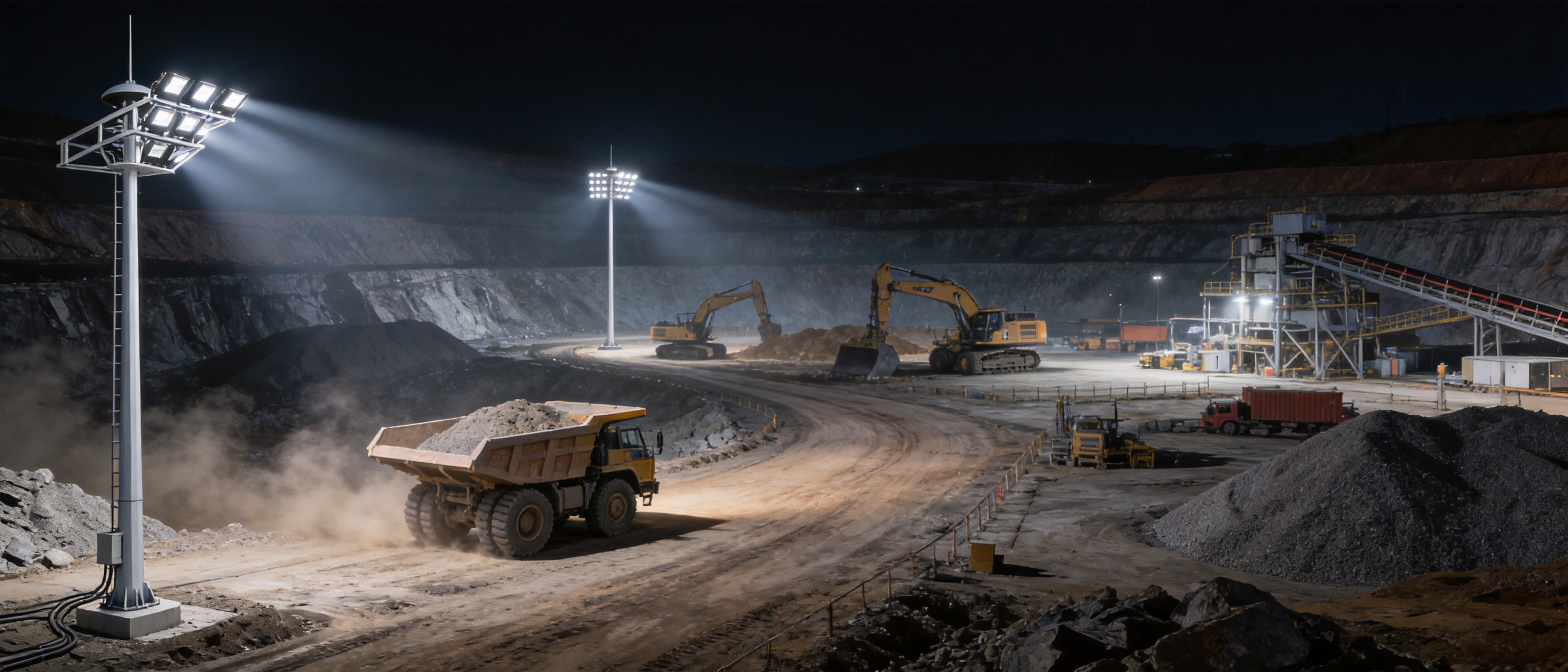
Mining environments require lighting that can withstand dust, vibration, temperature variation, and heavy equipment movement. Large work zones may change over time as extraction areas, haul roads, stockpiles, and maintenance locations develop.
The modular design provides a degree of adaptability for these changing layouts. Projection units can be aimed toward haul routes, loading points, crusher areas, material storage locations, and maintenance zones. Because mining conditions are demanding, the final design should be supported by detailed environmental assessment, structural calculations, access planning, and an appropriate spare-parts strategy.
6.4 Airport Aprons and Transport Facilities
Airport aprons and transport facilities require clear visibility across broad paved areas. Ground crews, service vehicles, maintenance teams, and inspection personnel depend on lighting that supports accurate recognition of equipment, markings, obstacles, and moving vehicles.
High-mast lighting can reduce the need for numerous low-level fixtures across an apron or service yard. However, airport projects require careful control of glare, light spill, aiming direction, and operational procedures. The final photometric design should be coordinated with aviation requirements and the facility’s safety-management system.
6.5 Stadium Surroundings and Large Venues
Although stadium lighting may involve specialized sports-lighting systems, high-mast projection equipment can be useful for surrounding parking areas, service roads, loading points, pedestrian approaches, and perimeter zones. The flexible color-temperature range and adjustable projection directions allow the installation to be coordinated with the venue’s public-safety and event-management requirements.
For large venues, lighting demand can vary significantly between ordinary days, event periods, and post-event cleaning or servicing. Dimming and group control can help create different operational modes while reducing energy consumption during lower-activity periods.
7. Product Specifications
The following table summarizes the principal information provided for the equipment. Final project specifications may be customized according to the site, structural calculations, photometric requirements, local electrical standards, and installation conditions.
| Specification | Provided Information | Engineering Significance |
|---|---|---|
| Product type | High-mast industrial projection lighting equipment | Designed for large-area outdoor illumination from an elevated support structure |
| Light source | LED | Supports high efficiency, long service life, and controllable output |
| Luminous efficiency | Up to 140 lm/W | Helps maximize useful light output for the installed electrical power |
| Input voltage | AC 85–265 V | Provides compatibility with a broad range of AC supply conditions |
| Color temperature | 3000K–6000K | Allows the visual character of the lighting to be matched to the application |
| Color rendering index | Ra 70 | Provides practical color recognition for many outdoor industrial environments |
| Lamp housing | Aluminum alloy | Combines low weight, corrosion resistance, and heat-dissipation capability |
| Ingress protection | IP65 | Protects against dust ingress and water jets under specified test conditions |
| Dimming | DC 0-10V / DALI | Supports professional lighting-control and energy-management systems |
| Operating temperature | -35°C to 65°C | Suitable for a broad outdoor temperature range when correctly specified |
| Warranty | 5 years | Provides a defined support period for the supplied product |
| Pole materials | Q235, Q355, SS400, GR65, and others | Allows structural material selection according to project conditions |
| Listed pole height range | 6 m–10 m | Provides a configurable platform for selected high-mounted applications |
The listed height range should be interpreted in the context of the final project design. Some facilities may classify a 6–10 meter arrangement as a high-mounted or mid-mast solution, while larger port, mining, airport, or stadium projects may require taller structures or a customized mast configuration. The support structure, array weight, wind loading, foundation, lowering mechanism, and optical performance must be reviewed as one engineered package.
8. Advantages Compared with Conventional Alternatives
8.1 Fewer Ground-Level Obstacles
A distributed network of low-mounted fixtures can create more poles, foundations, cables, and maintenance points throughout an operating area. High-mast lighting concentrates the main support structure into selected locations, leaving more unobstructed space for vehicles, machinery, storage, and pedestrian movement.
This does not mean that every project will require fewer poles. The final quantity depends on the area geometry and illumination standard. Nevertheless, the elevated multi-projector approach can reduce installation complexity where broad coverage is required and where ground-level obstacles would interfere with operations.
8.2 More Flexible Light Distribution
Fixed floodlights may provide strong illumination in one direction but leave adjacent zones poorly covered. The adjustable matrix arrangement allows several beams to be aimed independently. This creates more opportunities to balance illumination across the entire site.
Compared with a single high-output source, a multi-module array can also provide redundancy in the lighting pattern. If one module requires service, other modules may continue operating, depending on the control and circuit arrangement. Such continuity can be valuable in facilities where complete darkness is unacceptable.
8.3 Safer and More Efficient Maintenance
The electric lowering structure is a clear lifecycle advantage over systems that require routine work at the top of the mast. Ground-level servicing can reduce work-at-height exposure, simplify troubleshooting, and shorten maintenance windows. This benefit becomes more significant as the number of fixtures and the operating hours of the facility increase.
8.4 Better Energy Management
LED efficiency, dimming support, intelligent distribution, and monitoring work together to improve energy management. Conventional systems that operate at one fixed output may consume the same amount of electricity during periods of high activity and periods of low activity. A controllable LED system can be programmed to follow actual operational demand.
8.5 Stronger Protection against Outdoor Exposure
The combination of aluminum-alloy housings, IP65 protection, tempered glass, surface treatment, and anti-corrosion coating is intended to improve reliability under outdoor conditions. The exact service life will depend on environmental exposure and maintenance, but this integrated approach is more suitable for demanding outdoor applications than an inadequately protected indoor-oriented lighting product.
9. Advanced Manufacturing and Quality Control
The performance of a high-mast lighting product depends heavily on manufacturing quality. Even a well-designed concept can fail if the pole is inaccurately formed, welds are inconsistent, coatings are poorly applied, or optical and electrical components are not assembled correctly. The manufacturer’s production capabilities are therefore a central part of the product’s value.
9.1 Material Selection and Inventory Control
The manufacturing operation supports material options including Q235B, Q345B, S275JR, S355JR, Q460, A36, A572, GR56, GR50, and other grades. Maintaining an extensive material inventory can help reduce project delays and provide greater flexibility when a customer requires a specific structural grade or when a design must be adapted to local engineering requirements.
Material traceability is important for infrastructure products. A controlled process should confirm the material grade, thickness, surface condition, and suitability for the intended fabrication operation. Consistent material preparation contributes to predictable bending, welding, coating, and load performance.
9.2 CNC Bending
Precise CNC bending helps produce repeatable pole sections and structural components. Accurate bending improves dimensional consistency, supports proper assembly, and reduces the amount of post-production adjustment required at the installation site.
For tapered or polygonal poles, controlled bending is particularly important because small dimensional deviations can affect alignment, joint fit, flange position, and the final appearance of the completed structure. Repeatable CNC production is therefore valuable for both quality and installation efficiency.
9.3 High-Accuracy Cutting
The company identifies cutting accuracy of up to 0.01 mm for its production processes. High-accuracy cutting supports clean edges, precise component dimensions, and improved fit between fabricated parts. In large-scale projects, dimensional consistency can reduce assembly problems and help maintain a predictable production schedule.
Clean cutting also benefits subsequent operations such as welding, grinding, drilling, and coating. Correctly prepared edges can reduce unnecessary rework and help ensure that components meet the intended design dimensions.
9.4 Welding Capability
Certified welders with extensive welding experience contribute to the structural reliability of poles, brackets, frames, and other fabricated components. Welding quality affects load transfer, fatigue resistance, joint durability, and long-term corrosion behavior.
A professional welding process includes preparation, correct fit-up, suitable parameters, inspection, and finishing. Welded areas may require particular attention during surface preparation and coating because discontinuities, sharp transitions, or contamination can become early points of corrosion.
9.5 Automated Production Lines
Automated production lines can improve consistency while reducing avoidable production costs. Automation is beneficial when it is combined with human inspection and process control. Machines can repeat cutting, forming, coating, or assembly operations efficiently, while experienced technicians verify dimensions, surface quality, welding results, electrical connections, and final appearance.
Automation may also support environmental performance by improving material utilization, reducing rework, and controlling coating application. A more stable process can produce less waste and reduce the number of rejected or repaired components.
9.6 Anti-Corrosion Treatment
The anti-corrosion process is designed to extend the outdoor service life of the support structure and related metal components. Sandblasting creates a suitable surface profile, after which the selected coating system can bond more effectively. The coating specification should be determined according to the environmental category, expected service duration, and customer requirements.
For coastal, industrial, or chemically aggressive sites, additional protective measures may be considered. These can include upgraded coating systems, enhanced edge treatment, protected fasteners, improved drainage, and a more frequent inspection schedule. The manufacturer’s ability to adapt production and surface treatment is an advantage for projects with different environmental demands.
10. Engineering and Project Support
Large-area lighting projects require more than product delivery. The mast location, foundation, photometric layout, electrical distribution, control system, transport route, and installation sequence all affect the final result. The company provides several design and engineering services intended to support customers from early planning through completion.
10.1 CAD Design
CAD design helps establish the overall dimensions of the mast, lighting array, brackets, access features, cable routing, and foundation interface. Drawings can be reviewed before fabrication, allowing project teams to confirm dimensions and identify potential conflicts.
10.2 Three-Dimensional Product Simulation
Three-dimensional product simulation provides a more complete view of the equipment than two-dimensional drawings alone. It can help customers evaluate the relationship between the pole, projection array, lowering mechanism, mounting brackets, and service components.
10.3 Three-Dimensional Scene Simulation
Scene simulation places the proposed lighting equipment within a representation of the project environment. This can help stakeholders visualize mast locations, projection directions, access routes, and the relationship between the lighting system and surrounding buildings or operating zones.
Simulation is also useful for identifying possible glare concerns, obstructions, maintenance-access limitations, and conflicts with vehicle movement before construction begins. While simulation does not replace a final photometric or structural calculation, it improves communication between the manufacturer, designer, contractor, and end user.
10.4 Specification and Color Customization
Industrial projects often have specific requirements for pole material, dimensions, coating, color, mounting arrangement, electrical interface, and control method. Specification and color customization allow the product to be coordinated with the site’s visual standards, corrosion requirements, and technical documentation.
10.5 Mechanical Calculations
Wind and foundation calculations are essential for safe installation. The manufacturer can support the evaluation of wind loading, structural geometry, lighting-array weight, and foundation requirements. The final calculations should be reviewed and approved according to the regulations and professional responsibilities applicable in the installation location.
10.6 Overseas Installation Guidance
For international projects, overseas installation guidance can help contractors understand assembly procedures, lifting requirements, electrical connections, lowering-system operation, and commissioning steps. Clear technical communication is especially valuable when the local installation team is working with a product manufactured in another country.
11. Recommended Selection Process
Choosing the correct high-mast lighting system begins with a clear understanding of the site. The end user should identify the area to be illuminated, the activities performed there, operating hours, vehicle and pedestrian routes, surrounding properties, environmental exposure, and applicable safety requirements.
11.1 Define the Lighting Objective
The project should establish whether the primary objective is general area lighting, cargo handling, vehicle circulation, security observation, emergency access, event support, or a combination of these functions. Different objectives may require different illumination levels, uniformity targets, color temperatures, glare controls, and dimming schedules.
11.2 Evaluate Site Conditions
Important site conditions include wind speed, soil characteristics, temperature range, dust, humidity, salt exposure, chemical pollutants, flood risk, and access for transport and installation. The mast and coating system should be selected according to the actual environment rather than a generic outdoor classification.
11.3 Confirm Electrical Requirements
The available power supply should be checked against the equipment’s AC85-265V input range, connected load, circuit arrangement, protection devices, grounding system, and control architecture. If DALI or DC 0-10V dimming is required, the control system should be specified at the beginning of the project rather than added after installation.
11.4 Plan Maintenance Access
The lowering structure reduces the need for high-altitude work, but the ground-level service area must still be kept clear. The project should reserve adequate space for lowering, inspection, component replacement, and safe isolation of the electrical supply.
11.5 Review Structural and Photometric Documentation
Before production, customers should review the mast drawings, foundation interface, lighting layout, projection angles, control arrangement, coating specification, and maintenance procedure. Early review reduces the possibility of changes after fabrication and helps align all project participants.
12. Installation, Commissioning, and Long-Term Operation
Installation should follow the approved drawings, lifting plan, electrical design, and local safety requirements. The foundation must achieve the required strength before the mast is erected. Bolted connections, anchor assemblies, cable entries, grounding connections, and structural interfaces should be checked before the lighting array is energized.
After installation, each projection unit should be aimed according to the approved lighting plan. Small changes in angle can influence coverage and glare, so aiming should be completed with reference to actual site conditions. The system should then be tested at different output levels, including full power and dimmed operation where applicable.
Commissioning should include inspection of the electric lowering function, control interfaces, monitoring signals, protective devices, and emergency procedures. Operators should be trained in normal control, fault response, and safe lowering. Documentation should be retained for future maintenance and replacement work.
Long-term operation benefits from a preventive maintenance program. Routine inspections may include checking housing seals, tempered glass, coating condition, fasteners, pole interfaces, electrical connections, grounding, control equipment, and the lowering mechanism. Dust and deposits should be removed where they affect optical performance or heat dissipation.
In corrosive locations, the coating should be inspected for scratches, blistering, peeling, or exposed metal. Early repair is generally easier and less expensive than waiting until corrosion has spread beneath the coating. Similarly, unusual noise, vibration, intermittent dimming, or uneven brightness should be investigated promptly.
13. Why Manufacturing Strength Matters to Buyers
For a large industrial lighting project, the buyer is not purchasing only a lamp. The buyer is investing in a structural system, an electrical system, a maintenance strategy, and a long-term operating asset. Manufacturing strength influences all of these aspects.
A manufacturer with material inventory, CNC forming, high-accuracy cutting, experienced welding teams, automated production lines, coating capability, design services, and engineering support can coordinate more stages internally. This may reduce communication gaps between separate suppliers and improve consistency between the structural, electrical, and optical portions of the product.
The manufacturer described in the supplied information has operated in the road-illumination industry since 2002 and is affiliated with a larger electrical group. Its business includes streetlight poles, LED streetlights, solar streetlights, light fixtures, and related infrastructure products. The company reports a production site of more than 70,000 square meters, more than 300 professional technicians, and exports to over 200 countries.
Its quality and environmental management framework includes ISO9001, ISO14001, and OHSAS18001-related standards. The production base includes bending machines, powder electrostatic painting equipment, automatic welding and cutting machines, and a 1250-ton die-casting machine. These capabilities support the production of both structural and lighting components and provide a foundation for serving projects with different specifications.
International project experience can also be valuable because requirements vary by climate, voltage, structural standard, logistics environment, and installation practice. A supplier that regularly works with overseas customers is more likely to understand the need for clear drawings, packing protection, technical documentation, spare-parts planning, and remote installation assistance.
14. Q&A
Q1: What is high-mast industrial projection lighting equipment used for?
It is used to illuminate large outdoor areas from elevated positions. Typical applications include port terminals, logistics yards, open-pit mines, airport aprons, industrial compounds, stadium surroundings, transport facilities, and other locations where broad and long-distance coverage is required.
Q2: How does it differ from ordinary street lighting?
Ordinary street lighting generally focuses on a linear roadway, while high-mast projection lighting is designed for expansive areas. It uses a multi-unit projection array with adjustable aiming directions, allowing light to be distributed across yards, work zones, storage areas, and open operating spaces.
Q3: What light source does the equipment use?
The equipment uses LED light sources. The listed luminous efficiency is up to 140 lm/W, although the actual project performance depends on the selected model, power level, optical configuration, ambient temperature, and operating conditions.
Q4: Can the lighting output be adjusted?
Yes. The system supports DC 0-10V and DALI dimming interfaces. These can be integrated into a suitable control system for scheduled operation, grouped control, energy management, and different lighting levels according to facility activity.
Q5: How is maintenance performed?
The equipment uses an electric lifting and lowering structure. The lighting array can be lowered toward ground level so that personnel can inspect, clean, repair, or replace components without routinely working at the top of the mast.
Q6: Is the product suitable for coastal or dusty environments?
It is designed for outdoor use and includes IP65-rated housing, tempered glass, sandblasting, and anti-corrosion coating. Coastal or highly corrosive projects should receive additional engineering review so that coating systems, fasteners, drainage, and maintenance intervals are matched to the site.
Q7: What materials can be used for the lamp pole?
Available material options include Q235, Q355, SS400, GR65, and other structural grades. The selection should be based on structural calculations, wind loading, local standards, pole dimensions, lighting-array weight, and environmental exposure.
Q8: What temperature range is specified?
The stated operating temperature range is -35°C to 65°C. Actual performance also depends on correct electrical design, heat dissipation, installation, and the environmental conditions of the project.
Q9: Can the equipment be customized?
Yes. Support is available for CAD drawings, three-dimensional product and scene simulations, specification customization, color selection, structural calculations, lighting-array configuration, and overseas installation guidance. Customization should be confirmed before production.
Q10: What is the warranty period?
The supplied information states a five-year warranty period. Warranty coverage should be confirmed in the commercial agreement, including the covered components, operating conditions, installation requirements, exclusions, and service process.
Q11: Is the listed 6–10 meter height suitable for every high-mast project?
No. The listed height range describes the provided product information, but the final height must be selected according to the site area, required coverage, wind conditions, foundation, lighting design, and local regulations. Larger projects may require a customized or taller configuration.
Q12: Why are optical calculations important?
Optical calculations help determine projection angles, coverage, uniformity, glare, light spill, and the number and position of luminaires. They ensure that the system is designed around the actual operational area rather than relying only on nominal lumen output.
Q13: Does high luminous efficiency automatically guarantee lower energy costs?
Not by itself. Energy consumption also depends on installed power, operating hours, dimming schedules, maintenance, and lighting requirements. High efficiency combined with intelligent control can provide a stronger energy-saving result than efficiency alone.
Q14: What should buyers request before placing an order?
Buyers should request technical drawings, photometric information, structural calculations, coating specifications, electrical details, control-interface information, installation instructions, warranty terms, packing details, and a recommended spare-parts list. These documents help ensure that the product is suitable for the intended site.
15. Conclusion
High-mast industrial projection lighting equipment provides a practical solution for facilities that need reliable, broad-area illumination without filling the operating space with numerous low-level fixtures. Its value comes from the integration of elevated structural support, modular LED projection units, precision optics, protective housing, anti-corrosion treatment, intelligent power control, and electric lowering functionality.
The product’s advantages over conventional alternatives include flexible light distribution, reduced ground-level obstruction, improved energy-management potential, enhanced outdoor protection, and safer maintenance access. Its suitability for ports, logistics centers, mines, airport aprons, transport facilities, stadium surroundings, and industrial yards makes it a versatile platform for demanding outdoor applications.
Manufacturing capability is equally important. Material availability, CNC bending, high-accuracy cutting, experienced welding, automated production, surface preparation, coating control, design services, mechanical calculations, and installation guidance all contribute to project quality. A supplier that can coordinate these capabilities provides more than a standard luminaire; it provides an engineered lighting infrastructure solution.
When properly selected, installed, commissioned, and maintained, the system can support visibility, operational safety, energy efficiency, and long-term serviceability. The best project results will come from evaluating the complete environment, defining the operational objectives, completing structural and photometric calculations, selecting suitable materials and coatings, and establishing a clear maintenance and control strategy from the beginning.
References
1. Product technical information for High-Mast Industrial Projection Lighting Equipment, including supplied electrical, optical, structural, environmental, and maintenance specifications.
2. Manufacturer-provided information on material options, CNC bending, precision cutting, welding, automated production, coating, design services, and installation guidance.
3. ISO 9001, Quality Management Systems—Requirements.
4. ISO 14001, Environmental Management Systems—Requirements with Guidance for Use.
5. International Commission on Illumination, principles of outdoor lighting quality, glare control, uniformity, and visual performance.
6. General engineering practice for wind loading, foundation design, structural steel fabrication, protective coatings, and outdoor electrical installations.
7. Professional lighting-control practices for 0-10V and DALI dimming systems.