


JINYUAN
JINYUAN
JINYUAN
JINYUAN
JINYUAN
JINYUAN
JINYUAN
JINYUAN
JINYUAN
JINYUAN
JINYUAN
JINYUAN
JINYUAN
JINYUAN
JINYUAN
JINYUAN
Content
- 1 1. A Contemporary Lighting Form for Modern Landscapes
- 2 2. Square-Pole Engineering and Structural Stability
- 3 3. Organized Light Distribution from the Square Diffuser
- 4 4. LED Efficiency and Flexible Electrical Performance
- 5 5. Aluminum Alloy Housing and Long-Term Weather Resistance
- 6 6. Manufacturing Strengths Behind Consistent Quality
- 7 7. Advantages Compared with Conventional Garden Lights
- 7.1 Advantage one: architectural compatibility
- 7.2 Advantage two: improved structural identity
- 7.3 Advantage three: controlled illumination
- 7.4 Advantage four: flexible light atmosphere
- 7.5 Advantage five: energy-conscious operation
- 7.6 Advantage six: broad environmental suitability
- 7.7 Advantage seven: project customization
- 8 8. Design Support from Concept to Installation
- 9 9. Recommended Applications
- 10 10. Installation and Maintenance Considerations
- 11 11. Quality, Certification, and Supplier Reliability
- 12 12. How to Specify the Product for a Project
- 13 13. Sustainability and Lifecycle Value
- 14 14. Q&A
- 14.1 Q1: What is the primary design feature of this garden light?
- 14.2 Q2: Is the square shape only intended for appearance?
- 14.3 Q3: Where can this product be used?
- 14.4 Q4: What is the product’s ingress protection rating?
- 14.5 Q5: What temperatures can the light operate in?
- 14.6 Q6: What color temperatures are available?
- 14.7 Q7: Does the light support dimming?
- 14.8 Q8: What is the stated luminous efficacy?
- 14.9 Q9: What material is used for the lamp body?
- 14.10 Q10: How is the surface protected?
- 14.11 Q11: Can the color or specification be customized?
- 14.12 Q12: Does the manufacturer provide engineering support?
- 14.13 Q13: What manufacturing processes support the product?
- 14.14 Q14: What warranty period is specified?
- 14.15 Q15: What should be confirmed before ordering?
- 15 15. Conclusion
- 16 References
- 17 Product: Modern Minimalist Square-Pole Garden Light
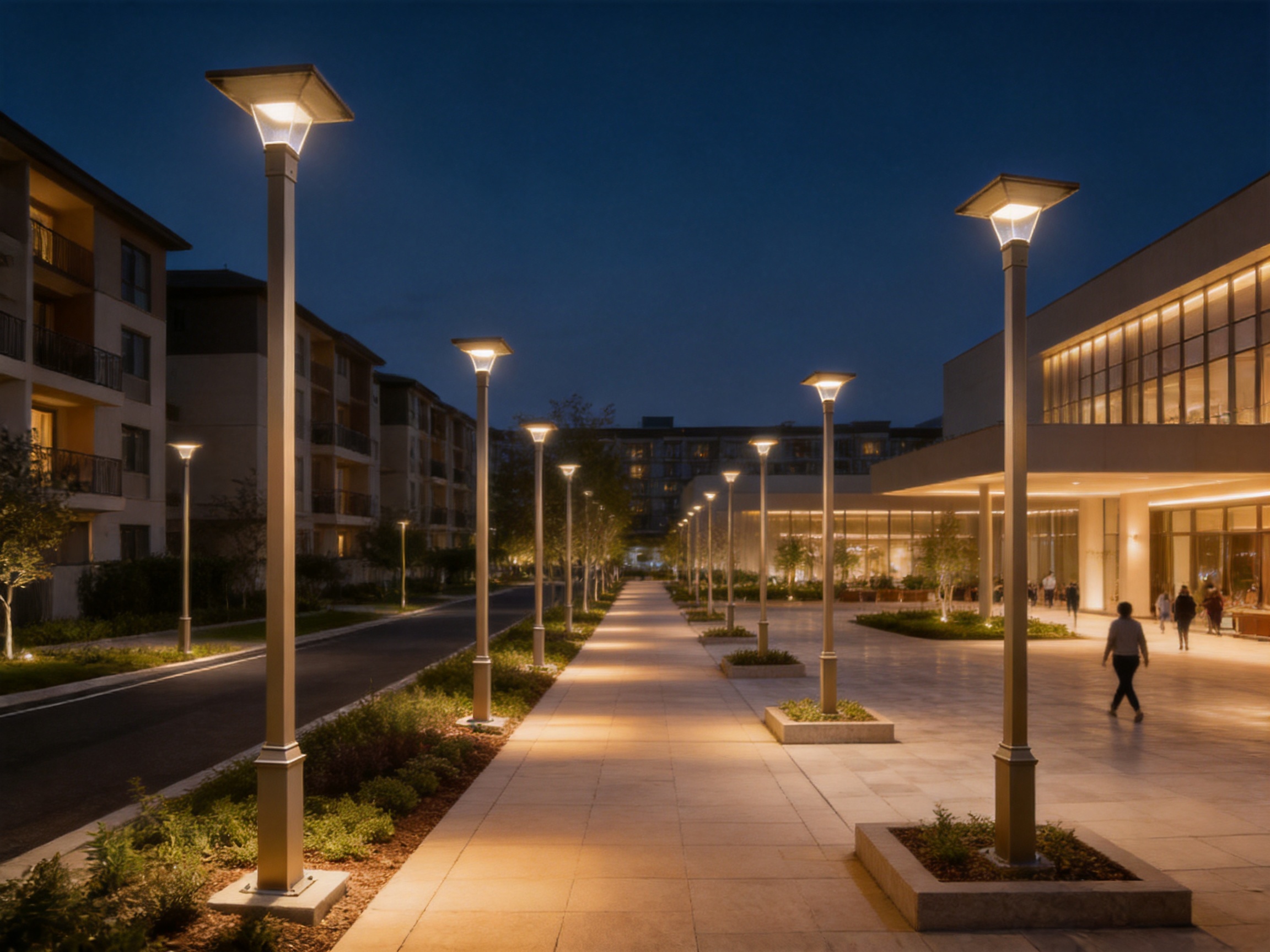
Modern outdoor lighting must do more than provide visibility after sunset. It must also complement architecture, support safe movement, withstand changing weather, preserve visual comfort, and deliver dependable performance over many years. The Modern Minimalist Square-Pole Garden Light is designed around these requirements. Combining a clean vertical form, structured light distribution, corrosion-resistant construction, efficient LED technology, and flexible control options, it offers a practical lighting solution for roads, pathways, gardens, residential developments, commercial landscapes, and public outdoor areas.
Unlike conventional garden luminaires that may rely on rounded poles or decorative forms, this product uses a minimalist square-pole structure. Its defined edges and orderly proportions create a contemporary visual identity that fits naturally into modern architectural environments. At the same time, the square tube improves the structural behavior of the pole by strengthening resistance to torsion and bending. This combination of appearance and engineering performance gives the luminaire an advantage over products designed only for visual appeal.
Manufactured by Yangzhou Jinyuan Lamps Co., Ltd., the product benefits from the company’s experience in road illumination equipment, lighting fixtures, pole manufacturing, and outdoor engineering. Established in 2002, the company operates a production site of more than 70,000 square meters, employs over 300 professional technicians, and serves customers in more than 200 countries. Its manufacturing capabilities include CNC bending, precision cutting, automated welding, electrostatic powder coating, and aluminum die casting. These processes provide a strong foundation for consistent quality, efficient production, and project-specific customization.
1. A Contemporary Lighting Form for Modern Landscapes
The visual design of a garden light has a direct influence on the atmosphere of an outdoor space. A fixture that is too ornate may conflict with minimalist buildings, while a fixture that is too plain may fail to create a sense of design. The Modern Minimalist Square-Pole Garden Light occupies a balanced position between these two approaches. Its vertical square structure is simple, recognizable, and architectural without becoming visually excessive.
The pole presents clean lines and defined edges. These characteristics help the luminaire coordinate with modern façades, geometric paving patterns, low walls, metal railings, structured planting beds, and contemporary street furniture. The square profile also produces a stronger sense of vertical extension than many cylindrical alternatives. As a result, the light can contribute to the visual rhythm of a pathway or landscape while remaining subordinate to the surrounding architecture.
This design is particularly suitable for projects where outdoor lighting is expected to form part of the overall site concept. In a residential community, the fixture can support a consistent visual language across entrances, walkways, and shared gardens. In a hotel or resort, it can reinforce a refined and orderly landscape aesthetic. In a commercial or civic setting, it can provide a professional appearance that complements modern buildings and carefully planned public spaces.
The square-pole form is also easy to repeat throughout a project. Repetition is an important principle in landscape design because a consistent series of fixtures can guide movement and create spatial unity. When installed along a road, path, or garden edge, the uniform vertical elements can establish a clear visual boundary and improve nighttime orientation.
Integration with architecture and vegetation
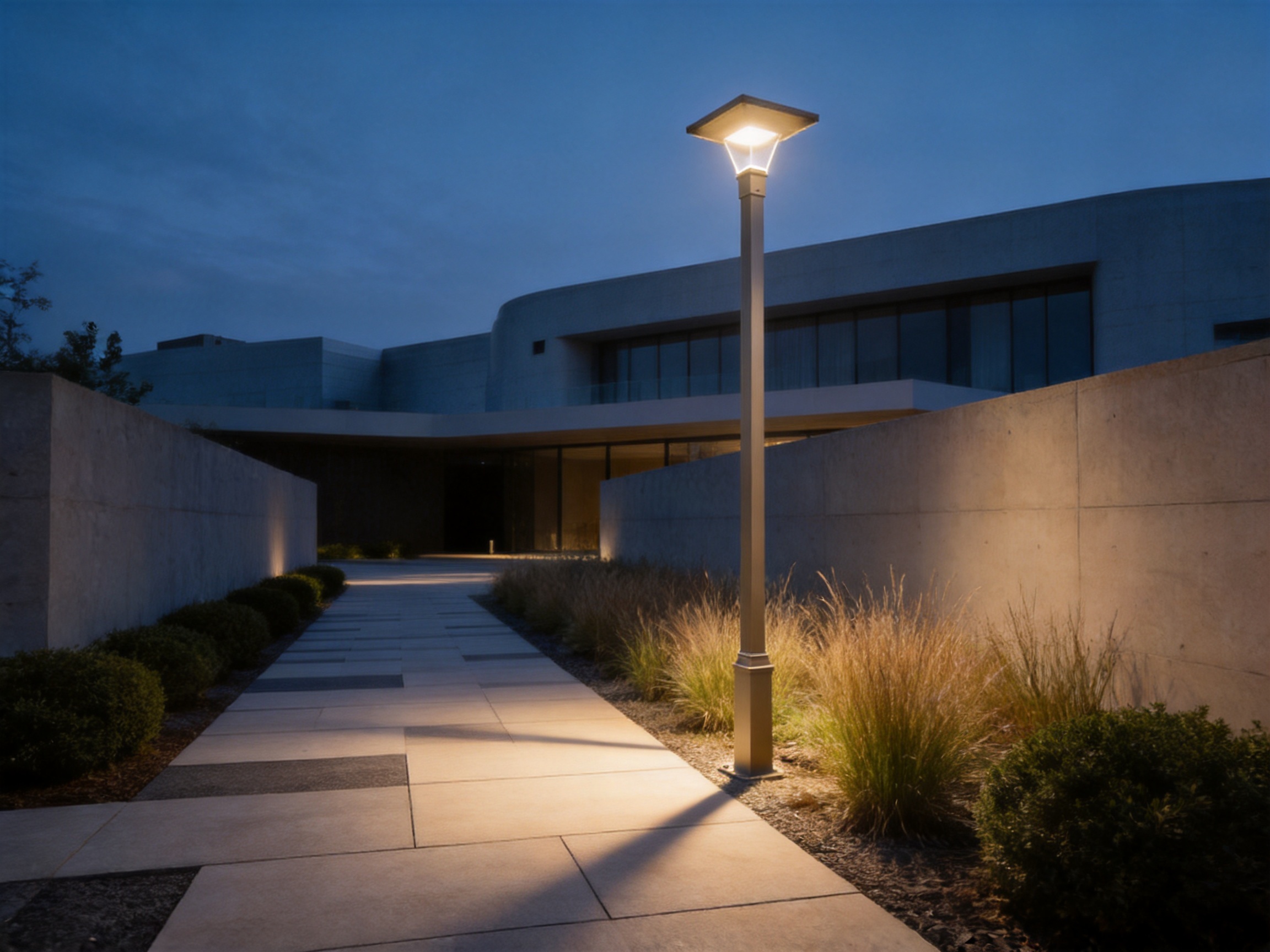
Modern landscapes frequently combine hardscape and softscape elements in a highly organized arrangement. Paved walkways, concrete plazas, linear planters, ornamental grasses, clipped shrubs, and architectural trees often rely on clear geometry. The square profile of this garden light works well in these environments because its edges echo the straight lines already present in the site.
The fixture can also be used to create contrast. For example, a dark powder-coated square pole can stand out against light paving, while a lighter finish can integrate with stone, concrete, or pale building façades. The product’s specification and color customization capabilities allow project teams to select a finish that supports the desired design direction.
Because the luminaire is visually restrained, it does not need to dominate the landscape during the daytime. This is an important advantage over heavily decorative fixtures. The light remains functional and attractive after dark, but it can also blend into the landscape when switched off.
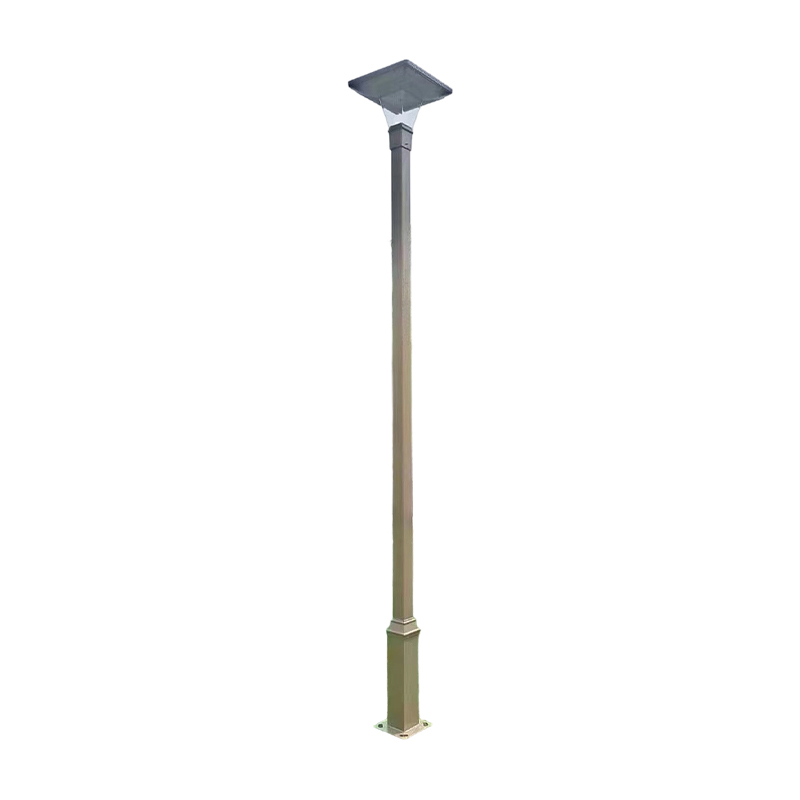
Modern Minimalist Square-Pole Garden Light
2. Square-Pole Engineering and Structural Stability
The square tube is not simply a styling choice. It also contributes to the mechanical performance of the luminaire. Outdoor lighting poles may be exposed to wind loads, vibration, accidental impact, thermal changes, and long-term environmental stress. A well-designed structure must retain its alignment and stability throughout its service life.
Compared with a basic thin-walled decorative post, the square-pole configuration provides defined faces and corners that help improve resistance to twisting. Its geometry also supports bending resistance, which is important when the upper luminaire and pole are subjected to wind. The result is a stronger visual and physical presence in complex outdoor conditions.
Structural performance depends on more than the cross-sectional shape. Material selection, wall thickness, welding quality, bending accuracy, anchoring, foundation design, and installation practice all influence the final result. Yangzhou Jinyuan Lamps Co., Ltd. supports these requirements through a complete manufacturing and engineering process that includes material options, precise forming, welding, mechanical calculations, and installation guidance.
Material options for project requirements
The company can work with a range of structural steel grades, including Q235B, Q345B, S275JR, S355JR, Q460, A36, A572, GR56, and GR50, subject to project requirements and product configuration. This material flexibility is useful for international projects because local engineering standards, wind conditions, pole heights, loading requirements, and procurement specifications may vary.
Maintaining an extensive material inventory can also shorten production lead times. When appropriate materials are available for production, manufacturers can reduce delays caused by repeated procurement cycles. More importantly, selecting a suitable grade provides a reliable foundation for the pole’s strength, weldability, durability, and fabrication quality.
Precision bending and accurate fabrication
Inconsistent bending can create dimensional variation, alignment problems, and additional correction work during assembly. The company’s CNC bending process provides repeatable forming and improved control over the geometry of structural components. Accurate bending supports better fit-up, cleaner appearance, and more consistent installation across a large project.
The company also reports cutting accuracy of up to 0.01 millimeters in its precision cutting process. Such accuracy helps produce clean edges and exact dimensions, reducing unnecessary post-production adjustments. It also supports a more reliable fit between components, particularly when multiple parts must be assembled into a consistent product family.
For buyers managing large developments, process consistency is especially valuable. A single sample may look satisfactory, but a successful project requires every production batch to meet the same dimensional and finish expectations. Controlled CNC operations help reduce variation between units.
3. Organized Light Distribution from the Square Diffuser
The luminaire’s square diffuser continues the product’s structured design language. Rather than producing an uncontrolled glow in every direction, the diffuser is intended to provide a more orderly distribution of light around the pathway or outdoor area. This approach can improve the usefulness of the illumination while helping limit unnecessary light spill.
Structured light distribution is important for pedestrian environments. A pathway should be bright enough for users to recognize changes in surface level, edges, intersections, and nearby obstacles. At the same time, excessive light directed toward residences, neighboring properties, or the sky can create visual discomfort and reduce the overall quality of the nighttime environment.
The square diffuser helps maintain a coherent relationship between the source, the housing, and the illuminated area. Its geometry complements the square pole and gives the fixture a unified appearance. The result is a product that looks deliberate from every angle rather than appearing to combine unrelated decorative and technical parts.
Applications for pathway and garden illumination
This garden light can be used along pedestrian paths, internal estate roads, garden entrances, courtyards, landscaped plazas, hotel grounds, residential developments, parks, and other outdoor circulation areas. It can provide a visual guide through a site while helping define transitions between different functional zones.
In a garden, the light may be positioned beside planting beds or along the edge of a paved walkway. In a residential project, it can support safe movement between parking areas, building entrances, community facilities, and recreational spaces. In a hospitality setting, it can reinforce the arrival experience and help guests navigate the property without relying on excessively bright floodlighting.
Final lighting performance depends on mounting height, spacing, optical configuration, surface reflectance, surrounding obstructions, local regulations, and project-specific calculations. For this reason, the product should be integrated into a complete lighting design rather than installed according to appearance alone.
4. LED Efficiency and Flexible Electrical Performance
The product uses LED as its light source and provides a stated lamp luminous efficacy of 140 lumens per watt. This level of efficacy supports efficient energy use while maintaining useful illumination for outdoor applications. Compared with older conventional light sources, LED technology can reduce energy consumption, simplify maintenance, and provide more stable control over color temperature and dimming.
The available input voltage range is AC85-265V. This broad range makes the product suitable for electrical systems with different supply conditions and provides additional tolerance for voltage variation. Project designers should still confirm compatibility with the local power network, protective equipment, earthing requirements, and installation standards before ordering.
The color temperature range is 3000K to 6000K. Warmer 3000K light can create a welcoming atmosphere in residential landscapes, hospitality areas, courtyards, and garden paths. Neutral or cooler options can provide a cleaner and more functional appearance for roads, public spaces, commercial developments, and security-conscious environments.
The stated color rendering index is Ra 70. This level is appropriate for many general outdoor lighting applications where efficient visibility and reliable object recognition are more important than highly accurate color reproduction. For projects involving architectural displays, plant presentation, retail environments, or art installations, the design team should evaluate whether a higher color rendering specification is required.
Dimming and smart control compatibility
The light supports DC 0-10V and DALI dimming. These control options allow the fixture to be integrated into broader lighting management systems. Instead of operating continuously at full output, luminaires can be adjusted according to time of night, occupancy, traffic patterns, seasonal requirements, or energy-saving policies.
DC 0-10V is widely used for analog dimming and can be incorporated into many commercial lighting control systems. DALI provides digitally addressable control, enabling more detailed management of individual fixtures or lighting groups where the control infrastructure supports it.
In a residential development, dimming may allow lower output during quiet late-night hours while maintaining a basic level of pathway visibility. In a commercial or public project, scheduled scenes can support different operating periods. These capabilities can improve energy management and contribute to a more responsive outdoor lighting environment.
Although the product supports these control methods, the complete installation must include compatible drivers, wiring, controllers, sensors, and commissioning procedures. The lighting manufacturer, electrical contractor, and control-system provider should coordinate these elements during the design stage.
| Specification | Product Detail | Project Significance |
|---|---|---|
| Product type | LED garden light | Suitable for landscaped paths, roads, gardens, and outdoor circulation areas |
| Structural design | Minimalist square pole | Supports modern architectural integration and visual uniformity |
| Light source | LED | Efficient, controllable, and suitable for long-term outdoor operation |
| Input voltage | AC85-265V | Broad electrical compatibility, subject to local verification |
| Luminous efficacy | 140 lm/W | Supports energy-conscious outdoor lighting design |
| Color temperature | 3000K-6000K | Allows warm, neutral, or cool visual atmospheres |
| Color rendering index | Ra 70 | Appropriate for general outdoor visibility requirements |
| Ingress protection | IP65 | Protection against dust and water jets from typical outdoor directions |
| Operating temperature | -35°C to 65°C | Supports operation across a wide range of climates |
| Lamp material | Aluminum alloy | Combines low weight, heat dissipation, and corrosion resistance |
| Dimming | DC 0-10V / DALI | Enables integration with compatible lighting control systems |
| Warranty | 5 years | Provides a defined period of product support |
5. Aluminum Alloy Housing and Long-Term Weather Resistance
Outdoor lighting products must withstand moisture, dust, sunlight, temperature changes, wind-driven particles, and repeated seasonal exposure. The product uses corrosion-resistant aluminum alloy for the lamp body. Aluminum alloy is widely used in outdoor luminaires because it combines relatively low weight with good structural performance and effective heat dissipation.
Heat management is particularly important for LED products. Efficiently transferring heat away from the LED and driver can help protect component performance and support stable operation. The housing design, internal thermal path, installation orientation, and ambient conditions all influence actual thermal behavior, but aluminum provides a suitable foundation for outdoor luminaire construction.
The fixture is finished with electrostatic powder coating. This process applies a dry powder coating to the prepared metal surface, after which the coating is cured to form a durable protective layer. Powder coating can provide consistent coverage, a refined surface texture, and resistance to fading and corrosion when the preparation, coating formulation, curing, and inspection processes are properly controlled.
The stated IP65 rating indicates protection against dust ingress and water jets from typical directions. This rating is appropriate for many exposed outdoor environments, including gardens, roads, landscaped public spaces, and pedestrian areas. However, IP65 does not mean that the fixture should be submerged or installed in a location subject to permanent standing water. Correct drainage, sealing, cable entry, and installation orientation remain essential.
Performance across demanding temperatures
The operating temperature range is specified as -35°C to 65°C. This broad range supports use in both cold and hot outdoor climates. Actual performance will also depend on solar radiation, airflow, installation height, driver conditions, and the temperature of the surrounding enclosure. Project teams should consider local climate data and installation conditions when selecting the final configuration.
Weather resistance is not created by one component alone. The aluminum housing, powder-coated surface, gaskets, fasteners, cable glands, LED module, driver, and installation details must work together. A complete quality-control process therefore has greater value than a single material claim. The company’s manufacturing equipment and experience in outdoor illumination provide a basis for coordinating these elements.
6. Manufacturing Strengths Behind Consistent Quality
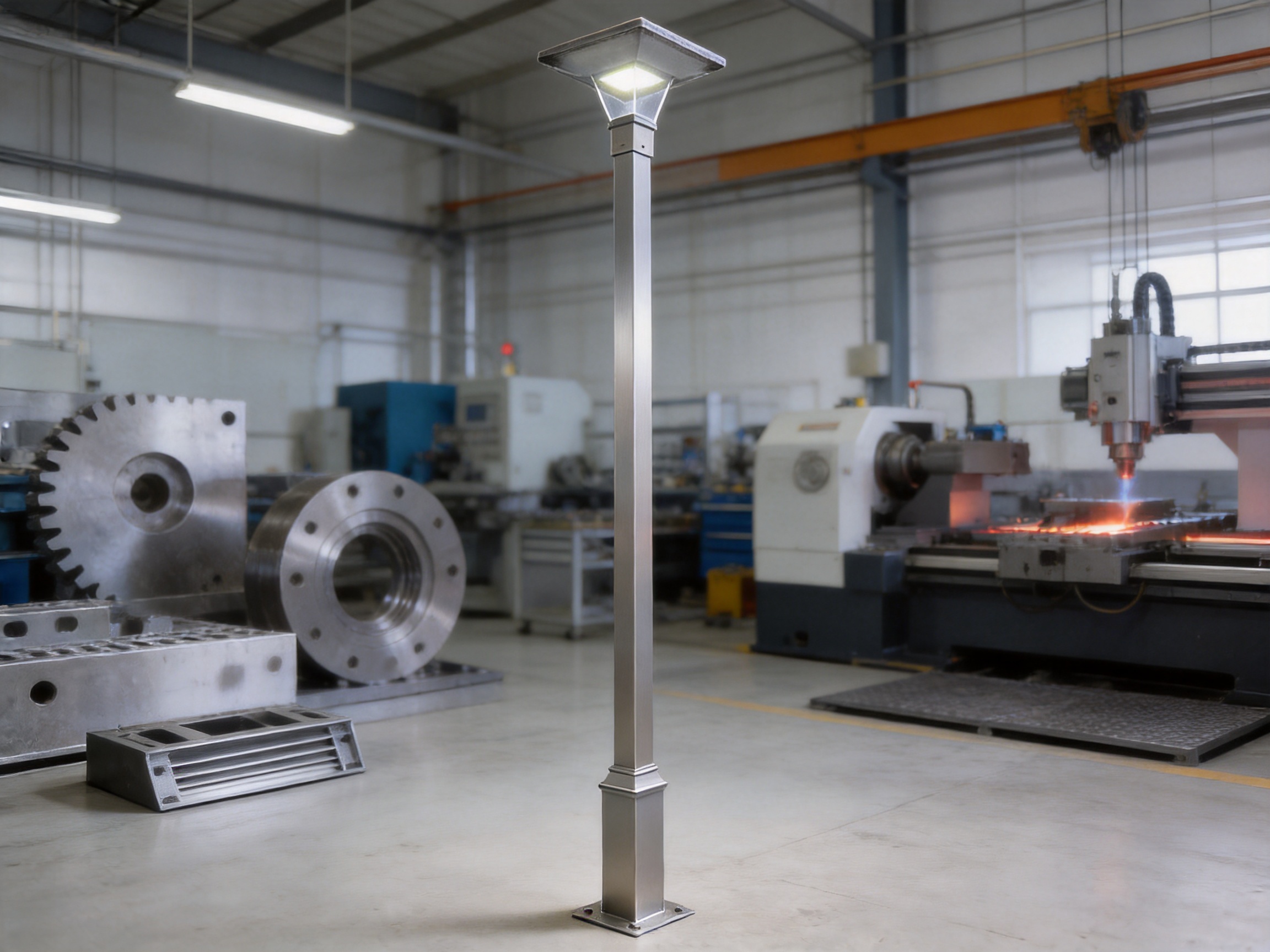
Product performance is closely connected to manufacturing discipline. A well-designed garden light can lose its advantages if materials are inconsistent, bends are inaccurate, welds are weak, coatings are uneven, or assembly is not controlled. Yangzhou Jinyuan Lamps Co., Ltd. combines product design, production, engineering, and project support within one organization.
The company is affiliated with Jinshang Electric Group and has specialized in road illumination products since 2002. Its product scope includes street light poles, LED street lights, solar street lights, light fixtures, and related lighting equipment. This broader experience is relevant to garden lighting because many of the same engineering principles apply: structural reliability, corrosion protection, electrical safety, optical performance, and large-scale project coordination.
Material preparation and production planning
Material availability is an important factor in delivery reliability. The company maintains extensive stocks of structural materials and offers several steel options. This can support faster production planning and reduce the risk of schedule interruptions caused by material shortages.
For international customers, material selection may need to comply with project specifications, engineering calculations, regional standards, or consultant requirements. The ability to discuss alternatives with the manufacturer gives buyers greater flexibility during design development and value engineering.
CNC bending
Computer-controlled bending allows structural elements to be formed with repeatable dimensions. This is especially valuable when a project requires large quantities of identical poles or when components must connect accurately with bases, arms, covers, or other assemblies.
Consistent bending can also improve the finished appearance. Uneven angles, irregular faces, or visible correction marks may reduce the perceived quality of a lighting installation. Controlled forming helps maintain a clean and professional result across the entire project.
Precision cutting
The company’s stated cutting accuracy of 0.01 millimeters supports exact dimensions and clean edges. Precise cutting helps reduce burrs, minimize fitting problems, and improve the repeatability of assemblies. It also reduces the amount of manual correction required after cutting, which can contribute to more efficient production cycles.
In a large outdoor lighting program, small dimensional differences can become significant when repeated across hundreds or thousands of units. Precision equipment helps control this cumulative variation and supports more predictable installation.
Automated welding and certified personnel
Welding quality has a direct effect on structural safety and durability. The company uses automated welding and cutting equipment while also employing certified welders with extensive experience. Automation can improve repeatability for suitable production tasks, while trained personnel remain important for setup, inspection, specialized joints, and quality verification.
Reliable welds help ensure that poles and structural assemblies maintain their intended strength. They also support a cleaner surface before coating, which is important because rough welds, spatter, sharp edges, or incomplete preparation can affect both appearance and corrosion resistance.
Electrostatic powder coating
Powder coating equipment provides a controlled method for applying protective finishes to metal parts. A suitable coating system can improve resistance to weathering, ultraviolet exposure, and surface corrosion. The process also allows project-specific color selection, supporting visual coordination between the light poles, architecture, paving, signs, and other street furniture.
Coating quality depends on surface preparation, powder selection, film thickness, curing temperature, and inspection. The manufacturer’s use of dedicated electrostatic painting equipment supports a more organized approach than informal or inconsistent finishing practices.
Aluminum die casting
The company operates a 1250-ton die-casting machine. Die casting can produce complex aluminum components with consistent dimensions and repeatable surface forms. For lighting products, this capability may support the production of housings, brackets, covers, and other parts requiring dimensional stability.
Consistent cast components can improve assembly efficiency and help maintain the product’s visual quality. They can also support better integration of thermal, optical, and mechanical functions within the luminaire design.
Automated production and environmental efficiency
Automated production lines can increase productivity while reducing unnecessary material waste and process variation. A more efficient manufacturing process may support competitive pricing without requiring compromises in structural or finish quality.
Automation can also contribute to a more sustainable production model when it reduces rework, improves material utilization, and controls energy consumption. Environmental responsibility is further supported by the company’s stated ISO14001 certification, while ISO9001 and OHSAS18001 reflect its focus on quality management and occupational health and safety systems.
7. Advantages Compared with Conventional Garden Lights
The Modern Minimalist Square-Pole Garden Light offers several advantages over basic conventional garden lights. These advantages are not limited to appearance; they result from the integration of structural design, optical control, materials, manufacturing, and service.
Advantage one: architectural compatibility
Many conventional garden lights use decorative shapes that are difficult to coordinate with modern architecture. The square-pole design is more adaptable to contemporary buildings and organized landscapes. Its simple geometry can be repeated consistently across a site without creating visual clutter.
Advantage two: improved structural identity
A square tube provides a defined structural profile and contributes to torsional and bending resistance. While final performance depends on engineering details and installation, the geometry provides a stronger design basis than a purely ornamental post. This is useful for exposed locations and projects that require a stable, substantial appearance.
Advantage three: controlled illumination
The square diffuser is designed for a structured distribution that illuminates nearby paths while reducing uncontrolled spill. This is preferable to a fixture that produces excessive glare or sends light into unwanted areas. Proper optical planning can improve pedestrian comfort and reduce the impact on adjacent properties.
Advantage four: flexible light atmosphere
The 3000K-6000K color temperature range gives project designers control over the visual atmosphere. Warm light can support comfort and hospitality, while neutral or cool light can provide a more functional and contemporary appearance. This flexibility makes the product useful for multiple project types.
Advantage five: energy-conscious operation
With a stated efficacy of 140 lumens per watt and support for dimming, the product can contribute to a lower-energy lighting strategy. The greatest savings will depend on operating schedules, spacing, mounting height, control settings, and local electricity costs, but the technical platform is suitable for efficient design.
Advantage six: broad environmental suitability
The IP65 rating and -35°C to 65°C operating range support use in a wide variety of outdoor conditions. The aluminum alloy housing and powder-coated finish provide additional protection against weather exposure. These characteristics make the luminaire a practical candidate for projects that require reliable year-round operation.
Advantage seven: project customization
Different projects may require changes in color, dimensions, mounting details, optical output, control method, or structural configuration. The company provides specification and color customization, CAD design, three-dimensional product simulation, three-dimensional scene simulation, mechanical calculations, and overseas installation guidance. This level of support is more valuable than selecting a standard product without considering the complete project context.
8. Design Support from Concept to Installation
Outdoor lighting procurement is rarely limited to selecting a product from a catalog. Projects often involve site-specific constraints, local wind conditions, foundation requirements, cable routing, visual coordination, and lighting calculations. The company’s service model is designed to support customers from consultation through project completion.
CAD design
CAD design can help confirm dimensions, interfaces, mounting details, and product proportions before manufacturing begins. This is useful when the light must coordinate with existing foundations, paving modules, landscape edges, or architectural elements.
Three-dimensional product simulation
A three-dimensional product model allows buyers and consultants to review the luminaire from multiple angles. It can help identify potential conflicts between the pole, luminaire head, access doors, brackets, and surrounding structures. It also supports more accurate technical presentations and approval documents.
Three-dimensional scene simulation
Scene simulation places the product into a representative landscape or architectural environment. This helps stakeholders understand how the fixture will appear during the day and night, how it will relate to paths and vegetation, and whether the selected finish supports the overall design concept.
Mechanical calculations for wind and foundations
Wind loading is a critical consideration for outdoor poles. The required foundation depends on pole height, soil conditions, wind speed, luminaire size, base dimensions, anchor bolts, and local engineering rules. The company provides mechanical calculation support for wind and foundation requirements, helping project teams move from visual selection to responsible engineering design.
Specification and color customization
A project may require a particular powder-coating color, surface texture, or specification package. Customization allows the lighting system to coordinate with other outdoor elements and can help large developments maintain a consistent identity.
Overseas installation guidance
International projects can involve different construction practices, site conditions, and local standards. Overseas installation guidance can help contractors understand assembly sequences, foundation interfaces, electrical connections, and commissioning requirements. Proper installation is essential to preserving the product’s structural, electrical, and weather-resistance performance.
9. Recommended Applications
The product’s appearance and technical features make it suitable for a broad range of outdoor settings. Each application should be supported by a project-specific lighting plan, but the following environments are particularly compatible with the square-pole concept.
Residential communities
Residential developments need lighting that improves wayfinding and safety without creating excessive brightness near homes. The minimalist appearance can support a premium and orderly community image, while dimming can help balance nighttime visibility with residential comfort.
Hotels and resorts
Hotels and resorts often invest heavily in landscape design. The square-pole garden light can reinforce the property’s architectural character along entrances, garden paths, parking connections, and outdoor recreation areas. Warm color temperatures may be appropriate for guest areas, subject to the lighting designer’s recommendations.
Commercial complexes
Shopping centers, office parks, mixed-use developments, and commercial campuses require durable lighting that remains visually consistent across public areas. The product can be used along pedestrian routes and internal roads, with control systems used to adjust lighting according to operating hours and traffic patterns.
Public parks and civic spaces
In parks and civic landscapes, lighting must support safe movement while respecting surrounding residences, vegetation, and public-space character. The structured diffuser and controlled placement can help create a clear but comfortable nighttime environment.
Private gardens and institutional campuses
Schools, hospitals, corporate campuses, cultural facilities, and private estates can use the product to establish a consistent lighting language across paths and open spaces. The square profile is appropriate for sites where functional design and low-maintenance construction are important.
10. Installation and Maintenance Considerations
Correct installation is essential for achieving the intended performance of any outdoor luminaire. Before installation, the project team should verify the foundation design, anchor-bolt arrangement, pole orientation, cable routing, driver location, earthing method, and compatibility of the supply voltage and control system.
The square pole should be aligned consistently along the path or road. A small change in orientation between units can become noticeable when the fixtures are installed in a long, repeated line. The installer should therefore check the orientation of each pole before final tightening of the anchor bolts.
Cable entries and access doors should be properly sealed after electrical work is completed. The IP65 rating depends on the integrity of the complete enclosure, including gaskets, covers, glands, and fasteners. Any missing screw, damaged seal, or poorly fitted cable gland may reduce weather protection.
The foundation must be suitable for the soil and wind conditions of the site. A lighting pole should not be installed on an assumed foundation size without confirming the engineering requirements. Soil bearing capacity, frost conditions, drainage, nearby excavation, and local construction codes may all affect the foundation design.
Routine maintenance should include visual inspection of the coating, fasteners, access doors, cable glands, and luminaire housing. Dirt, leaves, or other deposits should be removed when necessary, particularly in environments where pollution or biological growth may accumulate. The optical surface should be cleaned with appropriate non-abrasive materials to maintain light output.
Any maintenance work must follow local electrical safety procedures. Power should be isolated before opening the luminaire or control enclosure. Where DALI or 0-10V systems are installed, the control network should also be checked during commissioning and after major maintenance work.
11. Quality, Certification, and Supplier Reliability
For buyers of outdoor lighting, supplier reliability is as important as the product specification. A successful project depends on accurate communication, repeatable production, suitable packaging, documentation, inspection, delivery coordination, and after-sales support.
Yangzhou Jinyuan Lamps Co., Ltd. states that its products meet international quality standards including ISO9001, ISO14001, and OHSAS18001. ISO9001 is associated with quality management systems, ISO14001 with environmental management, and OHSAS18001 with occupational health and safety management. These systems can provide a framework for more organized manufacturing and responsible operations.
The company’s scale is another relevant factor. A site area exceeding 70,000 square meters and a workforce of more than 300 professional technicians provide production capacity for both standard products and larger infrastructure programs. Its export experience in more than 200 countries also indicates familiarity with international customer communication and project requirements.
Nevertheless, buyers should request project-specific documentation before placing an order. This may include product drawings, photometric data, electrical details, material certificates, coating information, inspection procedures, packing details, installation instructions, and warranty terms. A clear technical file helps ensure that all stakeholders understand what will be supplied.
12. How to Specify the Product for a Project
A practical specification should begin with the purpose of the lighting. Designers should identify whether the fixture is intended for pedestrian circulation, a low-speed internal road, a garden feature, a courtyard, a public plaza, or a combination of functions. The required light level and distribution will vary according to the application.
The next step is to define mounting height, spacing, pole orientation, luminaire output, color temperature, and control strategy. These choices should be evaluated together. For example, increasing spacing may require a higher output or a different optical arrangement, while a warmer color temperature may affect the perceived brightness and atmosphere.
Environmental conditions should also be documented. The project team should identify the minimum and maximum ambient temperatures, wind speed, coastal exposure, pollution level, salt spray risk, potential flooding, and local maintenance conditions. Although the product provides IP65 protection and a broad operating temperature range, unusually aggressive environments may require additional coating or material considerations.
Electrical requirements should include supply voltage, frequency, driver arrangement, surge protection, dimming protocol, control zoning, emergency procedures, and earthing. Compatibility should be confirmed before production, especially when the luminaire will be connected to an existing smart lighting management system.
Finally, the project should define the required finish. Color and texture can have a major effect on the perceived quality of an outdoor installation. A consistent coating specification should be applied to all relevant components, and approval samples may be considered for large projects.
13. Sustainability and Lifecycle Value
Sustainable lighting design considers more than the initial purchase price. It includes energy consumption, replacement frequency, maintenance requirements, material durability, manufacturing efficiency, and end-of-life considerations. The Modern Minimalist Square-Pole Garden Light supports lifecycle value through LED efficiency, dimming compatibility, corrosion-resistant construction, and a stated five-year warranty.
LED technology can reduce energy use when it replaces less efficient light sources or when it enables lower operating levels through controls. Dimming can further reduce consumption during periods of low activity. However, savings should be calculated using the actual operating schedule rather than relying only on nominal efficacy.
Durable materials can reduce the frequency of repainting, replacement, and corrective maintenance. The aluminum alloy housing, powder-coated finish, and IP65 protection are intended to support long-term outdoor use. Good installation and regular inspection remain necessary because even a durable product can be damaged by impact, improper wiring, flooding, or neglected maintenance.
Manufacturing efficiency can also contribute to sustainability. CNC equipment, automated lines, precise cutting, and controlled coating processes may reduce rework and material waste. The company’s environmental management certification provides an organizational framework for addressing production-related environmental responsibilities.
14. Q&A
Q1: What is the primary design feature of this garden light?
The primary design feature is its minimalist vertical square pole combined with a square diffuser. The structure provides clean lines and defined edges that suit contemporary architecture, organized landscaping, paved pathways, and modern public spaces.
Q2: Is the square shape only intended for appearance?
No. In addition to creating a modern visual identity, the square tube contributes to resistance against torsion and bending. Final structural performance still depends on dimensions, material, wind conditions, foundation design, and installation quality.
Q3: Where can this product be used?
It can be used along garden paths, residential roads, hotel grounds, commercial landscapes, public parks, courtyards, institutional campuses, plazas, and other outdoor circulation areas. A project-specific lighting design should determine the most suitable height, spacing, and output.
Q4: What is the product’s ingress protection rating?
The product has an IP65 rating. This indicates protection against dust ingress and water jets from typical outdoor directions. It is not designed for permanent submersion or installation in locations with unmanaged standing water.
Q5: What temperatures can the light operate in?
The stated operating temperature range is -35°C to 65°C. Actual performance also depends on installation conditions, solar radiation, ventilation, driver temperature, and local climate.
Q6: What color temperatures are available?
The specified range is 3000K to 6000K. This allows designers to select warmer light for welcoming environments or neutral and cooler light for more functional and contemporary settings.
Q7: Does the light support dimming?
Yes. It supports DC 0-10V and DALI dimming, provided that compatible drivers, controllers, wiring, and commissioning procedures are included in the complete system.
Q8: What is the stated luminous efficacy?
The stated lamp luminous efficacy is 140 lumens per watt. Actual system performance should be confirmed using the final luminaire configuration, driver, optical package, and operating conditions.
Q9: What material is used for the lamp body?
The lamp body is made from aluminum alloy. This material supports a relatively lightweight construction, heat dissipation, and corrosion resistance when combined with suitable surface treatment and proper maintenance.
Q10: How is the surface protected?
The fixture uses electrostatic powder coating. The coating provides a protective and decorative finish designed to resist fading and corrosion caused by outdoor exposure. Surface preparation, curing, film thickness, and environmental conditions influence final durability.
Q11: Can the color or specification be customized?
Yes. The manufacturer provides specification and color customization. Customers should confirm the available options, minimum quantities, color standards, sample approval process, and production lead time for their specific project.
Q12: Does the manufacturer provide engineering support?
Yes. Available support includes CAD design, three-dimensional product simulation, three-dimensional scene simulation, mechanical calculations for wind and foundations, and overseas onsite installation guidance.
Q13: What manufacturing processes support the product?
The company uses material preparation, CNC bending, precision cutting, automated welding and cutting, electrostatic powder coating, automated production lines, and aluminum die casting. Certified welders and experienced technical personnel also contribute to quality control.
Q14: What warranty period is specified?
The stated warranty period is five years. Buyers should confirm the exact warranty scope, exclusions, environmental conditions, claim procedure, and responsibilities for installation and maintenance in the final commercial agreement.
Q15: What should be confirmed before ordering?
Before ordering, buyers should confirm the required dimensions, mounting height, output, color temperature, control method, finish, supply voltage, foundation design, wind conditions, photometric data, certification documents, packaging, delivery schedule, installation requirements, and warranty terms.
15. Conclusion
The Modern Minimalist Square-Pole Garden Light combines contemporary appearance with practical outdoor engineering. Its square structure creates a strong architectural identity while supporting resistance to torsion and bending. The square diffuser provides an orderly lighting concept, and the aluminum alloy housing, electrostatic powder coating, IP65 protection, and wide operating temperature range support dependable outdoor use.
Its LED platform provides a stated efficacy of 140 lumens per watt, a 3000K-6000K color temperature range, broad AC85-265V input compatibility, and support for DC 0-10V and DALI dimming. These features allow the product to serve both straightforward pathway applications and more advanced lighting schemes involving scheduling and control systems.
The product is strengthened by the manufacturing capabilities of Yangzhou Jinyuan Lamps Co., Ltd. The company’s experience since 2002, large production site, international export reach, technical workforce, extensive material options, CNC fabrication, automated welding, electrostatic coating, aluminum die casting, and project design services provide a comprehensive supply foundation.
For developers, landscape architects, lighting designers, contractors, and distributors, the key value of this product lies in its balanced approach. It is visually restrained but distinctive, structurally purposeful, energy-conscious, customizable, and supported by a manufacturer capable of handling both individual requirements and large-scale outdoor lighting programs.
References
1. Product technical information supplied for the Modern Minimalist Square-Pole Garden Light.
2. Manufacturer information supplied by Yangzhou Jinyuan Lamps Co., Ltd.
3. General principles of outdoor LED luminaire design, photometric planning, and landscape lighting practice.
4. General guidance on ingress protection classifications for electrical enclosures.
5. General principles of powder coating, aluminum alloy heat dissipation, and corrosion protection for outdoor lighting equipment.
6. General quality-management, environmental-management, and occupational-safety frameworks referenced in the manufacturer’s certification information.