


JINYUAN
JINYUAN
JINYUAN
JINYUAN
JINYUAN
JINYUAN
JINYUAN
JINYUAN
JINYUAN
JINYUAN
JINYUAN
JINYUAN
JINYUAN
JINYUAN
JINYUAN
JINYUAN
Content
- 1 Introduction
- 2 Product Concept and Application Positioning
- 3 Decorative Design for Premium Landscapes
- 4 Integrated Solar Lighting Architecture
- 5 LED Performance and Visual Comfort
- 6 Engineering Materials and Structural Reliability
- 7 Manufacturing Process and Quality Assurance
- 8 Advantages Compared with Conventional Alternatives
- 9 Customization and Project Support
- 10 Recommended Project Selection Process
- 11 Technical Reference Table
- 12 Maintenance and Long-Term Operation
- 13 Company Manufacturing Strength
- 14 Q&A
- 14.1 What type of project is best suited to this solar street light?
- 14.2 Can it be used on a public road?
- 14.3 Does the system require underground wiring?
- 14.4 How does the light turn on automatically?
- 14.5 How long can the light operate each night?
- 14.6 What color temperatures are available?
- 14.7 What materials are used for the lamp and pole?
- 14.8 Can the appearance be customized?
- 14.9 What factory tests are performed?
- 14.10 Is installation support available for overseas projects?
- 14.11 What maintenance does an integrated solar light require?
- 14.12 What is the warranty period?
- 15 Conclusion
- 16 References
- 17 Product: Decorative Landscape Integrated Solar Street Light
Introduction
Landscape lighting has evolved from a purely functional requirement into an important part of architectural, environmental, and public-space design. In parks, tourist resorts, residential communities, commercial developments, and cultural destinations, lighting must provide safe visibility while also supporting the identity and atmosphere of the surrounding environment. A successful lighting installation should look attractive during the day, create comfortable illumination at night, reduce operating costs, and remain reliable through changing weather conditions.
The Decorative Landscape Integrated Solar Street Light series has been developed for precisely this combination of requirements. It integrates a solar photovoltaic module, LED light source, controller, and energy storage system into a coordinated outdoor lighting solution. By combining energy generation and illumination in one independent unit, the system can operate without underground power cables, extensive trenching, or complicated electrical infrastructure.
Unlike conventional solar street lights that often prioritize utility over appearance, this series places equal emphasis on decorative form and engineering performance. The product is suitable for scenic paths, resort entrances, garden roads, high-end residential neighborhoods, cultural parks, pedestrian areas, and other environments where the lighting fixture itself becomes part of the landscape. Its decorative structure can complement traditional architecture, while its modern curved designs can support contemporary public-space planning.
The series is manufactured by Yangzhou Jinyuan Lamps Co., Ltd., a Chinese road-lighting enterprise with experience in street lighting, solar lighting, LED luminaires, lighting poles, and related engineering services. Established in 2002 and affiliated with Jinshang Electric Group, the company operates a production site of more than 70,000 square meters, employs over 300 professional technicians, and serves customers in more than 200 countries.
This article examines the product’s design philosophy, technical characteristics, solar operating principle, manufacturing process, quality-control system, customization services, and practical advantages over less integrated or less specialized alternatives.
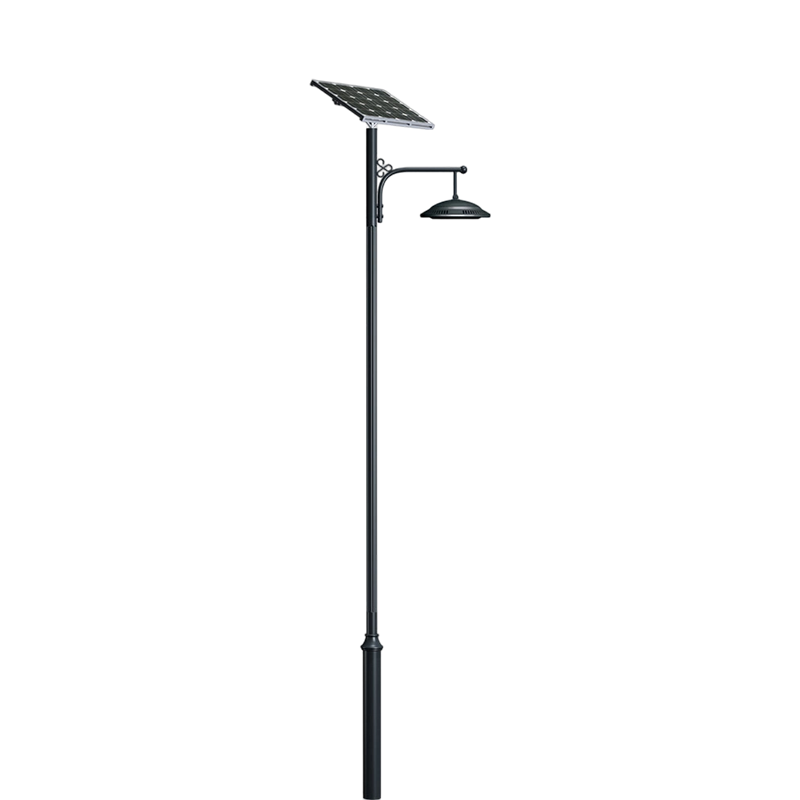
Decorative Landscape Integrated Solar Street Light
Product Concept and Application Positioning
The Decorative Landscape Integrated Solar Street Light is intended for locations where illumination must harmonize with the built and natural environment. Standard roadway luminaires are usually designed around maximum functional efficiency, and their appearance may be secondary. Landscape lighting requires a broader approach. The pole, arm, solar panel, lamp housing, light distribution, and surface finish must work together visually.
This series is therefore positioned between decorative garden lighting and full-scale solar roadway lighting. It can provide the independent power advantages associated with solar street lights while offering a taller pole structure and stronger illumination performance suitable for paths, internal roads, public spaces, and selected low- to medium-traffic areas.
Typical applications include park walkways, resort circulation roads, residential community lanes, pedestrian streets, waterfront promenades, heritage districts, entrances to hotels, landscaped commercial areas, and tourist attractions. The product can also be used along access roads where a decorative appearance is preferred over a conventional industrial-style fixture.
The product information specifies pole heights from 6 to 10 meters. This range supports different site conditions and illumination requirements. A lower pole may be appropriate for pedestrian paths and landscaped garden roads, while a taller configuration can provide broader coverage along internal roads or larger public areas. Final pole height, spacing, foundation design, photovoltaic capacity, battery capacity, and LED power should be selected through a project-specific lighting and structural assessment.
Because the system incorporates its own energy source and storage, it is especially valuable in locations where grid connection is expensive, difficult, or visually undesirable. It can reduce the need for cable trenches, distribution cabinets, junction boxes, and underground conduits. This feature is useful in completed landscapes, protected areas, historic sites, and remote developments where civil works may disturb existing paving or vegetation.
Decorative Design for Premium Landscapes
Classic-Inspired Hanging Arm Configuration
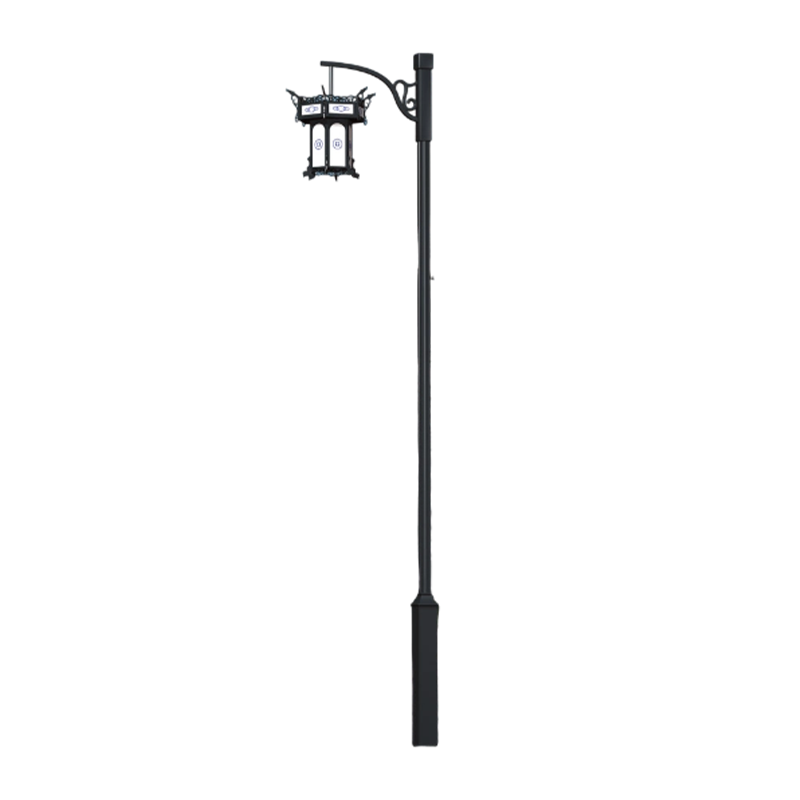
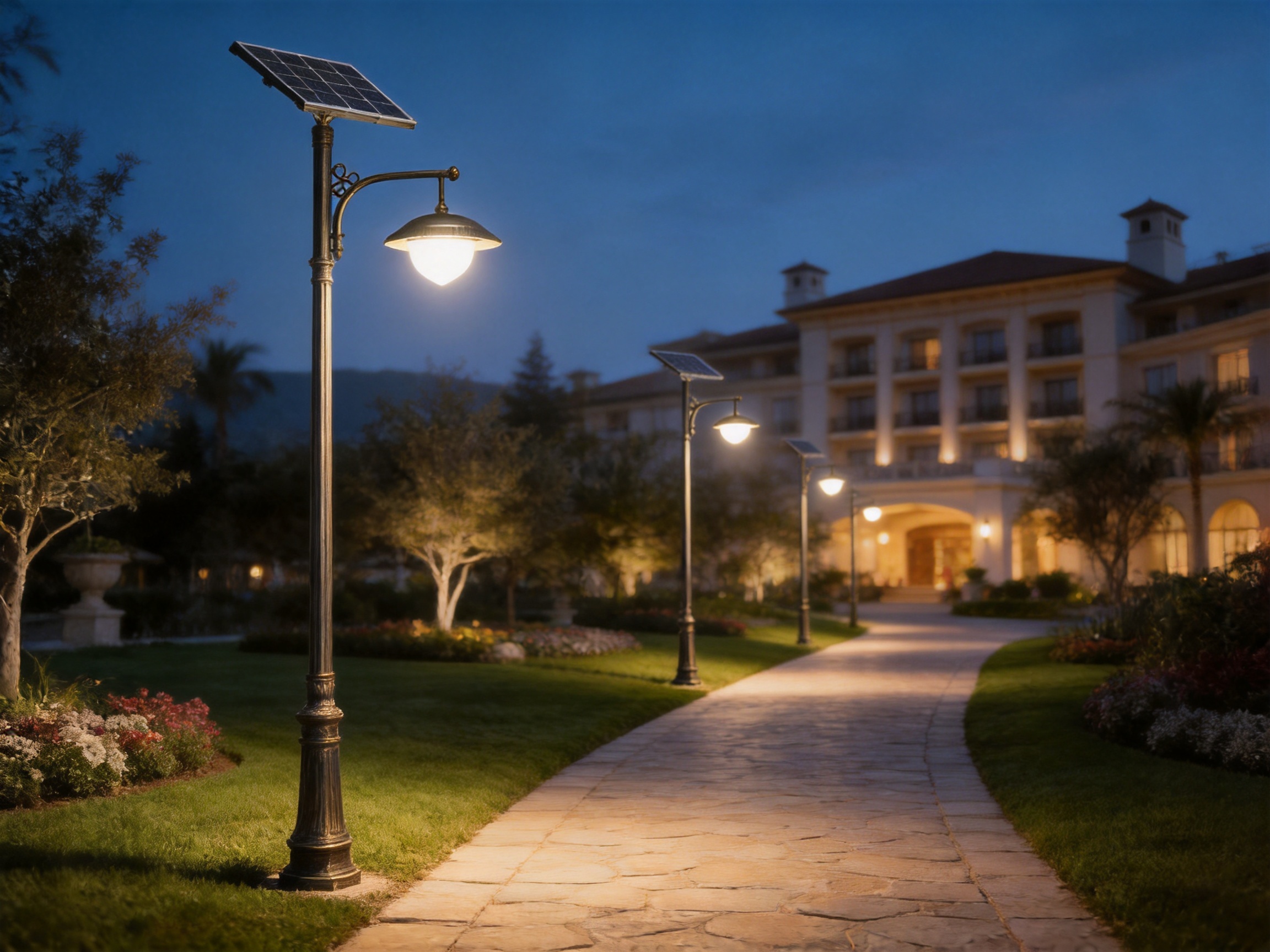
One design approach within the series uses a classic-inspired decorative hanging arm. This arrangement gives the fixture a refined, architectural character and can complement European-style buildings, traditional gardens, hotel entrances, and heritage-inspired developments.
The umbrella-shaped lamp shade helps create a soft downward lighting effect. In addition to shielding and directing the light source, the shade contributes to the visual identity of the product. During daylight hours, the fixture appears as a coordinated landscape element rather than a simple technical pole. At night, it helps establish a comfortable and welcoming atmosphere.
The hanging arm structure can also visually separate the luminaire from the solar panel and pole, allowing the lighting component to retain a more traditional decorative appearance. This is beneficial in projects where the solar technology should be present but not visually dominant.
Modern Curved Cantilever Configuration
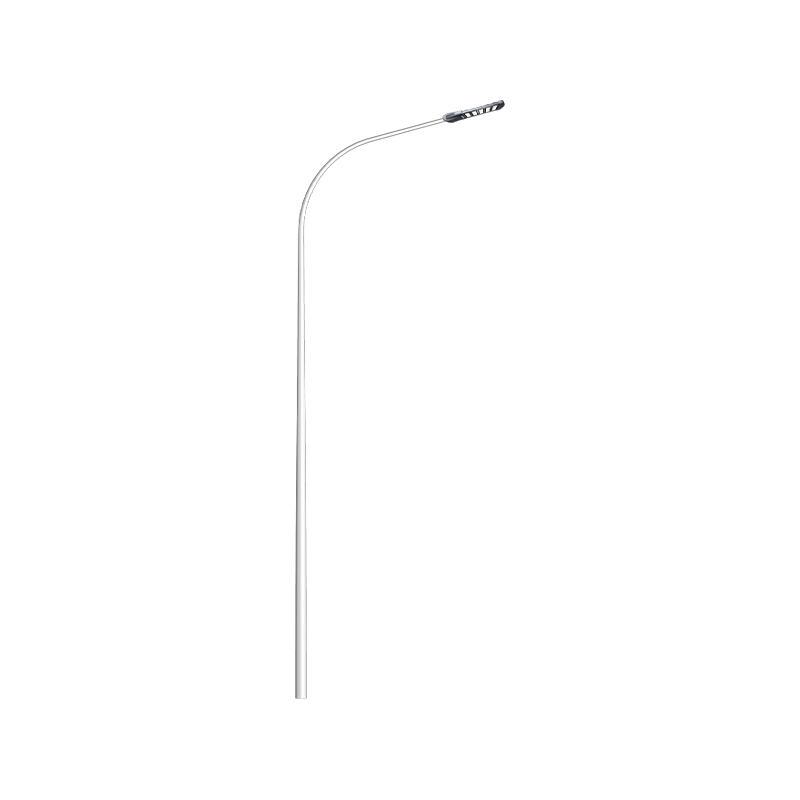
A second design approach uses a modern curved cantilever layout. Its fluid lines create a balanced relationship between the photovoltaic panel and the LED light unit. The curved structure can reduce the visual heaviness often associated with rectangular solar modules mounted on conventional brackets.
The cantilever arrangement is suitable for modern residential developments, contemporary parks, commercial landscapes, technology campuses, and newly planned urban spaces. Its streamlined form supports a clean visual rhythm when multiple units are installed along a road or pathway.
Although the two design approaches differ in appearance, both are based on the same principle: the supporting structure should provide mechanical stability without overwhelming the landscape. The solar panel, lamp head, arm, and pole are treated as one coordinated product rather than as unrelated components assembled after production.
Surface Finishes and Material Integration
The lamp body is made from aluminum alloy, a material that offers a useful combination of low weight, corrosion resistance, thermal performance, and structural practicality. Aluminum alloy is well suited to outdoor luminaires because it can help dissipate heat from LED components and reduce the load imposed on decorative arms and poles.
Surface finishes may include antique-style coatings or modern matte powder coatings. An antique finish can blend with traditional architecture, brick paving, stone walls, and ornamental landscaping. A matte modern finish can support minimalist developments and contemporary public spaces.
Powder coating also contributes to outdoor durability when the substrate preparation, coating thickness, curing process, and inspection standards are properly controlled. The finish helps protect the metal from moisture, ultraviolet exposure, and everyday environmental contamination while providing an opportunity for project-specific color coordination.
For large projects, consistency of color and texture is important. A lighting fixture may be repeated dozens or hundreds of times, and small variations can become visible across a long pathway. Controlled in-house production helps manufacturers maintain a more consistent appearance from batch to batch.
Integrated Solar Lighting Architecture
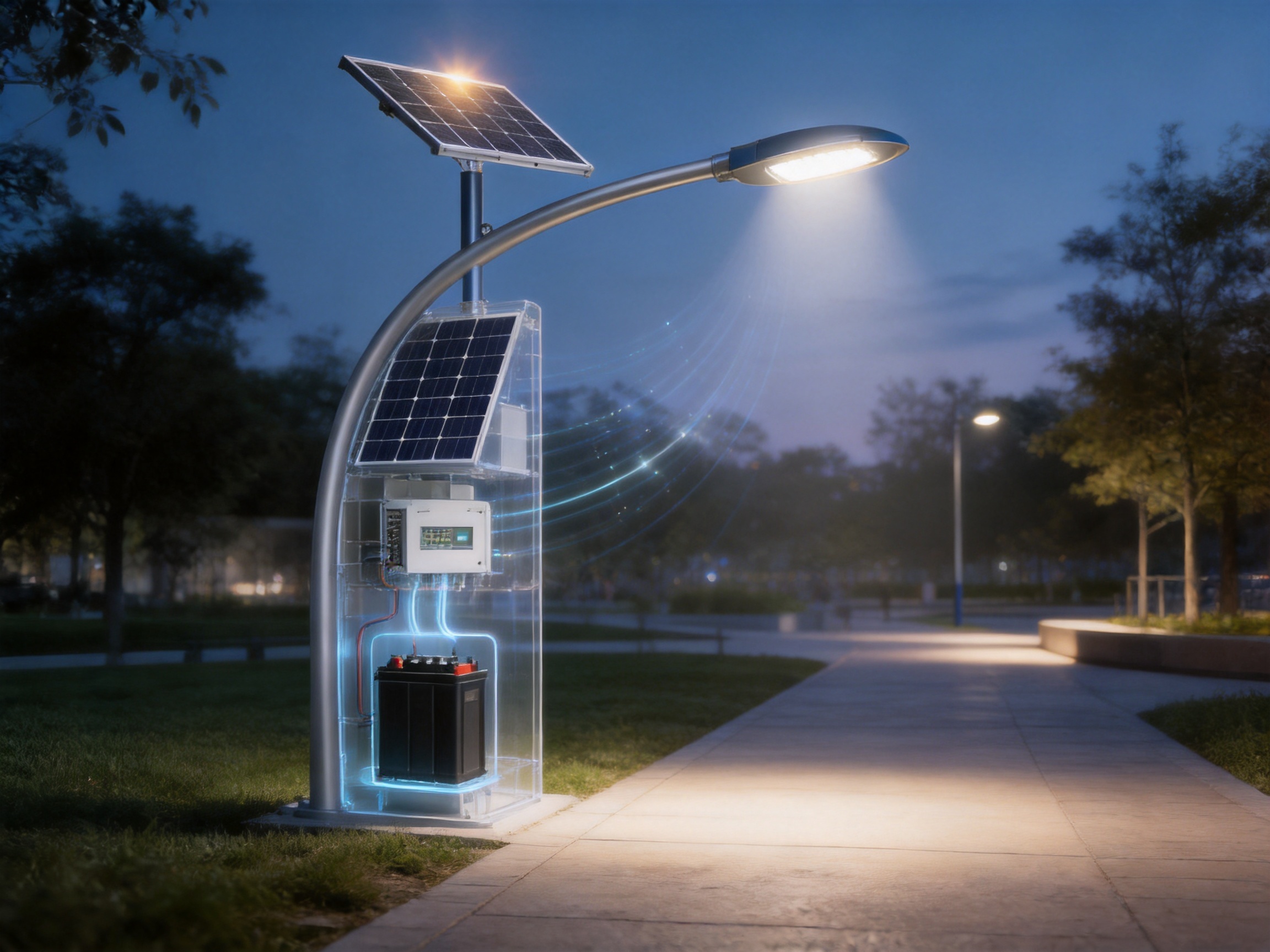
The central technical advantage of an integrated solar street light is the combination of major operating components into one coordinated assembly. The solar photovoltaic module generates electricity during the day, the internal storage system retains energy for nighttime operation, and the LED luminaire uses that stored energy after sunset.
The integrated arrangement reduces the number of exposed cables and separate housings. It can also simplify installation because the main functional components are prepared as a factory-matched system. This reduces the risk that an installer will combine incompatible panels, batteries, controllers, or luminaires.
During daylight, the high-efficiency monocrystalline silicon photovoltaic module converts solar radiation into electrical energy. The controller regulates charging and helps protect the energy-storage system from abnormal operating conditions. After sunset, the lighting control system activates the LED source according to ambient light levels and programmed operating parameters.
The product uses light control and time control. Light control allows the fixture to respond automatically to dusk and dawn conditions. Time control allows the operating schedule to be configured according to project requirements, local habits, seasonal conditions, or energy-management objectives.
The supplied production information describes a practical operating procedure: after installation, the transport mode should be disabled so that the light-sensing system can begin normal operation. Once activated, the fixture can turn on automatically at night and begin charging again when daylight returns.
This automatic operation is useful for locations with limited maintenance staff. It eliminates the need for daily manual switching and reduces dependence on an external control cabinet. In projects with many lighting points, the reduction in manual operation can provide meaningful administrative and maintenance benefits.
Monocrystalline Photovoltaic Technology
Monocrystalline silicon modules are used because they generally offer high conversion efficiency within a relatively compact surface area. For decorative lighting, this is important. A large photovoltaic panel may provide more energy, but it can also dominate the visual profile of a landscape fixture. A high-efficiency module can help meet energy requirements while maintaining a more proportionate design.
The product’s stated photovoltaic material is based on Grade-A silicon wafers. High-quality wafers can support stable energy conversion and long-term outdoor operation when combined with suitable cell processing, encapsulation, sealing, and quality inspection.
Weather resistance is particularly important for solar panels installed in open landscapes. The modules are exposed to rain, humidity, dust, heat, ultraviolet radiation, wind, and temperature cycling. Reliable encapsulation and sealing help reduce the risk of moisture penetration, performance degradation, and premature aging.
In addition to energy efficiency, the photovoltaic module must be structurally matched to the supporting frame. The frame must resist wind loads while maintaining the intended angle and orientation. A visually attractive panel that shifts under repeated wind pressure will not deliver dependable energy performance. For this reason, photovoltaic integration must be considered as both an electrical and mechanical design task.
Energy Storage and Nighttime Operation
Energy storage allows the light to operate after solar generation stops. The product information specifies continuous lighting times of approximately 5 to 12 hours, depending on configuration and operating conditions. Actual duration is influenced by LED power, battery capacity, solar irradiance, weather, panel orientation, temperature, control strategy, and the selected lighting schedule.
For professional projects, the energy-storage design should be evaluated against local solar conditions rather than relying only on nominal runtime. A site with frequent cloud cover, high latitude, seasonal shading, or dust accumulation may require a larger photovoltaic and storage configuration than a location with strong year-round solar resources.
Battery management is also important. The controller should coordinate charging and discharging to avoid unnecessary stress on the storage system. Temperature conditions must be considered because the specified operating range extends from approximately -35°C to 65°C. The system selection should take local extremes, enclosure conditions, installation orientation, and expected maintenance practices into account.
LED Performance and Visual Comfort
The light source is LED, with a stated luminous efficacy of up to 140 lumens per watt. High luminous efficacy allows the system to provide useful illumination with comparatively efficient energy consumption. This is especially important for solar lighting because every watt saved at the lamp contributes to lower photovoltaic and storage requirements or longer nighttime operation.
The luminaire is designed with downward light distribution. Proper downward distribution can improve pathway visibility, reduce wasted upward light, and help limit glare when the optical system is correctly selected. In landscape projects, the goal is not simply to create maximum brightness. The goal is to provide comfortable, uniform, and purposeful illumination.
The product supports color temperatures from 3000K to 6000K. Warm white settings around the lower end of this range can create a relaxed atmosphere for parks, resorts, gardens, and residential environments. Neutral or cooler settings may be selected where higher visual clarity or a more contemporary appearance is preferred.
The specified color rendering index is Ra 70. This level can provide practical color recognition for general outdoor circulation and security lighting. For applications involving art, landscaping, retail displays, heritage buildings, or hospitality environments where color appearance is especially important, project designers should confirm whether a higher-CRI configuration is available or required.
Micro-light sensing technology is integrated into the lamp head. This helps the fixture respond to surrounding brightness and supports automatic dusk-to-dawn operation. When combined with time control, the system can be configured to balance visibility, energy consumption, and the desired nighttime atmosphere.
Comfortable lighting also depends on installation spacing, mounting height, optical distribution, pole orientation, and surrounding reflectance. A well-designed lighting plan should therefore accompany product selection. The luminaire is one part of the total lighting system, and its performance is maximized when the spacing and layout are engineered for the site.
Engineering Materials and Structural Reliability
Outdoor lighting structures must remain stable through wind, rain, temperature variation, corrosion exposure, and repeated maintenance activity. The series uses aluminum alloy for the lamp body and offers poles manufactured from materials such as Q235, Q355, SS400, GR65, and other project-specified grades.
These structural steel options allow the pole design to be adapted to different strength, availability, fabrication, and project-standard requirements. The selected grade should be confirmed through mechanical calculations and local engineering codes. Pole thickness, taper, base plate, anchor bolts, arm geometry, fixture weight, photovoltaic area, and regional wind speed all influence structural design.
The company provides mechanical calculation services for wind and foundation requirements. This is an important advantage for projects that require more than a catalog product. The foundation must transfer vertical and lateral loads into the ground, while the pole and decorative arm must maintain adequate safety margins throughout the expected service life.
Precise CNC bending contributes to repeatable geometry and structural consistency. Controlled bending can improve dimensional accuracy, reduce post-production adjustment, and help ensure that multiple poles align correctly during installation. Consistency is particularly valuable in decorative projects, where uneven arms or mismatched angles can affect the visual quality of an entire avenue.
Automatic welding and cutting equipment supports repeatable fabrication of pole components and brackets. Accurate cutting reduces fit-up errors, while controlled welding can improve joint quality and reduce deformation. These manufacturing advantages are relevant not only to structural strength but also to the finished appearance of the product.
The pole surface may receive protective treatment and powder coating according to project requirements. Surface preparation is essential because coating performance depends on adhesion, cleanliness, and appropriate curing. A properly protected pole can provide a longer service interval and retain a more attractive appearance in outdoor conditions.
Manufacturing Process and Quality Assurance
Material Selection and Supply Chain Control
The company identifies a broad range of available steel material options, including Q235B, Q345B, S275JR, S355JR, Q460, A36, A572, GR56, and GR50. The exact material selected should correspond to the mechanical design, applicable standards, production requirements, and customer specifications.
Maintaining extensive material stock can reduce production delays caused by supply shortages. It also allows production planning to respond more quickly to project schedules. For contractors and distributors, predictable material availability can be important when lighting poles and fixtures must be coordinated with civil works, road construction, or landscape completion dates.
Supply chain oversight extends beyond raw steel. Solar modules, LED components, controllers, storage units, aluminum parts, coatings, fasteners, and electrical accessories must all meet the intended product specification. A coordinated manufacturing system reduces the risk that a finished fixture will contain components with inconsistent performance characteristics.
Advanced Fabrication Equipment
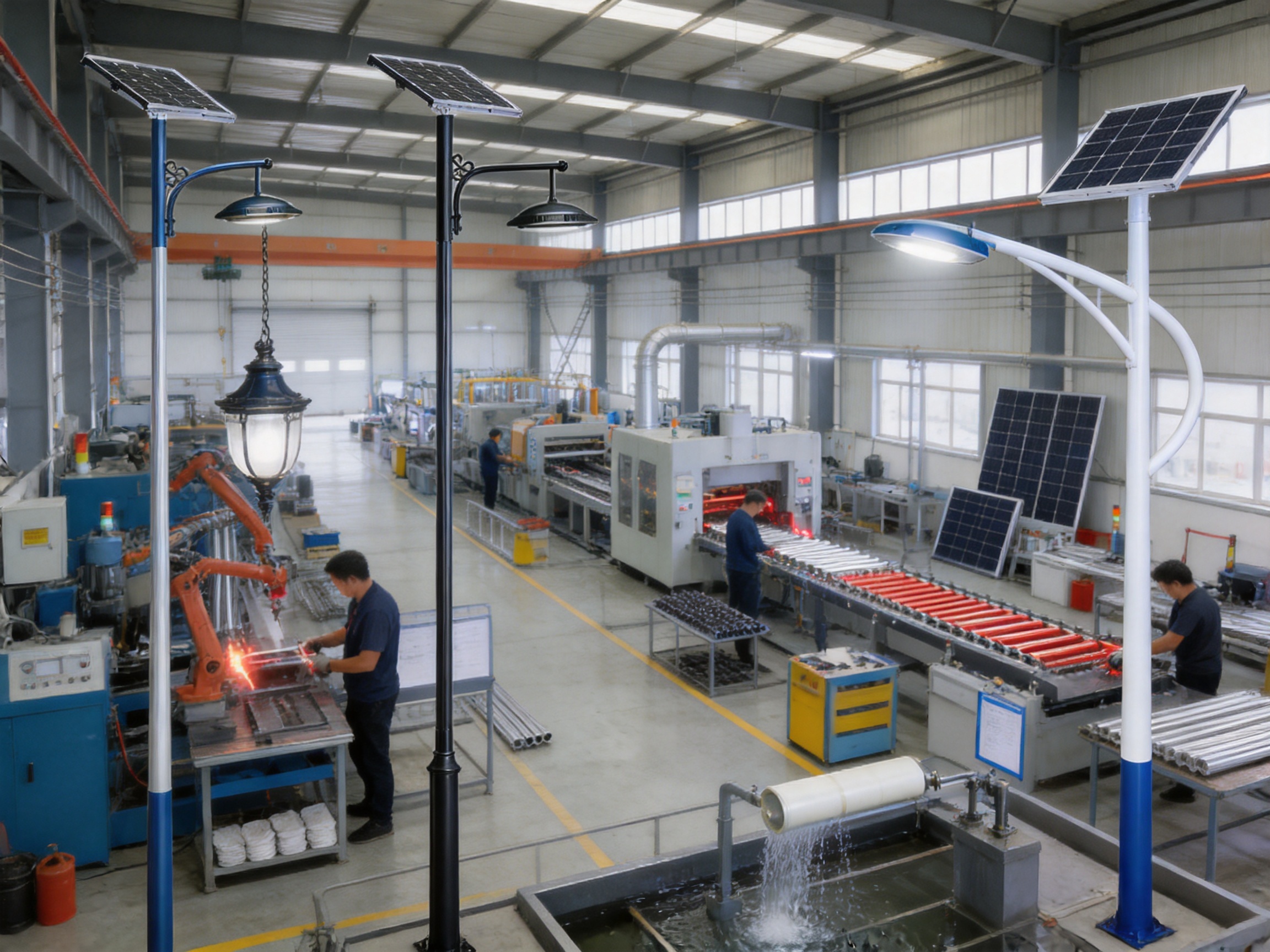
The production site is equipped with bending machines, electrostatic powder-painting equipment, automatic welding and cutting machines, and a 1250-ton die-casting machine. These capabilities support the manufacturing of lighting poles, lamp bodies, brackets, structural parts, and related components.
The 1250-ton die-casting capability is significant for producing complex metal components with repeatable dimensions. Die-cast parts can support clean appearance, integrated geometry, and efficient production when the tooling and process are properly managed. For lighting applications, this can help create housings and connection components that balance aesthetics, strength, and manufacturability.
Machine-based processing helps reduce variation between units. While skilled technicians remain important for process supervision and quality decisions, automated equipment can improve repeatability in cutting, forming, welding, coating, and inspection. This is particularly beneficial for large orders where consistent fit and finish are required.
Solar Panel Production and Sealing
The solar module must be protected from environmental exposure throughout its service life. Automated production lines and standardized encapsulation procedures help create more consistent panel sealing. Proper sealing protects cells and electrical connections from moisture and other outdoor hazards.
Machine-based inspections are performed during production, from solar-cell encapsulation through final verification. This type of process control helps identify defects earlier, reducing the likelihood that a problem will remain hidden until field installation.
The use of high-quality silicon wafers supports the electrical foundation of the module, but wafer quality alone is not enough. Cell interconnection, encapsulation, junction-box installation, frame assembly, surface protection, and final testing also influence reliability. A complete manufacturing system must therefore control the entire module assembly process.
Three Critical Factory Tests
Each unit undergoes three major factory checks: light-source aging and durability testing, structural waterproofing testing, and comprehensive performance verification. These tests address different categories of risk.
Light-source aging and durability testing help verify LED operation and identify early component failures. Operating the light source under controlled conditions can reveal abnormal heating, unstable electrical behavior, or performance inconsistencies before shipment.
Structural waterproofing testing evaluates the protection of the lamp body, electrical compartments, and relevant connections against water exposure. Outdoor lighting fixtures must withstand rain and humidity, and waterproofing is especially important for products that combine electronics, batteries, solar modules, and decorative housings.
Comprehensive performance verification can include checks of illumination, charging behavior, control functions, electrical connections, mechanical assembly, and overall product operation. The exact test sequence may vary according to the project specification, but the principle is consistent: finished products should be evaluated as complete systems rather than judged only by individual components.
Dual-layer quality control is intended to reduce post-sales issues. Factory inspection is the first layer, while project-level verification, installation guidance, and customer support provide the second. Together, these measures can improve the transition from manufacturing to field operation.
Advantages Compared with Conventional Alternatives
Reduced Civil Works
Traditional grid-connected street lighting generally requires underground cables, conduits, distribution equipment, inspection chambers, and connection to an electrical network. These requirements can increase installation time and civil-engineering costs, particularly in finished landscapes.
The integrated solar configuration avoids the need for underground power wiring between lighting points. Installation still requires a stable foundation and appropriate mechanical anchoring, but the absence of power cables can reduce excavation, reinstatement, and disruption to landscaping.
This advantage is particularly relevant in tourist destinations, parks, heritage areas, and high-end residential projects where protecting paving, trees, planting beds, and decorative surfaces is a priority.
More Coordinated Appearance
Many conventional solar installations use a standard solar panel mounted on a separate bracket above a generic street-light body. Although this arrangement can be effective, it may appear visually heavy or disconnected from the surrounding architecture.
The Decorative Landscape Integrated Solar Street Light is designed as a unified assembly. The solar panel, lamp head, arm, and pole are coordinated in proportion and finish. This can produce a more refined appearance and reduce the visual conflict between modern energy technology and traditional landscape design.
Independent Operation
Because each unit generates and stores its own energy, the system can continue operating independently of the local grid. This can improve resilience in areas with unreliable power infrastructure and can provide lighting in locations where grid extension is uneconomical.
Independent operation also simplifies the expansion of a project. Additional lighting points can potentially be added without extending a central electrical distribution network, subject to foundation, lighting, and local regulatory requirements.
Lower Routine Switching Requirements
Automatic light sensing and time control reduce the need for manual switching. The system can activate at night and charge during daylight according to its programmed operating logic. This is useful for scattered lighting points where daily access would be inconvenient.
Automated operation does not eliminate the need for maintenance. Solar panels should remain reasonably clean, structural connections should be inspected, and battery and control performance should be monitored. However, it can reduce routine operating labor compared with manually controlled lighting.
Flexible Design Selection
The availability of classic and modern structural forms allows the same basic solar-lighting concept to serve different architectural styles. Customers can select a decorative hanging-arm design for traditional landscapes or a curved cantilever design for contemporary projects.
Color temperature, pole height, materials, finishes, photovoltaic capacity, LED configuration, and control parameters can also be reviewed during the design process. This flexibility is more suitable for professional landscape projects than a one-size-fits-all product approach.
Customization and Project Support
Large lighting projects often require more than standard product supply. Site conditions, road geometry, architectural style, wind load, illumination targets, local standards, and construction schedules can all influence the final configuration.
The company offers CAD design and three-dimensional product simulation design. CAD documentation can help confirm dimensions, connection points, mounting arrangements, and foundation interfaces. Three-dimensional product simulation allows customers and designers to review the visual proportions of the fixture before mass production.
Three-dimensional scene simulation design provides an additional level of project review. It can show how the lighting pole will appear along a road, beside a building, near planting, or within a resort environment. This helps stakeholders evaluate visual compatibility and spacing before installation.
Specification and color customization can support design consistency across a project. Customers may request specific finishes, pole materials, light distributions, color temperatures, or component configurations. Customization should be confirmed through technical drawings and written specifications to ensure that aesthetic requirements remain compatible with structural and electrical performance.
Mechanical calculation for wind and foundation design is available for projects requiring engineering documentation. This service is especially useful for poles between 6 and 10 meters high, where wind exposure and foundation conditions can vary significantly from one site to another.
Overseas onsite installation guidance is another valuable service for international customers. Correct assembly, transport-mode deactivation, panel orientation, pole alignment, foundation curing, cable connection, and initial functional testing can all affect the success of a solar lighting installation.
Recommended Project Selection Process
A successful project begins with a clear understanding of the site. Designers should identify the road or pathway width, desired illumination level, pole spacing, landscape features, tree cover, building shadows, soil conditions, local wind speed, minimum temperatures, and solar resource.
The next step is to select the visual style. A classic hanging-arm design may be appropriate for traditional architecture, while a curved cantilever design may be better suited to contemporary environments. Finish and color should be reviewed against paving, façades, fences, planting, and street furniture.
Lighting performance should then be assessed. The project team should determine the required LED power, color temperature, optical distribution, mounting height, and operating schedule. For areas requiring strong visual comfort, glare control and uniformity should receive particular attention.
Solar and storage sizing should be based on local conditions and the required autonomy. Designers should consider the least favorable seasonal solar conditions, not only average summer performance. If trees or nearby buildings may shade the panels, this should be included in the evaluation.
Structural design must address wind load, pole height, panel area, arm geometry, fixture weight, foundation type, and soil conditions. The use of Q235, Q355, SS400, GR65, or another specified material should be determined through engineering requirements rather than appearance alone.
Finally, the procurement specification should define the product configuration, test requirements, packaging, installation instructions, warranty terms, documentation, and acceptance procedure. Clear documentation helps ensure that the delivered product matches the approved design.
Technical Reference Table
| Item | Specification | Project Significance |
|---|---|---|
| Product type | Decorative integrated solar street light | Combines solar generation, energy storage, control, and LED illumination in one coordinated unit |
| Typical applications | Roads, parks, resorts, pathways, residential landscapes, tourist areas | Suitable for functional lighting locations where appearance is also important |
| Voltage options | 3.2V / 12V / 24V | Allows configuration according to the selected electrical architecture |
| Light source | LED | Supports efficient, long-life outdoor illumination |
| Operating temperature | -35°C to 65°C | Provides a broad stated environmental operating range |
| Lamp body material | Aluminum alloy | Combines low weight, corrosion resistance, and heat dissipation potential |
| Continuous lighting time | 5 to 12 hours | Depends on solar conditions, storage capacity, LED power, and control settings |
| Luminous efficacy | Up to 140 lm/W | Supports efficient use of stored solar energy |
| Color temperature | 3000K to 6000K | Offers warm, neutral, and cooler appearance options |
| Color rendering index | Ra 70 | Provides practical color recognition for general outdoor lighting |
| Control method | Light control plus time control | Supports automatic dusk-to-dawn operation and scheduled management |
| Warranty period | 3 years | Provides a defined period of product support subject to contract terms |
| Pole materials | Q235, Q355, SS400, GR65, and others | Allows structural selection based on engineering and project requirements |
| Pole height | 6m to 10m | Supports different coverage requirements for paths and internal roads |
Maintenance and Long-Term Operation
Solar lighting is often selected to reduce infrastructure and operating costs, but long-term performance still depends on proper maintenance. The photovoltaic surface should be inspected periodically and cleaned when dust, leaves, bird contamination, or other deposits significantly reduce solar collection.
Vegetation should be managed so that growing trees and plants do not shade the panel. Seasonal changes should be considered because a location that is open in winter may become shaded in summer. Routine inspection can identify whether branches, construction changes, or new structures affect solar exposure.
The pole, decorative arm, lamp housing, anchor bolts, and foundation area should be checked for corrosion, deformation, loosening, or damage. In regions with strong winds, coastal exposure, heavy rainfall, or severe winter conditions, inspection intervals may need to be adjusted.
Lighting performance should be reviewed after installation and during scheduled maintenance. A gradual reduction in nighttime duration may indicate panel soiling, battery aging, controller problems, or changes in shading. Early diagnosis can prevent a minor issue from developing into a complete lighting failure.
Because the product uses light and time control, the operating program should be verified when seasonal schedules or project requirements change. The transport mode must remain disabled after commissioning, and installation personnel should confirm that charging and nighttime activation are functioning correctly.
A three-year warranty is stated for the product. Warranty interpretation should be confirmed in the commercial agreement, including coverage boundaries, exclusions, spare parts, response procedures, and responsibilities for installation or environmental damage.
Company Manufacturing Strength
Yangzhou Jinyuan Lamps Co., Ltd. operates as a professional production, design, and engineering company in the road illumination sector. Its product range includes street light poles, LED street lights, solar street lights, light fixtures, and related lighting systems.
The company’s more than 70,000-square-meter site provides space for manufacturing, assembly, testing, storage, and related operations. A workforce of more than 300 professional technicians supports product development, engineering, production, quality management, and project service.
International export experience is another important strength. Serving customers in more than 200 countries requires attention to different climate conditions, technical expectations, packaging practices, documentation requirements, and project workflows. International experience can also help a manufacturer understand the practical challenges of overseas installation and after-sales communication.
The company reports compliance with quality and management standards including ISO9001, ISO14001, and OHSAS18001. These certifications and management systems indicate an organized approach to quality, environmental responsibility, and occupational health and safety, although project buyers should always request current certificates and confirm their scope.
The combination of manufacturing equipment, material availability, engineering design, testing, customization, and installation guidance allows the company to provide more than a basic catalog product. For distributors, contractors, municipalities, and developers, this integrated support can simplify procurement and reduce coordination between multiple suppliers.
Q&A
What type of project is best suited to this solar street light?
The product is well suited to scenic parks, tourist resorts, high-end residential landscapes, landscaped roads, pedestrian paths, hotel entrances, cultural districts, and commercial developments where decorative appearance and independent solar operation are both important.
Can it be used on a public road?
The product information lists road applications and pole heights from 6 to 10 meters. It may be suitable for internal roads, access roads, residential roads, and selected public lighting projects. The final suitability depends on required illumination levels, local regulations, traffic conditions, structural calculations, and the selected photovoltaic and storage configuration.
Does the system require underground wiring?
The integrated solar design is intended to operate without underground power wiring. Each fixture generates and stores its own energy. A foundation and mechanical anchoring system are still required, and installation must follow the approved structural and electrical procedures.
How does the light turn on automatically?
The lamp uses light control and time control. The light sensor detects nighttime conditions and activates the LED system according to the programmed control logic. After installation, transport mode should be disabled so automatic operation can begin.
How long can the light operate each night?
The stated continuous lighting time is approximately 5 to 12 hours. Actual performance depends on panel capacity, battery capacity, LED power, local solar radiation, temperature, weather, shading, and the selected control schedule.
What color temperatures are available?
The stated range is 3000K to 6000K. Warm light is generally suitable for relaxing landscape environments, while neutral or cooler light may be selected for contemporary designs or applications requiring a brighter visual character.
What materials are used for the lamp and pole?
The lamp body uses aluminum alloy. Pole material options include Q235, Q355, SS400, GR65, and other grades subject to project requirements. The final selection should be based on structural calculations, local standards, corrosion conditions, and customer specifications.
Can the appearance be customized?
Customization may include classic or modern structural styles, powder-coating colors, antique finishes, pole configurations, specifications, and selected lighting parameters. CAD drawings and three-dimensional simulation can be used to confirm the design before production.
What factory tests are performed?
The production information identifies light-source aging and durability testing, structural waterproofing testing, and comprehensive performance verification. These tests are intended to evaluate lighting reliability, weather protection, and complete system operation before shipment.
Is installation support available for overseas projects?
Overseas onsite installation guidance is available as part of the company’s project-service offering. The precise scope should be confirmed before purchase, including travel arrangements, commissioning responsibilities, technical documentation, and local installation requirements.
What maintenance does an integrated solar light require?
Routine maintenance includes cleaning the photovoltaic surface, checking for shading, inspecting the pole and foundation, verifying fasteners and structural connections, reviewing nighttime operating duration, and checking the control system. Maintenance frequency should reflect the site environment.
What is the warranty period?
The stated warranty period is three years. Buyers should review the contract for exact warranty coverage, exclusions, service procedures, component responsibilities, and conditions relating to installation, misuse, environmental damage, and unauthorized modification.
Conclusion
The Decorative Landscape Integrated Solar Street Light combines renewable energy generation, LED efficiency, automatic control, energy storage, structural engineering, and decorative design in one outdoor lighting solution. Its purpose is not simply to illuminate a road or pathway, but to become a visually compatible part of the landscape while reducing dependence on conventional electrical infrastructure.
The classic decorative hanging-arm design can complement traditional and hospitality-oriented environments, while the curved cantilever version supports modern architectural settings. Aluminum alloy lamp construction, multiple pole-material options, powder-coated finishes, monocrystalline photovoltaic modules, light and time control, and LED efficacy of up to 140 lumens per watt provide a broad technical foundation for project customization.
Its advantages over basic conventional alternatives include reduced underground wiring, independent operation, automatic switching, coordinated visual design, adaptable installation, and the possibility of lower civil-work requirements. These advantages are strengthened by manufacturing capabilities that include CNC bending, automated welding and cutting, electrostatic powder coating, die casting, standardized solar-module production, machine-based inspection, and three critical factory tests.
For developers, contractors, distributors, landscape designers, and public-space planners, the product offers a practical route to combining sustainability with visual quality. Proper site assessment, solar-storage sizing, lighting design, structural calculation, and installation supervision remain essential, but the integrated manufacturing and service approach can simplify the overall project process.
When selected and installed according to local environmental and engineering conditions, the Decorative Landscape Integrated Solar Street Light can provide a durable, attractive, and energy-conscious lighting solution for modern outdoor spaces.
References
1. Product technical information supplied for the Decorative Landscape Integrated Solar Street Light series.
2. Manufacturer information concerning production facilities, equipment, quality systems, and project services.
3. General principles of photovoltaic system design, energy storage sizing, and solar outdoor-lighting operation.
4. General engineering practices for outdoor LED lighting, optical distribution, color temperature, and visual comfort.
5. General structural design principles for lighting poles, decorative arms, wind loading, foundations, and outdoor equipment.
6. General quality-management practices for metal fabrication, powder coating, solar-module encapsulation, waterproofing, and finished-product testing.
7. General landscape-lighting planning principles for parks, resorts, residential developments, pedestrian paths, and public spaces.
8. General maintenance practices for solar photovoltaic modules, LED luminaires, lighting poles, controllers, and outdoor energy-storage systems.