


JINYUAN
JINYUAN
JINYUAN
JINYUAN
JINYUAN
JINYUAN
JINYUAN
JINYUAN
JINYUAN
JINYUAN
JINYUAN
JINYUAN
JINYUAN
JINYUAN
JINYUAN
JINYUAN
Content
- 1 1. The Changing Role of Urban Road Lighting
- 2 2. Product Concept and Design Philosophy
- 3 3. Key Technical Specifications
- 4 4. Optical Performance and Light Distribution
- 5 5. Visual Advantages Over Conventional Road Lights
- 6 6. Engineering Advantages Over Basic Decorative Fixtures
- 7 7. Advanced Manufacturing Capabilities
- 8 8. Installation and Maintenance Considerations
- 9 9. Smart Control and Energy Management
- 10 10. Applications and Project Suitability
- 11 11. Project Customization and Engineering Support
- 12 12. Quality Systems and Production Reliability
- 13 13. Comparison with Common Alternatives
- 14 14. Procurement Guidance for Project Owners
- 15 15. Sustainability and Lifecycle Value
- 16 16. Recommended Design Approach
- 17 17. Frequently Asked Questions
- 17.1 Q1: What type of project is this LED road light designed for?
- 17.2 Q2: Is the product only decorative, or can it provide functional road lighting?
- 17.3 Q3: What pole heights are available?
- 17.4 Q4: What input voltage does the luminaire support?
- 17.5 Q5: Can the light be dimmed?
- 17.6 Q6: What color temperatures are available?
- 17.7 Q7: How does the system help reduce light pollution?
- 17.8 Q8: Is the housing suitable for outdoor use?
- 17.9 Q9: What is the operating temperature range?
- 17.10 Q10: How is maintenance performed?
- 17.11 Q11: What materials are available for the lamp pole?
- 17.12 Q12: What manufacturing capabilities support the product?
- 17.13 Q13: Can the product be customized?
- 17.14 Q14: What warranty is provided?
- 17.15 Q15: Why is the product suitable for large projects?
- 18 18. Conclusion
- 19 References
- 20 Product: Neo-Chinese Classical Rhythmic LED Road Light
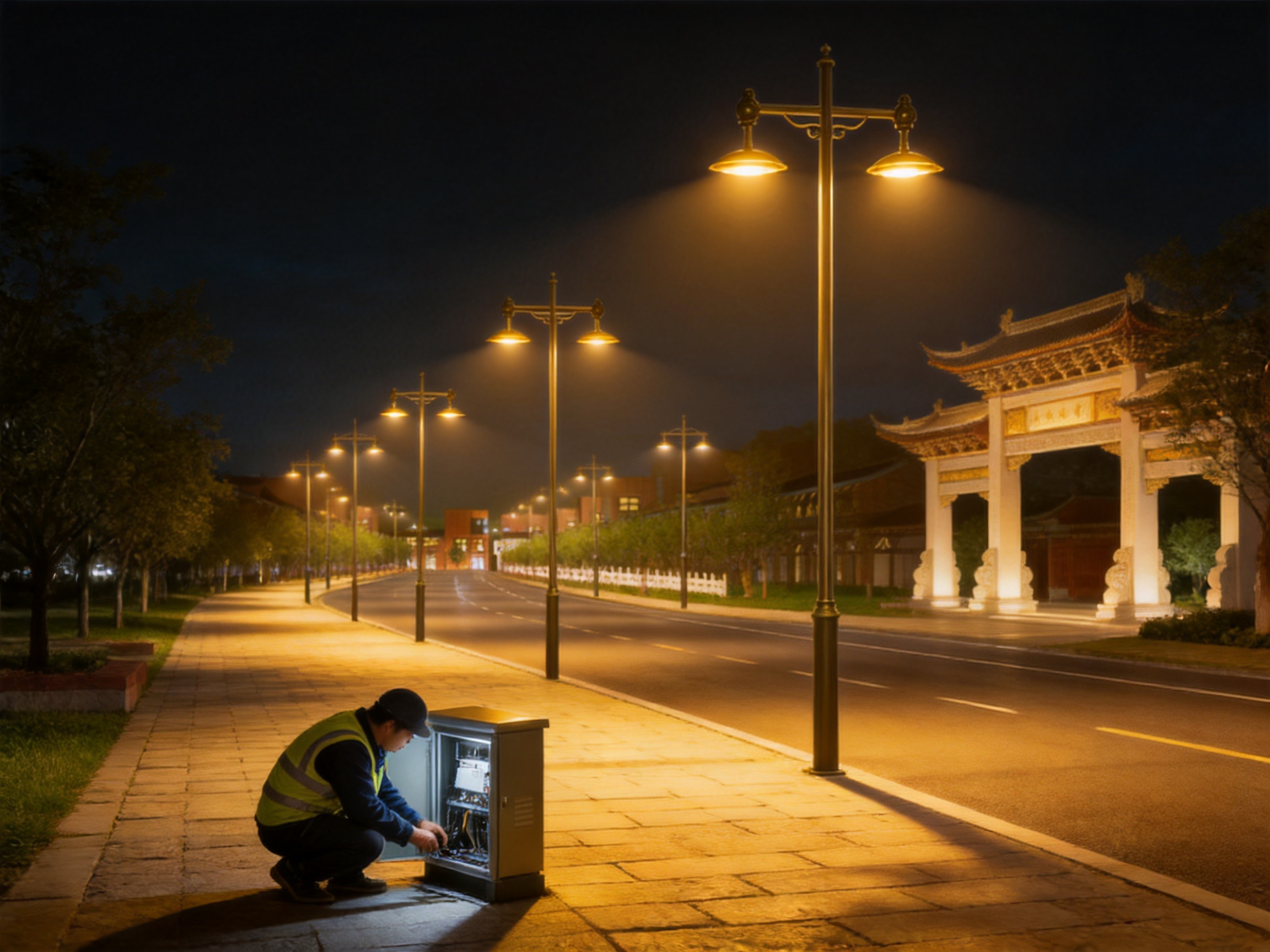
Modern urban lighting is no longer limited to providing basic visibility after sunset. In many public spaces, the road light has become an important architectural and landscape element that influences how residents, visitors, and businesses experience a city. Historical districts, cultural tourism destinations, premium residential developments, heritage streets, and distinctive urban avenues require lighting that performs reliably while respecting the character of the surrounding environment. The Neo-Chinese Classical Rhythmic LED Road Light is designed for precisely this purpose.
This product combines the visual language of traditional Chinese architecture with the efficiency, control, and durability expected from a contemporary LED road-lighting system. Its decorative structure, antique-style surface treatment, modular maintenance design, and high-performance optical system allow it to function as both infrastructure and urban ornament. Rather than placing a conventional modern luminaire into a historically sensitive environment, the system provides a coordinated lighting solution in which the pole, luminaire head, finish, and light distribution work together.
The product is categorized as an LED double-arm light and is suitable for roadways, pedestrian routes, landscape avenues, municipal projects, and cultural tourism developments. Its 6-meter to 10-meter pole-height range supports different road widths and spatial compositions, while its asymmetric optical distribution helps direct light toward the required area and reduce unnecessary illumination beyond the road boundary.
1. The Changing Role of Urban Road Lighting
Road lighting has traditionally been evaluated through practical criteria such as illuminance, uniformity, energy consumption, service life, and maintenance cost. These factors remain essential, but today’s projects increasingly demand additional qualities. Lighting must contribute to identity, support safe movement, reduce glare and light trespass, and integrate with public-realm design.
A generic road luminaire may provide adequate illumination, yet it can appear visually disconnected from a traditional gateway, historic façade, landscaped promenade, or culturally themed public space. In contrast, a heritage-inspired road light can reinforce the design language of an entire district. When properly selected, it becomes part of the streetscape during the daytime and establishes a recognizable atmosphere at night.
The Neo-Chinese Classical Rhythmic LED Road Light addresses this broader requirement through a balanced combination of appearance and performance. Its architectural styling introduces traditional visual references without relying on outdated lighting technology. The LED source, driver system, die-cast aluminum housing, advanced coating, and modular access panels are all based on modern engineering principles.
This balance is important because decorative lighting products sometimes sacrifice optical precision or maintainability for visual effect. The present system is intended to avoid that compromise. It retains an elaborate, culturally inspired appearance while incorporating standardized construction and accessible service components. As a result, the product can be considered for projects where aesthetics are highly visible but operational reliability remains non-negotiable.
2. Product Concept and Design Philosophy
The design philosophy of the Neo-Chinese Classical Rhythmic LED Road Light is based on the integration of traditional character and contemporary function. The product uses classical architectural elements as visual references, but its construction is adapted to modern industrial production. This approach allows the light to achieve a high level of visual recognition without becoming impractical to manufacture, install, or maintain.
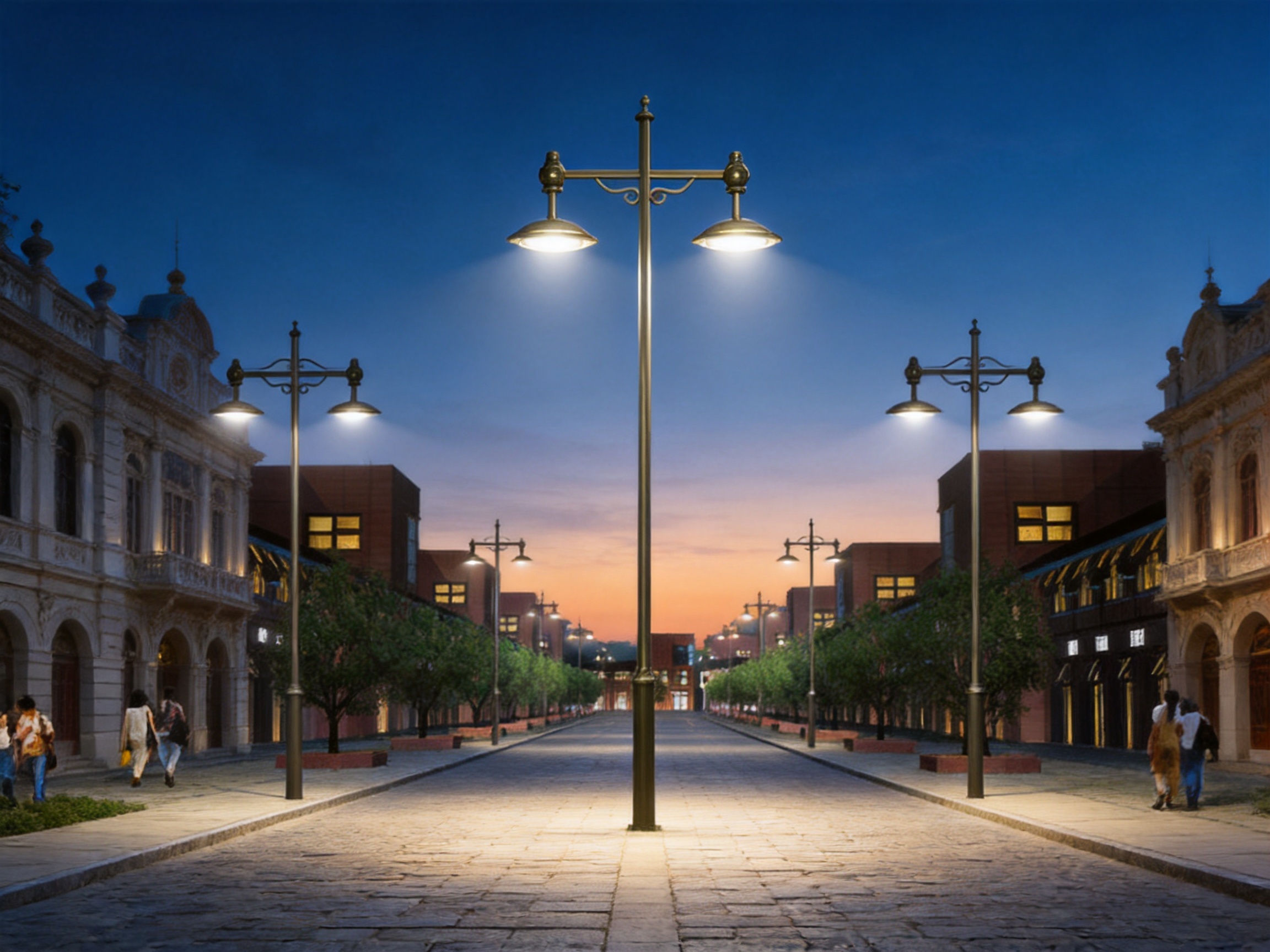
The term “classical rhythmic” reflects the coordinated repetition and proportion of the product’s decorative elements. In an avenue application, repeated poles and double-arm luminaires can create a consistent rhythm along the road. This rhythm helps define the character of the public space and can strengthen the visual continuity between road edges, pedestrian paths, landscaping, buildings, and entrance features.
The luminaire head is designed to align with the ornamental structure of the pole. This alignment is important because the lamp and pole are viewed together as a single object. A modern, visually unrelated lamp head could weaken the intended architectural effect, even if it performed well technically. The coordinated form of this system helps preserve the design concept from the base of the pole to the light-emitting component.
At the same time, the structure is not merely decorative. The lamp housing is manufactured from aluminum alloy, a material widely used in outdoor luminaires because of its favorable balance of strength, weight, thermal performance, and corrosion resistance. Precision die-casting supports repeatable shapes, clean detailing, and consistent dimensional quality across production batches.
The antique-style coating further supports the heritage-inspired appearance. It provides a surface treatment that can harmonize with traditional architecture, stone paving, landscaped areas, bronze-toned details, and other historic-style urban furniture. The finish is also intended to withstand outdoor exposure and protect the underlying metal from environmental deterioration.
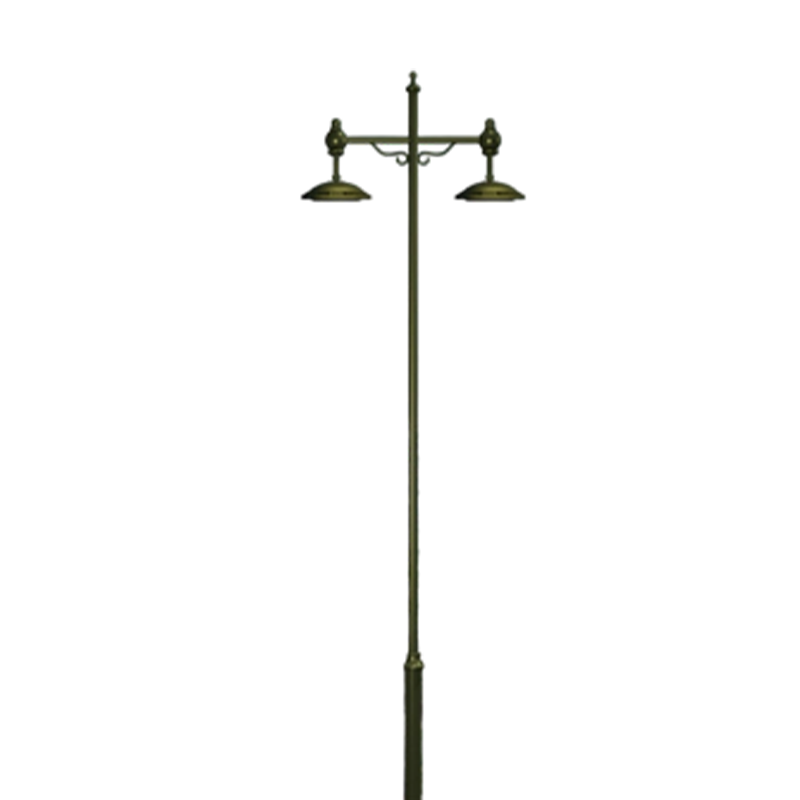
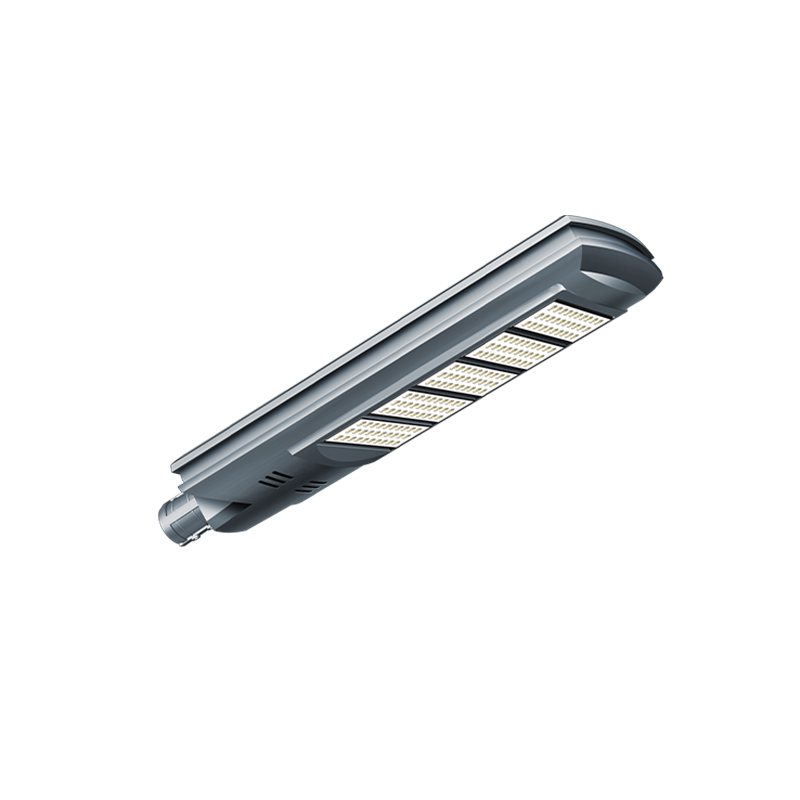
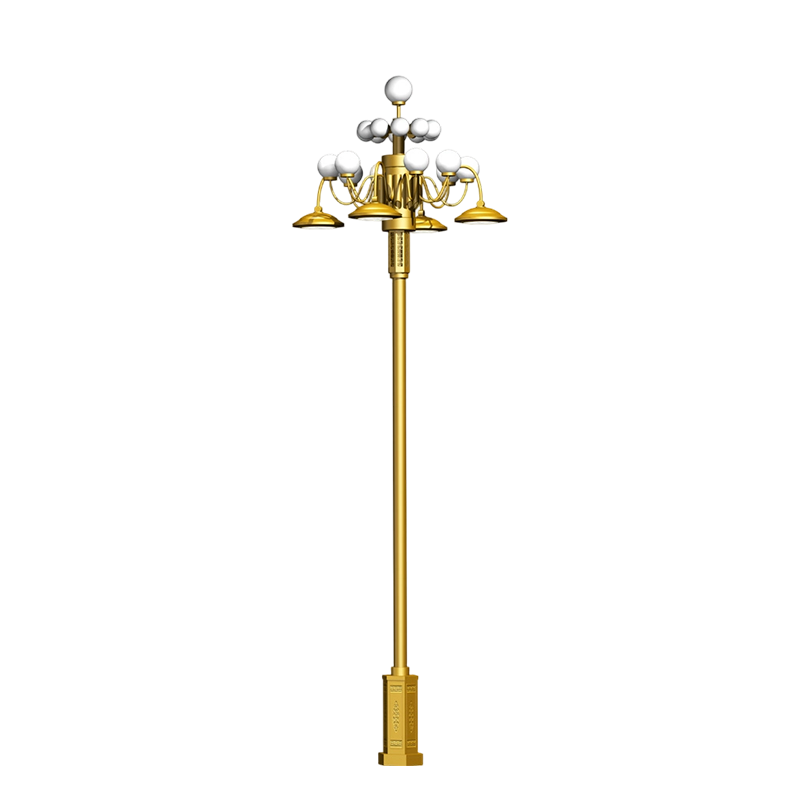
Neo-Chinese Classical Rhythmic LED Road Light
3. Key Technical Specifications
The system is engineered for a broad range of municipal and architectural road-lighting conditions. Its primary specifications provide a practical foundation for project planning, while the overall design can be adapted through pole selection, color temperature, control method, and project-specific configuration.
| Specification | Product Information |
|---|---|
| Product Type | Neo-Chinese classical rhythmic LED road light |
| Light Category | LED double-arm light |
| Application | Road and pedestrian-route lighting |
| Brand | Jinyuan |
| Input Voltage | AC 85-265 V |
| Light Source | LED |
| Operating Temperature | -35 to 65 degrees Celsius |
| Lamp Housing Material | Aluminum alloy |
| Ingress Protection | IP65 |
| Luminous Efficiency | Up to 140 lm/W |
| Color Temperature | 3000 K to 6000 K |
| Color Rendering Index | Ra 70 |
| Dimming and Control | DC 0-10 V and DALI |
| Warranty | 5 years |
| Compatible Pole Materials | Q235, Q355, SS400, GR65, and related options |
| Typical Pole Height | 6 m to 10 m |
The AC 85-265 V input range provides compatibility with a variety of electrical supply conditions. This is especially useful for projects that are installed in different regions or involve replacement of older road-lighting equipment. The wide input range can simplify electrical planning, although final project design should always confirm local voltage, frequency, protection, and electrical-code requirements.
The operating temperature range of -35 to 65 degrees Celsius supports use in diverse outdoor environments. This broad range is valuable for projects exposed to cold winters, hot summers, intense sunlight, or significant seasonal variation. Proper thermal design, driver selection, installation practice, and electrical protection remain important factors in achieving dependable performance.
The IP65 rating indicates protection against dust ingress and water jets from various directions. This level of protection is appropriate for many outdoor road and landscape applications. It helps protect the optical and electrical compartments from common environmental conditions such as rain, airborne dust, and routine washing. Project designers should nevertheless ensure that cable entries, connectors, fasteners, and installation interfaces are correctly sealed.
4. Optical Performance and Light Distribution
Optical performance is one of the most important differences between a decorative road light and a purely ornamental fixture. A visually attractive product must still provide useful illumination across the road or path, maintain acceptable uniformity, and limit excessive light outside the intended area. The Neo-Chinese Classical Rhythmic LED Road Light uses a deeply optimized asymmetric light distribution system to address these requirements.
Asymmetric distribution directs a greater proportion of light toward the roadway or pedestrian route rather than distributing light equally in all directions. This improves the relationship between installed power and useful illumination. It can also reduce light spilling into nearby windows, gardens, façades, or natural areas.
For historical districts and cultural tourism projects, this control is especially valuable. Such sites often include narrow streets, irregular building lines, residential properties, landscaped courtyards, and visually sensitive architectural details. Excessive upward or sideways light can create glare, disturb occupants, reduce the visibility of architectural features, and increase the sense of visual clutter. Carefully controlled distribution helps maintain a more comfortable and coherent nighttime environment.
The product offers a luminous efficiency of up to 140 lumens per watt. This figure indicates the amount of light produced for each watt of electrical input under specified conditions. High efficacy can contribute to lower energy consumption when compared with older, less efficient light sources, although actual project savings depend on operating hours, lighting levels, control schedules, mounting height, spacing, and existing equipment.
The available color-temperature range of 3000 K to 6000 K enables designers to select an appearance suited to the project. Warm white settings near 3000 K can support a more traditional, welcoming, and intimate atmosphere. Neutral or cooler settings can provide a cleaner and more contemporary appearance where higher visual contrast is preferred. The selected value should be coordinated with surrounding architectural materials, road classification, landscape design, and local regulations on nighttime lighting.
A color rendering index of Ra 70 supports general outdoor road-lighting applications. It allows common materials, signs, vehicles, paving, vegetation, and architectural surfaces to appear with reasonable color distinction. For special projects involving artwork, premium retail frontage, or highly detailed cultural displays, the lighting designer may evaluate whether a higher color-rendering specification is required in selected zones.
5. Visual Advantages Over Conventional Road Lights
The most visible advantage of this product is its ability to function as a design element rather than an isolated technical device. Conventional street lights often use a standardized pole and a simple horizontal or curved luminaire. These forms may be entirely appropriate for highways, industrial roads, and utilitarian urban corridors, but they may not suit spaces with a strong cultural or architectural theme.
The Neo-Chinese Classical Rhythmic LED Road Light provides a more integrated visual solution. Its classical styling can support the identity of a historical district, entrance road, temple-style landscape, traditional commercial street, resort development, or civic avenue. The result is a lighting installation that remains visually relevant during daylight hours instead of becoming noticeable only after dark.
The double-arm configuration can improve symmetry and support lighting on both sides of a road or central median, depending on the project layout. It can also create a formal avenue composition in which the poles contribute to perspective, proportion, and rhythm. When the spacing and mounting heights are designed correctly, the repeated fixtures can guide movement and strengthen the sense of arrival at a destination.
Another advantage is the coordinated relationship between the decorative pole and lamp head. Some decorative lighting products use an ornamental pole with an ordinary replacement luminaire, producing a visually mismatched result. In this system, the lamp head is designed to align with the pole’s decorative language, helping the complete assembly appear intentional and unified.
The antique-style coating provides additional flexibility for landscape and architectural coordination. Depending on project requirements, the surface may be specified to complement traditional masonry, dark metalwork, timber details, stone paving, or other heritage-inspired materials. A coordinated finish can reduce visual competition between the light and surrounding buildings.
6. Engineering Advantages Over Basic Decorative Fixtures
Decorative appearance alone does not determine the long-term value of a road light. A product used in public infrastructure must also withstand weather, vibration, temperature changes, routine maintenance, and continuous operating cycles. The Neo-Chinese Classical Rhythmic LED Road Light is designed around several engineering features that support this objective.
First, the aluminum-alloy housing provides a strong and relatively lightweight enclosure for the LED components and driver. Lower weight can simplify handling during installation and reduce the mechanical demand placed on the mounting arm. At the same time, aluminum supports heat dissipation when the housing is properly designed with appropriate thermal paths and surface area.
Second, precision die-casting improves repeatability. A controlled die-casting process can produce consistent wall thicknesses, mounting interfaces, contours, and decorative details. Consistency is important for both appearance and assembly because it reduces variation between units and helps components fit together accurately.
Third, the system incorporates accessible maintenance panels. The light-source cavity and driver modules can be reached through designated service areas, allowing technicians to inspect, replace, or troubleshoot components without dismantling the entire decorative assembly. This is a significant practical advantage over ornamental fixtures that require extensive disassembly for basic servicing.
Fourth, the product supports standardized and modular maintenance. Modular construction makes it easier to manage replacement components and can reduce the time required for field work. It also helps project owners establish a more systematic maintenance program across multiple roads or districts.
Finally, the five-year warranty provides a defined period of manufacturer support. Warranty conditions should be reviewed in relation to installation practices, operating schedules, surge protection, environmental conditions, and maintenance responsibilities. When these requirements are properly managed, a clear warranty can support long-term procurement confidence.
7. Advanced Manufacturing Capabilities
The quality of a road-lighting system depends not only on its design drawings but also on the manufacturing processes used to turn those drawings into finished products. The manufacturer behind this product operates as a professional production, design, and engineering company in the road-illumination field. Its manufacturing resources cover light poles, LED street lights, solar street lights, luminaires, and related outdoor lighting products.
The company has developed a production site covering more than 70,000 square meters and employs more than 300 professional technicians. Its export experience extends to more than 200 countries, giving the organization exposure to varied project specifications, environmental conditions, standards, packaging requirements, and installation practices.
Material availability is an important element of production stability. The manufacturer supports material options including Q235B, Q345B, S275JR, S355JR, Q460, A36, A572, GR56, GR50, and other related grades. Maintaining extensive material stock can help reduce procurement delays and create a more reliable foundation for large project orders.
Material selection should always be confirmed according to structural calculations, local standards, wind conditions, corrosion exposure, pole height, foundation design, and customer requirements. The availability of multiple material options gives engineers greater flexibility when adapting the product to different markets and project conditions.
7.1 CNC Bending
Precise CNC bending is used to form pole sections and other structural components with consistent angles and dimensions. Accurate bending is important because uneven or inconsistent shaping can affect assembly, appearance, load distribution, and alignment between the pole and luminaire arm.
Controlled CNC bending improves structural integrity by reducing unnecessary deformation and limiting the need for post-production correction. It also supports repeatability across a large batch, which is essential when an avenue requires dozens or hundreds of visually identical lighting poles.
For decorative products, dimensional consistency has an additional benefit. Small differences in angle, curvature, or arm position can become noticeable when fixtures are installed in a long, symmetrical row. CNC-controlled forming helps preserve the intended rhythm of the installation.
7.2 High-Accuracy Cutting
The manufacturing process includes cutting accuracy of up to 0.01 millimeters under specified production conditions. High-accuracy cutting supports clean edges, accurate component dimensions, and improved fit between parts. It can reduce the amount of grinding, adjustment, and rework required before welding or assembly.
Clean and consistent cuts also contribute to surface quality. Where parts are later coated or exposed to environmental conditions, rough edges and inaccurate interfaces can create weak points. Proper cutting and preparation help the production team maintain a more controlled process from raw material to finished structure.
7.3 Welding Expertise
Welding is critical to the safety and durability of road-lighting poles and their support structures. The manufacturer employs certified welders with many years of experience. Skilled welding helps ensure appropriate penetration, alignment, joint quality, and production speed.
For large-scale projects, welding consistency is especially important. A street-lighting order may contain numerous repeated components, and every joint must meet the required quality level. Experienced welders can identify issues such as poor fit-up, excessive distortion, insufficient preparation, or incomplete fusion before the product moves to later stages.
Welding quality also affects the appearance of decorative products. Visible welds, transitions, and connection points must be treated carefully so that they do not detract from the classical styling. A disciplined welding and finishing process supports both structural reliability and visual refinement.
7.4 Automated Production Lines
Automated production lines improve manufacturing efficiency and process control. Automation can reduce variation, shorten production cycles, and help maintain consistent results when order quantities are high. It can also reduce avoidable material waste and support more efficient use of labor and energy.
For customers, the practical benefit is a stronger relationship between quality and cost. A product that is manufactured through repeatable automated processes can offer more predictable dimensions and finish than one produced through entirely manual methods. Automation does not eliminate the importance of skilled technicians; instead, it allows technical staff to focus on process supervision, quality verification, engineering adjustments, and project-specific requirements.
7.5 Powder Electrostatic Painting and Corrosion Protection
Outdoor light poles and housings must resist moisture, sunlight, temperature fluctuations, airborne pollutants, and mechanical handling. The manufacturer uses powder electrostatic painting equipment as part of its surface-finishing capabilities. Electrostatic application helps distribute coating material across the prepared surface and can support consistent coverage.
The coating process is an important part of the product’s anti-corrosion strategy. Surface preparation, coating thickness, curing temperature, adhesion, and inspection all influence long-term performance. The final specification should be selected according to the project’s environmental exposure, including coastal air, industrial pollution, high humidity, or frequent rainfall.
The antique-style appearance is therefore not simply a decorative color choice. It is connected to a controlled finishing process intended to combine visual character with outdoor durability. When the coating system is correctly specified and applied, it can extend the useful service life of the metal components and help preserve the intended appearance.
7.6 Large-Capacity Die Casting
A 1250-ton die-casting machine supports the production of aluminum components with complex forms and repeatable quality. Large-capacity die casting is particularly useful for decorative luminaire housings because it can create integrated shapes, mounting features, and architectural contours with fewer separate pieces.
Reducing the number of individual parts can simplify assembly and reduce the number of potential connection points. A well-designed die-cast housing may also provide improved structural consistency and more efficient thermal pathways for the LED system. The specific benefits depend on mold design, alloy selection, wall thickness, cooling design, and quality inspection.
8. Installation and Maintenance Considerations
Successful installation begins before the products arrive at the site. The pole height, arm geometry, road width, luminaire orientation, foundation dimensions, cable routing, and maintenance access should be evaluated during the design stage. The manufacturer supports project development through CAD design, three-dimensional product simulation, three-dimensional scene simulation, specification customization, color customization, mechanical calculations, wind-load analysis, foundation calculations, and overseas installation guidance.
CAD design helps establish accurate dimensions and interfaces. This is useful when the lighting system must match existing road geometry, landscape features, architectural setbacks, or underground service locations. It also assists with reviewing the relationship between double-arm fixtures, roadway lanes, pedestrian paths, and nearby structures.
Three-dimensional product simulation allows stakeholders to examine the pole and luminaire before manufacturing. This can help identify proportion issues, arm clearances, decorative conflicts, access requirements, and visual inconsistencies. For projects with a strong heritage theme, simulation can be especially valuable because the appearance of repeated fixtures can significantly influence the overall atmosphere.
Three-dimensional scene simulation places the proposed lighting product into a broader environment. Designers can review how the light poles relate to façades, trees, paving, signs, gates, bridges, and public spaces. This process supports better coordination between lighting engineering and landscape architecture.
Mechanical calculations for wind and foundation design are essential for safe deployment. Pole height, projected area, local wind speed, soil conditions, foundation dimensions, anchor bolts, and luminaire weight all influence structural requirements. The product can be specified with different pole materials and heights, but final structural design must be confirmed for the actual project location.
During installation, the pole should be handled carefully to avoid damaging the antique-style coating. Lifting equipment, slings, storage supports, and temporary protection should be selected to prevent scratches, dents, or deformation. Electrical connections should be completed by qualified personnel, and all grounding, surge protection, insulation, and sealing requirements should be checked before commissioning.
Maintenance access is supported by the product’s service-panel design. Technicians can inspect the LED light-source cavity and driver module through accessible areas instead of removing the entire decorative structure. A planned maintenance schedule may include visual inspection, cleaning, fastener checks, cable and gasket inspection, coating evaluation, electrical testing, and verification of dimming or control performance.
In environments with heavy dust, salt, industrial emissions, or biological deposits, cleaning frequency may need to be increased. The cleaning method should be compatible with the coating and optical cover. Abrasive tools and aggressive chemicals should be avoided unless specifically approved by the manufacturer.
9. Smart Control and Energy Management
Although the product is designed with a classical visual language, it can support contemporary energy-management strategies. DC 0-10 V and DALI dimming provide options for integrating the road light into an appropriate lighting-control system. Dimming can reduce energy consumption during periods of low traffic while maintaining required safety levels.
Control strategies may include scheduled dimming, seasonal adjustment, event-based lighting, centralized monitoring, or staged operation. For example, a cultural tourism avenue may operate at a higher lighting level during evening visitor hours and transition to a lower level later at night. A residential historical district may use gradual dimming to reduce disturbance while preserving basic route visibility.
Lighting controls should be designed with consideration for safety, accessibility, pedestrian activity, traffic conditions, local ordinances, and emergency requirements. Dimming must not reduce lighting below the levels required for the road classification or create abrupt changes that could affect drivers and pedestrians.
The combination of high luminous efficiency and controllable output provides a stronger energy-management foundation than a decorative luminaire with fixed output. The system can deliver a visually distinctive installation without requiring the project to accept unnecessary power consumption throughout the entire night.
Control compatibility also supports future upgrades. As cities introduce centralized lighting management, remote monitoring, or smart infrastructure platforms, a luminaire with established dimming interfaces can be easier to integrate than a fixture with no control capability. The final system architecture should be confirmed with the lighting-control supplier and electrical engineer.
10. Applications and Project Suitability
10.1 Historical Districts
Historical districts require lighting that respects architectural scale and cultural identity. The classical styling of this product can complement traditional façades, gateways, courtyards, stone streets, and restored commercial buildings. Warm color temperatures can create a comfortable atmosphere, while asymmetric distribution can help control light on narrow roadways.
10.2 Cultural Tourism Areas
Cultural tourism projects depend heavily on atmosphere and visual memorability. A distinctive road-lighting system can contribute to the identity of an arrival route, scenic promenade, visitor center, or traditional-style commercial street. The product’s repeated visual rhythm can guide visitors and create a more complete nighttime experience.
10.3 Premium Landscape Paths
Landscape paths often require lighting that is attractive from multiple viewpoints. Because the product is designed as a complete decorative assembly, it can support the visual quality of parks, resorts, garden communities, riverfronts, and themed public spaces. The selected pole height and optical distribution should be matched to path width and surrounding vegetation.
10.4 Unique Urban Avenues
Urban avenues with special architectural or civic importance may require more than a standard utility pole. Double-arm configurations can create symmetry along broad streets, central medians, entrance corridors, and ceremonial routes. The product can help establish a recognizable boulevard identity while maintaining modern LED performance.
10.5 Residential and Mixed-Use Developments
In high-end residential and mixed-use developments, outdoor lighting must balance elegance, safety, comfort, and maintenance cost. The system can be used along internal roads, entrance streets, landscaped approaches, and pedestrian connections. Its controlled optics can help reduce unwanted light near residences when the photometric layout is carefully designed.
11. Project Customization and Engineering Support
One of the product’s strengths is the availability of project-oriented design support. Lighting projects often differ in road geometry, local wind conditions, architectural style, color requirements, electrical systems, and procurement standards. A product that can be supported through engineering documentation and customization is more adaptable than a fixed catalog item.
CAD drawings can define mounting interfaces, pole sections, foundation requirements, cable-entry locations, and luminaire orientation. Three-dimensional product simulations allow project teams to review the design from different angles. Scene simulations can help owners and architects compare finishes, proportions, and visual impact before committing to production.
Specification customization may include pole height, material grade, structural dimensions, surface finish, color temperature, control method, and other project parameters. Color customization is particularly relevant for heritage environments, where the surface tone must coordinate with the existing palette rather than appear as an unrelated industrial finish.
Mechanical calculations and foundation support help transform the visual concept into a safe installation. Wind and foundation conditions vary significantly between locations, so these calculations should not be replaced by assumptions based on a previous project. Accurate site information allows the final pole and foundation design to be properly coordinated.
For overseas projects, installation guidance can help local contractors understand assembly sequence, cable routing, fixture orientation, fastener requirements, and commissioning procedures. Clear technical communication can reduce installation errors and help preserve both structural performance and appearance.
12. Quality Systems and Production Reliability
The manufacturer reports compliance with international management and quality standards including ISO 9001, ISO 14001, and OHSAS 18001. These standards represent a structured approach to quality management, environmental management, and occupational health and safety. Certification alone does not replace product inspection, but it indicates that the organization has established formal systems for managing production and operational processes.
Quality control should be applied throughout the product lifecycle. Incoming materials should be identified and verified. Cutting, bending, welding, casting, surface preparation, coating, assembly, electrical integration, and final inspection should each have defined checkpoints. Consistent records can help trace results and identify opportunities for improvement.
For large projects, production planning is as important as individual product quality. The ability to maintain material stock, operate specialized equipment, and coordinate trained technicians can help reduce delays. Reliable scheduling is particularly valuable for public projects with fixed road closures, coordinated landscape work, or opening ceremonies.
Environmental responsibility is also relevant to modern procurement. Automated production can help reduce waste and improve resource efficiency, while environmental-management systems encourage more systematic control of emissions, materials, and production impacts. Project owners may request additional documentation according to their own sustainability requirements.
13. Comparison with Common Alternatives
Compared with a basic modern LED street light, this product offers a stronger architectural identity. A standard fixture may be more appropriate for highways, logistics parks, or utilitarian roads where visual integration is not a major concern. However, in a historic or premium landscape setting, the Neo-Chinese classical design can provide a more suitable appearance and better thematic continuity.
Compared with a purely decorative lamp using older light-source technology, this system offers the benefits of modern LED efficiency, controlled optical distribution, and dimming compatibility. It is therefore better positioned to meet contemporary requirements for energy management and light-pollution reduction.
Compared with a decorative fixture that is difficult to open, the modular maintenance arrangement can reduce service complexity. Accessible driver and light-source compartments help technicians perform maintenance more efficiently, which may lower labor time and reduce disruption to roads or pedestrian routes.
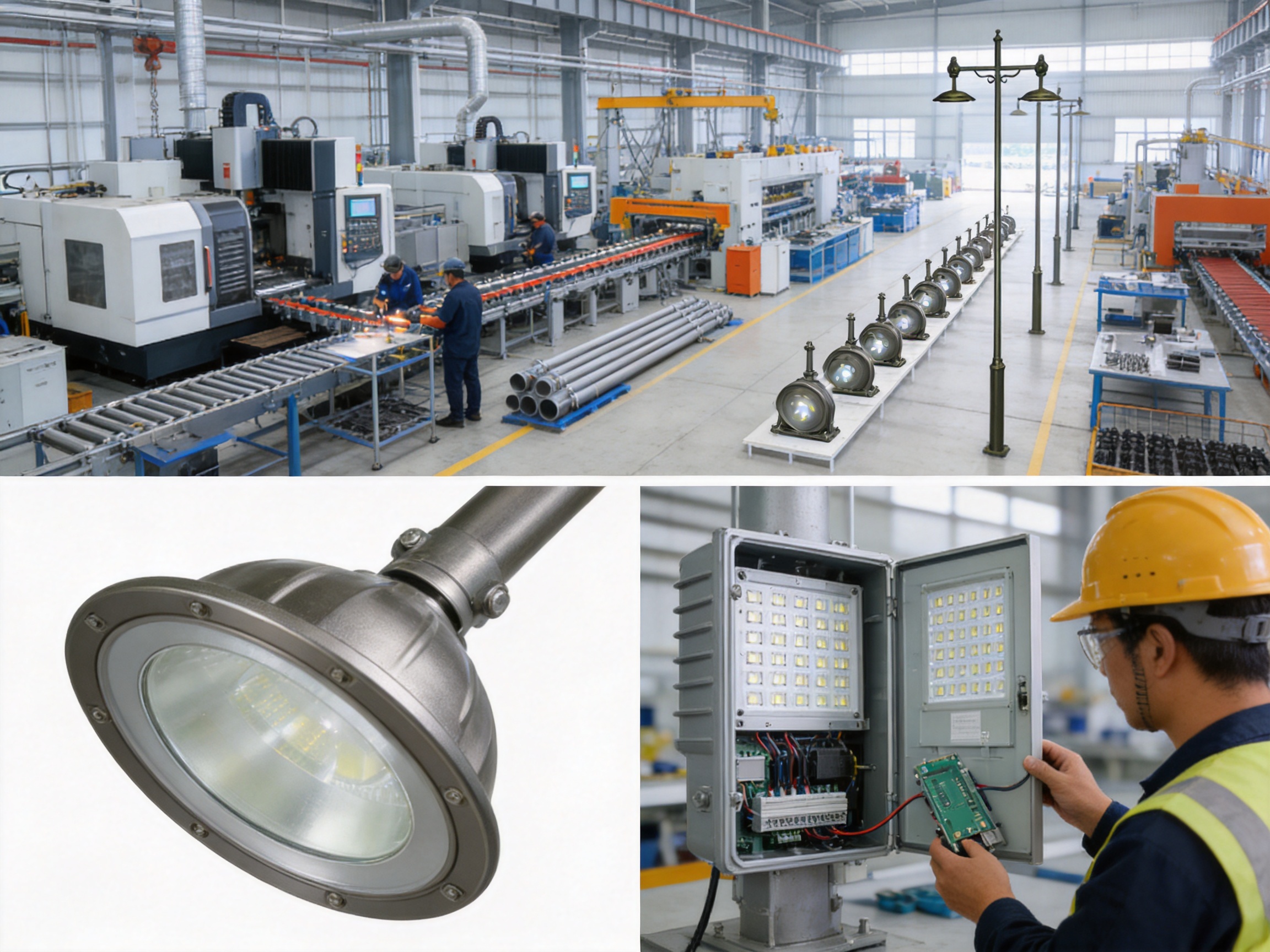
Compared with a product manufactured through inconsistent manual forming, CNC bending, precision cutting, experienced welding, automated lines, and die-casting provide a stronger basis for repeatability. This is particularly important when multiple poles must appear identical along a long avenue.
Compared with a one-size-fits-all lighting product, the availability of different pole materials, 6-meter to 10-meter heights, color temperatures, control methods, and finish options gives designers more opportunity to adapt the system to project conditions.
14. Procurement Guidance for Project Owners
Before placing an order, project owners should define the road classification, mounting arrangement, spacing, required illumination, color temperature, control strategy, pole material, surface finish, and environmental exposure. A complete lighting layout should be reviewed rather than selecting the fixture only from a product photograph.
The project team should request photometric files or lighting calculations for the intended installation. These documents can help confirm average illuminance, uniformity, glare considerations, light trespass, and power requirements. The final performance depends on the entire system, including pole spacing, mounting height, road width, arm projection, optical angle, and surrounding surfaces.
Structural information should include pole weight, wind-load assumptions, foundation requirements, anchor-bolt arrangement, and allowable installation tolerances. The designer should verify the relevant local standards and confirm whether additional treatments are required for coastal or high-corrosion environments.
Electrical documentation should cover input voltage, driver specifications, surge protection, grounding, cable requirements, dimming interfaces, and commissioning procedures. If a smart-control platform is planned, compatibility should be confirmed before production.
Finish samples or color references are recommended for projects with strict aesthetic requirements. Antique-style coatings can appear different under direct sunlight, diffuse daylight, and artificial illumination. Reviewing samples in the actual landscape context can help avoid unexpected differences after installation.
15. Sustainability and Lifecycle Value
Sustainability in outdoor lighting should be considered across the complete lifecycle rather than through energy efficiency alone. A durable housing, corrosion-resistant finish, maintainable driver compartment, efficient LED source, and replaceable modules can all contribute to longer service life and reduced material waste.
The high luminous efficiency of up to 140 lumens per watt can reduce the electrical energy required to achieve a specified lighting level. Dimming through DC 0-10 V or DALI can provide additional savings when operating conditions allow lower output. The best results are achieved when lighting calculations and control schedules are developed together.
Longer service intervals can reduce the environmental and financial impacts associated with maintenance travel, access equipment, replacement parts, and road disruption. Accessible maintenance panels support this objective by making inspection and repair more practical.
Durable aluminum-alloy construction and protective coating can also improve lifecycle value. A product that maintains its structural and visual quality for a longer period may reduce the need for premature replacement. This is especially important in historical districts, where replacing a large number of decorative poles can affect both budgets and the continuity of the public-space design.
16. Recommended Design Approach
A successful application should begin with an analysis of the site’s cultural, architectural, traffic, and environmental conditions. The lighting designer should identify the principal viewing directions, important buildings, pedestrian routes, road edges, landscape elements, and locations where light spill could create problems.
The pole rhythm should then be studied in relation to the avenue or path. Equal spacing may be suitable for a formal road, while a more varied arrangement may be appropriate for a landscape route. Double-arm poles should be oriented consistently, and the luminaire head should be aligned with the visual axis of the road wherever possible.
Color temperature should be selected as part of the wider nighttime palette. Warm white light may reinforce historical character, while neutral white may improve clarity on certain modern avenues. Mixing color temperatures should be avoided unless it is an intentional part of the lighting design.
Finally, the product should be evaluated as part of a complete infrastructure system. Foundation design, electrical distribution, control equipment, maintenance access, drainage, tree growth, signage, and future road changes should all be considered. The strongest result is achieved when the light pole is integrated into the project from the beginning rather than added after the landscape and architectural plans are complete.
17. Frequently Asked Questions
Q1: What type of project is this LED road light designed for?
The product is designed for historical districts, cultural tourism areas, premium landscape paths, distinctive urban avenues, residential developments, and other outdoor spaces where visual character is as important as road illumination. It can be used for roads, pedestrian routes, landscaped approaches, and formal avenue compositions.
Q2: Is the product only decorative, or can it provide functional road lighting?
It is a functional LED road-lighting system. The product uses high-performance LED sources and asymmetric light distribution to direct illumination toward roads and pedestrian paths. Its decorative structure enhances the appearance, but the system is engineered to provide practical outdoor lighting performance.
Q3: What pole heights are available?
The listed pole-height range is 6 meters to 10 meters. The appropriate height depends on road width, mounting arrangement, required lighting level, pole spacing, surrounding buildings, and the project’s structural calculations.
Q4: What input voltage does the luminaire support?
The product supports an AC 85-265 V input range. The final electrical configuration should be checked against the local power supply, frequency, protection requirements, and applicable electrical standards.
Q5: Can the light be dimmed?
Yes. The system supports DC 0-10 V and DALI dimming interfaces. These options can be used for scheduled dimming, energy management, and integration with suitable lighting-control systems.
Q6: What color temperatures are available?
The listed color-temperature range is 3000 K to 6000 K. Warm settings can support a traditional and welcoming atmosphere, while cooler settings can provide a cleaner and more contemporary appearance. The final selection should reflect the project’s architecture and lighting objectives.
Q7: How does the system help reduce light pollution?
Its asymmetric optical distribution is designed to control the direction of light and focus illumination on the road or pedestrian area. By limiting unnecessary sideways projection, the system can help reduce light trespass toward residential properties and adjacent spaces. A complete photometric design is still required for project-specific verification.
Q8: Is the housing suitable for outdoor use?
The lamp housing is made from aluminum alloy and has an IP65 rating. These features support outdoor use by providing a durable enclosure and protection against dust and water jets. Correct installation, sealing, grounding, and maintenance remain necessary.
Q9: What is the operating temperature range?
The listed operating temperature range is -35 to 65 degrees Celsius. Site conditions, driver selection, installation details, and electrical protection should be reviewed during project design.
Q10: How is maintenance performed?
The light-source cavity and driver module include accessible maintenance panels. This modular arrangement allows technicians to inspect or service key components without dismantling the entire decorative structure. Maintenance procedures should follow the manufacturer’s technical instructions.
Q11: What materials are available for the lamp pole?
Listed options include Q235, Q355, SS400, GR65, and related material choices. The suitable material grade depends on structural calculations, local standards, wind conditions, corrosion exposure, and project specifications.
Q12: What manufacturing capabilities support the product?
Production resources include CNC bending, high-accuracy cutting, certified welding, automated lines, powder electrostatic painting equipment, and a 1250-ton die-casting machine. These capabilities support dimensional consistency, structural quality, coating performance, and efficient large-scale production.
Q13: Can the product be customized?
Project support includes CAD design, three-dimensional product and scene simulation, specification and color customization, mechanical calculations, wind and foundation analysis, and overseas installation guidance. Specific customization options should be confirmed during technical consultation.
Q14: What warranty is provided?
The listed warranty period is five years. Warranty coverage should be reviewed together with installation conditions, operating schedules, electrical protection, maintenance obligations, and other terms in the project quotation or contract.
Q15: Why is the product suitable for large projects?
The manufacturer combines extensive material stock, specialized equipment, experienced technicians, automated production, quality systems, and international export experience. These resources can support consistent production and project coordination when many matching poles and luminaires are required.
18. Conclusion
The Neo-Chinese Classical Rhythmic LED Road Light offers a considered response to the growing demand for lighting that combines cultural expression with modern engineering. Its heritage-inspired appearance can strengthen the identity of historical districts, tourism destinations, landscaped avenues, and premium urban environments, while its LED technology supports efficiency, controlled distribution, dimming, and dependable outdoor operation.
The product’s advantages extend beyond its appearance. Aluminum-alloy construction, precision die-casting, IP65 protection, a broad operating-temperature range, asymmetric optics, accessible maintenance panels, and a five-year warranty provide a practical foundation for long-term use. The 6-meter to 10-meter pole range, multiple material options, color-temperature choices, and dimming interfaces offer flexibility for different site conditions.
Equally important is the manufacturer’s production capability. CNC bending, high-accuracy cutting, experienced welding, automated lines, powder electrostatic painting, and large-capacity die casting support repeatable quality and competitive production. Design simulation, structural calculations, customization, and installation guidance further strengthen the product’s suitability for complex projects.
For project owners and designers seeking a road light that contributes to both nighttime safety and daytime identity, this system provides a strong combination of architectural character, optical control, manufacturing capability, and lifecycle-oriented maintenance. When integrated through careful lighting calculations, structural engineering, and landscape coordination, it can become a defining element of a memorable and well-managed urban environment.
References
1. International Commission on Illumination. Principles of Outdoor Road and Public-Area Lighting Design.
2. Illuminating Engineering Society. Recommended Practices for Roadway and Pedestrian Lighting.
3. International Organization for Standardization. ISO 9001 Quality Management Systems.
4. International Organization for Standardization. ISO 14001 Environmental Management Systems.
5. International Electrotechnical Commission. Requirements for Outdoor Luminaires and LED Lighting Equipment.
6. General Principles of Aluminum Die Casting, Thermal Management, and Corrosion Protection for Outdoor Lighting Enclosures.
7. General Principles of Photometric Planning, Asymmetric Light Distribution, Glare Control, and Light-Trespass Reduction.
8. Manufacturer-provided technical specifications, production information, engineering-support capabilities, and product application materials.