


JINYUAN
JINYUAN
JINYUAN
JINYUAN
JINYUAN
JINYUAN
JINYUAN
JINYUAN
JINYUAN
JINYUAN
JINYUAN
JINYUAN
JINYUAN
JINYUAN
JINYUAN
JINYUAN
Content
- 1 1. The Role of Dual-Arm Lighting in Modern Road Design
- 2 2. Product Overview and Core Specifications
- 3 3. High-Brightness LED Performance with Efficient Optical Control
- 4 4. Structural Strength for Demanding Outdoor Conditions
- 5 5. Thermal Management and Long-Term LED Reliability
- 6 6. Intelligent Control and Energy Management
- 7 7. Advantages Compared with Conventional Roadway Lighting
- 8 8. Precision Manufacturing as a Source of Product Quality
- 9 9. Engineering Services from Concept to Installation
- 10 10. Application Areas
- 11 11. Installation and Maintenance Considerations
- 12 12. Lifecycle Value and Total Cost of Ownership
- 13 13. Quality Systems and Manufacturing Experience
- 14 14. Project Selection Guidance
- 15 15. Sustainability and Environmental Considerations
- 16 16. Procurement and Customization Support
- 17 17. Why This Product Is a Strong Competitive Choice
- 18 18. Questions and Answers
- 18.1 Q1: What type of projects is this dual-arm LED roadway light intended for?
- 18.2 Q2: What is the available pole height?
- 18.3 Q3: What materials are available for the pole?
- 18.4 Q4: Is the pole protected against corrosion?
- 18.5 Q5: Can the light be used in cold and hot climates?
- 18.6 Q6: Does the luminaire support dimming?
- 18.7 Q7: What is the luminous efficiency?
- 18.8 Q8: What color temperatures are available?
- 18.9 Q9: What does the IP65 rating indicate?
- 18.10 Q10: How does the dual-arm configuration help a road project?
- 18.11 Q11: Can the product appearance be customized?
- 18.12 Q12: Does the manufacturer provide structural design assistance?
- 18.13 Q13: What manufacturing equipment supports production?
- 18.14 Q14: What warranty is offered?
- 18.15 Q15: Can the product be used in a smart-city lighting network?
- 19 19. Conclusion
- 20 References
- 21 Product: Industrial-Grade High-Brightness Dual-Arm LED Roadway Light
Modern road infrastructure requires lighting systems that do much more than illuminate a pavement surface. A dependable roadway light must provide consistent visibility, resist severe weather, support efficient energy use, simplify maintenance, and integrate with evolving smart-city systems. It must also remain structurally reliable for many years while operating in environments exposed to moisture, dust, temperature changes, vibration, wind, and atmospheric corrosion.
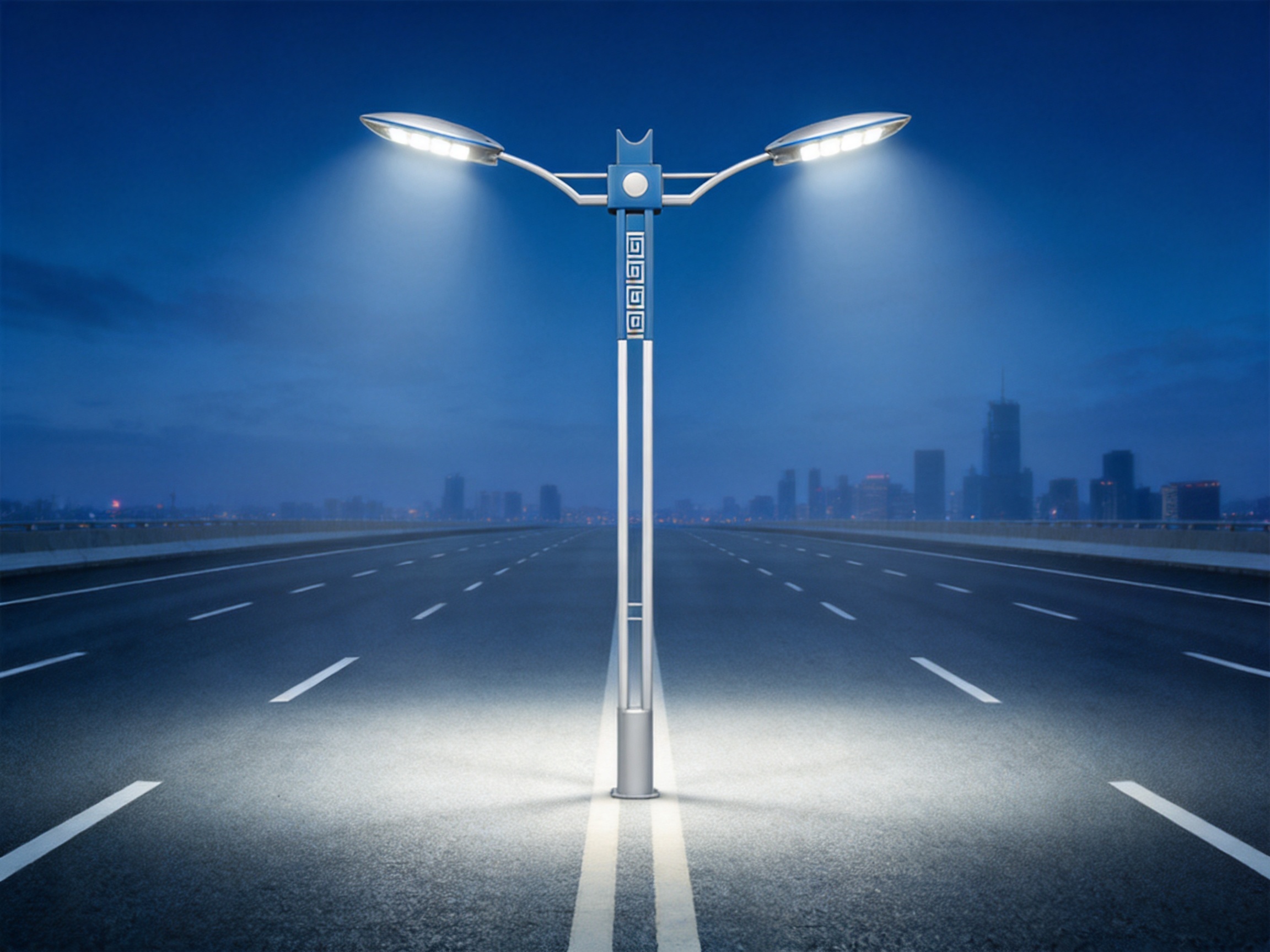
The Industrial-Grade High-Brightness Dual-Arm LED Roadway Light is designed to address these requirements in one integrated lighting solution. Its dual-arm configuration supports wide-area illumination for roads, junctions, interchanges, logistics parks, industrial facilities, and other large outdoor spaces where balanced coverage is essential. Combining a high-strength galvanized steel pole, aluminum-alloy LED luminaires, high-efficiency optical modules, intelligent dimming compatibility, and rigorous manufacturing processes, the system offers a practical alternative to conventional single-arm or low-quality roadway lighting products.
This product is supplied by Yangzhou Jinyuan Lamps Co., Ltd., a professional road illumination manufacturer with experience in lighting design, pole production, LED fixture manufacturing, engineering support, and international project delivery. The company’s broad manufacturing capabilities allow customers to obtain coordinated lighting products and structural components from one experienced source instead of managing multiple unrelated suppliers.
1. The Role of Dual-Arm Lighting in Modern Road Design
Road lighting is often evaluated by its brightness, but brightness alone does not determine lighting quality. The more important questions are whether the light is distributed evenly, whether glare is controlled, whether both sides of the road receive appropriate illumination, and whether the system can maintain performance over its service life.
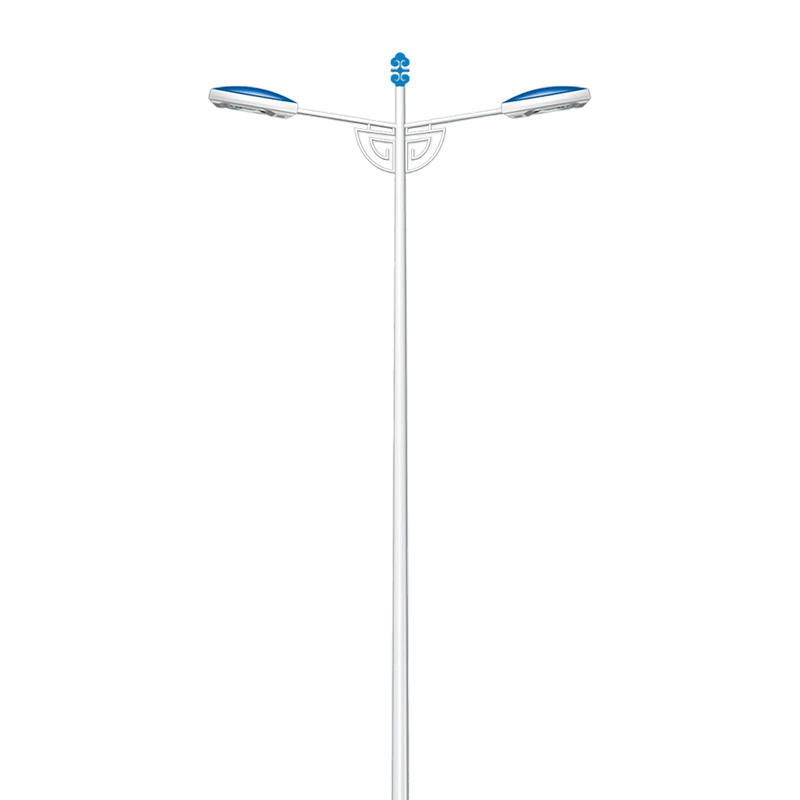
A dual-arm roadway light places two luminaires on a common pole structure. Depending on the road layout and arm orientation, the luminaires can illuminate opposite directions, separate carriageways, multiple lanes, central road areas, or adjacent circulation zones. This configuration may reduce the number of poles required for a project while maintaining a broad lighting footprint.
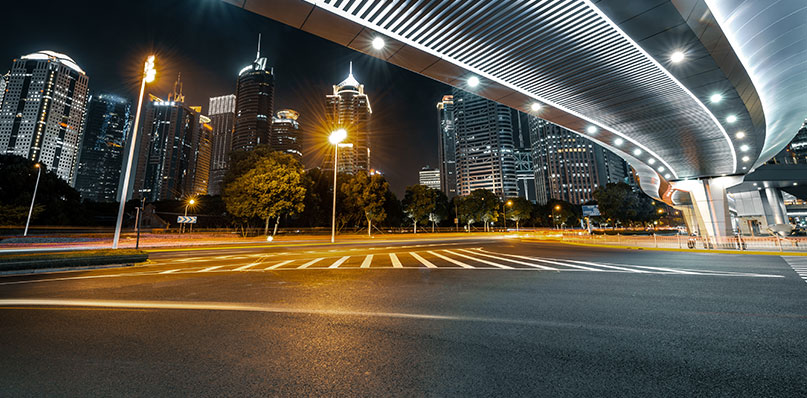
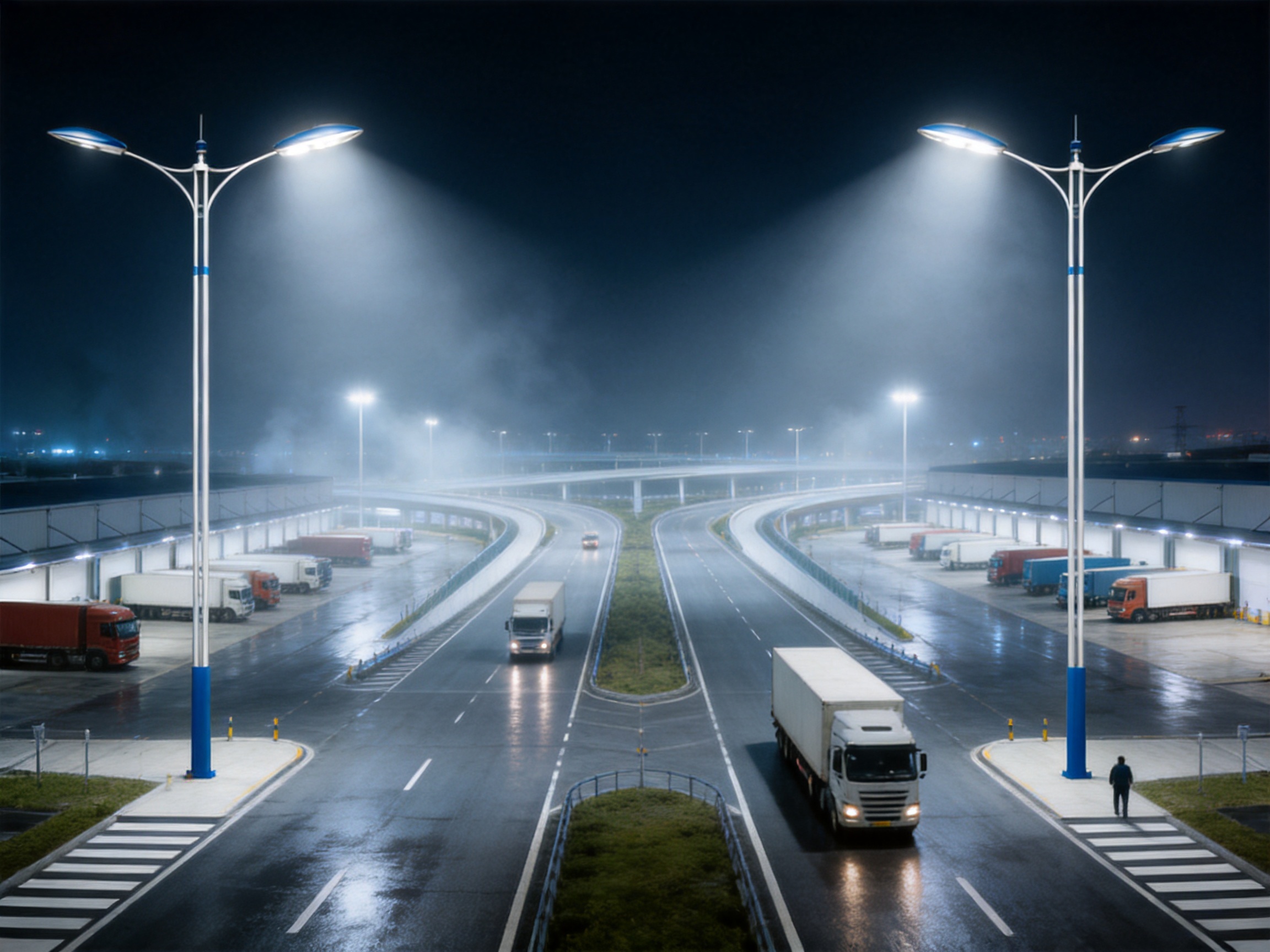
For urban arterial roads, a dual-arm system can provide coordinated illumination for opposing traffic flows. At highway interchanges, it can help cover merge areas, turning zones, ramps, and connecting lanes. In logistics parks, the broad output is suitable for truck circulation routes, loading areas, access roads, and large vehicle maneuvering zones.
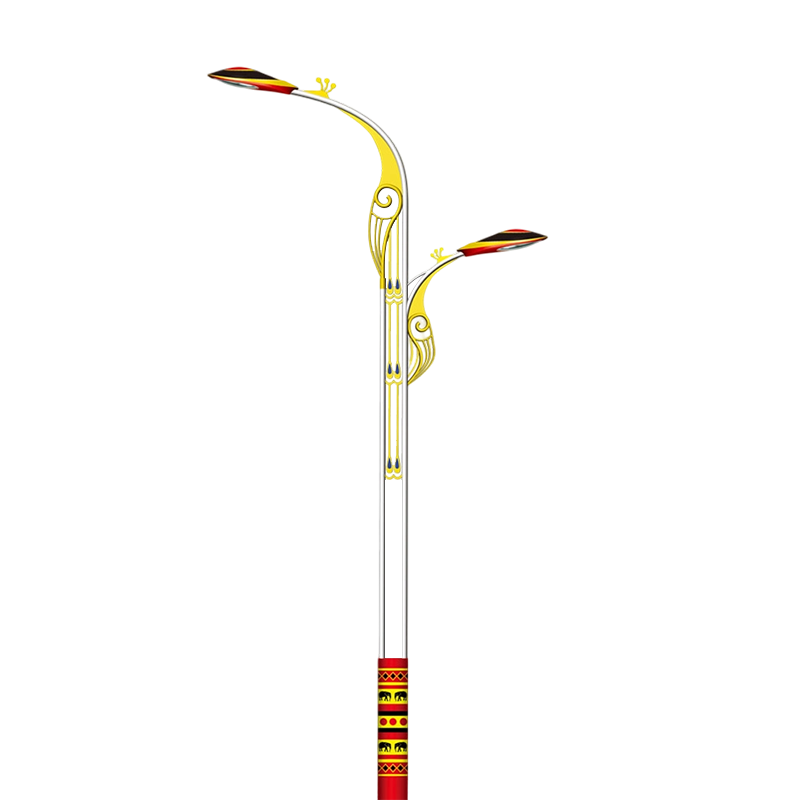
The dual-arm approach also creates a visually organized streetscape. A carefully proportioned pole and luminaire arrangement can provide a consistent rhythm along a road, supporting both functional lighting and architectural integration. The product can be supplied with a sleek, minimalist appearance or with design elements suited to a particular regional or urban landscape concept.
2. Product Overview and Core Specifications
The Industrial-Grade High-Brightness Dual-Arm LED Roadway Light is categorized as an LED Double-arm Light and is primarily intended for road applications. The system combines a structural pole with LED luminaires engineered for outdoor use. Its specification range is suitable for many medium-height roadway installations, while its modular format allows project-specific configuration.
| Item | Specification |
|---|---|
| Product type | Industrial-grade dual-arm LED roadway light |
| Primary application | Roads, arterial streets, highway interchanges, logistics parks, and large outdoor circulation areas |
| Input voltage | AC 85–265 V |
| Light source | LED |
| Lamp housing material | Aluminum alloy |
| Operating temperature | -35°C to 65°C |
| Ingress protection | IP65 |
| Luminous efficiency | Up to 140 lm/W |
| Color temperature | 3000 K–6000 K |
| Color rendering index | Ra 70 |
| Dimming options | DC 0–10 V and DALI |
| Warranty period | 5 years |
| Pole materials | Q235, Q355, SS400, GR65, and related options |
| Pole height | 6–10 m |
The broad AC 85–265 V input range supports deployment across different electrical environments and helps accommodate regional grid variations. The IP65 rating provides protection against dust ingress and water projected from common outdoor directions, making the luminaire suitable for exposed roadway applications when installed and maintained according to engineering requirements.
The product’s operating temperature range of -35°C to 65°C supports use in many climates, including cold winter environments and hot summer conditions. The actual suitability of a complete installation should always be confirmed through project-specific evaluation of solar exposure, wind, ambient temperature, electrical conditions, and local standards.
3. High-Brightness LED Performance with Efficient Optical Control
The optical system is one of the most important differences between a professional roadway light and a basic flood-type fixture. A floodlight may produce a large amount of light, yet still create uneven brightness, excessive glare, wasted upward light, or poorly illuminated road edges. The dual-arm roadway light uses multi-angle light distribution technology to direct illumination according to road width, mounting height, lane arrangement, and required coverage.
This approach allows the lighting design to be adapted to different installation conditions. A narrow roadway may require a concentrated distribution pattern, while a wide arterial road may need a broader lateral spread. A high mounting position may require a different optical angle from a lower pole installation. By selecting an appropriate distribution configuration, the project can achieve better uniformity without simply increasing power consumption.
The stated luminous efficiency can reach 140 lumens per watt. In practical terms, higher efficacy means that more visible light can be produced from each watt of electrical input. This can support lower operating costs compared with older high-pressure sodium, metal halide, or inefficient LED products, although the final energy result depends on the selected power, operating schedule, dimming strategy, and lighting design.
The LED modules are designed to provide stable color performance and low lumen depreciation. Low lumen depreciation is important because a roadway lighting system is expected to maintain useful illumination over a long operating period. A fixture that loses a substantial portion of its light output early in its service life may force operators to increase power, replace equipment prematurely, or accept lower roadway visibility.
Uniform lighting also contributes to driver comfort and road safety. Severe contrast between bright and dark areas can make it more difficult for drivers to identify pedestrians, vehicles, road markings, signs, and obstacles. A well-designed optical distribution reduces abrupt changes in brightness and helps create a more visually consistent driving environment.
3.1 Color Temperature Selection
The available color temperature range is 3000 K to 6000 K. Warmer color temperatures can produce a softer, more comfortable visual atmosphere and may be suitable for streets where landscape character or reduced visual harshness is important. Neutral and cooler options can provide a crisp appearance and strong visual contrast for highways, industrial roads, and large circulation spaces.
Color temperature should be selected according to the application, local regulations, surrounding land use, environmental requirements, and the intended visual identity of the project. The ability to select from a broad range gives designers greater control than products fixed to a single color option.
3.2 Color Rendering and Visual Recognition
The product provides a color rendering index of Ra 70. This level supports practical road illumination and helps users distinguish common objects, vehicles, markings, and environmental features under artificial light. Improved color recognition can be especially useful in logistics areas, access roads, public facilities, and locations where security monitoring is important.
4. Structural Strength for Demanding Outdoor Conditions
Road lighting poles are structural products as well as lighting products. They must carry the weight of the luminaires and arms while resisting wind pressure, vibration, rain, temperature changes, and long-term material stress. A failure in the structural system can create significant safety risks and operational disruption.
The main pole is manufactured from high-strength hot-dip galvanized steel and can be specified using materials such as Q235, Q355, SS400, GR65, and related grades. These material options provide flexibility for structural calculations, regional requirements, project budgets, and different wind-load conditions.
Hot-dip galvanizing creates a protective zinc layer over the steel surface. This layer helps isolate the steel from moisture and atmospheric exposure, reducing the risk of oxidation and rust. For roadway projects in coastal, industrial, humid, or high-rainfall environments, corrosion protection is a major factor in determining lifecycle value.
The pole can also receive an anti-corrosion spray coating. Used together with galvanizing, an appropriate coating system provides an additional barrier against environmental attack and allows the pole color and finish to be aligned with the surrounding infrastructure. Coating selection should be matched to local exposure conditions and the project’s maintenance expectations.
Structural integrity is supported by accurate bending, controlled welding, appropriate material selection, and engineering calculations for wind and foundation conditions. These details distinguish a professional pole manufacturer from a supplier that simply assembles standard components without evaluating the complete load path.
The 6 m to 10 m pole height range covers many urban and industrial road applications. A lower pole may be suitable for local access routes or pedestrian-oriented areas, while a taller pole can improve coverage for broad carriageways and large vehicle zones. The final height, arm length, luminaire power, foundation, anchor bolts, and spacing should be determined through a complete lighting and structural design.
5. Thermal Management and Long-Term LED Reliability
LED performance is closely connected to temperature. Although LED systems are more efficient than many traditional light sources, a portion of electrical energy is still converted into heat. If that heat is not transferred away efficiently, the LED junction temperature may rise, accelerating lumen depreciation, affecting electronic components, and shortening the useful life of the fixture.
The roadway light uses a scientifically engineered cooling structure designed to enhance heat convection. The aluminum-alloy lamp housing contributes to heat transfer while providing a strong and relatively lightweight enclosure. Efficient thermal pathways help maintain the LED chips and driver components within an appropriate operating range.
Good thermal management has several advantages. It supports more stable light output, helps protect the driver, reduces the risk of thermal stress, and improves long-term reliability in hot environments. It may also reduce the frequency of maintenance interventions caused by premature component failure.
Thermal performance should be considered together with installation conditions. Correct mounting, unobstructed ventilation, suitable electrical protection, and regular inspection all contribute to reliable operation. Dust accumulation, unauthorized modifications, blocked heat dissipation surfaces, or incorrect driver replacement can reduce the benefits of the original design.
6. Intelligent Control and Energy Management
Roadway lighting increasingly needs to respond to changing traffic levels, operating hours, weather conditions, and energy targets. A system that operates at full output throughout the entire night may provide unnecessary illumination during low-traffic periods. Intelligent control can reduce this waste while preserving required visibility.
The dual-arm LED roadway light supports DC 0–10 V and DALI dimming. These control interfaces allow the fixture to be incorporated into compatible lighting management systems. Time-based dimming can reduce output during predetermined low-traffic hours, while sensing functions can support automated responses where the overall control architecture includes suitable sensors and communication equipment.
Intelligent dimming may provide several benefits:
It can reduce energy consumption during periods of low activity.
It can extend the useful life of LED modules and drivers by reducing average operating stress.
It can support centralized monitoring and scheduled maintenance.
It can help municipalities and facility operators meet energy-efficiency targets.
It can improve the flexibility of lighting operation as traffic patterns change.
Smart control should not be treated as a replacement for proper lighting design. The baseline system must first provide appropriate illumination, uniformity, glare control, and safety. Control settings should then be developed around traffic conditions, local requirements, environmental considerations, and the operating priorities of the site.
7. Advantages Compared with Conventional Roadway Lighting
7.1 Compared with Traditional Discharge Lamps
Traditional high-pressure sodium and metal halide systems often require more energy for a comparable roadway lighting result, particularly when their optical control and aging characteristics are considered. They may also require longer warm-up periods, more frequent lamp replacement, and additional maintenance related to ballasts, igniters, and lamp failures.
The LED dual-arm system offers instant startup, controllable output, lower lumen depreciation, and compatibility with modern dimming systems. Its higher luminous efficiency can reduce energy demand, while its modular construction can simplify service procedures. LED light also provides more consistent color characteristics throughout operation than many traditional discharge technologies.
7.2 Compared with Basic Single-Arm Fixtures
A single-arm light may be suitable for narrow roads, but it can be less effective when both directions of a broad road or two separate areas must be illuminated. Installing more single-arm poles may increase foundation work, cable length, pole quantity, visual clutter, and maintenance points.
A dual-arm arrangement can provide broader and more balanced coverage from a coordinated structural location. This does not mean that a dual-arm system is automatically the best option for every road. It is most valuable where the road geometry, lane arrangement, median design, or site layout benefits from two directional lighting outputs.
7.3 Compared with Low-Quality LED Products
Low-cost LED fixtures may appear attractive at the purchasing stage, but their total cost can increase when poor heat dissipation, weak housings, unstable drivers, inadequate sealing, inconsistent optical performance, and premature failures are considered. A professional product should be evaluated by its complete lifecycle value rather than by the initial unit price alone.
The Industrial-Grade High-Brightness Dual-Arm LED Roadway Light combines a protective housing, controlled optical system, thermal design, wide voltage compatibility, IP65 protection, dimming support, and a five-year warranty. These features provide a more structured basis for long-term project planning.
7.4 Compared with Unprotected Steel Poles
Unprotected or poorly coated steel can deteriorate quickly in humid or polluted environments. Corrosion may affect appearance, structural strength, access doors, fasteners, and foundation connections. Hot-dip galvanizing combined with an appropriate spray coating provides a more durable surface protection strategy than untreated steel or an inadequate paint layer alone.
8. Precision Manufacturing as a Source of Product Quality
Product performance is strongly influenced by manufacturing accuracy. Even an excellent design can fail to deliver consistent results if materials are poorly controlled, dimensions vary, welds are inconsistent, or coatings are applied without process discipline. The manufacturer’s production capabilities are therefore an important part of the product’s value proposition.
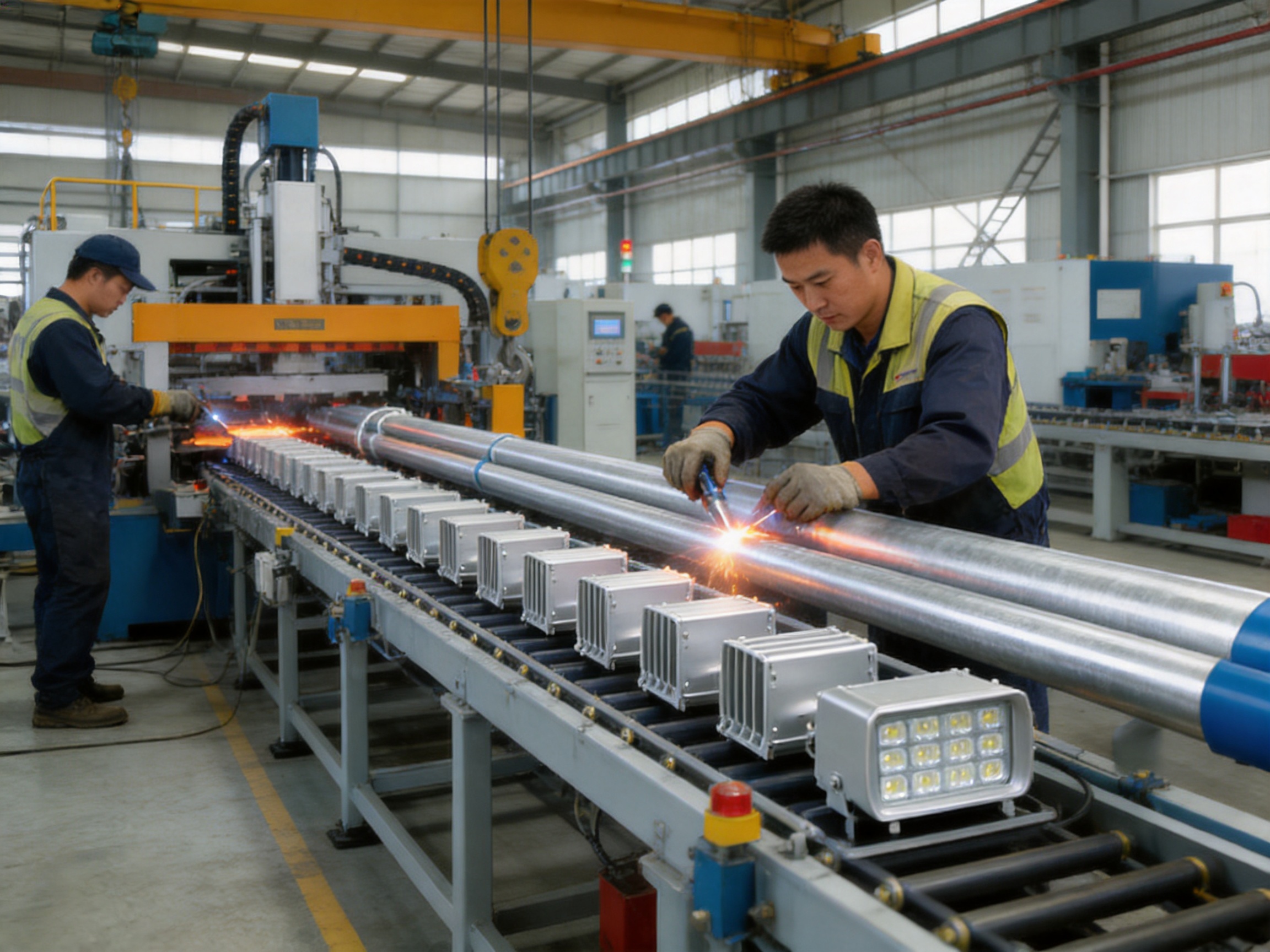
Yangzhou Jinyuan Lamps Co., Ltd. maintains a large-scale production and engineering operation serving the road illumination sector. The company’s facilities cover more than 70,000 square meters and include professional technicians, production equipment, design resources, and quality-control procedures. This scale supports both standard product manufacturing and customized project delivery.
8.1 Material Availability and Production Continuity
The company supports material options including Q235B, Q345B, S275JR, S355JR, Q460, A36, A572, GR56, GR50, and other grades. Maintaining an extensive material inventory can help reduce project delays caused by shortages or long procurement cycles. It also gives engineering teams more flexibility when selecting steel according to structural calculations and customer requirements.
Material traceability and incoming inspection are important considerations in pole production. Appropriate checks can verify thickness, grade, surface condition, and dimensional conformity before materials enter bending, cutting, or welding operations. These controls help create a more reliable foundation for finished-product quality.
8.2 CNC Bending
Precise CNC bending supports consistent pole geometry and improves structural repeatability. Accurate bending reduces variation between production batches and helps limit post-production adjustment. It also supports proper alignment of the pole shaft, arm assembly, access components, and luminaire mounting points.
For dual-arm structures, dimensional consistency is particularly important. If the two arms are not correctly aligned, the luminaires may not point toward their intended road areas, which can affect lighting uniformity and visual appearance. CNC-controlled forming helps maintain the planned geometry across multiple units.
8.3 High-Accuracy Cutting
Cutting accuracy affects the fit of pole sections, doors, brackets, reinforcement pieces, and connection components. The company describes cutting accuracy of up to 0.01 mm for applicable manufacturing operations. Precise cutting can create cleaner edges, improve assembly fit, reduce unnecessary rework, and support a more consistent finished product.
Accurate cutting is also valuable for customized projects. When a customer specifies a particular access-door position, arm length, flange pattern, decorative profile, or mounting interface, controlled cutting helps the production team achieve the required dimensions more reliably.
8.4 Welding Expertise
Welding quality directly influences the strength and durability of a steel pole. The manufacturer’s team of certified welders brings extensive experience to large-scale pole and lighting projects. Proper welding practice helps ensure that joints, brackets, reinforcement sections, flanges, and structural connections perform as intended.
Weld quality should be assessed through appropriate inspection procedures, including visual checks and any project-specific non-destructive testing requirements. Consistent welding also reduces the likelihood of cracks, distortion, weak connections, and coating defects that could become more serious during long-term outdoor use.
8.5 Automated Production Lines
Automation can improve repeatability, production speed, and process control. Automated welding, cutting, and coating operations help reduce human variation in repetitive tasks while allowing skilled personnel to focus on supervision, inspection, setup, and engineering judgment.
Efficient automated production can also help reduce manufacturing costs without relying on low-quality materials or excessive labor shortcuts. For large infrastructure projects, this can improve delivery consistency and support more competitive pricing.
8.6 Die Casting and Luminaire Components
The company operates advanced equipment, including a 1,250-ton die-casting machine. Die casting can support the production of strong, dimensionally consistent aluminum-alloy components for LED luminaires and related parts. A well-formed housing contributes to heat dissipation, enclosure strength, mounting accuracy, and visual quality.
8.7 Anti-Corrosion Treatment
Anti-corrosion protection is supported by hot-dip galvanizing and powder electrostatic painting equipment. Electrostatic coating can improve coverage consistency and finish quality when the surface is correctly prepared. The combination of galvanizing and coating is particularly useful for outdoor poles that must withstand rain, humidity, pollution, ultraviolet exposure, and temperature cycling.
Surface preparation, coating thickness, curing conditions, handling, and inspection all affect final corrosion resistance. A controlled production environment helps reduce defects such as pinholes, uneven coverage, poor adhesion, and damage during transport.

Industrial-Grade High-Brightness Dual-Arm LED Roadway Light
9. Engineering Services from Concept to Installation
A roadway lighting project involves more than selecting a fixture from a catalog. Pole height, arm geometry, foundation design, wind load, road width, spacing, power supply, control method, environmental exposure, transportation, and maintenance access must work together. The manufacturer supports customers with services intended to connect product selection with project execution.
9.1 CAD Design
CAD design can be used to prepare dimensional drawings, mounting details, pole profiles, arm arrangements, foundation interfaces, access-door locations, and other project-specific information. Clear drawings help contractors, consultants, and project owners review the design before production begins.
9.2 Three-Dimensional Product Simulation
Three-dimensional product simulation allows customers to visualize the relationship between the pole, arms, luminaires, brackets, and decorative features. This can be useful when a project has a distinctive streetscape, a constrained median, or a requirement for a specific visual profile.
9.3 Three-Dimensional Scene Simulation
Scene simulation places the proposed product within a representative road or landscape environment. It can help stakeholders evaluate scale, visual balance, arm orientation, pole spacing, and compatibility with surrounding buildings or infrastructure. Early visualization may reduce design changes after production has started.
9.4 Specification and Color Customization
Customers may require different pole materials, dimensions, finishes, color tones, mounting arrangements, or decorative details. Customization helps the lighting system match regional design standards, municipal identity, industrial branding, or existing infrastructure.
9.5 Mechanical Calculation for Wind and Foundation
Wind load is a critical factor in pole design. The manufacturer provides mechanical calculation support for wind and foundation requirements. The calculation process should consider pole height, arm projection, luminaire size, projected area, terrain, wind speed, exposure category, soil conditions, and applicable local design codes.
Foundation design is equally important. A structurally suitable pole still requires an appropriate reinforced-concrete foundation, anchor-bolt arrangement, drainage approach, and soil interface. Project engineers and local construction professionals should verify all foundation details before installation.
9.6 Overseas On-Site Installation Guidance
International projects may involve different construction practices, electrical standards, site conditions, and contractor experience. Overseas on-site installation guidance can help teams understand assembly sequences, luminaire orientation, anchor-bolt positioning, cable routing, grounding, tightening procedures, and commissioning requirements.
Professional guidance is especially valuable for dual-arm systems because correct alignment of both luminaires affects the final lighting result. It also helps reduce installation errors that could otherwise cause delays, rework, or premature damage.
10. Application Areas
10.1 Urban Arterial Roads
Urban arterial roads carry substantial traffic and connect major districts, commercial areas, residential zones, and public facilities. They require dependable illumination with good uniformity, controlled glare, and a visual appearance that complements the city environment.
The dual-arm configuration can serve opposing traffic flows or illuminate a broad central corridor. The availability of different color temperatures, pole finishes, and decorative options allows the product to adapt to both modern minimalist streetscapes and more traditional urban design concepts.
10.2 Highway Interchanges
Interchanges contain merging lanes, curved ramps, acceleration zones, exit areas, and changes in road elevation. These conditions can create complex lighting requirements. Multi-angle light distribution and appropriate pole positioning can help direct light into key conflict areas while reducing unnecessary spill.
Highway projects also place strong demands on structural strength, corrosion resistance, access for maintenance, and reliable operation under variable weather conditions. The galvanized steel pole and IP65 LED luminaire are designed for this type of demanding outdoor environment, subject to project-specific engineering approval.
10.3 Logistics Parks
Logistics parks operate throughout the day and night, with heavy trucks, forklifts, service vehicles, trailers, and pedestrians sharing circulation routes. Clear, consistent illumination supports safe movement, loading operations, vehicle positioning, and site security.
The dual-arm product can illuminate internal roads, perimeter routes, intersections, loading approaches, and large vehicle staging areas. Intelligent dimming can be programmed to reflect activity levels, reducing output during quiet periods while allowing higher output during loading or shift-change operations.
10.4 Industrial and Commercial Access Roads
Industrial facilities often require lighting that is durable, easy to maintain, and compatible with safety management systems. The product’s wide input-voltage range, modular interface, aluminum-alloy housing, and corrosion-resistant pole structure make it suitable for many industrial access applications.
10.5 Large Outdoor Public Areas
Although designed primarily for roads, a dual-arm roadway system may also be considered for large outdoor circulation areas, transport facilities, campuses, and infrastructure compounds. The application should be evaluated according to illumination levels, pedestrian needs, glare limits, emergency access, and local regulations.
11. Installation and Maintenance Considerations
Correct installation is essential to achieving the intended performance of any roadway lighting system. Before installation, the project team should verify foundation dimensions, anchor-bolt position, cable routing, pole orientation, arm direction, luminaire tilt, electrical protection, and grounding.
The foundation must be completed and adequately cured before the pole is erected. Lifting equipment should be selected according to the pole’s weight, height, center of gravity, and site conditions. The pole should be protected from impact during transport and installation, especially around flanges, access doors, coating surfaces, and cable entry points.
After installation, the two luminaires should be aimed according to the approved lighting design. Incorrect tilt or rotation can shift light away from the carriageway, increase glare, reduce uniformity, or create unwanted illumination outside the project boundary.
Maintenance procedures should include periodic visual inspection of the pole, flange, anchor bolts, access door, coating, luminaire housing, cables, connectors, and control equipment. Coastal or industrial environments may require more frequent inspection than mild inland environments.
Because the system uses a modular interface, maintenance personnel can benefit from simplified access to replaceable components. Before opening or servicing a fixture, electrical power must be isolated according to applicable safety procedures. Replacement drivers, LED modules, seals, and control components should be compatible with the original system.
Cleaning the luminaire housing and optical surface can help preserve light output, particularly in dusty areas or locations exposed to industrial deposits. Cleaning methods should avoid abrasive materials and should follow the maintenance instructions provided for the finished product.
12. Lifecycle Value and Total Cost of Ownership
The purchase price of a roadway light is only one part of its economic impact. A complete evaluation should include energy consumption, installation labor, maintenance access, replacement frequency, spare parts, downtime, structural durability, and expected service life.
The product’s potential lifecycle advantages come from several coordinated features. High luminous efficiency can reduce energy use. Intelligent dimming can lower average operating output. Low lumen depreciation can help maintain performance for a longer period. Aluminum-alloy housings and thermal management can support LED reliability. Galvanized and coated steel can reduce corrosion-related repairs. Modular interfaces can simplify maintenance.
For a large road project, even small differences in energy consumption or failure rates can become significant over many years. A higher-quality fixture may have a greater initial cost than a basic alternative, but the investment can be justified when the project considers reduced operating expenses and fewer service interruptions.
Lifecycle analysis should be based on the actual project design. Important inputs include luminaire wattage, annual operating hours, electricity price, dimming schedule, number of poles, maintenance labor cost, access equipment, replacement component cost, and local environmental conditions.
13. Quality Systems and Manufacturing Experience
Yangzhou Jinyuan Lamps Co., Ltd. was established in 2002 and is affiliated with Jinshang Electric Group. The company operates as a production, design, and engineering organization focused on road illumination products. Its product scope includes street light poles, LED street lights, solar street lights, light fixtures, and related systems.
The company has more than 300 professional technicians and exports products to more than 200 countries. This international project experience can help the manufacturer understand the practical requirements of overseas procurement, packaging, documentation, customization, shipping coordination, and installation support.
The company’s stated management and quality credentials include ISO9001, ISO14001, and OHSAS18001. ISO9001 is associated with quality management systems, ISO14001 with environmental management, and OHSAS18001 with occupational health and safety management. Customers should review the current scope and validity of any certification during the procurement process, but these systems demonstrate the importance placed on organized production and management practices.
A broad product range is another advantage. Customers planning road, solar lighting, high mast, traffic facility, photovoltaic, communication tower, or mid-mast projects may be able to coordinate multiple infrastructure products through one supplier. This can simplify communication and promote better compatibility across a wider project package.
14. Project Selection Guidance
Before ordering the dual-arm roadway light, purchasers should prepare a clear project brief. The brief should include road width, number of lanes, median arrangement, pole spacing, required mounting height, wind speed, environmental exposure, power supply, control requirements, desired color temperature, and local lighting standards.
Designers should also identify whether both luminaires will serve opposing traffic directions, separate carriageways, intersections, pedestrian edges, loading areas, or another arrangement. The answer will influence arm length, orientation, luminaire distribution, tilt angle, and pole spacing.
Where a smart lighting system is required, the project should define the control architecture at an early stage. Dimming compatibility alone does not constitute a complete smart-city network. The customer should confirm the controller type, communication method, sensor requirements, cabinet configuration, commissioning process, and software responsibilities.
For high-wind or exposed locations, structural calculations should be completed before production. The project team should confirm the applicable wind standard, basic wind speed, terrain category, importance factor, luminaire projected area, arm geometry, and foundation conditions.
For coastal areas, industrial zones, or locations with chemical exposure, the corrosion-protection system should be reviewed in detail. Galvanizing thickness, coating type, surface preparation, fastener material, drainage, and maintenance intervals should be selected according to the severity of the environment.
15. Sustainability and Environmental Considerations
Energy-efficient LED lighting can contribute to lower operational electricity consumption compared with older technologies. When combined with time-based or sensor-based dimming, the system can reduce output during periods when full illumination is not required.
The manufacturer also describes automated production lines as helping reduce costs while supporting environmentally sustainable manufacturing. Efficient production can reduce material waste, improve process repeatability, and limit unnecessary rework. Controlled coating processes can also support more consistent use of surface-treatment materials.
Environmental performance should be considered throughout the product lifecycle. This includes responsible material selection, manufacturing energy, packaging, transportation, operation, maintenance, and end-of-life handling. Steel and aluminum components can generally be recovered through established recycling streams, subject to local facilities and contamination conditions.
Lighting design itself is an important environmental issue. Appropriate optical distribution can reduce unnecessary upward or sideways light, helping limit light trespass and sky glow. Correct dimming schedules can further reduce the environmental impact during low-activity hours.
16. Procurement and Customization Support
Wholesale and project buyers often need more than a standard product description. They may require drawings, samples, technical data sheets, test documentation, color samples, packaging specifications, inspection arrangements, and installation instructions.
The manufacturer’s engineering services can support this process from consultation through completion. CAD drawings and three-dimensional simulations help establish the intended design. Specification and color customization allow the product to meet local requirements. Mechanical calculations support structural review. Overseas installation guidance can help contractors complete field assembly correctly.
Customization should be controlled through an approved technical document. This document should identify pole height, steel grade, wall thickness, arm dimensions, flange details, luminaire model, LED power, optical distribution, color temperature, coating system, control interface, cable requirements, and inspection criteria.
Clear technical confirmation reduces the risk of misunderstandings between the customer, manufacturer, designer, and installer. It also helps ensure that the delivered product matches the assumptions used in the lighting and foundation calculations.
17. Why This Product Is a Strong Competitive Choice
The product’s main competitive advantage is not one isolated specification. It is the combination of structural engineering, optical control, LED efficiency, thermal management, smart-control compatibility, corrosion protection, manufacturing accuracy, and project support.
Compared with basic roadway lights, it provides a more complete solution for demanding infrastructure applications. Compared with conventional discharge lighting, it offers greater control flexibility, high luminous efficiency, and a modern modular architecture. Compared with low-cost LED products, it places greater emphasis on housing quality, thermal behavior, pole strength, process control, and long-term project value.
The dual-arm design can also improve the efficiency of site planning where two lighting directions are required. Instead of treating each luminaire as an isolated product, the system considers the pole, arms, fixtures, foundation, optical distribution, and control strategy as a coordinated assembly.
For buyers, this integrated approach can simplify supplier management and reduce the technical gaps that sometimes occur when poles, luminaires, and controls come from separate sources. For designers, the available customization and simulation services provide more control over the appearance and engineering details of the installation.
18. Questions and Answers
Q1: What type of projects is this dual-arm LED roadway light intended for?
It is intended for urban arterial roads, highway interchanges, logistics parks, industrial access roads, commercial circulation routes, and other large outdoor areas requiring broad, balanced illumination.
Q2: What is the available pole height?
The listed pole height range is 6 m to 10 m. The correct height should be selected according to road width, pole spacing, luminaire power, optical distribution, traffic conditions, and local design standards.
Q3: What materials are available for the pole?
Available pole materials include Q235, Q355, SS400, GR65, and related steel options. Other material grades may be considered for project-specific structural requirements.
Q4: Is the pole protected against corrosion?
Yes. The pole is constructed from hot-dip galvanized steel and can receive an anti-corrosion spray coating. The final coating system should be selected according to the local environmental exposure and project requirements.
Q5: Can the light be used in cold and hot climates?
The stated operating temperature range is -35°C to 65°C. Actual project suitability should also consider electrical equipment, installation conditions, solar exposure, wind, humidity, and local climatic factors.
Q6: Does the luminaire support dimming?
Yes. The product supports DC 0–10 V and DALI dimming interfaces. Compatibility with a complete smart-lighting system should be confirmed during project design.
Q7: What is the luminous efficiency?
The listed lamp luminous efficiency is up to 140 lumens per watt. Actual system performance depends on the selected LED module, driver, optical configuration, operating temperature, and project settings.
Q8: What color temperatures are available?
The available color temperature range is 3000 K to 6000 K. Customers can select a suitable option based on visual comfort, road use, surrounding architecture, local standards, and environmental considerations.
Q9: What does the IP65 rating indicate?
IP65 indicates protection against dust ingress and water projected from common outdoor directions. The product should still be installed, sealed, wired, and maintained correctly to preserve its protective performance.
Q10: How does the dual-arm configuration help a road project?
It allows two luminaires to be mounted on one coordinated pole structure. This can support illumination in opposite directions, across separate carriageways, or over broad road and circulation areas, depending on the project layout.
Q11: Can the product appearance be customized?
Yes. The manufacturer provides specification and color customization services. Decorative details, pole dimensions, arm arrangements, finishes, and other features should be confirmed through approved drawings before production.
Q12: Does the manufacturer provide structural design assistance?
Yes. Mechanical calculation support is available for wind and foundation considerations. Final structural approval should be completed by the responsible project engineer according to applicable local codes.
Q13: What manufacturing equipment supports production?
The company operates CNC bending equipment, precision cutting equipment, powder electrostatic painting equipment, automated welding and cutting machines, and a 1,250-ton die-casting machine, supported by experienced technical and production personnel.
Q14: What warranty is offered?
The listed warranty period is five years. Warranty conditions, exclusions, installation requirements, operating limits, and claim procedures should be confirmed in the commercial and technical contract.
Q15: Can the product be used in a smart-city lighting network?
It can support compatible intelligent control systems through DC 0–10 V and DALI interfaces. A complete smart-city deployment will also require suitable controllers, communication equipment, sensors, software, power infrastructure, and commissioning procedures.
19. Conclusion
The Industrial-Grade High-Brightness Dual-Arm LED Roadway Light is engineered for infrastructure projects where lighting performance, structural reliability, energy efficiency, and long-term serviceability must work together. Its dual-arm configuration supports broad road coverage, while multi-angle optical technology helps adapt illumination to different road geometries and mounting conditions.
The product combines up to 140 lm/W luminous efficiency, LED modules with low lumen depreciation, aluminum-alloy housings, thermal management, IP65 protection, a wide AC 85–265 V input range, multiple color temperatures, and support for DC 0–10 V and DALI dimming. Its galvanized and coated steel pole structure is designed to provide resistance to corrosion and demanding outdoor weather conditions.
Its competitive value is strengthened by the manufacturer’s production capabilities. CNC bending, precision cutting, experienced welding teams, automated production lines, die-casting equipment, coating systems, engineering calculations, CAD design, three-dimensional simulation, customization, and overseas installation guidance provide an integrated path from concept to completed project.
For urban roads, highway interchanges, logistics parks, industrial facilities, and other large outdoor environments, this dual-arm system offers a balanced combination of illumination quality, structural strength, smart-control readiness, and manufacturing support. When selected through a complete project design and installed according to approved engineering requirements, it can provide a dependable foundation for safer, more efficient, and more visually coherent roadway infrastructure.
References
1. Manufacturer-provided product specification for the Industrial-Grade High-Brightness Dual-Arm LED Roadway Light.
2. Manufacturer-provided information regarding Yangzhou Jinyuan Lamps Co., Ltd., its facilities, engineering services, production equipment, and quality systems.
3. International Electrotechnical Commission. General principles and requirements for lighting equipment and LED luminaires.
4. International Electrotechnical Commission. Degrees of protection provided by enclosures for electrical equipment.
5. International Organization for Standardization. Quality management systems and requirements for manufacturing organizations.
6. International Organization for Standardization. Environmental management systems and sustainable production practices.
7. Road lighting design principles covering illumination, uniformity, glare control, visual comfort, and roadway safety.
8. Engineering practices for steel lighting poles, wind-load assessment, foundation design, corrosion protection, and outdoor infrastructure maintenance.